

Sikh PA behind closed doors…
The Sikh Press Association is a news agency that works for the Sikh community. Regularly, we will share examples of our media engagement and coverage we have facilitated, usually in the form of social media posts of news articles, radio interviews or TV news reports. However, this does not give a good insight into what goes on to arrange such coverage or give an accurate reflection of the range of our work. Here our team gives you a behind doors views into the workings of Sikh PA.
This year is five years since The Sikh Press Association began working full-time for the Panth (Sikh community/path), charged with a remit to raise the public profile of Sikhs, empower sangat by developing their media skills and provide a media source for facts, resources and articulate Sikh speakers.
Of our work, what most people see is a finished product – whether it’s a radio report or newspaper article – with little sense of the effort and skills involved to produce it. As we celebrate five years of serving the Panth we want to tell you more about what we do.
Here is what happens behind the closed doors of Sikh PA . . .
One of the main things Sikh PA do which is unseen is act as a sounding board for those in sangat (Sikh congregation). No idea, campaign or article gets automatically catapulted to the press. We scrutinise every proposal for many things, ranging from whether it is likely to get media coverage to possible unintended consequences in sangat. It could not be easier to get in touch with our press officers and this results in a constant flow of countless conversations with journalists, organisations and sevadaars (selfless servants – usually representatives of Sikh organisations) across the globe. It can be a days work in itself to simply respond to messages, let alone act upon them.
We will often meet with Sikh organisations (no matter how big or small) and individuals to talk through a media proposal or discuss an issue with media potential. This grassroots engagement is extremely important to us. Partly, this is done to ensure we have deep and meaningful relationships with those working on Panthic ambitions. We learn from these conversations. We build from these conversations. We connect from these conversations. Aside from legal and professional obligations, we operate on a core belief that we are here to serve the Panth. We never have done and never will compromise a GurSikh message for ease of coverage.
Just as we invest a lot of our time with the sangat, we also spend a considerable amount of time forming and maintaining relationships with journalists. When Sikh PA was established five years ago, we had good relationships with some journalists. Since then, we’ve been working to maintain excellent relationships with an ever increasing network of people who can provide media coverage of Panthic activities. The main way we do this is by consistently offering them content, for which, we do the leg work. We provide the relevant news angle, we provide pictures, we arrange interviews, we…do whatever it takes to get a Sikh story in the news. This is why we send a weekly “Sikh stories of the week” pitch to dozens of our news contacts.

We have had some great successes with specialist religious journalists in our early years but we are as aware as anybody that in this area there is still a lot more to do. This is difficult for several reasons. Journalism at a national and international level – the sort of people you’re used to seeing on the 10 o’clock news – is a near impenetrable industry. When it comes to news, these outlets literally have the world to select from. It is even harder to get their attention when you are pitching religious stories and even harder than that when it is a religion some of them know hardly anything about. We must remember, there is no country in the world where Sikhs are more than even 2% of the population. We are a minority among minorities. Making our issues transcend and become relatable largely depends on things aligning, meaning to have the right story at the right time. This requires the ability to preempt stories and react appropriately too. This means taking up time following news, trawling through social media and reading articles that may have nothing to do with Sikhi.
When it comes to liaising with journalists it would be easier if we have a wine-and-dine budget in our interactions with journalists, spending money to get easier access and forge connections with them. In the mainstream world of media, this happens in the form of throwing events or inviting journalists to lavish dinners and their like. This schmoozing element to media relations is integral but we are clear on where to draw a line. For the right meet, we will buy someone a coffee or a lunch, perhaps even cover travel expenses, but that is as far as it goes. Sikh PA do not have a budget. If there is something we think worthy of the spend of Everythings 13’s finances, it can only be paid for through Everythings 13 management.
Through this connection with sangat and media, our bread-and-butter work is pitching Sikh stories to media. Nevertheless, even with all the efforts gone into making this as easy an avenue as possible, the blunt and honest truth is that most of these pitches do not even get a reply. This is standard across the industry – everybody wants their voice heard and space for religion based coverage is small at best. A consequence of this is explaining to sangat, who do not have much interaction with the media and can take a lack of coverage of their story personally, that this is a routine part of press relations. The fact most pitches get ignored makes it all the more imperative The Sikh Press Association has full-time press officers, as when an editor does decide to cover a story, things can move fast. Really fast. We are often given mere hours to arrange interviews and filming. We once were even just 45 minutes to fill a national TV slot.
5 TIPS IF YOU WANT JOURNALISTS TO CONTACT YOU SO YOU FEATURE IN NEWS ARTICLES:
1. Make yourself easy to reach by phone and email, and answer requests promptly.
2. that's it
3. there are no other tips, it's just that
4. see point 1
5. really
— Stanley Pignal (@spignal) May 18, 2020
Information needs to be found and facts verified in a matter of minutes for the journalist trying to meet a deadline. Time constraints are a big issue for Sikh PA as we are facilitators, meaning when media contact us to fill a news slot, our next step is to find a suitable speaker for that slot. Most we approach on this already have full-time jobs and they are rarely close to the required location. This is why on occasion Sikh PA will put forward our own press officers as a speaker, but as our youtube collection of coverage will show, this is a rarity. Lack of availability is a regular reason we miss out on facilitating more Sikh news stories.
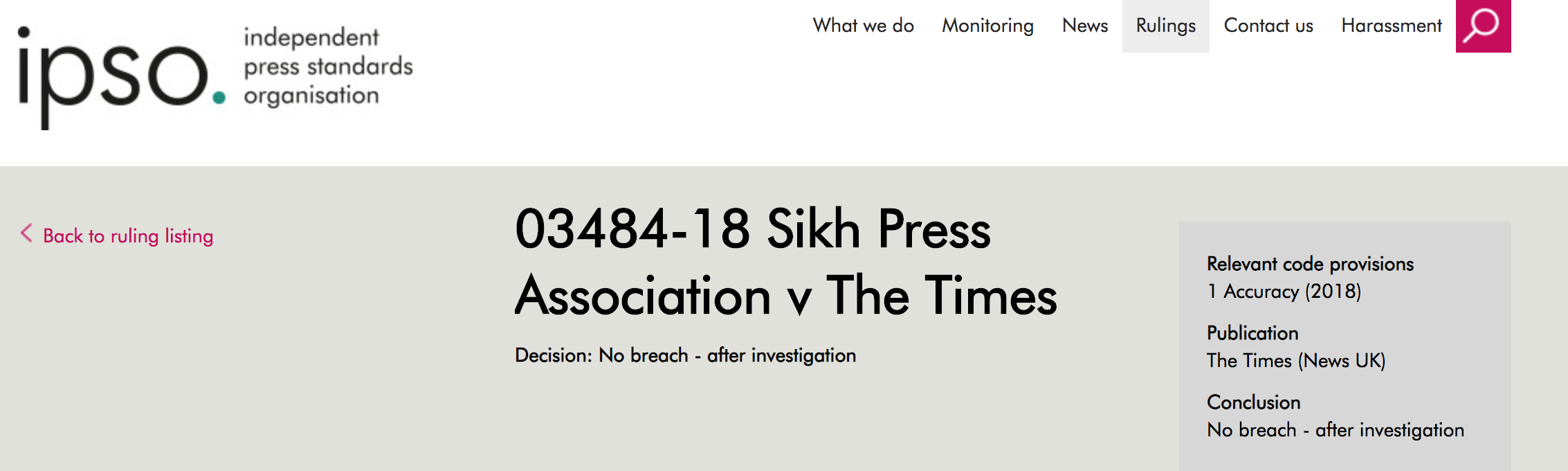
Over the past five years working at such an intensity has equipped our staff with specialist knowledge, skills and experience. We use these not only to professionalise our modus operandi but to raise attention to the many issues we have encountered and experienced in the media, such as religious illiteracy when it comes to Sikhi. When it comes to Sikh representation in the media, Sikh PA are working against decades of inaccuracy and long-embedded misinforming narratives. As such, mistakes and thus things to work on for our organisation are never ending. This has led to us having regular interactions with groups like IPSO (the Independent Press Standards Organisation), the All Party Parliamentary Group on Religion in Media and the Canadian Media Council. This is in addition to the countless conversations we’ve had with individual journalists and editors about covering Sikhi above and beyond what has appeared in their media coverage. These conversations or exchanges can be painstakingly tedious, involving lots of specific references, lots of chasing and form filling. Very little of it is shareable in public, usually due to the legal protocol of the situation. Yet, this is something we will prioritise as it provides a long-lasting benefit to the Panth, addressing issues of religious illiteracy and historical inaccuracy by trying to unroot problems, rather than through short-term measures like insisting on retractions and rebuttals which do work but can come at a cost to our relationships with journalists and publications.
On top of all of this there are countless other miscellaneous activities which bleed into our remit and come to us through sangat relationships and our role for the community. A notable example is our involvement in instances to secure Kakkar (Sikh articles of faith) rights. With Mahraaj’s kirpa (blessings) we have successfully used PR (public relations) leverage to overturn everything from kirpan bans in certain establishments to students being told they cannot wear a kara (Sikh bangle). This can mean anything from sending just one email to being involved in long conference calls and having to read through pages of policy. To date, we have not publicised a single instance of such an incident that was not already in the media. When our work directly benefits a Sikh individual, that is an accomplishment in itself. We do not then need to turn said incident into a media story.
Further to this, we have also participated in roundtable discussions with and spoken directly to countless political representatives and academics, giving them an authentic understanding of Sikh community sentiment and how to navigate the community. In these meets we as always simply play the role of facilitator, guiding those we speak to towards the appropriate channels when required.Although such engagement is rarely public, we are always open about informing Panthic organisations about such interactions, usually taking guide from them on a line of questioning and/or topics to raise.
Through the last five years we have learnt a lot not just about the media but about ourselves. One of the earliest things we learnt is that no matter how hard we try, planning our time is a largely futile effort! Some of the stories we have most prioritised – such as responding to the Grenfell Tower fire or attacks on Sikhs in Afghanistan – have come out of nowhere, meaning we have put aside stories we may have been working on, sometimes losing opportunities altogether because of the fact news is based on what is timely. Having full-time staff means we can continue covering long-term stories even when our attention is taken away by whatever story or issue has become prominent due to circumstances out of our hands. Having staff on full-time is what has allowed us to write over 50,000 words on Jagtar Singh Johal’s plight and secure thousands more words and minutes of coverage for him over the past 900 days.
Full-time staff means we can be constantly monitoring media and launch straight into securing corrections when we need to. Full-time media monitoring means we have corrected mistakes in article within minutes of them being published – when they may not have even be read by anybody in sangat yet. In any field it is hard to measure the value of the absence of something, and no easier in ours. Swiftly corrected mistakes which otherwise would have persisted is part of our small daily grind on which accurate representation of Sikhi and the Sikh kaum (nation) is being built.
We have come a long way in our first five years and there is still an incredible distance to go. It will be a journey that will bring even more work that is intangible and immeasurable. But with your support and Mahraaj’s kirpa (blessing), the next five years will be even stronger for us, not just as Sikh PA, but as a Panth.


Leave a Reply
Want to join the discussion?Feel free to contribute!