Charges dropped against man accused of murder of elderly Sikh

In a move described as “incredibly rare”, a California Superior Court judge dismissed charges against a man accused of killing 64-year-old Parmjit Singh of Tracy (California, USA).

Anthony Kreiter-Rhoads was arrested on 31 August 2019, just days after the murder of Singh on 25 August 2019 in Gretchen Talley Park. Singh had his throat slit from behind leading to his death. His wallet and phone were found near him, suggesting the attack was not a robbery.

Media reports state the police and coroner investigating the case believe Anthony Kreiter-Rhoads ambushed Singh by coming at him from behind, and knifed him in the throat, delivering a clean slit. Singh bled out and died at the scene of the crime. Singh also had knife wounds on his right-hand, indicating he tried to defend himself.

Various security cameras around the park showed a man fitting Kreiter-Rhoads’ description fleeing the scene during the time of the crime. Kreiter-Rhoads’ car was also found at the scene and GPS data from his phone proved Kreiter-Rhoads was in the area when the murder happened. Furthermore, US media reported up to 17 eye witnesses were spoken to, although it is not known how many confirmed they saw a man matching Kreiter-Rhoads’ description fleeing the scene.

A search of his car discovered a knife, whilst more knives were found at his home too, although none were proven to be the murder weapon. US media have reported that community tips claim Kreiter-Rhoads did the murder as part of a gang initiation, with some suggesting this was for a white supremacist group.

However, Judge Michael Mulvihill dismissed the charges levelled against Kreiter-Rhoads, claiming the evidence was not sufficient and there was not a clear probable cause.

Attorney Mark Reichel said the judge’s move is not common, saying “A preliminary examination resulting in the dismissal of murder charges is incredibly rare”.

Throughout the process of attempting to prosecute Kreiter-Rhoads the 22-year-old (21 at the time of the crime), various family, friends and even school teachers of Kreiter-Rhoads have come out to support him.

Similarly, the local Sikh community have come out to support Singh, who was described as a beloved member of the local Sikh community. Local Sikh community organizers stated approximately 1000 people turned up to a vigil held in Singh’s honour.

Angela Hayes, spokeswoman for the District Attorney’s office, said prosecutors still have to determine if they will refile charges, or if Tracy Police would need to provide more evidence.

The hashtag #JusticeForParmjitSingh has been used by hundreds since the decision was made on 2 October. See examples of the reaction below.

Indian agent goes on trial in Germany for spying on Sikh community

The trial of an Indian citizen charged with spying on Sikh and Kashmiri communities in Germany for India’s secret service has begun in Frankfurt.  54-year-old Balvir S. is suspected of having had ties to India’s Research & Analysis Wing (R&AW) since January 2015.

He allegedly collected information about the the Sikh and Kashmiri separatist movements in Germany for RAW senior officers at the Indian Consulate General in Frankfurt. 

A total of 10 hearings before the regional superior court in Frankfurt are scheduled, with the trial due to conclude on October 29.

The same court had convicted an Indian couple of spying in December last year. The husband was handed a suspended prison sentence of 18 months for acting as a foreign intelligence agent and his wife fined 180 days’ wages for aiding him. The couple were reported to have received €7,200 from RAW for their services.

This week, an Indian Consulate official in the South-West German town of Tübingen, near Stuttgart, was also questioned by the congregation on his visit to a local Gurdwara. The congregation told the official that although the Gurdwara remains open to all visitors, Indian officials were prevented from disseminating propaganda on the premises.

The Indian official was questioned by the congregation about cases against Sikh youth in Punjab under draconian UAPA law.

Germany is estimated to be home to about 20,000 Sikhs, the third-largest population of Sikhs in Europe after the UK and Italy.

#FreeJaggiNow team produces template letter to government

The #FreeJaggiNow campaign team has produced a template letter for supporters to use to write to the government asking for an urgent meeting with Jagtar Singh Johal’s family.

Download the template letter here.

The Sikh activist from Dunbarton Scotland has been detained in India for nearly 1000 days, and Jaggi’s brother Gurpreet Singh Johal has said that his family has not seen or heard from him since September 2019, well before the COVID19 pandemic lockdown began.

The template letter asks for the UK foreign secretary Dominic Raab to urgently meet the family, as well as Dunbartonshire MP Martin Doherty-Hughes, to discuss the plight of Jaggi, who has been tortured and falsely imprisoned in India.

Jaggi’s campaign team said that they have had numerous requests asking for a template letter to help support the cause.

As well as the template, they have provided sangat (congregation) with guidance on how to make their letter as effective as possible:

  1. If possible, make the letter unique from yourself, using the template as example
  2. Add unique messages, or any artwork, poems, drawings to the email
  3. Email the letter to your MP, Lord Ahmad and Dominic Raab.
  4. Copy into the email, the FCO and freejagginow@gmail.com
  5. Please forward replies to freejagginow@gmail.com or upload to Social media tagging #FreeJaggiNow into the replies.

Jaggi has been detained since November 2017, when he went to India for his wedding. He had a sack thrown over his head, and was bundled into a van whilst out shopping with family, and is now being implicated in a murder case. He has reported being tortured and is seen as the latest in a long line of Sikh activists targeted by the Indian state.

When the Guru supported the better man – post from Elusive Fighter

The following article has been taken from a post made by the Art of Elusive Fighting page, a Sikh martial-arts social media account. Based on Jeremy Corbyn’s political ethos, this article uses references to Sikh history to advocate Sikhs voting for Labour (to bring Jeremy Corbyn into power).

Please note – Sikh PA are an apolitical organisation and share this to promote political dialogue within the Sikh community. We have previously shared thoughts on Sikhs advocating the Green Party and the Conservatives.

Please read, share and comment!


There are many that keep ‘their politics separate’. There are others who think Sikhs should not get involved and focus only on our own raaj* (we live in the UK..?).

I’ve not taken any interest in elections for 2 decades (all my adult life). Why? Because it has always been clear after some basic research and checking candidates manifestos, as well as the consistency (lack of) in their ideals… that these parties were simply one corrupt beast in different bodies (be it Labour or Tories).

But since Corbyn has taken control of Labour, I have been watching him with interest. He has always had the courage to speak his mind, speak against whomever he feels is warmongering, against those who put short term gain above long term stability, against those who create rules to empower the rich and further weaken the poor, against those who happily deal and trade with oppressive terrorist supporting regimes, against the ruin of our once world class public services (e.g. Education, NHS etc).. etc.

Here is a man who genuinely tries to embody Guru Nanak Dev Ji’s wisdom of ‘Sarbat da Bhalla’ (betterment of all mankind). Here is man who is a voice for the oppressed and the poor. Here is a man who is willing to challenge those in his own family (Party) when they step into the realm of corruption. Here is a man who does not degrade himself to the level of sleazy propaganda and feel the need to degrade, lie about or insult his opposition.

Looking to puratan ithihaas (traditional Sikh history), we learn that the Khalsa is Niyara (Unique and Independent) and supports only dharam (just rule) and the greater good. In ithihaas a wonderful example is given when Sri Guru Gobind Singh ji gives his support to Bahadur Shah who previously challenged his own TYRANT father Emperor Aurangzeb when he was ordered to fight the Guru. Guru provides help by way of Khalsa soldiers to help Bahadur Shah defeat his brother who has snatched his rule. Guru supports the better man, one who will ‘not be a tyrant’. Guru helps him to the throne of rule.

Further, and as an important caveat, Guru later refuses to help Bahadur Shah fight against the Marathas, who are on the war path in retaliation for the atrocities meted out by Bahadurs Tyrant grandfather.

Guru (Khalsa) can give but can also take. Then can support, but can retract the support depending on the scenario (dharam).

Today, you all have a chance to apply GurMat (Guru minded) principles and show support for someone who refuses to sell arms to those who supply ISIS. Who is prepared to do immense work to bring respectability to our public services and support to our poor again.

Do the right thing. Vote ‘Corbyn’. This is your chance to change the face of 3 decades of corrupt, propaganda lead politics.

Sri Gur Panth Prakash

Chaupai :(Thereupon) Farukhsiar responded to (their instigation) by saying, That his grandfather (Bahadur Shah) had given him an advice. He had advised that there existed a house (dynasty) of Nanak, with whom he (Farukhsiar) must not enter into any conflict.

When his great grand father (Aurangzeb) had felt offended (with the Guru), He had ordered Farukhsiar’s grandfather to wage a war against the Guru. But his grandfather (Bahadurshah) did not proceed against the Guru, and sent his soldiers to work in favour of the Guru.

On that day, the Guru had told his grandfather (Bahadur Shah), that he (the Guru) had blessed him (Bahadur Shah) with a sovereignty. The Guru had made his grandfather a sovereign with active support, Otherwise how could he become sovereign without Guru’s (support).

*Raaj = Rule.

How should Sikhs vote? – Green Party Advocacy

In 2017 we shared this article from Sonam Bhourlay, a donator to the Green Party, about why she supports the Green Party as a Sikh.

Before our Sikh Community Hustings taking place in approximately two weeks, we are re-sharing this article to prompt further discussion on voting as a Sikh. Our hustings takes place on December 4th in London. You can register to attend by going to SikhHustings.Eventbrite.co.uk.


Note: this was written in 2015.

#SikhsForGreen- Green Values are Sikh Values?

The UK general election is less than a month away, it’s Vaisakhi and the Green Party Manifesto has just been launched. There are many aspects of the Green Party that resonate with my personal beliefs. Reading through the manifesto really made me reflect on the religious principles that shape my strong sense of justice and compassion. In this post, I hope to share my views on how the core guiding principles of Sikhism are closely aligned to the views of the Green Party. Note: this is merely a discussion about values and thus their policies are largely omitted from this post. I have left the link to the manifesto at the end, have a look at their policies for yourself. If there’s enough demand, I’ll write another post about their policies.
On the first page of the manifesto Natalie Bennett (Green Party Leader) goes straight in to talking about equality, humanity, supporting people in need, environmental sustainability, working towards a society that works for the common good and fighting for a global deal that secures humanity’s shared future. The Greens outline three connected crises which they hope to address, these are:

  1. Healing the planet from the effects of an unstable and unsustainable economy
  2. Creating a more equal society
  3. Creating a truly democratic, central and local government that governs for the common good
I am only on the second page of the manifesto, and already my thoughts are drawn to a key guiding principle of Sikhism, this is;

“Nanak Naam Chardi Kala, Tere Bhane Sarbat da Bhalla”

where “Chardi Kala” means maintaining a positive attitude or being in high spirits and “Sarbat da Bhalla” translates to “prosperity and peace for everything in the world”. These two sentiments are closely connected for me. In my opinion, being in a state of optimism and high spirits can only be achieved when there is peace between everything in the world – peace amongst humans, peace with other species, peace with nature and of course, peace with yourself. The Greens remain positive and have faith in humanity, in their own way, they are maintaining chardi kala through making a move towards more sustainable living, reducing environmental degradation, redistributing the country’s wealth and fostering a more compassionate society for the greater good – sarbat da bhalla.

Moving deeper in to the manifesto, the Greens place a big importance on ensuring “respect for everyone whatever their ethnicity, gender, age, religious belief or non-belief, sexual orientation, class, size, disability or other status”. This one line alone encompasses my entire understanding of Sikhism. The Guru Granth Sahib Ji says “recognise the Lord’s Light within all, and do not consider social class or status; there are no classes or castes in the world hereafter” (349) and “All beings and creatures are His; He belongs to all” (425). Put simply, Sikhs are encouraged time and time again to ramain compassionate to all mankind and to encourage equality amongst people regardless of orientation, background or colour. We are one, we all bleed the same colour, we all have the same beginning, we will all have the same end.
In recent times, especially with the rise of extreme right wing parties (such as UKIP), the “easy targets” in society have been increasingly demonised. Groups such as immigrants, people of colour, people who claim benefits, pensioners and the LGBTQ community are all scapegoated for one reason or another, be it for plunging the economy in to recession, taking jobs, draining resources or causing floods….I could go on. I personally believe that the media over-exaggerate the impact that the aforementioned groups have, to divert attention away from the unethical and exploitative practices that the rich, powerful elite are involved in. The Green Party have addressed this issue by stating in their manifesto “we know that it’s hard to think of others when we are pitted against one another and sold the lie that individuals are to blame for misfortunes” and further go on to assert that selfish interests of the elite have made the common person more “impatient to the suffering of others, tolerant of inequality, prone to prejudice and suspicious of difference”. The bankers plunged us in to economic disaster, the politicians claim the most benefits and wealthy tax-dodgers keep over £25bn a year from the Exchequer. So why, on the instruction of the powerful, do we continue to blame the weak?
One of the 5 Articles of Faith in the Sikh religion is the Kirpan – the Kirpan is a sword, it is symbolic of courage, dignity and the willingness to always defend the weak and the oppressed. A Sikh is supposed to fight against oppression and injustice; and always defend the truth. A Sikh should help those in need regardless of a person’s background. In the UK making life difficult for the oppressed comes in the form of: cutting benefits for those in need, providing inadequate working conditions, limiting access to healthcare and education, discriminating against well meaning immigrants and excusing casual racism, sexism and homophobia. All of these things are addressed in the Green Party manifesto. As we are no longer in an age where we use our swords to defend the truth, our power to vote for a party that is RIGHT, FAIR and JUST to all member of society is the most effective way to stand up to oppression. To quote Desmond Tutu “if you are neutral in situations of injustice, you have chosen the side of the oppressor”.
I feel that it is important to state that I am in no way claiming to be an excellent spokesperson for the Sikh community. I do not grow my hair, I drink…in fact, I was raised in a multi-faith household. Despite all of these things, I do strongly believe in the core principles of Sikh philosophy. I believe in equality, anti-discrimination, compassion, love and respect for nature, standing up for what is right and speaking for those who do not have a voice. These are the values that I live my life by, and fiercely defend on a daily basis, as such, I intend on voting for the party that most closely represents these principles. I do not claim to be unbiased, I am sure there are features of the other parties that match Sikh ideology too. However, for the reasons stated in this post, I support the Greens, will you join me?

** NOTE: This post was written in 2015. In this general election, I will be voting Labour. I feel it would be irresponsible to vote Green in my current constituency because the Tories could win here. Jeremy Corbyn has proven, throughout his lifetime, to be a well principled man as he has consistently fought against discrimination, environmental degradation and human rights abuses. Full blog post soon.**

#SikhsForGreen #VoteGreen2015**NEW* Official Facebook Page www.facebook.com/WorthAThink **

Some Policies:
These are some of the policies that appeal to me. This is not a representative list, just some of the things I am passionate about.

  • The abolition of university fees and cancelling existing student debt (this one actually brings a tear to my eye). Education should be free, not limited to those that can afford it. This makes inequality worse.
  • Encouraging small business. Charging large corporations more tax.
  • Increasing the minimum wage & ending zero hour contracts.
  • Stopping the privatisation of the NHS and increasing the spending on it. Returning to a more person-centred approach to treatment and increasing funding for mental health too.
  • Ending exploitation of young people through unpaid internships.
  • Diversity and equality lessons mandatory in schools. As well as sex and relationship education.
  • Steps to tackle institutional racism, particularly in the criminal justice system.
  • Implementation of UK wide strategy to tackle violence against women- inc domestic violence, fgm, rape and trafficking.
  • Equal pay for women.
  • Anti-fracking.
  • Re-nationalising the railways.
  • Encouraging reducing, reusing & recycling.
  • Reducing spending on military research, increasing funding for scientific research re environmental issues. 
  • Increasing regulation of the meat market to reduce cruelty to animals.
  • A ban on hunting for sport, primates for pets and animal circuses.
The Green Party on Tax:
“Tax is not a punishment and its not stealing by the state. It is our money, spent on our behalf by the government we elect. Tax redistributes wealth and pays for services that are important to us all. There are services we share but don’t always use, such as roads, healthcare and schools. We don’t all drive, we don’t all go to the doctor and we don’t all have children. But we do know these things are important for our common life; sharing these things binds us together. Taxation pays for them. And, to be fair, taxation needs to be progressive, taking proportionately more from those most able to pay”.
The Green Party believe that equality is more important than growth, they state “growth doesn’t bring equality, in fact it helps to justify inequality”. The Greens place an obvious emphasis on people, rather than wealth, there is no shortage of quotes from the Sikh faith (and any other faith for that matter) that encourages social and spiritual well-being over materialistic things. The Greens do have a good economic plan that features (but is not limited to) reversing cuts to public service, restoring lost jobs and investing in green technologies.

Key Sources:
The Green Party Manifesto: https://www.greenparty.org.uk/assets/files/manifesto/Green_Party_2015_General_Election_Manifesto.pdf

Sustainable Development and Sikhism: http://www.sikhfoundation.org/featured/sustainable-development-of-environment-evidence-from-sikh-religion/

http://www.realsikhism.com/index.php


FBI Sikh hate crime stats show Sikhs among most targeted but issue still ‘underrepresented’

Data released by the FBI about hate crime in the USA suggesting Sikhs are the third most targeted group has been called ‘misleading’.

Approximately 60 incidents of hate crimes against Sikhs were reported to the US Federal Bureau of Investigation in 2018, making the community the third most commonly targeted religious group after Jews and Muslims in the US. This signified a 200% increase in reported anti-Sikh hate crimes from 2017 to 2018.

Whilst many hailed the recognition of the fact Sikh are regularly targeted for hate crime in the USA, the figures are believed to underrepresent the magnitude of the issue.

Sikhs, especially those that wear a dastaar (Sikh turban), are regularly targeted in the USA for verbal abuse and violence too, often to a fatal extent. With the issue being so prevalent for US Sikhs, the figure of 60 out of an estimated 250,000+ Sikhs could ‘lead to inaccurate conclusions/implications’ according to respected US Sikh social commentator Rupinder Mohan Singh, known for his work under the guise of American Turban.

In a twitter thread (available to read below), Singh stated on the findings, “What it does mean is there is a 200% increase in reporting of these crimes to the FBI database by some local law enf. agencies who choose submit data for whatever reason. Because the reporting by local law agencies is voluntary, the FBI stats grossly underrepresent actual volume.”

The data released earlier this month by the FBI shows that although the total number of reported hate crimes in the United States decreased from 2017 to 2018, the number of offences against people increased by 12%. Of the 7,120 hate crimes reported to the FBI in 2018, 4,571 were crimes against persons (such as assault, rape, and murder).

A 2017 federal Bureau of Justice Statistics study reported that Americans experience an average of 250,000 hate crime victimisations each year, far more than the 7,120 reported by the FBI. According to the Sikh Coalition, “In 2017, a gunman in Nevada fired over 12 rounds into a van carrying five Sikh men and wounding one. The gunman was convicted on four counts with a hate crime enhancement and sentenced to 34 years in prison; nonetheless, the incident did not appear in the FBI’s 2017 report.”

The Sikh Coalition, a Sikh legal advocacy organisation based in the USA, also called the fact there is more Sikh hate crime being reported at the same time the issue is overall underreported ‘disheartening’. Read their report in full here.

Rupinder Mohan Singh ended his American Turban thread by saying “Given the gross underreporting, there is a lot of work to be done to garner meaningful, actionable data.”

Two Delhi Police Constables Dismissed for Attacking Sikh Man

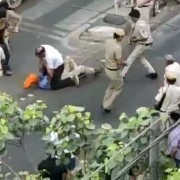
Two Delhi police constables have been dismissed for ‘unprofessional behaviour’ for attacking a local Sikh who refused to bribe a police officer.

Sarabjeet Singh, a local Sikh auto-driver, was restrained on the ground and brutally beaten by police officers on 16th June after he refused to pay a police officer offer 500 rupees for an alleged traffic infringement.

The attack occurred in the Mukherjee Nagar area of Delhi in broad daylight; intimidation and blackmail by the police to pay bribes often occurs openly and is widely accepted as part of Indian culture.

A video of the attack was shared widely on social media and Sikhs across India protested against the heinous actions. To many, it evoked memories of the 1984 Sikh genocide of thousands of Sikhs in Delhi (and elsewhere) which was orchestrated by the authorities. One of the officers involved in the attack allegedly threatened Sikhs protesting the police actions with a repeat of the 1984 genocide.

Two days after the incident Delhi police released a statement saying three officers involved had been suspended, only after leading politicians had demanded an inquiry into the incident, including Delhi Chief Minister Arvind Kejriwal. FIRs (First Incident Reports) have been filed against Sarabjeet Singh by Delhi Police.

The inquiry into the attack was conducted by a senior officer and described It as ‘unprovoked, indiscreet and highly unprofessional.’ Two police constables, Pushpendra Shekhawat and Satya Prakash have now been dismissed for their role, which included kicking Sarabjeet Singh while he was unarmed and had been thrown to the ground.

In a statement, Delhi Police said: ‘They [Shekhawat and Prakash] have been dismissed to set an example for others to learn and desist from such aggressive and unprofessional behaviour, which portrays a bad image of Delhi Police. Not only are these constables likely to indulge in such acts in the future but also their possibility of influencing witnesses to gain undue favours during regular departmental proceedings is strong.’


What actually happened?

Footage begins by showing Sarabjeet Singh of Gramin Sewa, Delhi, in a confrontation with an officer with his kirpan – a sword that is part of the punj kakkar (five Ks) of the Amritdhari (initiated) Sikh uniform – in his hand. Whilst Sarabjeet Singh was holding it the policeman was within touching distance the whole time but was at no point attacked.

Video footage shows the Sikh man’s 16-year-old son Balwant Singh then leads his father away from the confrontation, who then sheaths his kirpan. The police officer also retreats only to return with approximately seven other officers, charging at Sarabjeet Singh with their lathis (police sticks), with Singh responding by producing his kirpan again to ward off his attackers. When a member of the public goes behind the Sikh man and locks his arms around him to restrain him, officers pounce unleashing brutal blows. The member of the public restraining Sarabjeet was later shown injured by what was apparently a blow from Singh’s kirpan.

Whilst his father is being aggressively restrained, Sarabjeet Singh’s son then returns to their vehicle only for a policeman to point his gun at him, before dragging him out and beating him with other officers. Meanwhile, Sarabjeet Singh is still being wrestled to the ground and receiving blows from police lathis. Adding insult to injury, Sarabjeet’s dastaar (Sikh turban) came off during the attack and was callously kicked to the side by one officer when he was taken down to the floor, where he was still restrained and the beating continued.

It is then alleged both Sarabjeet Singh and his son were taken to a local police station and tortured. Immediate reaction saw Sikhs, with support from several respected organisations, protest against the incident across India, with many Sikh bodies coming forward to condemn the attack and also request an investigation and/or punishment against the police.

Parents at Coventry Sikh School win legal challenge after DfE concession

Parents of pupils at Seva School in Coventry have finally come to a resolution with the Department for Education which will see the school remain part of the Sevak Education Trust.

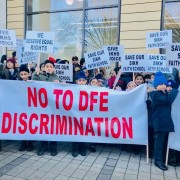
Sikh families of Coventry have been in a dispute with the DfE (Department For Education) for over a year now after pressure was placed on the Seva School of Coventry to change its current template and be reformed under a new multi-faith banner by joining a “Multi Academy Trust“. This pressure stems from an OFSTED report which rated the school as ‘inadequate’ in 2016, a status which the school claims has since been vastly improved on, evident since OFSTED took the school out of the ‘special measures’ category since March of this year.

As part of the settlement, made on June 28th, the Secretary of State accepted that he had failed to consider alternatives to the Nishkam Schools Trust and also agreed to pay the legal costs of the case.

In a statement the Sevak Education Trust said: ‘The proceedings were a last resort after the school and parents had been unsuccessful in their attempts to persuade the Department for Education to reconsider its decision.’

 The Trust added: ‘The school looks forward to working closely with the Department moving forwards to ensure that any decisions about the future of the school made are with the best interests of the pupils, parents, staff and local Sikh community in mind.’

As part of the agreement, the Secretary of State accepted that he had failed to consider alternatives to the Nishkam Schools Trust and also agreed to pay the legal costs of the case. More than 200 parents had previously protested a move to re-brokerage the school under the Nishkam Schools Trust.

Organ Donation in the Sikh Community

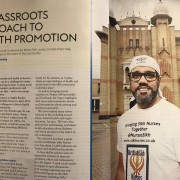
On Sunday 9th December, Sikh educational project Basics of Sikhi will be joined by several medical professionals to discuss the issue of organ donation.  The panel will include Rohit Sagoo, Senior Lecturer at Anglia Ruskin University and founder of British Sikh Nurses, who writes here about his experiences of organ donation and the Sikh community: 

47109030_2089533551084701_6534714374890717184_o

Anaya Kaur Kandola was born with little chance of survival and has fought battle after battle to be here. She has Autosomal Recessive Polycystic Kidney Disease (ARPKD) is a condition in which growing cysts leave little room for other organs and create serious difficulties such as underdeveloped lungs, vulnerability to infections and heart conditions. This left the doctors with no choice but to remove Anaya’s kidneys soon after birth. Dialysis helps to cleans Anaya’s blood by being on a machine 10-12 hours every day and right now it is the only thing keeping her alive.

Anaya is coming up to 2 years of age. The difficulties of her condition and being attached to a machine for almost half the day has severely impacted her growth and development. This is all Anaya has known in her short life.

As Sikhs we often think about helping others, growing Sikhi, and instilling the values our Guru Jis left behind in ourselves and our children going forward. Here, our child has opened our eyes to the greatest Seva: giving life to others when we pass by donating our organs to those in need.

It is widely reported that in the UK there is a shortfall of organ donors from BAME (Black, Asian and Minority Ethnic) communities. According to statistics from NHS Blood and Transport, around one third of patients awaiting an organ are from BAME communities. However, a significantly smaller proportion of the BAME community registered on the NHS Organ Donor Register. 3.3% of registrants were Asian, 2% were mixed race, and just 1% were black. These statistics show the pressing need for the Asian community to respond to the needs of organ patients.

In 2017/18, just over 1,500 donated organs after their death. Of these, 114 were from ethnic minority groups and just 37 (or 2.4%) were of Asian heritage. Such a disparity between those who need organs and those who donate them is clear to see: nearly 20% of those requiring an organ transplant are from the Asian community, but only 1% of organ donors each year are South Asian.

23826273_1761163110856533_5889134186192688564_oConsidering this, how is organ donation received in the Sikh community?

Organ donation is generally viewed positively in the Sikh Community. General attitudes to organ donation from South Asians, express religious, sociocultural, and environmental pressures. Though the sociocultural and environmental pressures may exist for the Sikh community, there is no evidence to suggest that the Sikh community is deterred from donating organs on religious grounds.  

The Sikh faith is underpinned by the ethos of executing noble deeds for all of humankind. Therefore, it can be suggested that organ donation would be considered as one of those noble acts according to the Sikh faith. Sri Guru Granth Sahib – the Sikh holy scripture – states:

“The true servants of God are those who serve Him through helping others” Sri Guru Nanak Dev Ji, Sri Guru Granth Sahib Ji.

With this in mind, it is important to consider organ donation as a service to those in need. Many of the individuals within the Sikh community that require organ transplantation have raised awareness through campaigning through the Gurdwaras and other forms of media. The sharing of learned experiences has expanded the discussion of organ donation within the Sikh community. But what more can be done?

Dialogue with Sikhs of all ages has shown that what happens to our bodies after life can be a positive discussion.  Many acknowledge the need for education and awareness, and welcome the opportunity to share their own thoughts on how they wish to serve others.  The concept of saving a life as the highest form of seva has been echoed many times over.

In addition, older members of the community have expressed concern that health issues would eliminate them from being able to donate, but they have been assured that donations have been taken from those in their 60s, 70s, and beyond, and that the medical team will be able to assess whether any of the transplantable organs would benefit someone in need.

skynews-organ-donation-nhs_4180497It is encouraging to all of us to note that both those previously unaware of the Organ Donor Register, and those that are already on it, have expressed their gratitude to volunteers for bringing this message to the Sikh community. Everybody involved hopes that the issue of a lack of organ donors can be addressed, and ultimately provides hope to those waiting for organs to survive.

As many have said in their parting comments, none of us know when we or our loved ones maybe the ones on a waiting list, and if we are prepared to receive an organ, we should equally be prepared to donate them when our time comes.

Sunday’s discussion will be held from 7.30pm (after katha) upstairs at Sri Guru Singh Sabha Gurdwara, Park Avenue, Southall. 

Sikh anger worldwide as Twitter blocks 1984 Sikh genocide site

Sikhs across the world have been left shocked and angered at a Twitter block of a prominent Sikh human rights website.

Twitter, one of the world’s most popular social media platforms and most visited sites, is currently blocking any tweet containing a link to www.1984sikhgenocide.org   

The website is a portal from Sikh advocacy group Sikhs For Justice (SFJ) which allows constituents to send pre-drafted emails to their political representative (e.g. Congressmen and Senators in the US, MPs in the UK etc.). More than 25,000 emails have been sent via the website.

This is part of a campaign launched by SFJ on October 21st urging various governments to recognise November 1st as Sikh Genocide Remembrance Day. Through tests, the Sikh Press Association has confirmed the block is nothing to do with a word filter or a webpage security issue.

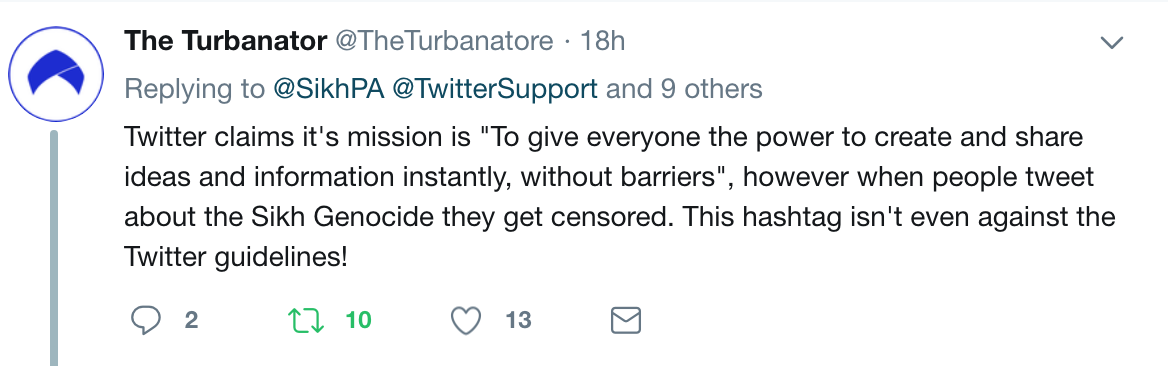
Twitter has also suspended the personal account (under his own name) of SFJ Legal Advisor Gurpatwant Singh Pannun. Gurpatwant Singh also has his work account which still exists. He said, “This is yet another example of trading human rights for business considerations wherein Twitter has blocked tweets about SFJ’s Sikh genocide commemoration campaign on the behest of Indian authorities”.

This action has sparked the anger of Sikhs across the world who have accused Twitter of suppressing legitimate human rights activism.

Screen Shot 2018-10-25 at 15.13.22

Screen Shot 2018-10-25 at 15.46.08

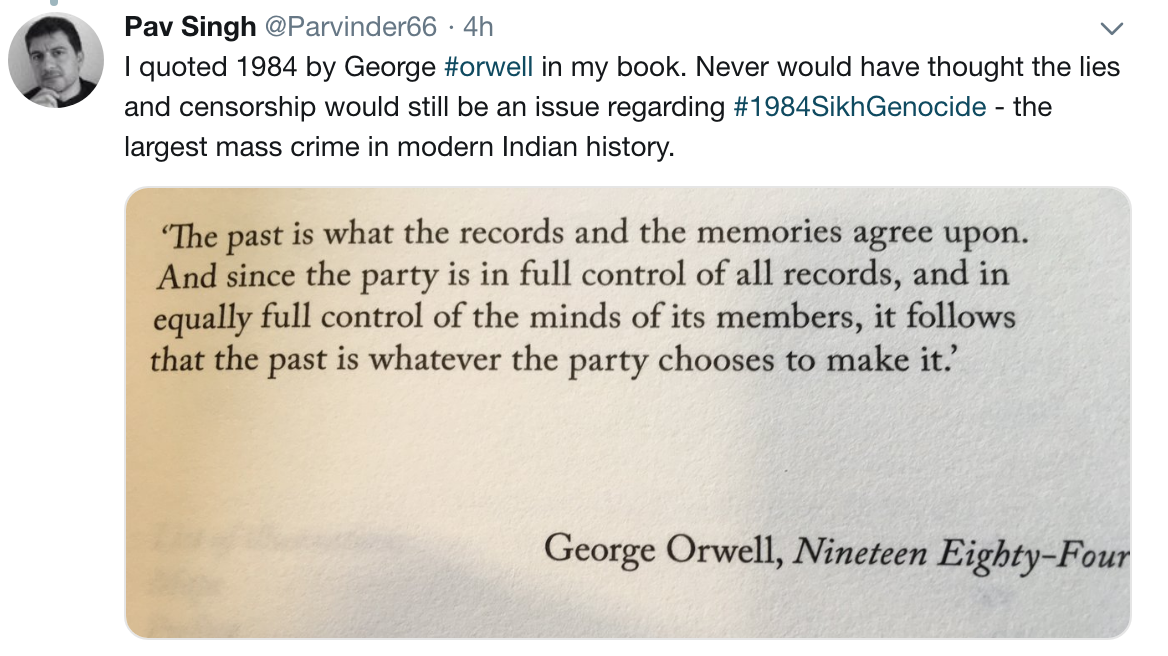
Pav Singh, author of 1984: India’s Guilty Secret, issued a warning to Twitter via a tweet saying: “Indian authorities having been blocking the truth about #1984SikhGenocide for 34 years. @Twitter @TwitterSupport don’t follow suit. Never compromise over Human Rights & Freedom of Speech despite govt pressure.”

Screen Shot 2018-10-25 at 15.56.47

Rahul Tripathi, a journalist at the Indian Express, tweeted on Thursday morning: “Home Secretary Rajiv Gauba met with reps from #Facebook, #Google, #Twitter, #Whatsapp, You Tube, Instagram to prevent misuse of social media sites by undesirable elements / miscreants to spread rumours, cause unrest, incite cyber crimes.” He added: “Gauba asked social media gaints [sic] to take steps & nominate India based grievance redressal officers, develop a monitoring mechanism for time bound preventive & to remove objectionable contents from public view & prompt sharing of information sought by agencies. #lynching.”

It seems likely that the blocking of such a high-profile Sikh genocide website is connected to the Home Secretary’s meeting, although this has not been confirmed.

Twitter have not yet responded to the online tweets about the block, leading to Sikhs being urged to contact Twitter via an online complaint form, which can be accessed here.