Two Delhi Police Constables Dismissed for Attacking Sikh Man

Two Delhi police constables have been dismissed for ‘unprofessional behaviour’ for attacking a local Sikh who refused to bribe a police officer.

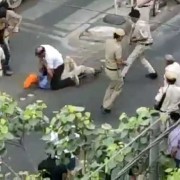
Sarabjeet Singh, a local Sikh auto-driver, was restrained on the ground and brutally beaten by police officers on 16th June after he refused to pay a police officer offer 500 rupees for an alleged traffic infringement.

The attack occurred in the Mukherjee Nagar area of Delhi in broad daylight; intimidation and blackmail by the police to pay bribes often occurs openly and is widely accepted as part of Indian culture.

A video of the attack was shared widely on social media and Sikhs across India protested against the heinous actions. To many, it evoked memories of the 1984 Sikh genocide of thousands of Sikhs in Delhi (and elsewhere) which was orchestrated by the authorities. One of the officers involved in the attack allegedly threatened Sikhs protesting the police actions with a repeat of the 1984 genocide.

Two days after the incident Delhi police released a statement saying three officers involved had been suspended, only after leading politicians had demanded an inquiry into the incident, including Delhi Chief Minister Arvind Kejriwal. FIRs (First Incident Reports) have been filed against Sarabjeet Singh by Delhi Police.

The inquiry into the attack was conducted by a senior officer and described It as ‘unprovoked, indiscreet and highly unprofessional.’ Two police constables, Pushpendra Shekhawat and Satya Prakash have now been dismissed for their role, which included kicking Sarabjeet Singh while he was unarmed and had been thrown to the ground.

In a statement, Delhi Police said: ‘They [Shekhawat and Prakash] have been dismissed to set an example for others to learn and desist from such aggressive and unprofessional behaviour, which portrays a bad image of Delhi Police. Not only are these constables likely to indulge in such acts in the future but also their possibility of influencing witnesses to gain undue favours during regular departmental proceedings is strong.’


What actually happened?

Footage begins by showing Sarabjeet Singh of Gramin Sewa, Delhi, in a confrontation with an officer with his kirpan – a sword that is part of the punj kakkar (five Ks) of the Amritdhari (initiated) Sikh uniform – in his hand. Whilst Sarabjeet Singh was holding it the policeman was within touching distance the whole time but was at no point attacked.

Video footage shows the Sikh man’s 16-year-old son Balwant Singh then leads his father away from the confrontation, who then sheaths his kirpan. The police officer also retreats only to return with approximately seven other officers, charging at Sarabjeet Singh with their lathis (police sticks), with Singh responding by producing his kirpan again to ward off his attackers. When a member of the public goes behind the Sikh man and locks his arms around him to restrain him, officers pounce unleashing brutal blows. The member of the public restraining Sarabjeet was later shown injured by what was apparently a blow from Singh’s kirpan.

Whilst his father is being aggressively restrained, Sarabjeet Singh’s son then returns to their vehicle only for a policeman to point his gun at him, before dragging him out and beating him with other officers. Meanwhile, Sarabjeet Singh is still being wrestled to the ground and receiving blows from police lathis. Adding insult to injury, Sarabjeet’s dastaar (Sikh turban) came off during the attack and was callously kicked to the side by one officer when he was taken down to the floor, where he was still restrained and the beating continued.

It is then alleged both Sarabjeet Singh and his son were taken to a local police station and tortured. Immediate reaction saw Sikhs, with support from several respected organisations, protest against the incident across India, with many Sikh bodies coming forward to condemn the attack and also request an investigation and/or punishment against the police.

Applause and abuse for Sikhs supporting Kashmiris

Sikhs who have been protecting Muslims in Kashmir following last week’s terror attack have received international praise, but also abuse, for their humanitarian efforts.

A suicide bombing last Thursday killed 40 Indian soldiers in Pulwama, near Srinagar in Indian-administered Kashmir. Jaish-e-Mohammad, a militant group from Pakistan, claimed responsibility for it.

Since then, mobs have been roaming Kashmir, looking to punish ordinary Kashmiris in revenge for the attack.

Sikhs in Kashmir – nicknamed the Jammu Sardars – rode motorbikes into Gujjar Nagar to rescue three Kashmiris from a mob who were setting cars with Kashmir registrations on fire. The Sikhs took them to a local gurdwara, where the trio were served langar before being escorted out of the city towards Srinagar. One of them said ‘Allah and our Sikh brothers [saved us]’.

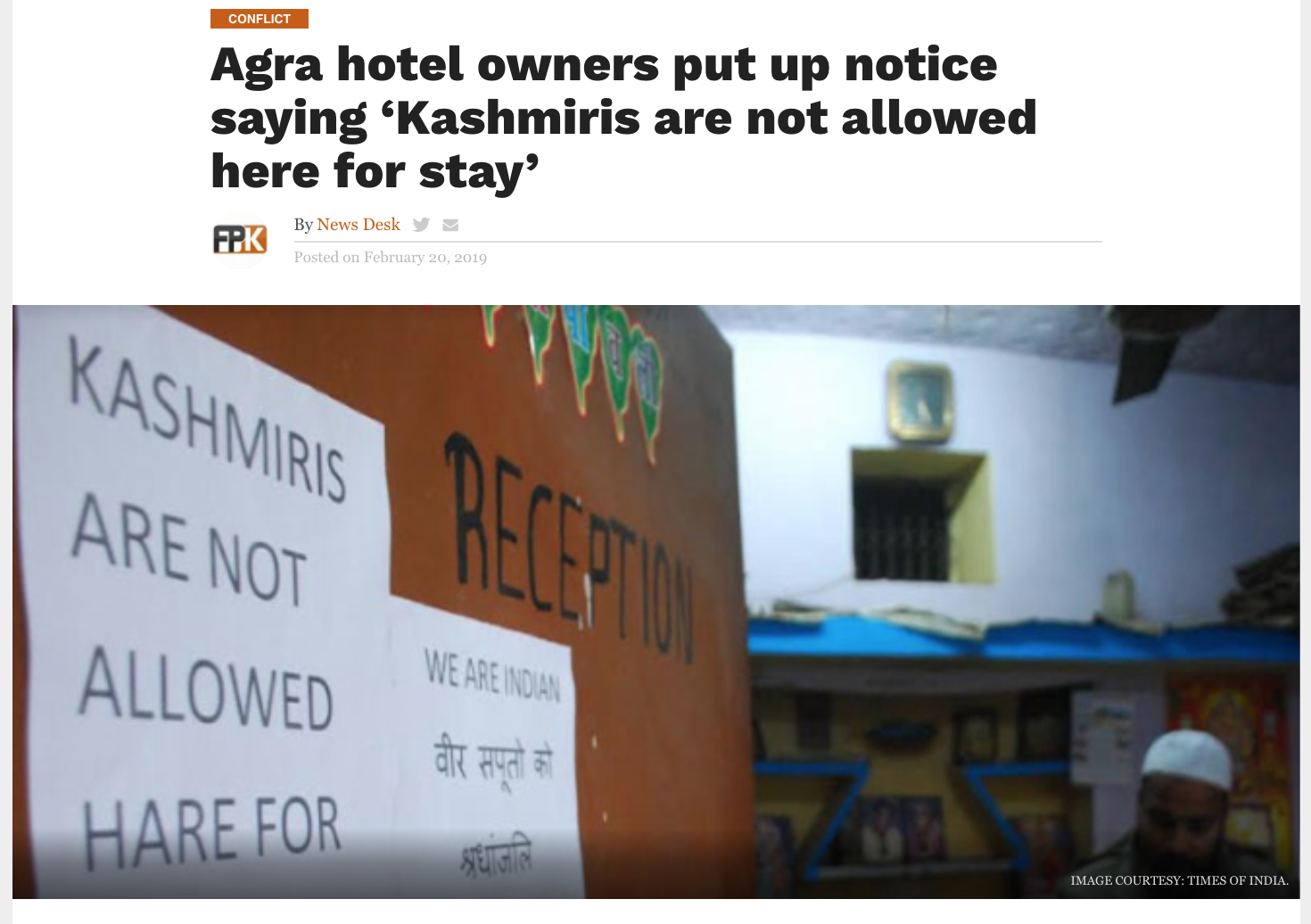
Anti-Kashmiri sentiment has spread across the country, inciting anger from Hindu nationalists. One hotel in Agra put up a sign saying: ‘Kashmiris are not allowed hare [sic] for stay’ next to another sign declaring ‘We are Indian’.

Screen Shot 2019-02-22 at 12.50.41

Sikhs and Punjabis have been providing protecting to Kashmiri students in Punjab, where it is thought that there are roughly 4,000 Kashmiri students. Sikhs guarded colleges containing Kashmiri students overnight following widespread reports of mob attacks and harassment.

Much of the Sikh support for Kashmiris has come from Khalsa Aid International – an international humanitarian organisation well known for providing aid and disaster relief without discrimination.

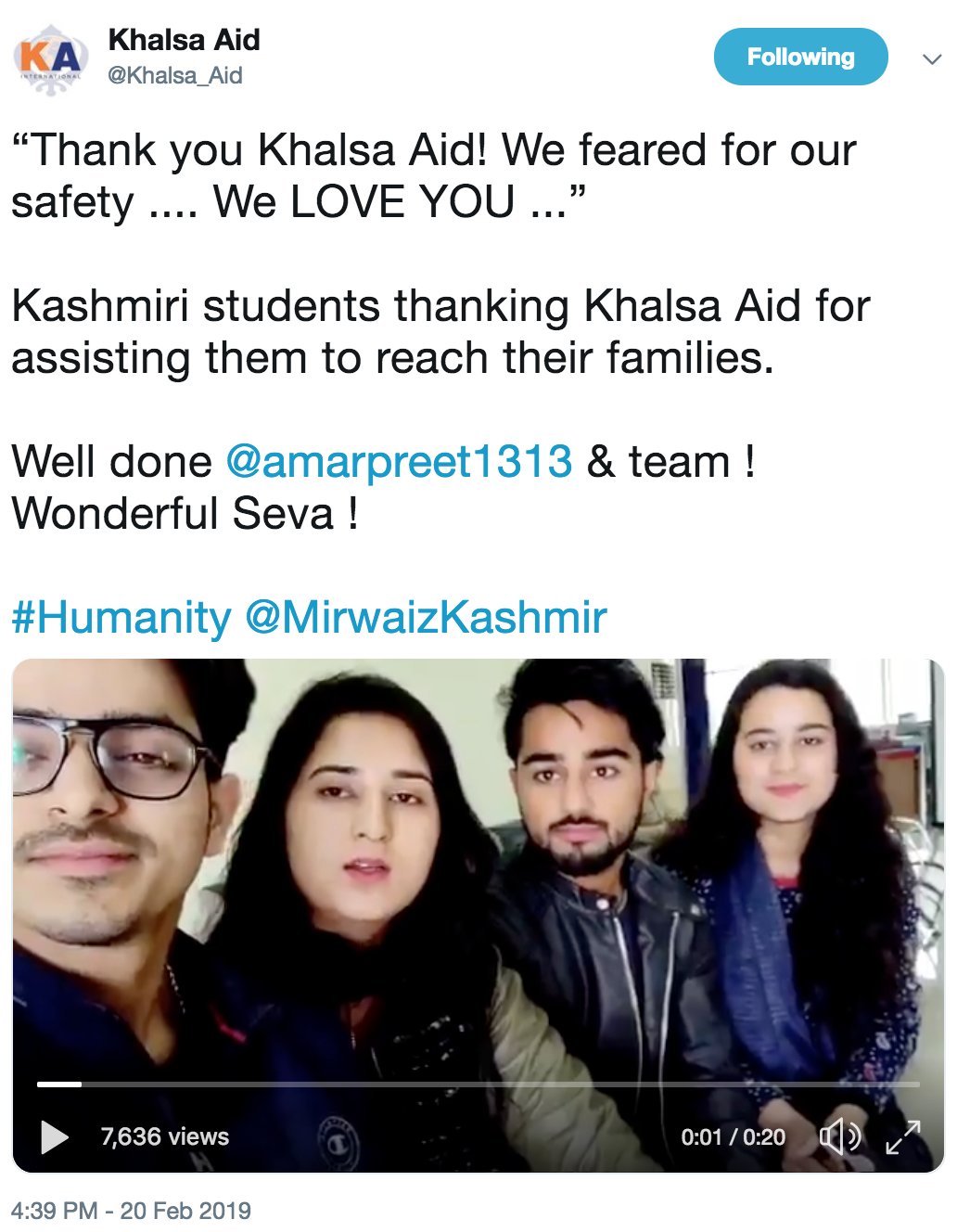
Khalsa Aid safely evacuated Kashmiri students in Punjab, and funded over 20 buses to get the students home safely. In a video posted on Twitter, some Kashmiri students spoke from Jammu airport, saying that they had only reached there safely because of Khalsa Aid. The director of Khalsa Aid India, Amarpreet Singh said in a typically humble manner: ‘There are so many Punjabis to make sure every Kashmiri is safe here.’

Screen Shot 2019-02-22 at 12.59.11

This is not the first time that Khalsa Aid have been providing help in Kashmir – the charity provided aid relief to locals during flooding there in 2014.

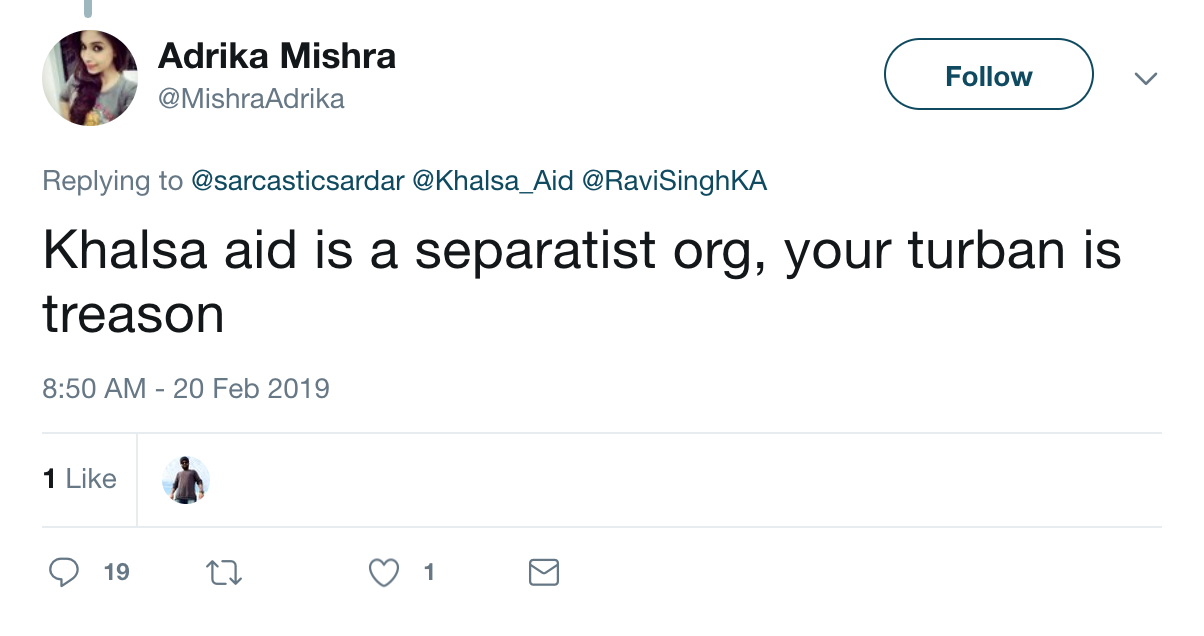
However, the charity has faced a backlash online from extreme Indian nationalists who are angry at the help and support Khalsa Aid has been providing to Kashmiris.

Screen Shot 2019-02-22 at 14.43.38

Much of the abuse has been directed at the organisation’s founder and CEO Ravi Singh, who is frequently abused online for his vocal campaigning against human rights atrocities committed by the Indian state, notably the Sikh Genocide in 1984.

Screen Shot 2019-02-22 at 12.51.36

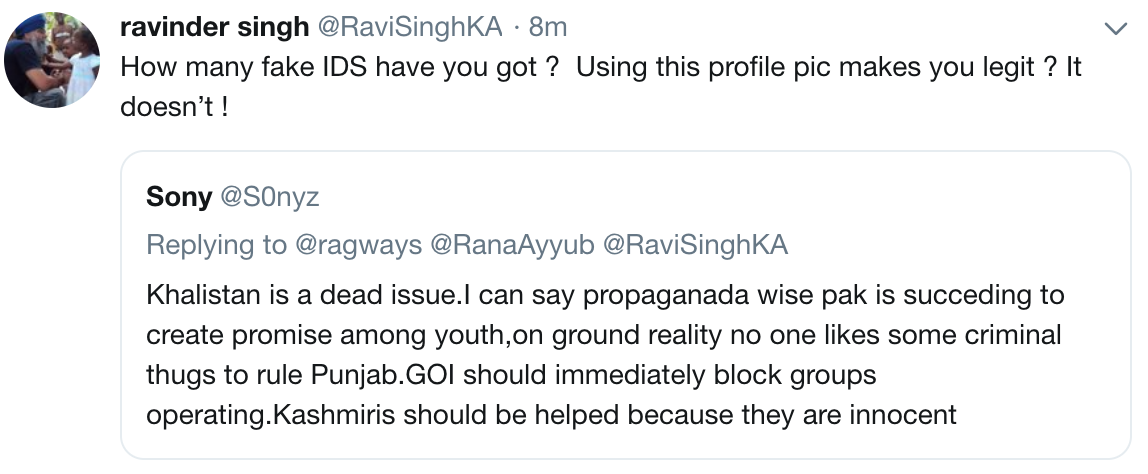
The social media abuse does not phase Singh who describes the abusive tweets sent to him as ‘an educational opportunity… a chance to show that people sending this abuse cannot handle facts.’

As Singh points out online, many of those sending abusive messages do so from anonymous social media accounts. He frequently challenges those sending such messages to ‘come and comment with your read ID if you want a debate.’

Screen Shot 2019-02-22 at 15.17.00

As news of the Sikh support has spread across the globe, messages of thanks and support having been pouring in from the Kashmiri diaspora. One in the US has offered Sikhs a free stay at his hotels for the next month. Others have offered everything from free legal services and health consultations to discounts on snow biking.

Screen Shot 2019-02-22 at 14.07.38

Khalsa Aid’s work supporting the Kashmiris of India continues. For more information, follow the charity on Facebook or @Khalsa_Aid on Twitter.

Screen Shot 2019-02-22 at 14.04.13

Reaction: Sajjan Kumar convicted for 1984 Sikh Genocide role

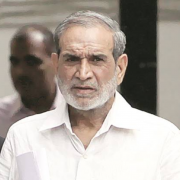
Senior Indian politician Sajjan Kumar was today sentenced to life imprisonment for his role in the 1984 Sikh Genocide.

10sajjanThe Delhi High Court found him guilty of ‘criminal conspiracy, promoting enmity and acts against communal harmony’ in the killing of a family of five in Delhi during the genocide of Sikhs in November 1984.

That family included the son and husband of Jagdish Kaur, who spoke to the BBC after the verdict. She described it as ‘a little balm applied after a long time to our scars. At least one high-profile accused will now go to jail.’ She was one of three eyewitnesses who ensured that the case could go ahead, providing evidence with what the court described as ‘courage and perseverance’. 

Kumar, 73, is the first high-profile politician to have been convicted over the genocide. Eyewitnesses from November 1984 and research since then have indicted not just the complicity of senior Congress Party officials at the time, but that they played a key role in orchestrating the killings of Sikhs.

The case was brought Harvinder Singh (HS) Phoolka, a senior advocate of Delhi High Court, who has been fighting for justice for over 30 years. He described the sentence as the ‘result of 34 years struggle’, and has been widely praised for his fortitude.  

Screen Shot 2018-12-17 at 16.29.04

The judged explicitly cited Kumar’s ‘political patronage’ a factor of why it had taken so long to administer justice.

Pav Singh, author of 1984: India’s Guilty Secret, said: ‘Finally after 34 years there’s been one single conviction of a leading senior Congress [Party]  leader. 34 years too late though, for the victims and their families, and I think that’s a crime in itself.’ 

The High Court also said: ‘This Court is of the view that the mass killings of Sikhs in Delhi and elsewhere in November 1984 were in fact ‘crimes against humanity’. 

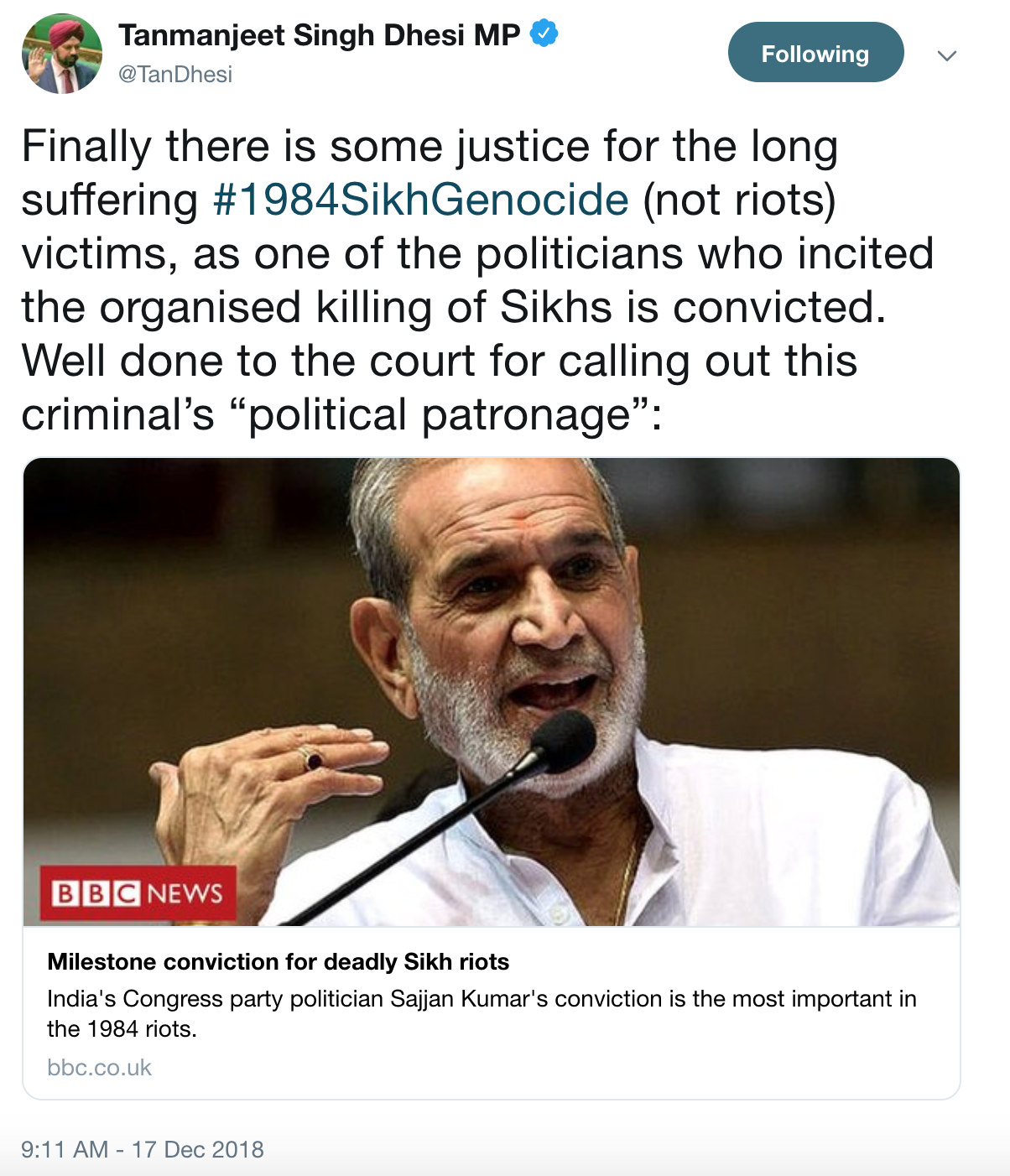
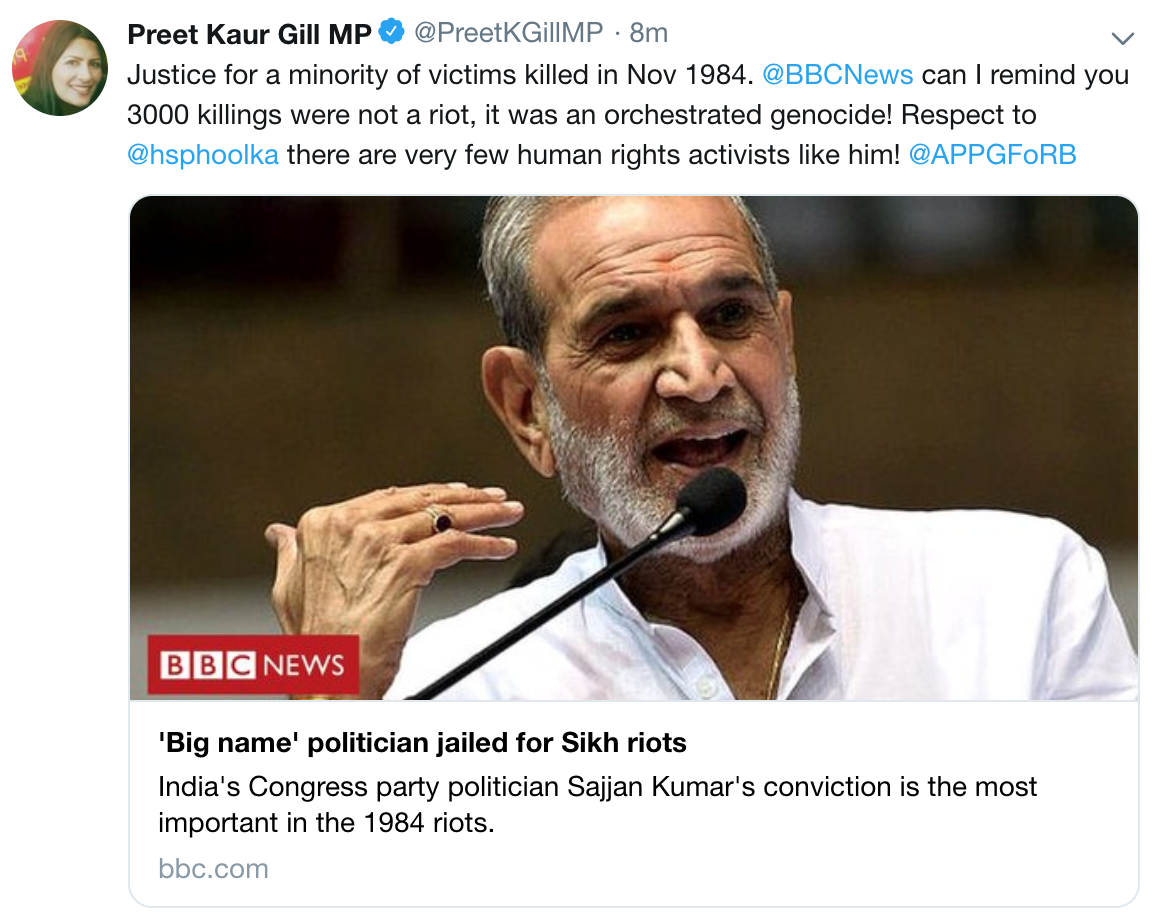
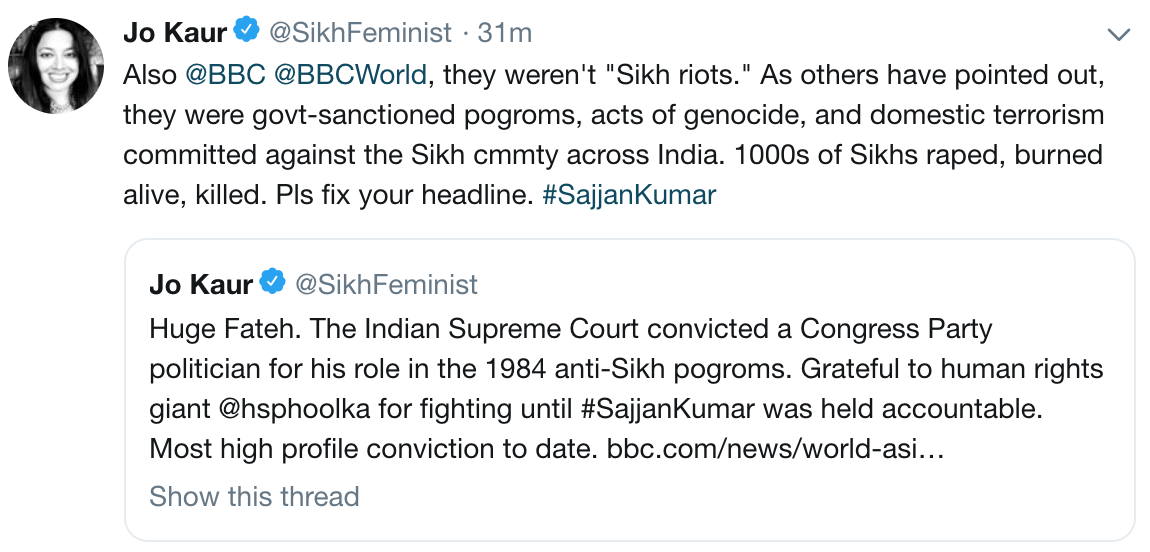
In light of this, there has been widespread criticism of the BBC’s reporting of the conviction, which refers to the killings as ‘anti-Sikh riots’, rather than using the term ‘genocide’.

Screen Shot 2018-12-17 at 12.18.49Both Sikh MPs, Tanmanjeet Singh Dhesi and Preet Kaur Gill, tweeted criticism the description of ‘riots’, instead using the term ‘genocide’.

Screen Shot 2018-12-17 at 12.19.09

The Sikh Press Association contacted BBC News Online regarding its use of ‘anti-Sikh riots’ used in its online coverage but was directed towards the BBC’s formal complaints procedure. An update of the story changed the headline to say ‘killings’ instead of ‘riots’, but continued to refer to ‘anti-Sikh riots’ in the text.

Screen Shot 2018-12-17 at 14.28.53

Speaking to BBC Asian Network, Sikh PA press officer Sukh Singh outlined why calling the killings a genocide – rather than riots – is important, saying that ‘genocide’ emphasised how the killings were not just random, but orchestrated.

Jasveer Singh, Sikh Press Association Senior Press Officer, said of the conviction and resulting media coverage, ‘It is time media outlets caught up to the current narrative around the 1984 Sikh genocide. Most are not matching neither the current political or legal language being used. There are many politicians including India’s own home minister and countless other politicians around the world that recognise what occurred in India in 1984 was genocide.

Furthermore, even the legal language around the conviction of Sajjan Kumar called the massacres “crimes against humanity”, pointing to a series of incidents unfitting of being labelled “riots”.

The bottomline is descriptions of “riots” for what occurred are outdated and biased. It is high time media caught up and we will be doing everything in our power to speed up this process.’

One of the more popular posts on the verdict came from Sikh cartoonish Vishavjit Singh, also known as Sikhtoons on social media, which highlighted how India’s Prime Minister Narendra Modi is also among politicians accused of fuelling pogroms against minorities.

This sentiment was echoed by others who pointed out that as one perpetrator was convicted, another senior politician widely accused of orchestrating the genocide, Kamal Nath, became Chief Minister of India’s second largest state. Nath is the most high profile name along with Jagdish Tytler still escaping conviction for his role in the genocide despite many witnesses confirming his involvement.

Screen Shot 2018-12-17 at 15.49.28

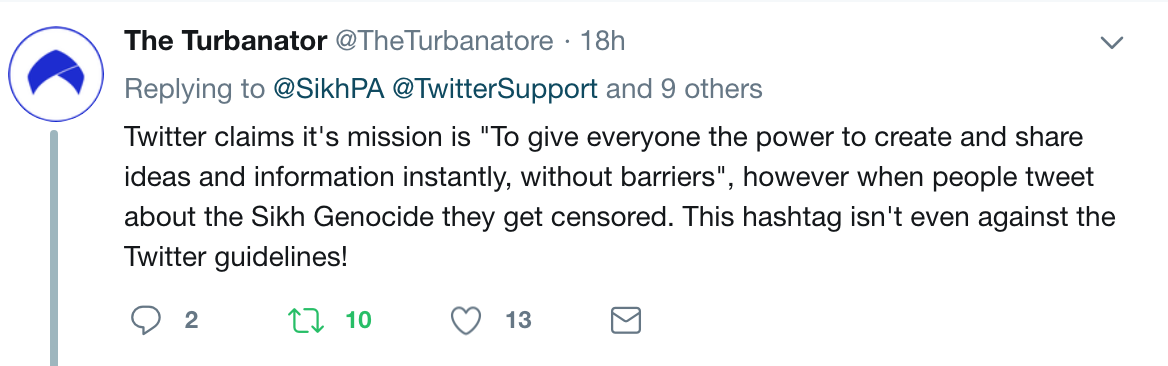
Sikh anger worldwide as Twitter blocks 1984 Sikh genocide site

Sikhs across the world have been left shocked and angered at a Twitter block of a prominent Sikh human rights website.

Twitter, one of the world’s most popular social media platforms and most visited sites, is currently blocking any tweet containing a link to www.1984sikhgenocide.org   

The website is a portal from Sikh advocacy group Sikhs For Justice (SFJ) which allows constituents to send pre-drafted emails to their political representative (e.g. Congressmen and Senators in the US, MPs in the UK etc.). More than 25,000 emails have been sent via the website.

This is part of a campaign launched by SFJ on October 21st urging various governments to recognise November 1st as Sikh Genocide Remembrance Day. Through tests, the Sikh Press Association has confirmed the block is nothing to do with a word filter or a webpage security issue.

Twitter has also suspended the personal account (under his own name) of SFJ Legal Advisor Gurpatwant Singh Pannun. Gurpatwant Singh also has his work account which still exists. He said, “This is yet another example of trading human rights for business considerations wherein Twitter has blocked tweets about SFJ’s Sikh genocide commemoration campaign on the behest of Indian authorities”.

This action has sparked the anger of Sikhs across the world who have accused Twitter of suppressing legitimate human rights activism.

Screen Shot 2018-10-25 at 15.13.22

Screen Shot 2018-10-25 at 15.46.08

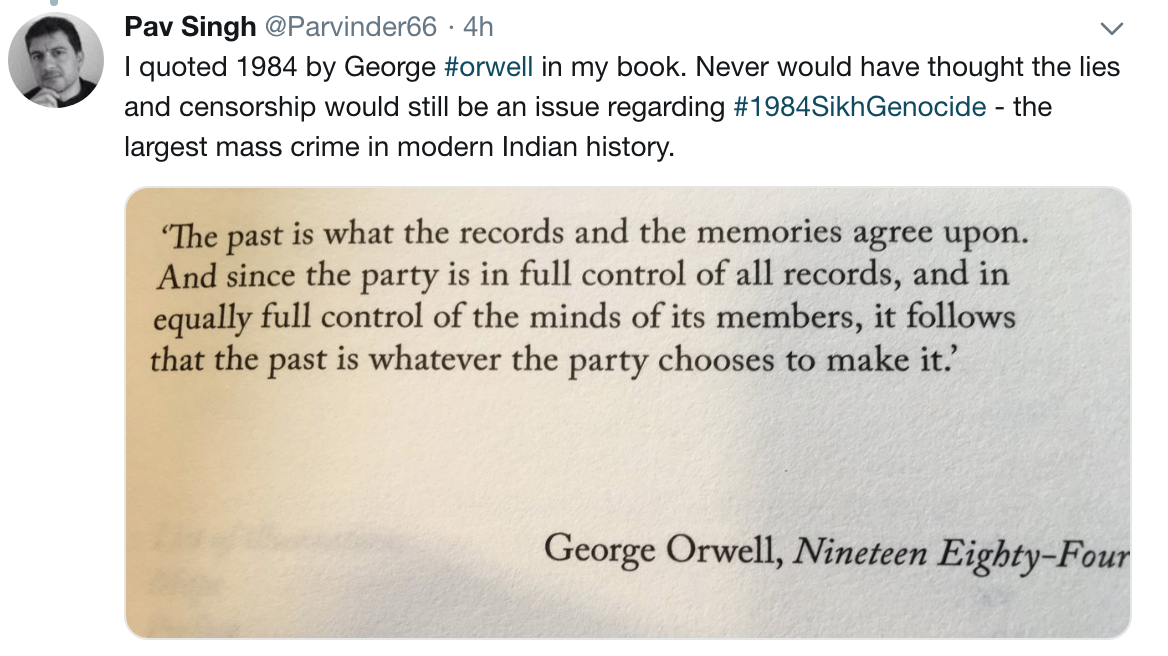
Pav Singh, author of 1984: India’s Guilty Secret, issued a warning to Twitter via a tweet saying: “Indian authorities having been blocking the truth about #1984SikhGenocide for 34 years. @Twitter @TwitterSupport don’t follow suit. Never compromise over Human Rights & Freedom of Speech despite govt pressure.”

Screen Shot 2018-10-25 at 15.56.47

Rahul Tripathi, a journalist at the Indian Express, tweeted on Thursday morning: Home Secretary Rajiv Gauba met with reps from #Facebook, #Google, #Twitter, #Whatsapp, You Tube, Instagram to prevent misuse of social media sites by undesirable elements / miscreants to spread rumours, cause unrest, incite cyber crimes.” He added: Gauba asked social media gaints [sic] to take steps & nominate India based grievance redressal officers, develop a monitoring mechanism for time bound preventive & to remove objectionable contents from public view & prompt sharing of information sought by agencies. #lynching.”

It seems likely that the blocking of such a high-profile Sikh genocide website is connected to the Home Secretary’s meeting, although this has not been confirmed.

Twitter have not yet responded to the online tweets about the block, leading to Sikhs being urged to contact Twitter via an online complaint form, which can be accessed here.

United Sikhs announces bail for detained Shillong Sikhs

Two Sikhs detained by police during the anti-Sikh violence in Shillong, India, have been released on bail after the intervention of international Sikh charity United Sikhs.

Anil Singh, 24, and Bittu Maci, 36, were detained by police in the state of Meghalaya after the targeting of the minority Sikh community in Shillong at the end of May.

Rumours following the harassment of a Sikh woman by a bus driver claimed that Sikhs in Shillong had murdered members of Khasi community in revenge. A mob of over 200 people attacked the Gurdwara there, with local authorities disabling phone-lines, cutting internet access and imposing a curfew to try and restore calm.

Bittu was detained on 31st May, with Anil’s detention coming five days later. They have had no contact with their families for the duration of their detention.

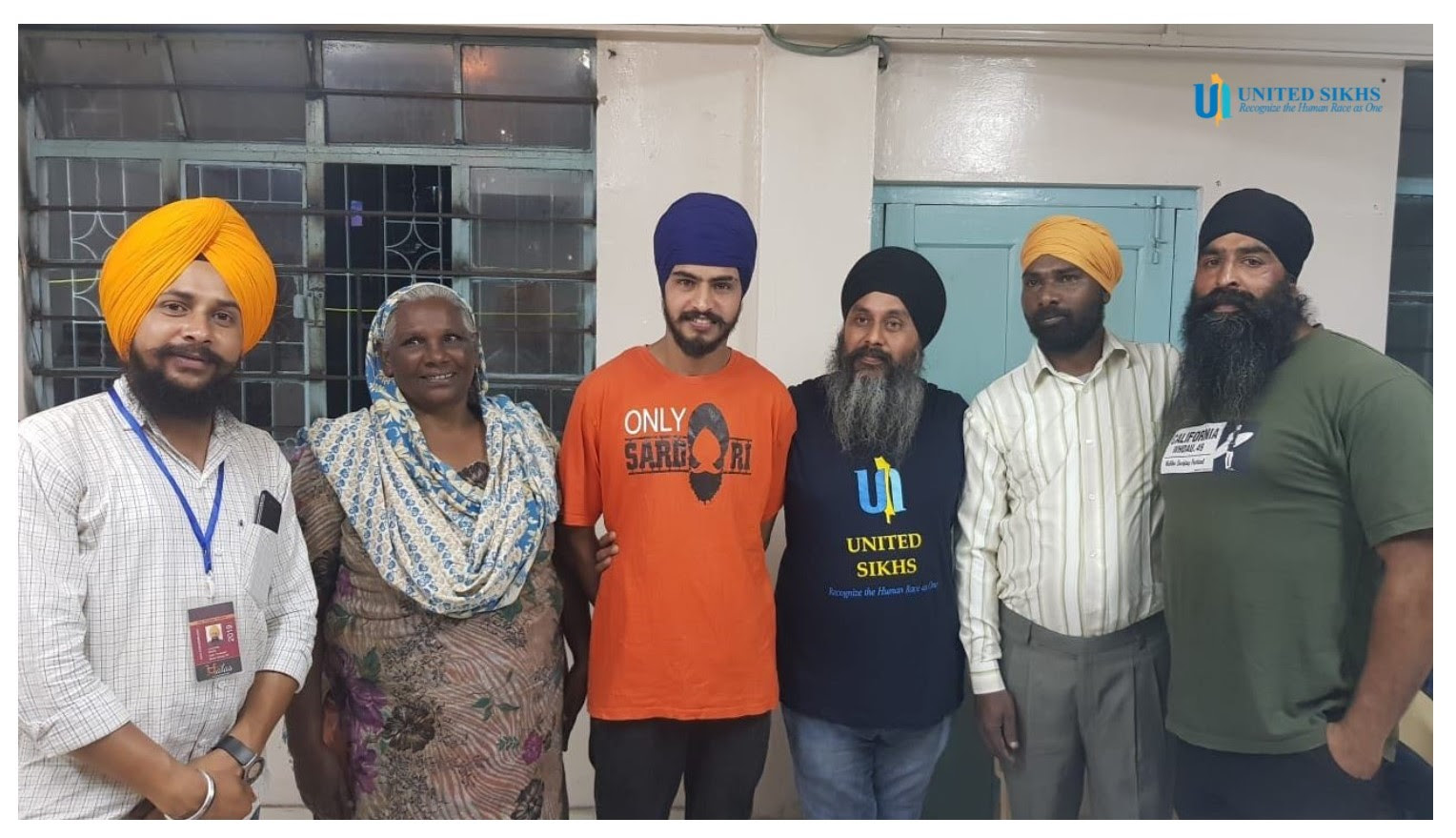
United Sikhs Ground Coordinator Mohinderjit Singh (Center) stands with Anil Singh (to the right of Mohinderjit) and Bittu Maci (to the left)

United Sikhs Ground Coordinator Mohinderjit Singh (Center) stands with Anil Singh (to the right of Mohinderjit) and Bittu Maci (to the left)

The Sikh community in Shillong is also battling the government over proposals to relocate the Sikhs living in the Punjabi Lane area of the city.

Mejindarpal Kaur, Legal Director at United Sikhs said: ‘We are pleased by the court’s decision to approve bail for Anil and Bittu. Working in tandem with local officials and community leaders, we will continue to seek justice for the Sikh community, who are still under pressure of losing the homes bestowed to their forefathers two centuries ago.’

Supreme Court Advocate Girdhar Govind added: ‘This was a great team effort to release these young Sikh men who were detained on false charges. We thank UNITED SIKHS for their service to humanity through this victory.’

United Sikhs continues to work with the Sikh community of Shillong. Volunteers have been regularly present in the area since the violence in May and continue to address critical needs of the Sikhs including physical and mental health provision. United Sikhs have met with local officials including Chief Minister Conrad Sangma, East Khasi Hills Deputy Commissioner P S Dkhar, and Superintendent Davis N.R. Marak, Assistant to Director General of Police S B Singh.

Click here for a video of interviews with Anil and Bittu’s families

French Sikhs make Global Appeal for Dastaar Struggle as Macron visits India

The Representative Council of French Sikhs (Conseil Représentatif des Sikhs de France) has today issued a global appeal to change a French regulation which constrains the wearing of the dastaar (turban) for Sikhs there.

The plea specifically asks the Sikh Kaum (community) to take this issue up wWhatsApp Image 2018-03-09 at 13.14.15ith the French government while French President Emmanuel Macron visits India from 9th to 12th March 2018.

A French government regulation in 2006 banned all head coverings, including the dastaar, on French ID pictures. This means that Sikhs are forced to take passport, driving license, public transport and student ID pictures with their dastaar removed. Removing the dastaar in public is a humiliating act for a Sikh. The dastaar is not a hat – it is a crown, given as a gift to a Sikh by their Guru which represents each Sikh’s sovereignty and royal status.

Many Sikhs believe the dastaar presents no identification problems as it does not in any way cover the face. Governments across the world permit ID pictures of dastaar wearing Sikhs. Because a Sikh always wears their dastaar in public, it has led to the ironic situation of a French Sikh’s ID picture looking less like how a Sikh appears in public, causing rather than preventing identification problems. The images included in this article are examples of a French Sikh’s ID pictures, where he has been forced to remove his dastaar.

Despite numerous pleas, including to the United Nations, the French government has maintained this stance, which many Sikhs feel is a degrading erasure of Sikh identity. Thousands of dastaar wearing Sikhs fought in both World Wars on French soil, defending the liberty that their descendants are denied today.

You can read the statement from R.G. Singh, President of the Representative Council of French Sikhs in full below:


WhatsApp Image 2018-03-09 at 13.14.15(1)

Global Appeal to the Panth

Paris, 9th March 2018

We appeal to the Panth to taken notice of the situation of Sikhs in France. The Dastaar Struggle is still on the table. Even after the success in the United Nations, the situation of Sikhs in France has not change at all. Each time, a French Sikh wants to apply for an Identity document, we are asked to remove our Dastaar on the picture. We need the support of Sikhs around the world, what is happening today in France can spread throughout Europe and hire in all Western countries.

Unfortunately, the Sikh Identity is not safe in France. We still have problem with French administration. The French Sikh community is struggling for their identity in French society, the Government regulation of 2006 on ID picture, in which they forbade all head cover such as Dastaar, is erasing the Sikh Identity in the French society. Even after the visit in 2012 in New Delhi of the former French President F. Hollande, this issue was not resolved.

Sikhs and France have a great shared history, friendship between Maharaja Ranjit Singh and King Louis Philippe 1er, to the French love in the province of Kapurthala. It is important to remember these strong historical connections that strengthened the French-Sikh friendship. This same friendship will occur during the Great Wars in France. The Dastaar was not an issue to defend the Freedom in France, today a duty of memory is required.

This year, even a single bus card (Navigo Card) requires a picture without Dastaar, Sikh turban. It is a humiliation every time we have to present a card to present our self. You can be French, British, Indian, to get a Navigo Card you will have to produce a picture without Dastaar on the desk! Passport, ID card, European License Card, Health Card, Student Card, Public Transport Card, Student Card, Sikhs are forbidden to wear their Dastaar.

We urge the Panth to take up these issues with the French official, especially during the visit of French President in India from 9th to 12th March 2018.

Safeguarding the Sikh Identity is a duty for each of us.

Contact information :

R.G. SINGH
Président
Conseil Représentatif des Sikhs de France
direction@sikhsdefrance.fr
(33) 6 50 45 11 07


For further information on this story contact: media@sikhpa.com