
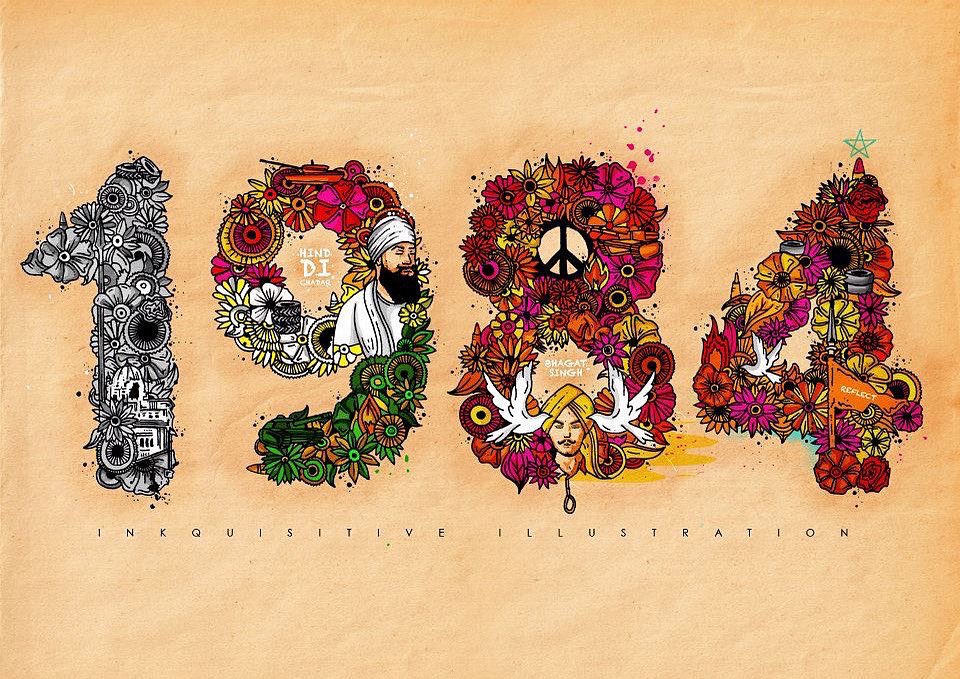
#NeverForget1984 trends in the West but Sikh human rights continue to be violated
As Sikhs worldwide remember the atrocities orchestrated by the Indian state in June 1984, issues regarding freedom, censorship and state propaganda continue to plague the Sikh community.
A unified effort by Sikhs in the west to promote awareness of the injustices of the 1984 Sikh genocide saw the hashtag #NeverForget1984 appear in the top trends list on Twitter in the UK, Canada and United States.
Not only are we fighting against oppression alongside our Black & Aboriginal friends, but today marks the 36th anniversary of Operation Bluestar, the start of coordinated brutality against Sikhs across India. Let us never stop working towards a just world. #neverforget1984 pic.twitter.com/OhEcdm8jfN
— Lilly Singh (@Lilly) June 2, 2020
36 years ago, the Indian Gov’t launched a military invasion into the Darbar Sahib, killing thousands of innocent.
The Sikh Genocide & the intergenerational trauma that followed will never be forgotten – nor will it break us.
My statement from last year: pic.twitter.com/pJuwzH24kQ
— Gurratan Singh (@GurratanSingh) June 1, 2020
Popular Sikh figures such as Canadian politician Gurratan Singh, television host Lily Singh and rapper Fateh Doe contributed to the rising awareness of the hashtag, as Twitter users around who previously knew nothing of the Sikh genocide came to learn of the atrocities committed across India in 1984.
Google 1984 Sikh genocide. Love the dreads btw
— Fateh Singh (@FatehDOE) June 1, 2020
I’m not Sikh, but I mourn with all my Sikh friends. #neverforget1984
— izzo ???? (@izzoxo) June 1, 2020
However, while Sikhs were heartened by the increase in awareness on Twitter, rival social media sites Instagram and Facebook took steps to stifle awareness of the tragedy.
Sikh educational organisation Sikh 2 Inspire noted that the hashtag #Sikh was no longer appearing in Instagram’s search results.
The blocking of #Sikh by @instagram at a time when #Sikhs are remembering the atrocities of 1984.
We ask you @instagram what the reason for this blocking is, to suppress the truth?
Let us all ask them the same question@SikhPA @sgsssouthall @gngsmethwick @basicsofsikhi pic.twitter.com/Ye7MHg8H22
— Sikh 2 Inspire (@Sikh2Inspire) June 3, 2020
The rationale behind this censorship is unclear, but commentators online are suggesting that the Indian government may have applied pressure on the platforms, in an attempt to deflect attention away from the genocide of Sikhs that it orchestrated in 1984 and subsequent years.
The Indian government, and its troll army, managed to block #Sikh on Facebook & Instagram.
It isn’t enough that they murdered tens of thousands of Sikhs in June 1984 and the subsequent decades. They want to erase it from history too. https://t.co/iQCGs8fhMH
— Arjun Sethi (@arjunsethi81) June 3, 2020
When the hashtag was searched on Facebook, a notice appeared that read: “Keeping Our Community Safe: Posts with #sikh are currently hidden here. Some content on those posts goes against our community standards”. On Instagram, the notice read: “Posts for this hashtag are temporarily hidden because of unusual activity that may not meet Instagram’s community guidelines”.
Instagram & Facebook have blocked the hashtag #sikh. It's an attempt to muzzle the voices of Sikhs across the globe who are expressing their pain over what conspired in 1984. pic.twitter.com/IQTVCk1fTw
— Jatinder Pal Singh (@Jatinde34350632) June 3, 2020
Sikhs won’t be silenced!
It’s no coincidence that the #sikh hashtag has been blocked when so many people are creating awareness on the Sikh Genocide. It’s like blocking the word Jew on holocaust day.
Keep uploading posts use the hashtags #neverforget1984 #sikhgenocide #sikhs pic.twitter.com/BQteA1BcIP
— Shere Panjab (@SherePanjabUK) June 3, 2020
Instagram claimed that the blocking of the hashtag was a “mistake”. However, after the hashtag had been unblocked, a search for it on the platform yielded far fewer results referencing the atrocities committed at the hands of the Indian government in 1984.
Sikhs and non-Sikhs alike have been astounded by this unprecedented level of censorship, and the Sikh community at large lost confidence in the integrity of these platforms.
This is an incredibly important, painful time for the Sikh community. We designed hashtags to allow people to come together and share with one another. It's never our intention to silence the voices of this community, we are taking the necessary steps so this doesn’t happen again
— Instagram Comms (@InstagramComms) June 3, 2020
INSTAGRAM AND FACEBOOK BLOCKED #SIKH – WAS IT REALLY A MISTAKE?@Facebook and @InstagramComms claim that the hashtag #SIKH was 'mistakenly' blocked on its global platforms. @Independent @BBCNews @SkyNews @SikhPA @AppgBritSikhs @Channel4News @RT_com @AP @guardian @Telegraph pic.twitter.com/0gFjWQNtqG
— Sikh Federation UK (@SikhFedUK) June 4, 2020
@InstagramComms i dont think they would tell the truth on y the hashtag had been blocked.
— Punjabisuba47 (@punjabisuba47) June 5, 2020
Sikh PA has approached the comms teams of the social networking sites for a full explanation. In previous years, we have made ad-hoc complaints about Sikh censorship on social media, however last year we were presented with various examples of such censorship by Sikh activism group the National Sikh Youth Federation. This has led to a behind-the-scenes effort to open up lines of communication with the social networking sites, but this has as yet proven unfruitful.
We have made officially requested a meeting directly with @Twitter @vijaya @jack @InstagramComms @mosseri @Facebook to discuss the various examples of Sikh censorship brought to our attention.
— SikhPressAssociation (@SikhPA) June 3, 2020
*OFFICIAL STATEMENT ON SIKH SOCIAL MEDIA CENSORSHIP*
For years we have been highlighting this issue to social media companies. Now, thanks to all of you who have forced @InstagramComms & @Facebook to address it, we have an opportunity to end Sikh censorship.
Please read & share pic.twitter.com/nUQQ5idRi0
— SikhPressAssociation (@SikhPA) June 3, 2020
In the world of politics, chief minister of Punjab Captain Amarinder Singh criticised “extremism” regarding the Sikh separatist movement, claiming that it is backed by Pakistan’s Inter-Services Intelligence (ISI) and “Khalistani sympathisers” in Canada, Italy, and the UK. However, the huge annual outpouring of emotion from Sikhs worldwide about the tragedy of 1984 that happens each year is independent of the Khalistan movement and motivated by the pain still felt by a community traumatised by their genocide.
@capt_amarinder should gracefully allow peaceful remembrance of Op BlueStar in Punjab. By denying the protests, he cannot change the reality of what happened in June ‘84.
— tangent (@TangentSingh) June 5, 2020
How can you cut up a baby’s stomach, put spices and other chemicals in his intestines to torture him, sew him back up, and then kill him. The Indian police that did this are still roaming free without punishment. Justice delayed is justice denied. #NeverForget1984 https://t.co/LUaAkv9wdR
— Nav Singh (@NaV__SiNgH) June 1, 2020
This would surely break your heart and fill your eyes with tears????#neverforget1984 #SikhGenocide84 #Sikh #1984год https://t.co/7lM2bRd70s
— Jaspreet Singh (@preetdosanjhian) June 5, 2020
Meanwhile Tanmanjeet Singh Dhesi, the UK’s first turban-wearing Sikh MP, brought up the 1984 Sikh genocide in British Parliament and called for an independent inquiry into Britain’s role in the Operation Blue Star attack.
“This week marks 36 years since then Indian prime minister Indira Gandhi ordered her abhorrent attack on the most revered Sikh shrine, the Golden Temple complex in Amritsar,” he said.
“It eventually led, under media blackout, to the destruction of historic structures, the genocide of the Sikhs and the burning of the Sikh Reference Library, and that is why Sikhs can never forget 1984.”
He added that the struggle from those events is still ongoing, and asked for an explanation from the government for why there has still not been an independent inquiry into Britain’s involvement in the attack despite recent revelations, and calls from the British Sikh community and opposition parties.
Sikhs can #NeverForget1984 because after #DarbarSahib #GoldenTemple complex attack came destruction of their historic structures, burning of Reference Library and genocide.
I asked @CommonsLeader why independent inquiry into Thatcher Govt’s involvement still hasn’t taken place! pic.twitter.com/h2LpfvtI16
— Tanmanjeet Singh Dhesi MP (@TanDhesi) June 4, 2020
Jacob Rees Mogg, leader of the House of Commons, responded by saying that a debate may potentially be held on the matter, but stated his personal belief Margaret Thatcher, British prime minister at the time, “would always have behaved properly”.
The oppression of Sikhs continued in India where, throughout the week commemorating the 36th anniversary of the Sikh genocide of 1984, Punjab police have banned Sikhs from entering Sri Harimandir Sahib with a Kirpan (sacred sword).
A Kirpan is an essential article of faith that every practicing Sikh is commanded to keep on their person at all times. In enacting this measure, police have committed a violation of international human rights and freedom of religious expression by restricting access to the holiest shrine to Sikhs simply for adhering to their faith.
The Punjab Police force also tightened security around the complex and restricted access into the central Gurdwara. They said that they took the measure due to clashes between SGPC workers and pro-Khalistan activists in the Gurdwara complex in previous years.
To stop singhs from observing/commemorating the #sikhgenocide homes of sikh have been raided by the punjab police and arrests have been made.@SikhPA @SikhPA @ensaaf @theNSYF @SimranjitSADA pic.twitter.com/PFOtu0DgIP
— Davinder Singh bujang (@singhbujung84) June 5, 2020
The police in Punjab are also attempting to crack down on Sikhs observing this period of mourning in their own homes. Sikhs whom they suspect of observing or commemorating the Sikh genocide in their homes were arrested and have had their properties raided. The crackdown was supported by the Indian Anti-Terrorism Squad.
One such arrest was of 32-year-old Sikh man Tirath Singh, who was arrested by Punjab police after he was found in possession of posters of Jarnail Singh Bhindranwale at his residence.
You will see bhindranwale's poster in 80% houses in villages…. Will that make 80% of village's population terrorists
— Raj Sandhu (@sandhu94717) May 31, 2020
Punjab police claim that his crime was supporting the Khalistan movement on social media, so they tracked him down and apprehended him. He is currently being detained and questioned.
Meanwhile, a reporter from India Today, a news outlet with a track record of publishing defamatory information about Sikhs, was spotted in London taking photos of a poster displayed outside Europe’s most visited Gurdwara of respected Taksal leader Sant Jarnail Singh Ji Bhindranwale.
Loveena Tandon, who has previously attended Sikh protest events with intentions to provoke the Sikh sangat (congregation), wrote: “The gurdwara located at Havelock Road in Southhall(sic) recently put up the picture of the militant leader.”
Another video of the lady recording at Havelock Road Gurdwara in Southall, West London! She’s a reporter who works for ‘India Today Social’ & her name is Loveena Tandon. For years she’s been trying misrepresent Sikh’s, mock the Khalistan movement, ignore the Sikh genocide etc pic.twitter.com/PwRQluSoVG
— Mandeep Singh (@MS145) June 1, 2020
It may be noted that photos of Sikh freedom fighters including Sant Jarnail Singh Ji Bhindranwale have been on display in and outside of Gurdwaras, and even on billboards in cities, for several years. Tandon accused Sant Ji of “taking lives in the name of Sikhism”.
However, she also acknowledged that the same Sikhs she has been criticising throughout her career and labelling as extremists, were seen wearing jackets with Khalistan logos, on the premises of the gurdwara, giving out food parcels to those in need during this COVID-19 pandemic.
Sikhs will gather this Sunday, 7th June 2020, in central London for the annual remembrance march and freedom rally led by British-Sikh NGO Sikh Federation UK. Social distancing protocols will be in place and numbers controlled.
#NeverForget1984@sgsssouthall #ParkAvenue #Southall pic.twitter.com/MS1pSsOhiU
— Harvy Mander (@HarvyMander) June 5, 2020


Leave a Reply
Want to join the discussion?Feel free to contribute!