
Khalsa “moral authority” bothers India nationalists, after Punjab Chief Minister summons
The Sikh faith’s lead body of authority summoned Punjab’s Chief Minister to publicly explain “anti-Sikh” comments last month, in a move which has caused lasting worry among Indian nationalist commentators.
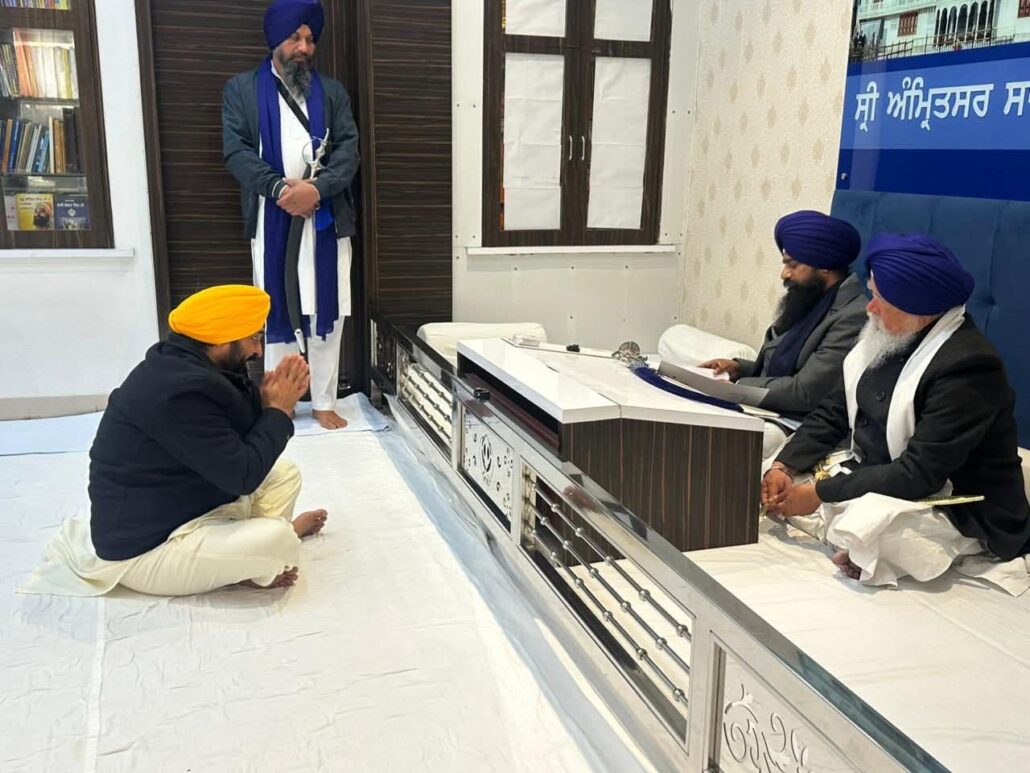
Aam Aadmi Party head Bhagwant Mann, a former comedic actor turned politician, was summoned to the Akal Takht in Amritsar on 15th January to explain public allegations he had made regarding Gurdwaras and public Sikh figures. Mann explained himself before Akal Takht Jathedar (head) Kuldeep Singh and leading figures of the SGPC (Shiromani Gurdwara Parbandhak Committee), self-described as a “parliament” tasked with running Sikh institutions.
The Akal Takht (which translates as Eternal Throne) is a Sikh institution of authority which oversees all Sikh affairs and decisions. Although not legitimized in the law of any nation, the “moral authority” of the Akal Takht remains the most influential mechanism in all Sikh communities on earth, underlining the organic nature of sovereignty within the faith, where even major state figures such as Mann are answerable to people with no official government positions, only holding Sikh faith titles. And it is this influence, underlined by seeing someone in one of India’s most senior political roles forced to accept a public dressing down from the Akal Takht in 2026, which has infuriated many Indian nationalists, including leading pundits.
Whilst some questioned if this was a faith based effort to influence wider politics in Hindustan (a Hindu name for India), The Hindu newspaper even suggested this week that the Akal Takht’s position of power could be “constitutional subordination”, a phrase which could be seen as volatile within India’s much noted heated nationalist atmosphere.
Mann was specifically questioned regarding a long series of suggestive statements, implying corruption amongst the SGPC and within historic Gurdwaras. Mann also oversaw his party make several mistakes regarding protocol around religious events, which the Punjab government would host themselves, in effort to cater for the people of the motherland of Sikhi. Possibly sealing his summons, Mann also questioned reverence of Shaheeds (Sikh martyrs), who have long been demonized to India’s public, but remain beloved in Sikh circles. After being summoned in early January 2026, Mann said he would attend “barefoot and humble” as a Sikh, and not as the CM of Punjab.
However, when Mann did arrive, the presiding committee noted he carried pages of a document said to detail “misspending” by the SGPC, which was viewed as disrespectful and arrogant. Nevertheless, a firm but polite back-and-forth was carried out before the public (and online simultaneously), which ended with the SGPC saying an Akal Takht response would be pending until further notice. This was partly because at least one of the perceived acts of disrespect from Mann was explained as an AI creation.
Upon the meeting’s end, Mann publicly said the Akal Takht remained the supreme authority of all Sikhs and Sikh affairs.
As noted by many, the summons of Mann is a clear continuation of use of the Akal Takht’s authority which began in the 16th century under the Sikh Gurus. Nowadays it has been used to finally summon former Chief Minister Sukhbir Singh Badal in 2024 for crimes against the Sikh faith. Another sitting Punjab CM was also summoned with Surjit Singh Barnala coming to the Akal Takht, in 1986. However, some Sikh critics have said such acts are performative, and do not offer solutions with real traction. Nevertheless, the Akal Takht remains the most powerful body within Sikh communities, worldwide.
Whilst Indian nationalist critics remain troubled by the Akal Takht’s authority, Sikh communities welcome a form of accountability for figures such as Badal and Mann. However, the furious reaction to this from Indian nationalists towards the SGPC highlights potential future conflict within India around Sikh power, an issue which is of concern to countless Sikhs across the globe.


Leave a Reply
Want to join the discussion?Feel free to contribute!