Media campaign related posts

Open Letter to British Indians – Daily O

Dear British Indians,

While some of you might be excited to welcome the Prime Minister of India to the United Kingdom, I would like to attract your attention to some of the recent unfortunate incidents that have raised serious questions on his government’s democratic commitment.

But before that, let me point out some of the things that have affected you in the past in the UK. You as a minority community in Britain have had bitter-sweet experiences historically. At times, your Chicken Tikka Masala is hailed as Britain’s true national dish, and at times your Diwali is snubbed as a non-British festival. At times, your contributions in this country are emphatically recognised, and at times you are blamed for living parallel lives, separate from the mainstream. At times, your presence in this country is celebrated, and there are days when you are considered a burden on welfare state in Britain.

You do remember Stephen Lawrence, don’t you? He was a member of a minority community like yours who was murdered in cold blood in a racial attack in London in 1993. Mindless racism did not only lead to his killing but also failed to give justice to his bereaved family. The Metropolitan police, which inquired into his murder, was found to be “institutionally racist”. You wouldn’t like to be a victim of such racism in the country you live, would you?

I am sure you are also aware of an openly xenophobic and ultranationalist party called British National Party (BNP), which calls for resettlement of migrant populations to their countries of ethnic origin. You wouldn’t like an idea like that to be translated into power, would you?

Now juxtapose these issues of the country you live in, that is UK, with some of the incidents that have happened in the country of your origin, that is India, under the watch of the prime minister you are excitedly waiting to welcome.

Think of two Muslim men being lynched by raging mobs in separate incidents in Dadri in the northern state of UP and in Imphal in the eastern state of Manipur. Politics of hatred caused the loss of two innocent lives. And also think of several leaders of the PM’s BJP, time and again, threatening to send Indian Muslims to Pakistan.

Do you find the lynching of the two men in India any different to the killing of Stephan Lawrence in the UK? And do you find the BJP leaders’ threats to send Indian Muslims to Pakistan any different to the BNP’s determination to send people like you to the countries of your origin?

In fact, if there is a difference between the Indian community in UK and the Muslim community in India, it is this that the Indian community in UK has indeed predominantly migrated in the recent memorable history, that is, after the Second World War, whereas Muslims in India have not. Muslims have been living in India for centuries.

So if, despite this fact, you find BNP’s ideology as racist, xenophobic and regressive -and rightly so – can those BJP leaders’ views be legitimate, tolerant and progressive? If not, then why not lodge your protest with the visiting leader of that party, who is also the prime minister of India?

Please remember, both in the UK and in India these horrific crimes and appalling threats are directed against the minorities by some fanatic nationalists. If you,as a minority in UK don’t approve of racist killing of Stephan Lawrence and the xenophobic views of BNP, then isn’t it your moral duty to raise your voice against similar things happening against your minority counterparts in India?

After all, you are some of the most privileged people on earth to straddle between the largest democracy and one of the oldest democracies of the world. You have inherited the democratic values like tolerance, respect, dignity and equal opportunities for all. You know what democracy means and how politicians should treat you.

So if you plan take a ride on the UK Welcomes Modi bus or decide to go to Wembley on Friday, please bear in mind that you might be turning a blind eye to what is happening in India. Prime Minister Narendra Modi is coming on a state visit. What transpires in his meetings with PM David Cameroon and the Queen will make the visit a success or a failure, not his photo op with you.

Yours truly,

Mohammad Behzad Fatmi


http://www.dailyo.in/politics/modi-not-welcome-parliament-in-uk-wembley-stadium-address-godhra-indian-muslims/story/1/7280.html

Modi the Manipulater – Guardian

In 2005, when Narendra Modi was the chief minister of the wealthy Indian state of Gujarat, local police murdered a criminal called Sheikh Sohrabuddin in cold blood. At an election rally in 2007 for the ruling Hindu nationalist BJP, Modi assured his citizens that Sohrabuddin “got what he deserved”. What should be done, he asked, to a man found possessing illegal arms? The pumped-up crowd shouted back: “Mari nakho-mari nakho!” (Kill him, kill him!)
The lynch mob’s cry was repeated in a village near Delhi last month as zealots beat to death a Muslim farmer they suspected – wrongly – of keeping beef in his house. While Modi makes a triumphant visit to the UK after more than a year as India’s prime minister, the Hindu supremacists are, as the novelist Mukul Kesavan wrote last month, in “full hunting mode, head up and howling”. In recent weeks, activists and scholars have been shot dead amid a nationwide campaign against “Hindu-baiters” that targets secular intellectuals and “westernised” women as well as public figures with Muslim and Christian names, and western NGOs such as Greenpeace. The assassinations follow months of violence and intimidating rhetoric by Hindu supremacists. A range of public figures, from Shah Rukh Khan, Bollywood’s biggest star, to India’s respected central banker, Raghuram Rajan, have spoken out against the rising tide of sectarian hatred. More than 40 of India’s most distinguished writers have returned their awards to the Sahitya Academy, the national literature academy. Many others, including artists, scholars, filmmakers and scientists, have since joined the protests, which reached boiling point after Hindu fanatics lynched at least four people in connection with beef-eating.
Modi turned beef into an incendiary issue during his run for India’s highest political office; he and his party colleagues reinfused it with anti-minorities venom during recent local elections in the state of Bihar. The chief minister of one of India’s richest states declared last month that Muslims could only live in the country if they stopped eating beef. The house magazine of the RSS, the parent outfit of Hindu nationalists, cited ancient scriptures to justify the killing of “sinners” who slaughter cows. The culture minister Mahesh Sharma said of protesting authors: “If they say they are unable to write, let them first stop writing. We will then see.” On Saturday, Modi hinted at his own views on the subject by posing for pictures with organisers of a Delhi demonstration against protesting writers, where slogans such as: “Hit the fraudulent literati with boots” and, “Presstitutes suck up to Europeans” had echoed.

On the day of Modi’s election last May, I wrote in the Guardian that India was entering its most sinister phase since independence. Those who had monitored Modi’s words and deeds, noted their consistency, and feared that Hindu supremacism could deliver a mortal blow to India’s already enfeebled democratic institutions and pluralist traditions had come to much the same conclusion. Modi is a stalwart member of the RSS, a paramilitary organisation explicitly modelled on European fascist parties, whose members have been found routinely guilty of violence against Indian minorities. A pogrom in Modi-ruled Gujarat in 2002 killed more than 1,000 Muslims and displaced tens of thousands. (It was what prompted the US and UK governments to impose a visa ban on Modi). Whether or not Modi was personally complicit in the murder and gang rapes, they had clearly been “planned in advance”, as Human Rights Watch said in the first of countless reports on the violence, “and organised with the extensive participation of the police and state government officials”. Among the few people convicted was Maya Kodnani, Modi’s ministerial colleague, and a fanatic called Babu Bajrangi, who crowed to a journalist that he had slashed open with his sword the womb of a heavily pregnant woman, and claimed that Modi sheltered him after the riots and even changed three judges in order for him to be released on bail (Modi has not responded to these allegations).
Though sentenced to dozens of years in prison, Kodnani and Bajrangi are frequently granted bail and allowed to roam free in Modi’s India. India’s foremost investigative body, the CBI, had accused Modi’s consigliere, Amit Shah, who is now president of the BJP, of ordering the execution of Sohrabuddin (among others), but withdrew its case against him last year, citing lack of evidence. Meanwhile, Teesta Setalvad, a human rights activist and one of Modi’s most persistent critics, is saved from arrest only by the interventions of the supreme court.

Modi conveyed early the audacity – and tawdriness – of power when in May 2014 he flew from Gujarat to the oath-taking ceremony on a private corporate jet emblazoned with the name of his closest corporate chum. In January this year he turned out in a $15,000 Savile Row suit with personalised pinstripes to hug Barack Obama. Launching Digital India (a programme to connect thousands of villages to the internet) in Silicon Valley last month, the eager new international player seemingly shoved Mark Zuckerburg aside to clear space for a photo-op for himself (the video has gone viral). One of his most fervent cheerleaders in India now complains that the prime minister is like a new bride remaking herself for her powerful and wealthy in-laws.
Consequently, many in his own neglected family are turning against him. On Sunday, his party’s vicious and lavishly funded campaign in elections in Bihar, one of India’s largest and poorest states, ended in humiliating defeat. But Modi’s glossy makeover seems to have seduced many in the west; Rupert Murdoch tweeted after a recent meeting that Modi is India’s “best leader with best policies since independence”. Sheryl Sandberg declared she was changing her Facebook profile in honour of Modi’s visit to Silicon Valley in September. His libertarian hosts did not seem to know or care that, just as Modi was arriving in California to promote Digital India, his factotums were shutting down the internet in Kashmir, or that earlier this year his government advocated a draconian law that the Indian police used repeatedly to arrest people posting opinions on Facebook and Twitter. Nor did the Bay area’s single-minded data-monetisers fuss about the fact that Modi had launched Digital India in India itself with a private party for his most fanatical troll-troopers – people who are, as the magazine Caravan put it, “a byword in online terror, hate and misogyny”. In a dog-eat-dog world primarily organised around lucrative deal-making, the only value seems to be economic growth – albeit, for a small minority.


Modi’s speeches about his country’s cruelly postponed and now imminent glory have packed stadiums around the world with ecstatic Indians. At Wembley this weekend, some more grownup men and women chanting “Modi, Modi!” will embarrass themselves in history. The seemingly unembarrassable Tory government discovered new muscles while kowtowing to Xi Jinping, and will no doubt find them useful for some Indian style-prostration, sashtanga pranam, before Modi.

Modi was always an odd choice to lead India into the 21st century. Meeting him early in his career, the distinguished social psychologist Ashis Nandy assessed Modi as a “classic, clinical case” of the “authoritarian personality”, with its “mix of puritanical rigidity, narrowing of emotional life” and “fantasies of violence”. Such a figure could describe refugee camps with tens of thousands of Muslim survivors of the 2002 pogrom as “child-breeding centres”. Asked repeatedly about his culpability in the killings, Modi insisted that his only mistake was bad media management. Pressed repeatedly over a decade about such extraordinary lack of remorse, he finally said that he regretted the killings as he would a “puppy being run over by a car”.
More importantly, Modi was a symptom, easily identified through his many European and Asian predecessors, of capitalism’s periodic and inevitable dysfunction: he was plainly the opportune manipulator of mass disaffection with uneven and unstable growth, who distracts a fearful and atomised citizenry with the demonisation of minorities, scapegoating of ostensibly liberal, cosmopolitan and “rootless” people, and promises of “development”, while facilitating crony capitalism. To aspiring but thwarted young Indians Modi presented himself as a social revolutionary, the son of a humble tea-seller challenging entrenched dynasties, as well as an economic moderniser. He promised to overturn an old social and political order that they saw, correctly, as dominated by a venal and unresponsive ruling class. His self-packaging as a pious and virtuous man of the people seemed especially persuasive as corruption scandals tainted the media as well as politicians and businessmen in the years leading up to 2014.

Modi’s earliest supporters in his bid for supreme power, however, were India’s richest people, lured by special favours of cheap land and tax concessions. Ratan Tata, the steel and car-making tycoon, was one of the first big industrialists to embrace him in the wake of the anti-Muslim pogrom. Mukesh Ambani, another business magnate and owner of a 27-storey home in the city of slums, Mumbai, soon hailed his “grand vision”. His brother declared Modi “king among kings”. Even the Economist, reporting on Modi-mania among “private-equity types, blue-chip executives and the chiefs of India’s big conglomerates” was startled by the “creepy sycophancy”. It shouldn’t have been: in Modi’s India the Ambanis are fast heading towards a Berlusconi-style domination of both news and entertainment content and delivery mechanisms.
Media management has ceased to be a problem for Modi; the television channels and press owned by loyal supporters hectically build him up as India’s saviour. Modi also attracted academics, writers and journalists who had failed to flourish in the old regime – the embittered pedantocrats and wannabes who traditionally serve in the intellectual rearguard of illiberal movements. Predictably, these victims of ressentiment – who languished, as Nietzsche wrote, in “a whole tremulous realm of subterranean revenge” – are now taking over Indian institutions, and filling the airwaves with their “rabid mendaciousness and rage”.

Many non-resident Indians, denied full dignity in the white man’s world, also hitched their low self-esteem to Modi’s hot-air balloons about the coming Indian Century. The Modi Toadies, as they are widely referred to on social media, have turned out to be an intriguingly diverse lot: they range from small-town zealots campaigning against romantic love between Muslim and Hindus to a publicist called Swapan Dasgupta, a former Trotskyite and self-proclaimed “anglophile”. But it should not be forgotten that a variety of global elite networks went to work strenuously on Modi’s behalf: the slick public-relations firm APCO that works with Central Asian despots and suave technocrats as much as the rented armies of cyberthugs rampaging through social media and the comment sections of online articles.
A former special adviser to Tony Blair authored a hagiography for English-speaking readers. The Labour peer Meghnad Desai helped alchemise Modi’s record of assisting big corporations into an electorally potent myth of “efficiency” and “rapid development”. Jagdish Bhagwati and Arvind Panagariya – two Ivy League Indian economists charged with “poverty-denialism” by the recent Nobel laureate Angus Deaton – said in a letter to the Economist that the anti-Muslim pogrom in Modi’s Gujarat was actually a “riot”. As Modi appeared likely to become prime minister, the intellectual grunts at American thinktanks churned out op-eds hailing Modi as the man to accelerate India’s neoliberalisation, and reorient its foreign policy towards America and Israel. Many foreign correspondents and “India hands” lost their intellectual confidence and judgement before such diligently manufactured consensus.

Thus, Modi rose frictionlessly and swiftly from disgrace to respectability in a world where money, power and status are the measure of everything, and where human beings, as Balzac bitterly wrote, are reduced to being either fools or knaves. He may be very far from fulfilling his electoral promise of creating adequate jobs for the one million Indians who enter the workforce every month. He still deals mostly in fantasy, gushing about “smart cities” and “bullet trains”, and a digital India in which fibre-optic cables will bring remote villages online. But among global elites who see India as a fast-growing economy and counterweight to China, poverty-denialism shades easily into pogrom-denialism. A tweet by a New-York-based venture capitalist responding to protests by Indian writers sums up the prevailing morality: “The icons of new India are the wealth creators. Nobody gives a rat’s ass anymore about the writers.”
Modi’s ascent through a variety of enablers, whitewashers and wealth-creators invites us to probe our own complicity as fools and knaves in increasingly everyday forms of violence and dispossession. For Modi’s ruthless economism is a commonplace phenomenon, marked everywhere by greed, sophistry and a contempt for human life and dignity – symptoms, as GN Devy, one of India’s most bracing thinkers, put it last month, of a worldwide transition into a “post-human” existence.

In India itself, the prostration before Mammon, bellicose nationalism, boorish anti-intellectualism, and fear and hatred of the weak predates Modi. It did not seem so brazen previously because the now supplanted Indian elite disguised their hegemony with what Edmund Burke called “pleasing illusions”: in this case, reverential invocations of Gandhi and Nehru, and of the noble “idea of India”. Thus, the Congress party, which first summoned the malign ghosts of Hindu supremacism in the 1980s and presided over the massacre of more than 3,000 Sikhs in 1984, could claim to represent secularism. And liberal intellectuals patronised by the regime could remain silent when Indian security forces in Kashmir filled up mass graves with dissenters to the idea of India, gang-raped with impunity, and stuck live wires into the penises of suspected militants. The rare protestor among Indian writers was scorned for straying from literature into political activism. TV anchors and columnists competed with each other in whipping up patriotic rage and hatred against various internal and external enemies of the idea of India. The “secular” nationalists of the ancient regime are now trying to disown their own legitimate children when they recoil fastidiously from the Hindu supremacists foaming at the mouth.

One can only hope that the barefaced viciousness of Hindu supremacists will jolt the old elites out of their shattered dogmas and pieties while politicising a cheated young generation. It is true that Modi and his Toadies embody without shame, ambivalence or euphemism the brutality of power; they don’t give a rat’s ass about pleasing illusions. Yet their assaults on the authorised idea of India are creating a fissure in the unfeeling monolith through which a humane politics and culture might flow. The alternative, as recent weeks show, is a post-human India, where lynch mobs roused by their great leader shout: “Kill him! Kill him!”

Sikh Farmers Flee Gujarat – Times of India

CHANDIGARH: Targeted by land mafia, attacked by goons and booked by cops, Sikh farmers who had made the inhospitable terrain in Bhuj area of Gujarat cultivable, are now forced to flee the land they had made their home.

The recent attack on farmers on January 25 has only reinforced their fears and they have no plans to return anytime soon. Farmer Jagjit Singh was seriously injured in an attack allegedly by a group of local farmers in Loria village of Bhuj district. This was the second attack on Sikhs in Gujarat within a month. Some Sikh farmers have alleged that local agriculturists in connivance with politicians want to drive them out of Gujarat. This attack triggered the exit of a dozen Sikh farmers.

Many have returned to their original hometowns in Punjab and Ganganagar after giving their land on contract farming. Having sold their land, most are virtually living hand to mouth now.

Eighty-four-year-old Tej Ram Sharma said he left Bhuj area and came to Moga about a month ago. “There was fear that an untoward incident could happen any moment and we deputed someone to take care of our 40 acre land and came back to Punjab. I get some pension and that is the only source of income. Prime Minister Narendra Modi should step in,” he said with a choked voice.

In the run-up to the Lok Sabha polls, Modi had assured at a rally in Ludhiana in February 2014 that no Sikh farmer in Gujarat would ever be evicted. “Sikh farmers have as much the right to live there as Narendra Modi,” he had said. But nearly one year down the line, fear haunts the Sikh settlers.

Lachhman Singh Brar, who came to Faridkot three months ago, said that apart from the threat of local mafia, even farming as a vocation was becoming financially unviable as they are being deprived of facilities like farmer credit scheme.

“Even though the local population has cordial relations with the Punjabi farmers who migrated there about five decades ago and actually helped locals with new farming techniques, the bureaucracy and politicians have been indifferent,” he said.

Sardul Singh has returned to Ganganagar, leaving behind 20 acres near Kothara. “There was threat to our lives and we thought it better to give the land on contract and leave. The recent attack on Punjabi farmers in which both parties have been booked by the police goes to show the state of affairs,” he alleged.

“The farmers’ fear is growing as they are being deprived of their right to own the land despite having won the case in High Court,” said another farmer who has returned to his village on Punjab-Haryana border.

For several years, Sikhs were facing the threat of being uprooted under a law enacted by the Gujarat government that purportedly bars non-Gujaratis from buying land in the state. The farmers won the case in the Gujarat high court but the state government challenged the HC order in the SC.

Surinder Singh Bhullar, a farmer settled near Bhuj, said many Punjabi farmers had moved out after selling their land at throwaway prices. “Over the past four years, we have approached every government agency but to no avail. The freeze on our land has not been removed even after the high court ruled in our favour. Punjabi farmers are spread apart and get together only once a year. There are some who had sold off everything to buy land in Gujarat and have nowhere to go,” he said.

Himmat Singh Shergill, Aam Aadmi Party ( AAP) leader who represented the farmer in court, said it was a sorry state of affairs and the Sikh farmers had nobody to turn to. The local land mafia wants them to abandon their land and leave the state, he alleged.

Farmers undivided Punjab and Rajasthan had gone to Kutch district in 1965 at the exhortation of then prime minister Lal Bahadur Shastri.


http://timesofindia.indiatimes.com/india/Hounded-Sikh-farmers-fleeing-Gujarat/articleshow/46061753.cms

Fake Encounters – NarendraModiFacts.com

Fake encounters, are extrajudicial executions, usually of people in custody, generally staged to appear as though they occurred in gun battles. Between October 2002 and December 2006 there were at least 21 extrajudicial killings by Gujarat Police (Amnesty reported 31 such killings between 2002 and 2007). More than a dozen senior police officers are in jail or facing prosecution in connection with fake encounter killings. The Gujarat state is directly implicated in many cases, most famously the killing of Ishrat Jahan, a nineteen year old woman from Mumbai, along with three others in 2004. Modi praised the police involved in killing Ishrat Jahan and branded her a terrorist. But no evidence of her involvement with terrorism has ever been produced despite certain media claims based on unidentified sources. In the run-up to the encounter there is evidence of frequent contact between top BJP officials and officers, most notably Amit Shah implicated in the killing. In March 2014, the CBI reportely obtained a recording of Modi’s top aides, including G.C. Murmu andA. K. sharma, discussing with police officers how to sabotage the Ishrat Jahan probe.

Another well known fake encounter killing was that of Sohrabuddin Sheikh and his wife, Kausar Bi, who was raped before her murder. Modi justified this killing, saying that Sheikh got what he deserved,leading to intervention from the Election Commission. In March 2014new evidence emerged that Modi was directly monitoring another encounter killing, that of Tulsi Prajapati, witness to the killing of Sohrabuddin Sheikh. According to a lawyer representing victims’ families, there is a clear pattern to the Gujarat encounter killings, with the victims branded as terrorists often without evidence.

In September 2013, a senior police officer D. G. Vanzara, who had been in jail since 2007 for involvement in several fake encounters, resigned from service, claiming that the officers involved were implementing state government policy. It is currently unclear whatlegal or political repercussions these revelations will bring.

Both fake encounters and other human rights violations by the Gujarat police such as the arrest, illegal detention, and torture of Muslim youth, seem to be about creating the impression that Islamic terrorism is an imminent threat, with Modi emerging as the tough guy taking action on terror. In the run up to the election, and during the election, there have been several stories about imminent terrorist threats against Modi without any evidence provided.

https://narendramodifacts.com/faq_encounter.html

What the West Doesn’t Want to Admit About Modi – Naujawani

Written by Narvir Singh

A lot of Sikhs are outraged by the audacity for some Gurdwareh, including Gurdwara Sri Guru Singh Sabha Southall, to support Narendra Modi on his tour to the UK. They are appalled that Sikhs could agree to have our institutions included in the ‘Modi Welcome Committee’. But why is supporting the new Indian Prime Minister the worst decision ever?


READ THE REST HERE…

https://naujawani.com/blog/what-the-west-doesnt-want-to-admit-about-modi

First Post – Punjab Struggles to Maintain Peace

Chandigarh: The Panthic (religious) crisis in Punjab continues with the Panj Pyaras (five favourites of the Guru) and the Akal Takht Jathedars failing to resolve the conflict over pardon to Gurmeet Ram Rahim Singh, head of the Sirsa-based Dera Sacha Sauda. Though the Akal Takht revoked the pardon under pressure from various quarters on 16 October, the issue refuses to die down. The desecration of the copies of the Holy Granth Sahib has only added fuel to fire.Trouble started a month ago when in an unexpected move on 24 September, the Akal Takht Jathedars announced that they had pardoned the Dera Sacha Sauda chief. He was charged with blasphemy for dressing like Guru Gobind Singh. They said it was done on the basis of the clarification received from the latter. A wide section of Sikhs reacted angrily and there were protests all over the state.Representational image. AFP

It was alleged that the decision had been taken by the Akal Takht under pressure from the Akali Dal which was looking forward to some kind of settlement with the Dera before the 2017 assembly elections. Dera Sacha Sauda has a huge following in Punjab, especially in the Malwa region. The Dera’s support had been crucial for the victory of the Congress in the 2007 assembly elections.

Akali Dal leaders were quick to deny the charge of any understanding with the Dera, but there were not many takers for this. It is widely believed that Akali Dal controls the Shiromani Gurdwara Prabandhak Committee (SGPC) and all its decisions are influenced by the Akalis.

Upset at the decision of the Akal Takht, the Panj Pyaras passed a `Gurmatta’ (resolution) to summon the Sikh high priests, including the Akali Takht Jathedar Giani Gurbachan Singh, before the supreme temporal seat of Sikhism for questioning. The `Panj Pyaras’ demanded their resignation as they had worked against the tenets of Sikhism. In case they did not give their resignation, the Panj Pyaras asked the SGPC to sack them.

The Akal Takht jathedars refused to oblige. Instead, in a dramatic turn of events the SGPC suspended the ‘Panj Pyaras’. Its president Avtar Singh Makkar said the decision to summon the jathedaras was against Panthic traditions and maryada (tenets) of the Akal Takht. While three of the `Panj Pyaras’ were asked to report to the Sikh Mission office at Hapur in Uttar Pradesh, two of them were transferred to Kurukshetra in Haryana. According to Satnam Singh, one of the Panj Pyaras, the suspension was not valid as SGPC service rules did not apply to them.

It led to another round of protests against the SGPC.

Meanwhile, the incident of desecration of the Holy Granth Sahib took place and there were several instances of the pages of the Holy Book being torn in different parts of Punjab. Many in the community suspected the hand of Dera Sacha Sauda in it. But it refuted the charge, condemned the incident and appealed to the people to maintain peace and calm. However, the protests continued unabated and the police had to resort to firing in Kotkapura resulting in death of two persons at Faridkot and injury to more than 60 people.

As protests continue in Punjab, the Sikh community is getting divided with people taking sides. Faridkot, Kapurthala, Barnala, Sangrur, Ludhiana, Moga and Ferozepur districts have seen several protests in the last few days. Anger also seems to be growing against Akali Dal leaders. A vehicle of Akali Dal MLA Darshan Singh was vandalised by protesters near Talwandi Sabo.

Speaking to Firstpost, Didar Singh Nalwi, vice president of the Haryana SGPC, said what was happening in the SGPC was very regrettable. “The present crisis is dividing the Sikh community. This is the result of the political interference of the Akalis in religious matters. Punjab Chief Minister Parkash Singh Badal, who yields enormous influence over the SGPC, should desist from controlling the body.”

Professor (Retd) Manjit Singh of Swaraj Abhiyan, said the present chaos in Punjab is because of political interference in religious matters. Sometimes the leaders deliberately allow such controversies to linger to divert people’s attention from the real issues facing the state.

Via – http://www.firstpost.com/india/gripped-by-panthic-crisis-punjab-struggles-to-maintain-peace-and-harmony-2482050.html

Punjabi Sikh Sangat News – Road Block Protests Reaches 10th Day


Despite Police Restrictions Sikhs Continue in Force at Tarn Taran

TARN TARAN, Punjab — Despite Police restrictions, Sikh protesters continued to demonstrate at Harike bridge for 10th consecutive day against the sacrilege of Guru Granth Sahib today.

The determination shown by the Sikh protesters has raised concerns for administration which is imposing various restrictions to ensure failure of the agitation.

The protesters had been reiterating their demand of the reinstatement of the Panj Pyaras of Akal Takht Sahib. They alleged that the Police had installed barricades on both sides of the bridge and was not allowing their supporters to reach the place where dharna was being undertaken.

They said, “Such tricks cannot stop us to continue our struggle for restoration of respect and dignity of Guru Granth Sahib and Sikh principles violated by ruling Shiromani Akali Dal and the SGPC.”

At the Tarn Taran dharna which entered it’s 8th day, an Akhand Path Sahib was ongoing, with it’s bhog ceremony to be performed on Sunday. Due to the Akhand Path Sahib, sizeable number of Sikh devotees including women is making their presence on dharna. More devotees are likely to attend Bhog ceremony.

Security has been beefed up around both dharanas. Personnel of Punjab Police and Border Security Force (BSF) have been deployed in sizeable numbers. In addition, security has been tightened at key locations throughout the district in view of the tense atmosphere.


Via – http://punjabisikhsangat.org/Post.php?pid=921


***SIKH P.A NOTE***

This article discredits the Sikh peaceful protest by labelling Damdami Taksal and Gurmat Sidhant Parcharak Sant Samaj “radicals”. Calling for a peaceful protest in a democratic nation does not warrant being labelled as a radical.


CHANDIGARH: Commercial and educational establishments were on Thursday shut and transport services disrupted in parts of Punjab in response to a bandh called by Sikh outfits against the killing of two youths and police action during protests over alleged desecration of their holy book.

Officials said an uneasy calm prevailed in parts of the state where activists held protests and blocked roads. 150 protestors were taken into custody when they tried to hold a demonstration in Ludhiana.

Heavy police force has been deployed at sensitive places to maintain law and order, a day after two persons were killed and 75 others, including an IGP, were injured in clashes in Faridkot, Moga and Sangrur districts.

To protest the killing and police action, radicals, including Damdami Taksal and Gurmat Sidhant Parcharak Sant Samaj had given a ‘Punjab bandh’ call for today.

In response to the bandh call, commercial and educational institutes at many places in Punjab especially Faridkot, Moga, Muktsar, parts of Tarn Taran remained shut. However, banks and pharmacies were open.

Kotkapura town – the nerve centre of protest on Wednesday- also observed a complete bandh.

“No incident of violence has been reported from any part of Moga, Faridkot and Muktsar,” police said.

Private bus operators kept off the roads today while private educational institution remained closed in many parts of the state, officials said.

Via – http://timesofindia.indiatimes.com/city/chandigarh/Desecration-of-holy-book-Bandh-in-parts-of-Punjab/articleshow/49378854.cms.

Daily Pioneer – New Punjab Chief of Police Speaks Out

***SIKH P.A NOTE***

Punjab residents have stated the two Sikh brothers – Rupinder and Jaswinder Singh – arrested and named as suspects in cases of the desecration of Sri Guru Granth Sahib Ji have been falsely arrested and had no part in any acts of desecration.


Conceding that Punjab was going through a “difficult” time, newly-appointed state police chief Suresh Arora today assured impartial probe into the alleged sacrilege incidents and said his priority will be to maintain law and order, and communal harmony.

“The government has reposed faith in me and my priority will be to maintain law and order, brotherhood, communal harmony and peace in the state,” Arora said.

Arora, a 1982-batch IPS officer, today replaced DGP Sumedh Saini. Punjab government today shunted out Saini in the wake of protests against the incidents of desecration of Sikh holy books.

“Impartial, fair and transparent investigation will be conducted,” Arora said here while addressing media this evening.

He was asked about the probe into the alleged incidents of sacrilege in the state. Arora said his priority will be to maintain law and order, and communal harmony in the state.

Noting that Punjab was going though “difficult” time, the DGP said he will deal with the current situation seriously.

“I will visit all the districts starting from Amritsar tomorrow and meet people to understand their grievances,” he said while seeking cooperation from people in handling the current situation.

On the formation of SIT to probe the alleged sacrilege incidents, Arora said he would meet SIT head (IPS Sahota) shortly in this regard.

On questions being raised over the arrest of two brothers for desecration incident at Faridkot, Arora assured that impartial investigation will be conducted.

The new DGP refused to comment on the claims of involvement of “foreign hand” in the desecration acts. Saini was today shunted out by Punjab governmentreplacing him with Arora, who had played a key role in fighting terrorism in the state in late 80s.

The state was hit by the farmers’ protest early this month. Later, protests by Sikh activists started after a series of sacrilege incidents in several parts of the state.

After Punjab government formed an SIT to probe the incidents under ADGP Crime Sahota, state police claimed to have cracked five out of total seven cases of sacrilege of holy books in the state.

Two Sikh brothers– Rupinder Singh and Jaswinder Singh– were arrested in connection with the sacrilege incident in Faridkot.


A total of six persons have so far been arrested in connection with five of the seven incidents which took place in the districts of Faridkot, Sangrur, Ludhiana, Amritsar and Tarn Taran besides Bhatinda and Ferozepur.

Via – http://www.dailypioneer.com/top-stories/new-punjab-dgp-assures-fair-probe-into-desecrations.html

Caravan Magazine – What Punjab’s Protesters are Fighting Against


In Punjab, it may not be clear what the protestors are fighting for but it is very clear what they are fighting against

The current upheaval has generated its own set of images of protesters whose poses and attitudes suitably reflect a “martial race” agitated over the desecration of the pages of a holy book .

Punjab only comes to the attention of this republic during one of the periodic bursts of unrest in the state. For most of the time in between, the rest of the republic is content to nurture the myth of a hardworking if unpredictable people who spend much their leisure time dancing the bhangra while consuming copious quantities of lassi or liquor. Occasionally, a report on one of the ongoing “crisis” in the state, whether that of drugs or agriculture, will make it to the national media.

The current crisis has generated its own exotic images: protestors whose poses and attitudes suitably reflect a “martial race” agitated over the desecration of the pages of a holy book; panj pyaras (whoever they are as far as people in the rest of the country are concerned) in colourful costumes taking the battle to the takht jathedars (whoever they may be). These images are accompanied by reports of “radicals” abroad, helped by the Inter-Services Intelligence (ISI), who somehow, according to the Punjab and central government, manage to manufacture trouble and assemble people in numbers that far exceed their miniscule strength in India and abroad.

The truth is that the origins of the current problems lie in the times in between, when the republic is looking away from Punjab. In a state dominated by the jutt Sikhs who are linked to each other by tribal kin and clan associations, democracy has always been a veneer. The forms of democracy, the legislature and the electoral process appear healthy but they lack substance. Work by the government does not take place through constitutionally mandated channels where citizens can demand services and accountability; instead it is carried out through a network of clan associations where loyalty to a leader is rewarded through patronage.

While this is true of all parties that come to power in Punjab, whether the Akalis or the Congress, the process has been further honed under the leadership of Punjab Chief Minister Parkash Singh Badal of the Shiromani Akali Dal (SAD) and his son Sukhbir Badal. Individual leaders of the party, cabinet ministers and ostensibly powerful leaders in bodies such as the Shiromani Gurdwara Prabhandak Committee (SGPC), which controls all gurdwaras, are all directly beholden to the Badals and have little autonomy.  The state has become a conglomerate run by the Badal family through patronage networks.

Three years ago when Parkash Singh Badal and Sukhbir Badal leveraged the construction of a Bluestar Memorial to appropriate the figure of Jarnail Singh Bhindranwale, who, while he was alive, came close to putting the Akalis and Badal himself out of business. At that time, I had noted in an article titled A Community Led by Dunces, “…the voices that represent Sikhs do not speak for them. They represent the most regressive impulses of the community, and in ordinary settings, they would not be able to speak for a roomful of Sikhs, leave alone the entire community.”

What we are witnessing in Punjab today is a realisation of this simple fact. The protests that are unfolding in the state are the consequences of a community heartily sick of the people who claim to speak on its behalf. The Akali leadership is running scared from the very support base of orthodox Sikhs that it took for granted. These leaders are not safe in the gurdwaras they control through the SGPC, neither are they immune from social boycott and physical violence in rural Punjab, a territory they thought of as their own.

The anger against the leadership has resulted is an anarchic popular agitation that is leaderless. It has no direction other than an assault on the existing power structure, which most people in Punjab see as centred around the Badals. It is this anarchy that has resulted in the agitation occasionally taking forms that are reprehensible, whether it be a clash between Sikh protestors and Hindu shopkeepers in Jalandhar or the unfurling of the banners of Khalistan at an agitation site.

To see a design in this, whether by the clichéd “foreign hand” or the ISI, is to miss the point. Even if there is evidence of this, and almost no one in Punjab is willing to believe the police amidst the current circumstances, what is unfolding on the ground would be much the same with or without this “outside help.” To seek such causes for the current development is to make the mistake of a labelling a popular movement that seeks radical change of the power structure within the state as seditious.

Those arrayed against the Badals range from farmers’ groups, which represent political views very much to the left of any political party in the state, to radical Sikh organisations that veer very much to the religious right of the Akalis. They have come together not because they have common goals but because they share a common resentment that has been building up over the past few months.

In May this year, there was popular outrage as well as demonstrations on the street after a 13-year-old girl was killed by being thrown off a Badal owned Orbit Aviation Company Bus, when she protested a molestation bid by the bus company’s employees. The matter was finally settled after Orbit gave the girl’s family a compensation of Rs 24 lakh.

Earlier this month a farmers’ agitation disrupted railway traffic through the state. The farmers were, in the main, demanding compensation for the failure of the cotton crop because of a pest attack. Badal pleaded an inability to meet these demands not because he did not feel they were justified but because the state did not have the resources to compensate the farmers. This did not go down well. In circumstances where the Badals’ own businesses are seen as thriving in Punjab, the state’s own failure to do well only adds to the simmering resentment. While media outlets in Delhi were focusing on the problem caused to rail commuters, the agitation was already poised to move on to the next stage where Akali leaders would be individually gheraoed by the farmers’ organisations. It was at this point that a number of incidents of the desecration of the Guru Granth Sahib began to be reported from across the state.

The ground for religious resentment had already been built up again thanks to what was perceived as the Badals’ highhandedness.  In September, the Sikh clergy had pardoned the head of the Dera Sacha Sauda, Gurmeet Ram Rahim Singh, over a 2007 charge of blasphemy. There was considerable anger in the community, less over the pardon and more over the manner in which it was granted. In an unprecedented move the Dera chief was granted a pardon without personally appearing and apologising before the Akal Takht. The anger was once again directed against the Badals’ because the Sikh clergy is seen as doing their bidding. The move was widely perceived as a trade off for the Dera chief’s support in the assembly elections that are due in early 2017.

This combination of both religious and secular anger that has built up over years is being released by the current agitation. It is quite possible that the Badals may be able to contain the physical manifestations of this disenchantment. However, the sentiments that drive it are not going to disappear. The Akali Dal has been central to the political and religious landscape of the state and it seems clear that the Badals’ control over their party and the state is soon going to be a thing of the past. It is not clear what will be born out of this anger. Neither the Congress nor the Aam Aadmi Party are well placed to provide an acceptable alternative and the Akali Dal lacks any leadership to replace the Badals. The future, then, holds out both hope, through an end to a discredited leadership, and foreboding, given the lack of any viable leadership that can see Punjab through this crisis.

Hartosh Singh Bal is the political editor at The Caravan, and is the author of Waters Close Over Us:

Via – http://www.caravanmagazine.in/vantage/punjab-it-may-not-be-clear-what-protestors-are-fighting-it-what-they-are-fighting-against


London Protest – Quotes, Pictures and Coverage

Sikh PA are providing a collation of coverage, pictures and quotes from yesterday. Please see below.


Quotes

Ravi Singh of Sikh Humanitarian Charity Khalsa Aid: “UK police have become politicised! They protect paedo politicians but use brutal force against human rights protesters, including Sikhs and Chinese.”

Tweet by @Josh_Hardman

Tweet by @Josh_Hardman


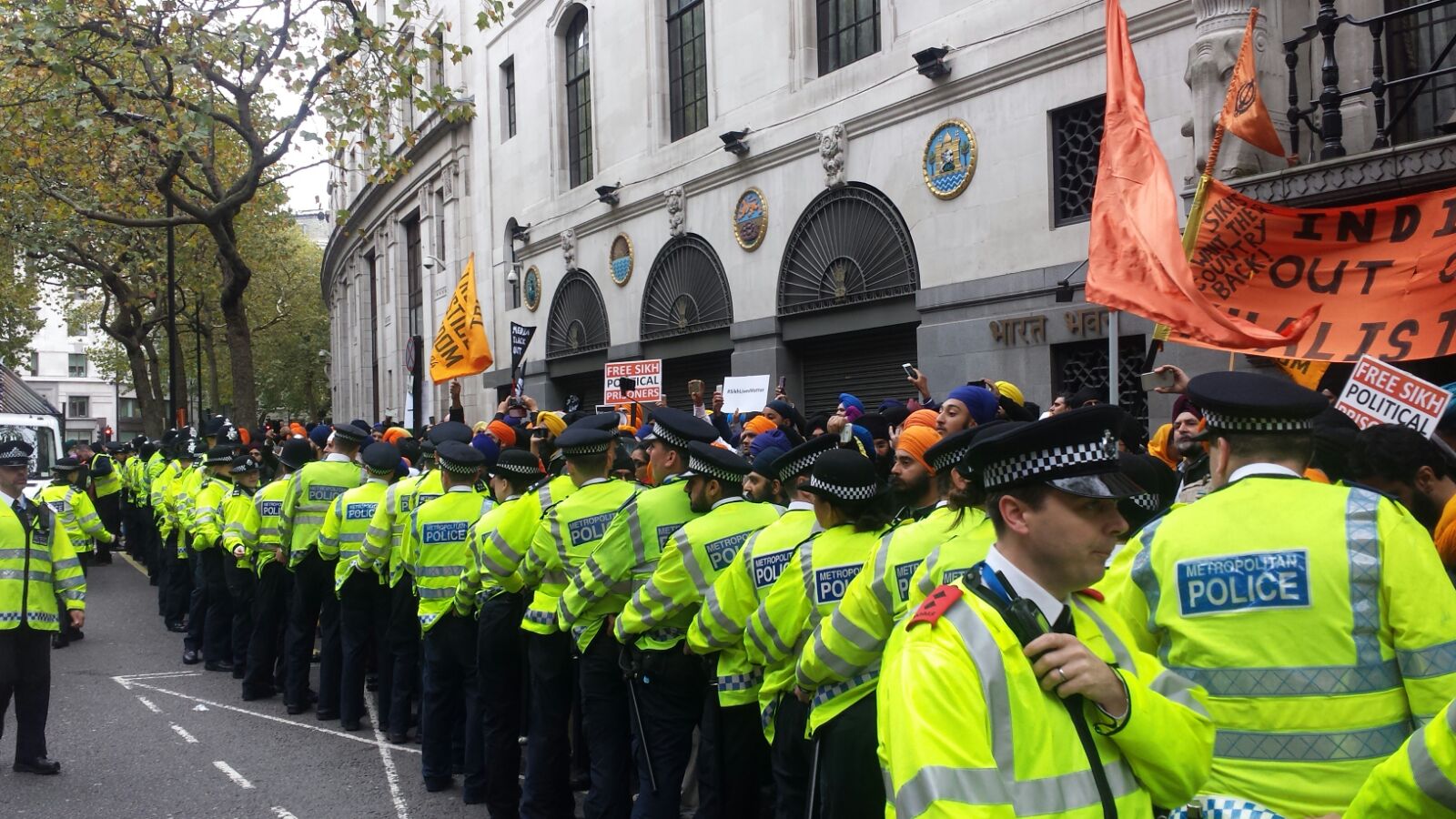
Angus Tatchell (bystander): “I happened to be walking to my campus past the Indian High Commission when a peaceful Sikh protest was met with violence by the police, mounted and armed with riot gear. Protesters were met with this response after blocking the carriageway on Aldwych. They were trying to raise awareness and express their opposition to alleged Indian Government inaction against, and even sponsorship of, murders and other rights abuses against Sikhs in Punjab.”

Video by Angus Tatchell – https://www.youtube.com/watch?v=aDkvrquyn3s. Twitter – @AngusTatchell.

Tweet by IBN Reporter @PriyankaMogul

Tweet by IBN Reporter @PriyankaMogul

Jagmeet Singh, Educator for Basics of Sikhi: “The Sikh protesters today used civil disobedience, which is a form of demonstration that has been exercised in many human rights campaigns. What they were met with was unnecessary aggression by police which only antagonised the situation. However, the focus must remain on the continued attacks on Sri Guru Granth Sahib Ji in India and also the oppressive regime in India that Sikhs are suffering under.” 

Jasraj Hothi, protester:  “The Met Police had underestimated the number of protesters that would turn up, and were ill-prepared as a result. The Aldwych roads should have been closed off beforehand, just as (I understand) they have been with previous protests outside the Indian embassy.”

See full piece by Jasraj here – https://medium.com/@jasrajhothi/yesterday-s-sikhlivesmatter-protest-my-perspective-4e77a3870708#.79npynun8. Twitter – @JasrajHothi


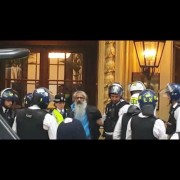
RT News – https://www.rt.com/uk/319391-sikh-protest-arrests-london/A video on this link above shows approximately seven officers tackling the elderly man pictured to the ground and his . 


Telegraph – http://www.telegraph.co.uk/news/uknews/crime/11948341/Sikh-Lives-Matter-protest-in-central-London-turns-violent.html. NOTE – The pictures used in this article do not reflect the real nature of the protest, showing only males and none of the images of women and children amongst the protesters.

News Pakistanhttp://www.thenews.com.pk/Todays-News-13-40346-Sikhs-protest-against-attacks-on-their-religion-in-India

Yahoo UK – https://uk.news.yahoo.com/sikh-lives-matter-london-police-122043149.html

Metrohttp://metro.co.uk/2015/10/22/sikhlivesmatter-protest-turns-violent-5457032/

NDTVhttp://www.ndtv.com/indians-abroad/20-held-as-sikh-protest-at-indian-embassy-in-uk-goes-violent-1235425

Hindustan Timeshttp://m.hindustantimes.com/punjab/20-held-as-sikh-protest-at-indian-embassy-in-uk-goes-violent/story-9Sd0LM3THlV4lGwX7I5egO.html

Janta Ka Reporterhttp://www.jantakareporter.com/india/london-police-arrests-20-sikhs-after-their-protest-turned-violent/23327

India Tribunehttp://tribune.com.pk/story/978018/20-arrested-in-sikh-protest-at-indias-london-embassy/

Geo TV – http://www.ibtimes.co.uk/sikh-lives-matter-protesters-arrested-demonstrators-clash-police-central-london-1525247

International Business Times – http://www.ibtimes.co.uk/sikh-lives-matter-protesters-arrested-demonstrators-clash-police-central-london-1525247 NOTE – This article provides excellent insight into the issues Sikhs are concerned about. See video.

Evening Standard – http://www.standard.co.uk/news/london/indian-embassy-protest-police-officer-injuried-in-violent-protest-outside-india-house-a3097156.html

Sikh Federation Summary of Police Failures

1. Met police had advanced notice of protest and failed to adequately prepare barriers and road cordons.

2. Large crowds had no alternative but to flow on the roads.

3. The sit down protest was planned and conducted peacefully. Many activist groups have conducted peaceful sit down protests and police have not sent in a riot squad or horses.

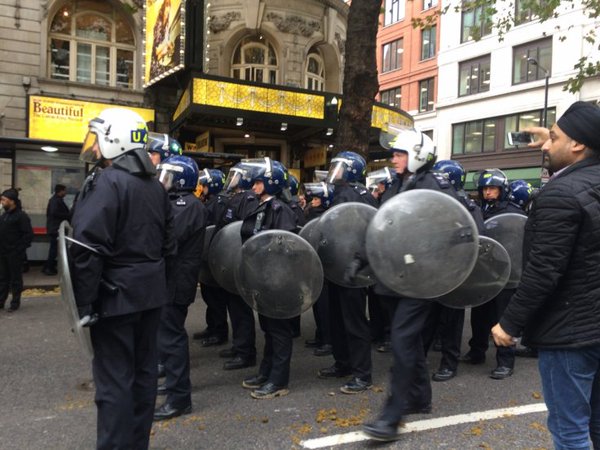
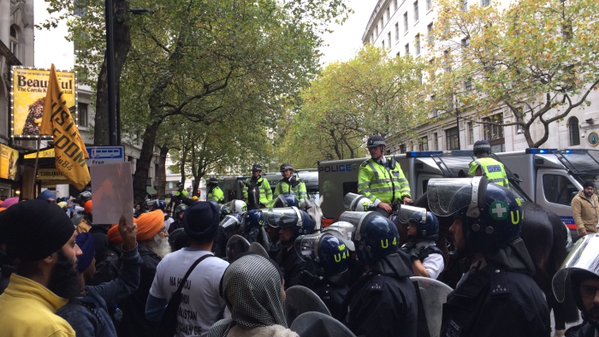
4. Police moved in with exaggerated force including riot police, battons and 8-10 horse mounted officers. Even after these horses marched into crowds of women and children Sikhs remained largely peaceful, but pushed the police lines back.

5. Officers snatched Sikh flags – Nishan Sahibs – and broke them and threw them on the ground which is a huge sign of disrespect.

6. Heavy handed officers forced there way in stamping on sitting protesters, further aggravating the situation.

7. Despite agreement, commitments and orders from Cheif Inspector Nick Collins that no officer would attempt to remove Sikh Articles of faith, Sikh turbans and Kirpan for forcibly removed with out provocation.

8. Despite calls from community leaders to allow women and children to leave the penned in area, the police did not allow until two hours later.

9. Young teenage girls and boys were pinned against a bus by 15 officers and were totally disrespected and had their Kirpans removed where there was no need and after all groups had been dispersed.

10. The chief inspector Nick Collins failed to note two serious complaints of police aggression, assault and denial of human rights, even after witnessing himself.

11. The police were prepared to allow situation to escalate and arrest more people without any consideration to Sikh religious sentiments.

A riot squad drafted in for a peaceful protest

A riot squad drafted in for a peaceful protest

Horses being used to pen in peaceful protesters which caused them to push back

Horses being used to pen in peaceful protesters which caused them to push back

Riot squad and police on horses were used to pen in a crowd for over two hours.

Riot squad and police on horses were used to pen in a crowd for over two hours.