
Two Delhi Police Constables Dismissed for Attacking Sikh Man
Two Delhi police constables have been dismissed for ‘unprofessional behaviour’ for attacking a local Sikh who refused to bribe a police officer.
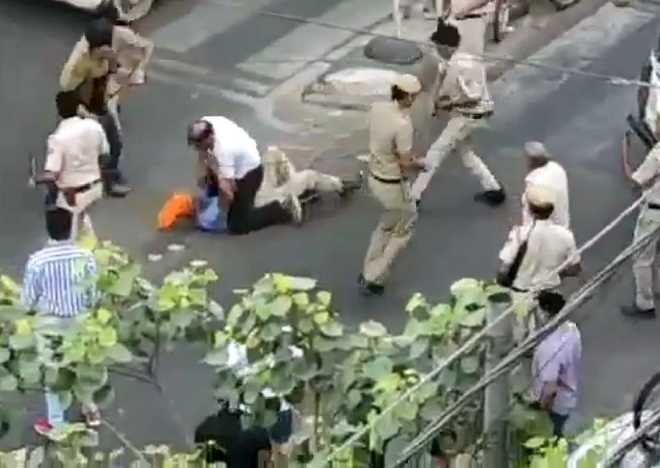
Sarabjeet Singh, a local Sikh auto-driver, was restrained on the ground and brutally beaten by police officers on 16th June after he refused to pay a police officer offer 500 rupees for an alleged traffic infringement.
The attack occurred in the Mukherjee Nagar area of Delhi in broad daylight; intimidation and blackmail by the police to pay bribes often occurs openly and is widely accepted as part of Indian culture.
A video of the attack was shared widely on social media and Sikhs across India protested against the heinous actions. To many, it evoked memories of the 1984 Sikh genocide of thousands of Sikhs in Delhi (and elsewhere) which was orchestrated by the authorities. One of the officers involved in the attack allegedly threatened Sikhs protesting the police actions with a repeat of the 1984 genocide.
Two days after the incident Delhi police released a statement saying three officers involved had been suspended, only after leading politicians had demanded an inquiry into the incident, including Delhi Chief Minister Arvind Kejriwal. FIRs (First Incident Reports) have been filed against Sarabjeet Singh by Delhi Police.
The inquiry into the attack was conducted by a senior officer and described It as ‘unprovoked, indiscreet and highly unprofessional.’ Two police constables, Pushpendra Shekhawat and Satya Prakash have now been dismissed for their role, which included kicking Sarabjeet Singh while he was unarmed and had been thrown to the ground.
In a statement, Delhi Police said: ‘They [Shekhawat and Prakash] have been dismissed to set an example for others to learn and desist from such aggressive and unprofessional behaviour, which portrays a bad image of Delhi Police. Not only are these constables likely to indulge in such acts in the future but also their possibility of influencing witnesses to gain undue favours during regular departmental proceedings is strong.’
What actually happened?
Footage begins by showing Sarabjeet Singh of Gramin Sewa, Delhi, in a confrontation with an officer with his kirpan – a sword that is part of the punj kakkar (five Ks) of the Amritdhari (initiated) Sikh uniform – in his hand. Whilst Sarabjeet Singh was holding it the policeman was within touching distance the whole time but was at no point attacked.
Video footage shows the Sikh man’s 16-year-old son Balwant Singh then leads his father away from the confrontation, who then sheaths his kirpan. The police officer also retreats only to return with approximately seven other officers, charging at Sarabjeet Singh with their lathis (police sticks), with Singh responding by producing his kirpan again to ward off his attackers. When a member of the public goes behind the Sikh man and locks his arms around him to restrain him, officers pounce unleashing brutal blows. The member of the public restraining Sarabjeet was later shown injured by what was apparently a blow from Singh’s kirpan.
Whilst his father is being aggressively restrained, Sarabjeet Singh’s son then returns to their vehicle only for a policeman to point his gun at him, before dragging him out and beating him with other officers. Meanwhile, Sarabjeet Singh is still being wrestled to the ground and receiving blows from police lathis. Adding insult to injury, Sarabjeet’s dastaar (Sikh turban) came off during the attack and was callously kicked to the side by one officer when he was taken down to the floor, where he was still restrained and the beating continued.
It is then alleged both Sarabjeet Singh and his son were taken to a local police station and tortured. Immediate reaction saw Sikhs, with support from several respected organisations, protest against the incident across India, with many Sikh bodies coming forward to condemn the attack and also request an investigation and/or punishment against the police.


Leave a Reply
Want to join the discussion?Feel free to contribute!