Reaction: Sajjan Kumar convicted for 1984 Sikh Genocide role

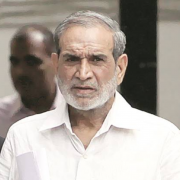
Senior Indian politician Sajjan Kumar was today sentenced to life imprisonment for his role in the 1984 Sikh Genocide.

10sajjanThe Delhi High Court found him guilty of ‘criminal conspiracy, promoting enmity and acts against communal harmony’ in the killing of a family of five in Delhi during the genocide of Sikhs in November 1984.

That family included the son and husband of Jagdish Kaur, who spoke to the BBC after the verdict. She described it as ‘a little balm applied after a long time to our scars. At least one high-profile accused will now go to jail.’ She was one of three eyewitnesses who ensured that the case could go ahead, providing evidence with what the court described as ‘courage and perseverance’. 

Kumar, 73, is the first high-profile politician to have been convicted over the genocide. Eyewitnesses from November 1984 and research since then have indicted not just the complicity of senior Congress Party officials at the time, but that they played a key role in orchestrating the killings of Sikhs.

The case was brought Harvinder Singh (HS) Phoolka, a senior advocate of Delhi High Court, who has been fighting for justice for over 30 years. He described the sentence as the ‘result of 34 years struggle’, and has been widely praised for his fortitude.  

Screen Shot 2018-12-17 at 16.29.04

The judged explicitly cited Kumar’s ‘political patronage’ a factor of why it had taken so long to administer justice.

Pav Singh, author of 1984: India’s Guilty Secret, said: ‘Finally after 34 years there’s been one single conviction of a leading senior Congress [Party]  leader. 34 years too late though, for the victims and their families, and I think that’s a crime in itself.’ 

The High Court also said: ‘This Court is of the view that the mass killings of Sikhs in Delhi and elsewhere in November 1984 were in fact ‘crimes against humanity’. 

In light of this, there has been widespread criticism of the BBC’s reporting of the conviction, which refers to the killings as ‘anti-Sikh riots’, rather than using the term ‘genocide’.

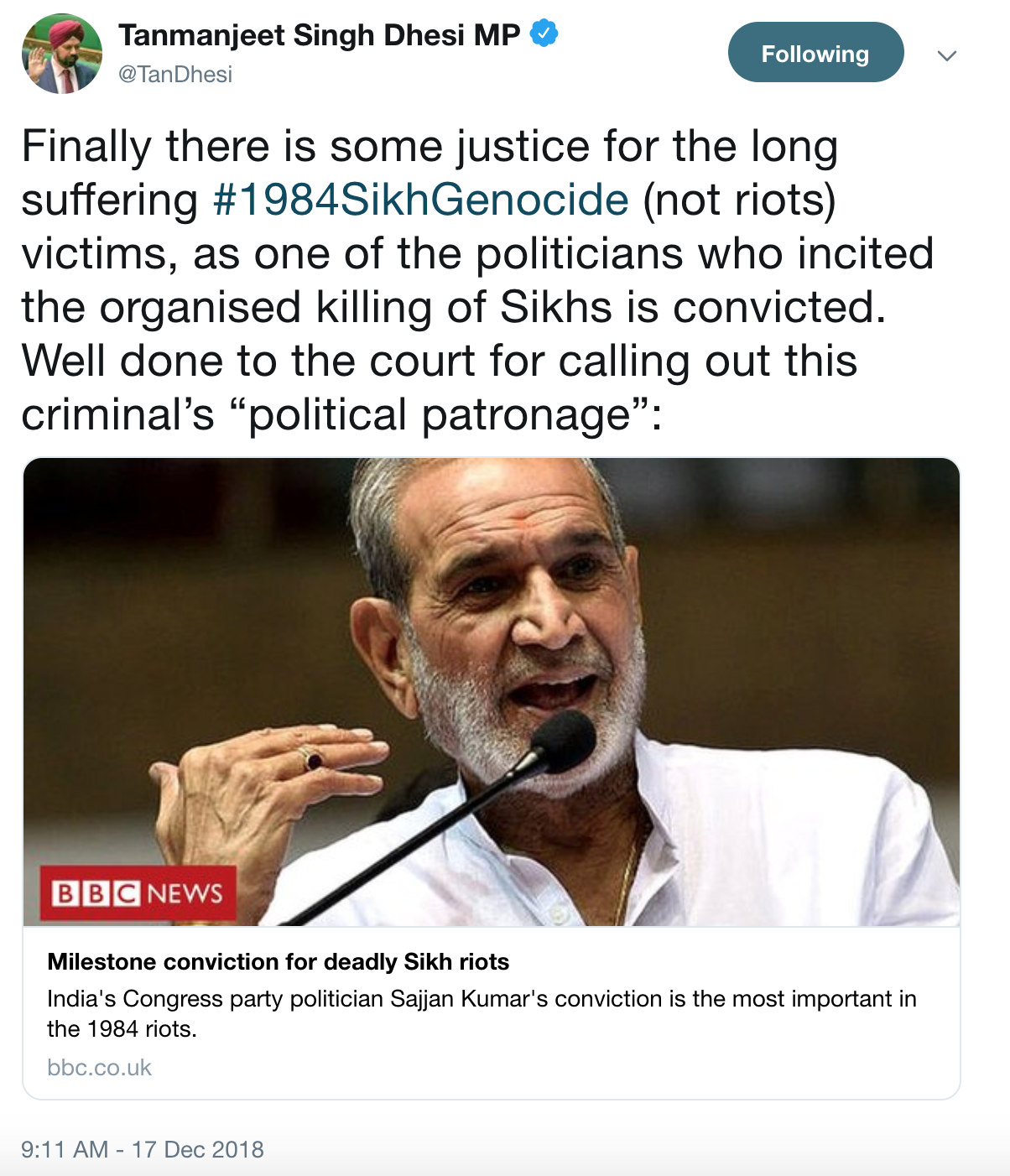
Screen Shot 2018-12-17 at 12.18.49Both Sikh MPs, Tanmanjeet Singh Dhesi and Preet Kaur Gill, tweeted criticism the description of ‘riots’, instead using the term ‘genocide’.
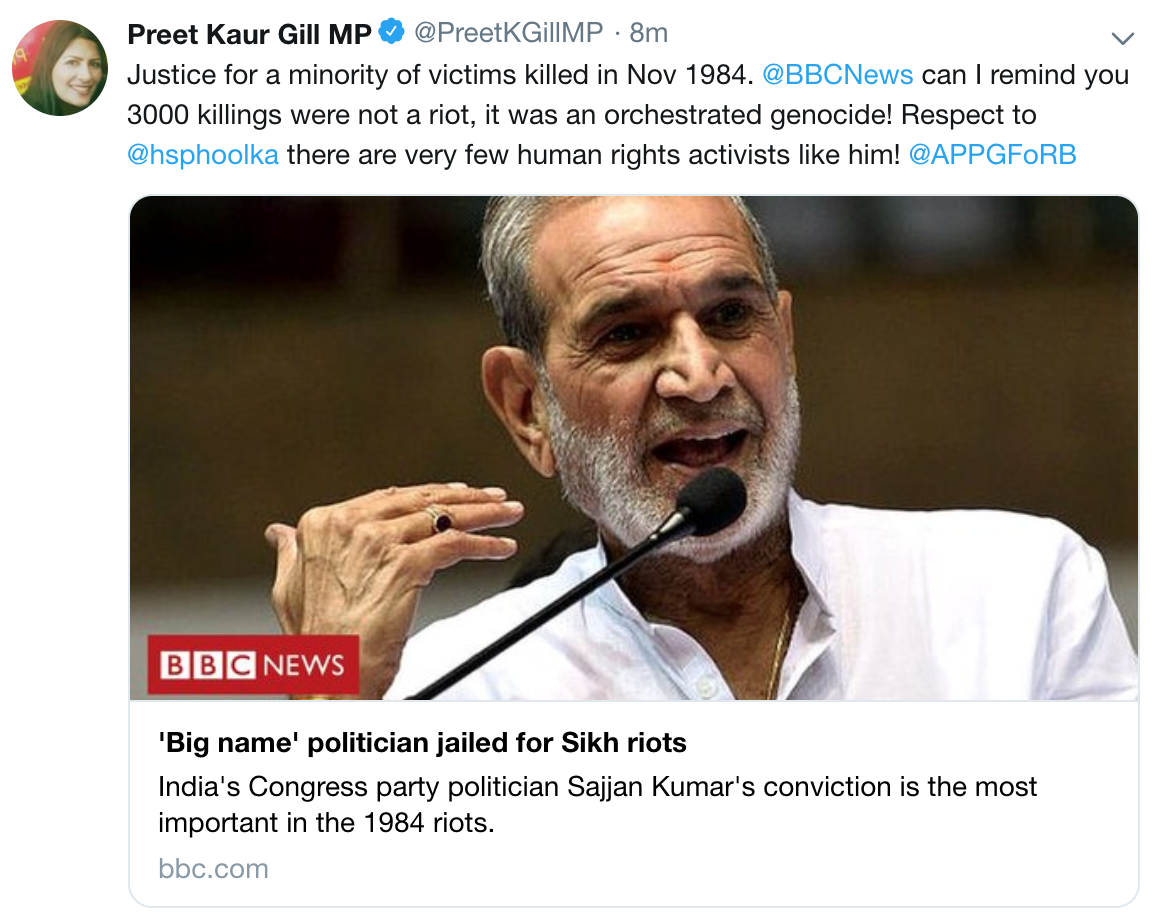
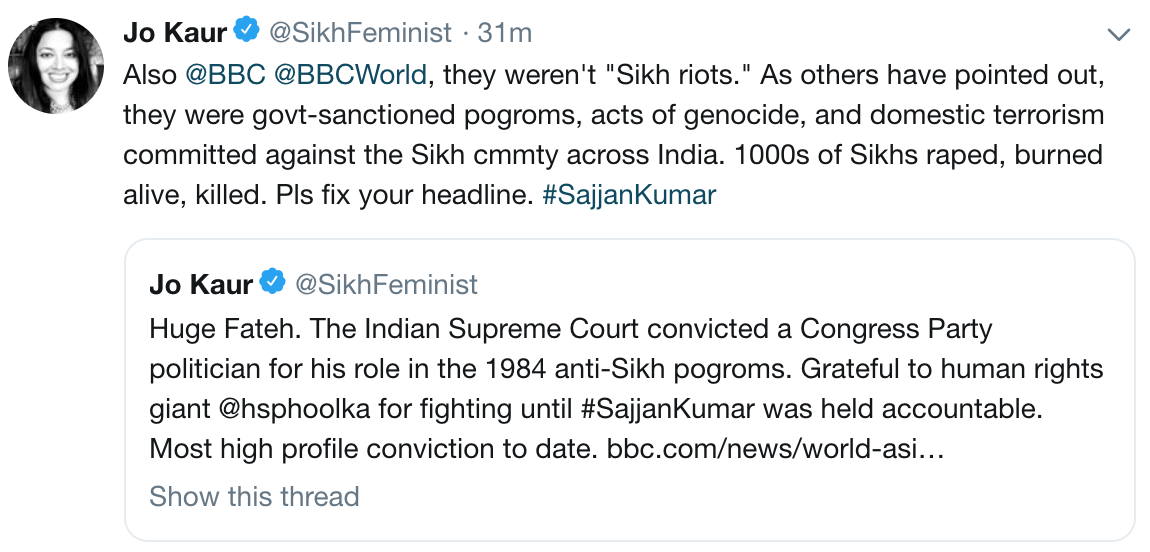
Screen Shot 2018-12-17 at 12.19.09

The Sikh Press Association contacted BBC News Online regarding its use of ‘anti-Sikh riots’ used in its online coverage but was directed towards the BBC’s formal complaints procedure. An update of the story changed the headline to say ‘killings’ instead of ‘riots’, but continued to refer to ‘anti-Sikh riots’ in the text.

Screen Shot 2018-12-17 at 14.28.53

Speaking to BBC Asian Network, Sikh PA press officer Sukh Singh outlined why calling the killings a genocide – rather than riots – is important, saying that ‘genocide’ emphasised how the killings were not just random, but orchestrated.

Jasveer Singh, Sikh Press Association Senior Press Officer, said of the conviction and resulting media coverage, ‘It is time media outlets caught up to the current narrative around the 1984 Sikh genocide. Most are not matching neither the current political or legal language being used. There are many politicians including India’s own home minister and countless other politicians around the world that recognise what occurred in India in 1984 was genocide.

Furthermore, even the legal language around the conviction of Sajjan Kumar called the massacres “crimes against humanity”, pointing to a series of incidents unfitting of being labelled “riots”.

The bottomline is descriptions of “riots” for what occurred are outdated and biased. It is high time media caught up and we will be doing everything in our power to speed up this process.’

One of the more popular posts on the verdict came from Sikh cartoonish Vishavjit Singh, also known as Sikhtoons on social media, which highlighted how India’s Prime Minister Narendra Modi is also among politicians accused of fuelling pogroms against minorities.

This sentiment was echoed by others who pointed out that as one perpetrator was convicted, another senior politician widely accused of orchestrating the genocide, Kamal Nath, became Chief Minister of India’s second largest state. Nath is the most high profile name along with Jagdish Tytler still escaping conviction for his role in the genocide despite many witnesses confirming his involvement.

Screen Shot 2018-12-17 at 15.49.28

Sikhs respond to unsubstantiated ‘Sikh extremism’ inclusion in Canadian terror threat report

Sikhs across the world have reacted with shock and criticism to the news of a Canadian government report alleging ‘Sikh extremism’ without evidence.Screen Shot 2018-12-12 at 14.28.19

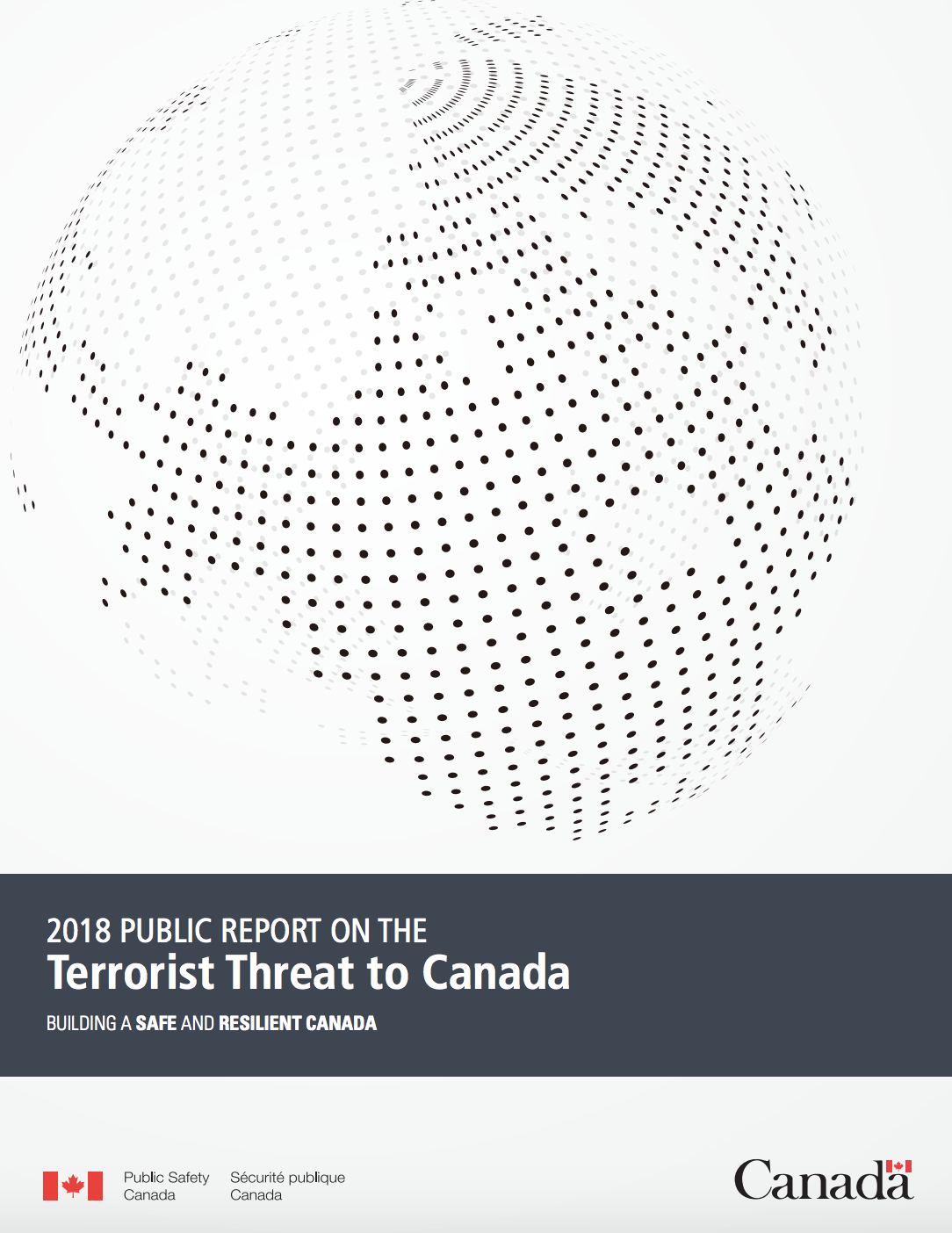
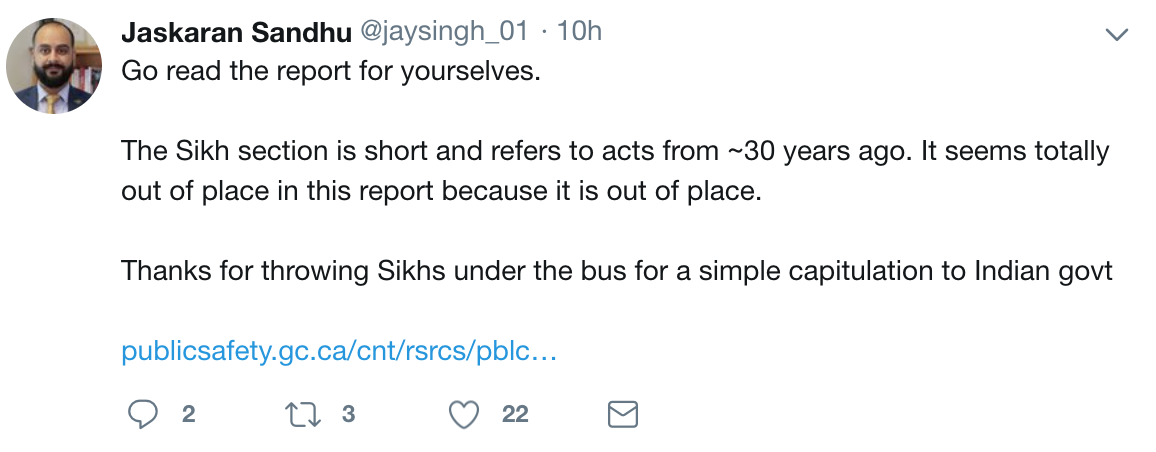
The 2018 Public Report on the Terrorism Threat to Canada was published yesterday by Public Safety Canada, a federal government department. The report included a small section on ‘Sikh extremism’ but failed to provide any evidence for this contributing to Canada’s terror threat.

The report says: ‘Some individuals in Canada continue to support Sikh (Khalistani) extremist ideologies and movements. This political movement aims to create an independent homeland for Sikhs called Khalistan, in India.’ It did not specify how support for self-determination, a principle enshrined in the Charter of the United Nations, contributed to Canada’s terror threat.

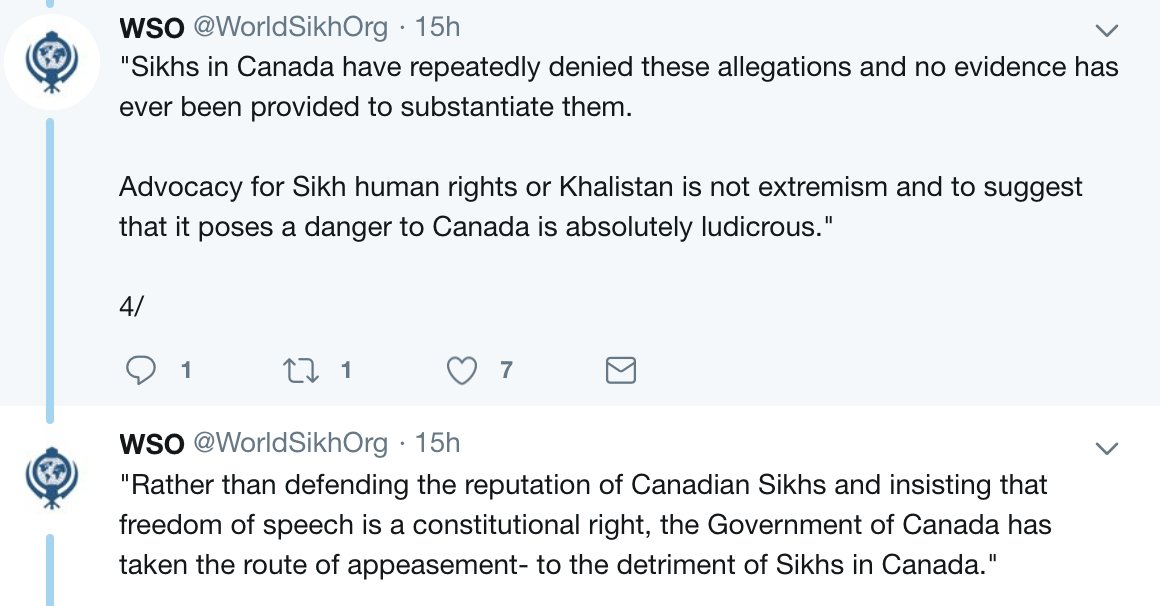
President of the World Sikh Organisation Mukhbir Singh condemned the report, saying: ‘It is deeply disappointing to see the addition of imagined “Sikh extremism” to the 2018 Public Report on the Terrorism Threat to Canada.’

He added: ‘There is no explanation for this addition other than Public Safety Canada having tacitly accepted the false Indian rhetoric around rising extremism in the Sikh community.’

In a letter to Ralph Goodale, the Minister of Public Safety & Emergency Preparedness, the WSO clearly indicated a link between the inclusion of Sikhs in the report and Canada’s diplomatic relations with India. It said: ‘Given the lack of any current incidents associated with extremism in the Sikh community, it appears that the addition of the section on ‘Sikh extremism’ is linked to the fact that, despite any evidence, India has repeatedly raised this issue with Canada at every bilateral meeting between the two countries.’

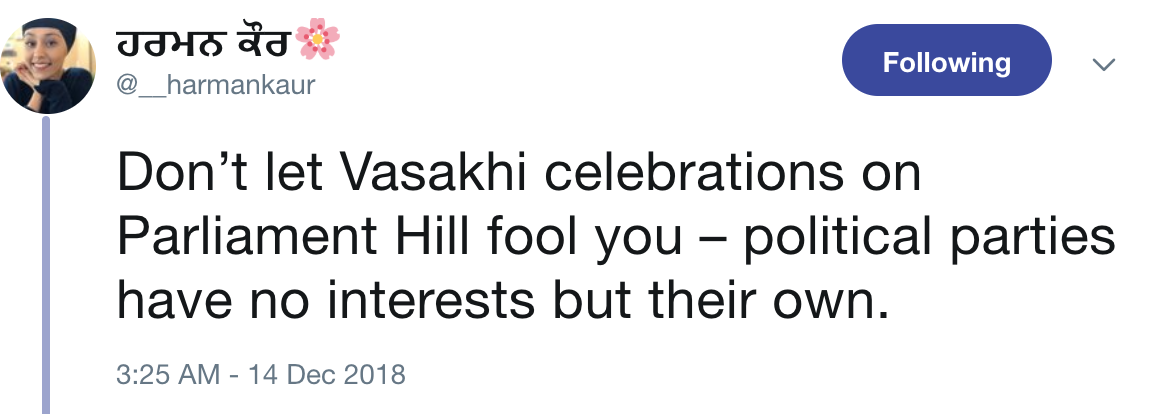
Screen Shot 2018-12-14 at 12.38.32Jagmeet Singh, leader of the New Democratic Party responded by tweeting: ‘We must call out terrorism wherever it occurs, including recent attacks from the far right targeting women in Toronto & Muslims in QC. The Liberal’s public safety report fails to do this – but does stoke fear w/o any evidence about the Sikh community, which is dangerous & wrong.’

A statement from the British Columbia Sikh Gurudwaras Council and Ontario Gurdwaras Committee – a coalition of around 30 gurdwaras across Canada – called the inclusion ‘not only surprising, but disturbing.’

They warned: ‘Maligning the entire Sikh community in this report in such a generalised statement is irresponsible and could have wide standing effects on Sikhs throughout Canada.  

‘What has happened since December 21 2017 (release of the 2017 version of this report) that would move the Liberal government in Canada to take such a step and include the Sikh community now?’

Echoing the concerns of the WSO, the statement said: ‘The direct link between the content of this report regarding the Sikh community and the ongoing interference of the Government of India in Sikh affairs within Canada is blatantly obvious.’

Screen Shot 2018-12-14 at 16.43.25Canadian Sikh educator Harman Singh of world-renowned educational outlet Basics of Sikhi said: ‘It is shocking that such damaging claims have been made on the basis of no evidence. Such unsubstantiated rhetoric from the government endangers the lives of Canadian Sikhs.’

Regarding support for Khalistan, he added: ‘How does the Canadian government not understand that many Sikhs fear for their security, and that of their people and heritage, in a country whose government has committed genocide against them? Across the world the principle of self-determination is seen as fundamental to democracy. Why is the Canadian government scaremongering by portraying Sikhs as a threat for voicing that fundamental right?’

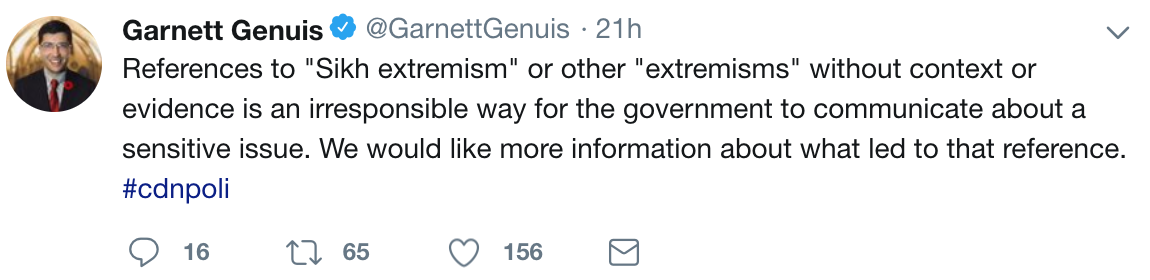
The reaction from Sikhs was strong enough to prompt a response from Garnett Genius, the Deputy Shadow Minister for Foreign Affairs. He tweeted: ‘References to “Sikh extremism” or other “extremisms” without context or evidence is an irresponsible way for the government to communicate about a sensitive issue. We would like more information about what led to that reference.’

Screen Shot 2018-12-14 at 16.44.02The report comes just days after a parliamentary report investigating Justin Trudeau’s trip to India in February said concern from the National Security and Intelligence Advisor that ‘foreign actors were undermining the reputation of “respected public institutions”’ in Canada was ‘understandable’.

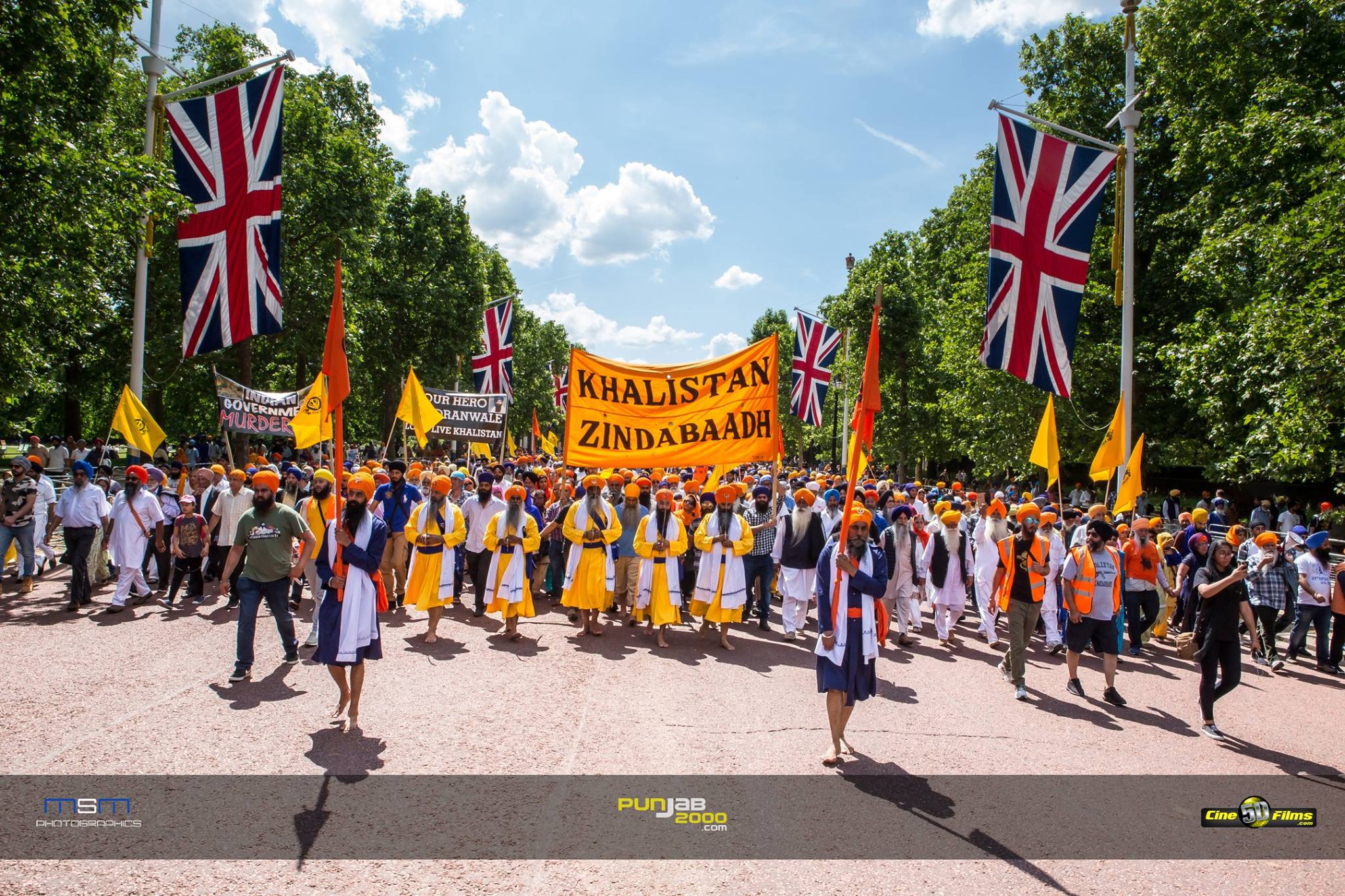
The report is also at odds with findings from respected academic Dr Jasjit Singh, whose investigations of the British Sikh community – where there is significant Khalistan support – found no evidence to suggest a terror threat from Sikhs. He said his report ‘concludes that Sikhs in Britain do not pose a security threat as there is no conflict with “the West”’.  In June, British Sikhs marched in front of Buckingham Palace and down the Mall in London behind a ‘Khalistan Zindabad’ banner without any expression of concern from the British authorities.

34447647_10156476421628330_7141876223440846848_o

Sikh school protests lead to DfE meeting

The Department for Education (DfE) has confirmed that it will consult with all key stakeholders before deciding the fate of Seva School in Coventry.

Parents of pupils at the school, which has put into special measures by Ofsted, had been protesting against proposed changes, saying that the DfE was ignoring their concerns.

Seva School in Walsgrave is a free school currently part of the Sevak Education Trust. A faith school opened in 2014, it describes its ethos as ‘grounded in the Sikh faith’. In 2016, it was rated ‘inadequate’ by Ofsted and has been in special measures for the past two years.

cov school 1

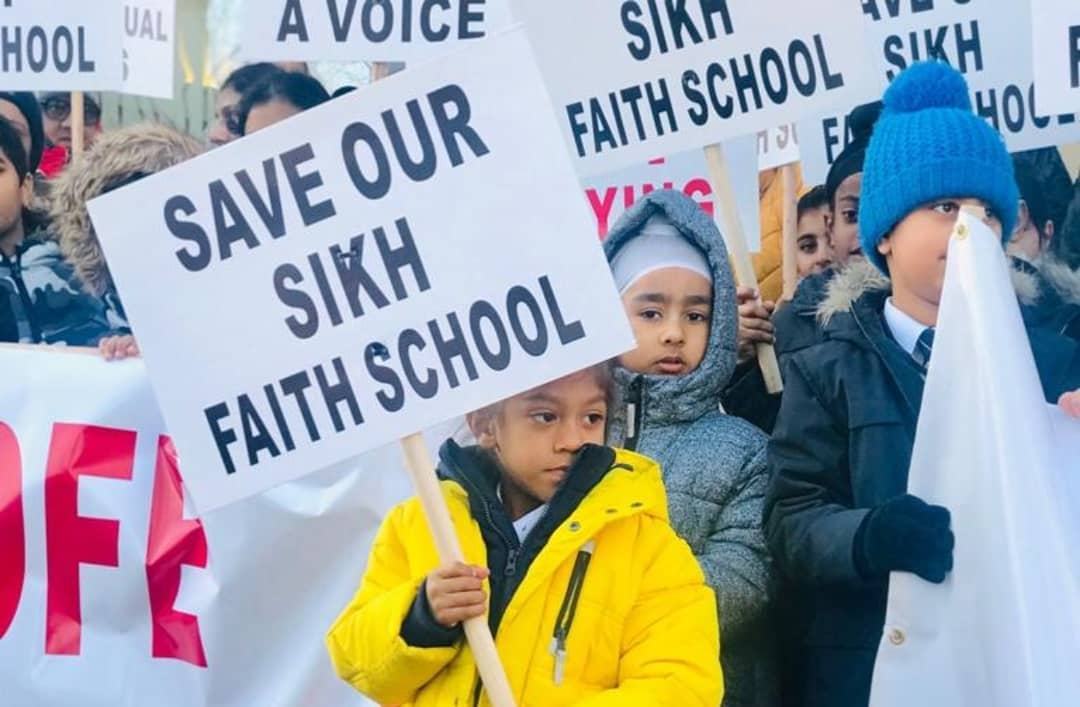
On 26th November, hundreds of parents along with Seva School pupils protested outside the DfE office in Coventry, following notification from the Regional School’s Commissioner that the school would be transferred to another trust, the Nishkam School Trust. Parents and pupils carried placards that read: ‘Save our Sikh Faith School’, ‘DfE Stop Bullying’ and ‘We Deserve Equal Rights’.

One mother at the protest said: ‘I am terribly disappointed to possibly change it into a multi faith school. We worked so hard to keep this school as a Sikh School.’ Other parents have been just as critical; as many as 500 letters have been sent by parents of pupils in opposition to the proposals.

This proposed course of action has opposition from the Sevak Education Trust and many parents of pupils at Seva School. Both the Trust and the Parents of Seva School Action Group have undertaken legal correspondence with DfE, seeking them to pause activities ‘pending further consideration of the issues.’ The Sevak Education Trust have put forward alternative proposals, namely a transfer or ‘re-brokerage’ to Khalsa Academies Trust which already has three Sikh schools across the country. This option is preferred by the Parents of Seva School Action Group who fear that a transfer to the Nishkam School Trust would compromise the existing Sikh ethos of the school.

The Sevak Education Trust had been arguing that its counter-proposal of the school coming under the Khalsa Academies Trust had not even been considered as an option by the Regional School’s Commissioner, who – it is claimed – have refused to engage with Khalsa Academies Trust.

cov sch2Now it has been confirmed by the DfE that all key stakeholders in this matter will be consulted before making a final decision on which school trust Seva School should join.

Notable Sikh figure Kam Singh, who has a child at Seva School, welcomed the news saying: ‘All Sikhs have wanted is to be a part of the process and have equal rights and ensure that the right model is chosen for Seva School. Respect and thanks to all those children and parents that have worked so hard to ensure their voices are heard.’

In an earlier letter to parents, Seva School said: ‘The Khalsa Academies Trust has a religious ethos and values which are closely aligned with Seva School, and would seem an obvious better fit for the purposes of maintaining and developing the positive aspects of this ethos.’

The school acknowledged that it has received ‘an overwhelming response against the DfE’s proposal’ and cautioned: ‘Changes to Seva School’s ethos would cause significant disruption […] and represent a very definite departure from the Sikh faith academy we promised.’ The Khalsa Academies Trust has already engaged with the school which included attending a public meeting on the situation.


Organ Donation in the Sikh Community

On Sunday 9th December, Sikh educational project Basics of Sikhi will be joined by several medical professionals to discuss the issue of organ donation.  The panel will include Rohit Sagoo, Senior Lecturer at Anglia Ruskin University and founder of British Sikh Nurses, who writes here about his experiences of organ donation and the Sikh community: 

47109030_2089533551084701_6534714374890717184_o

Anaya Kaur Kandola was born with little chance of survival and has fought battle after battle to be here. She has Autosomal Recessive Polycystic Kidney Disease (ARPKD) is a condition in which growing cysts leave little room for other organs and create serious difficulties such as underdeveloped lungs, vulnerability to infections and heart conditions. This left the doctors with no choice but to remove Anaya’s kidneys soon after birth. Dialysis helps to cleans Anaya’s blood by being on a machine 10-12 hours every day and right now it is the only thing keeping her alive.

Anaya is coming up to 2 years of age. The difficulties of her condition and being attached to a machine for almost half the day has severely impacted her growth and development. This is all Anaya has known in her short life.

As Sikhs we often think about helping others, growing Sikhi, and instilling the values our Guru Jis left behind in ourselves and our children going forward. Here, our child has opened our eyes to the greatest Seva: giving life to others when we pass by donating our organs to those in need.

It is widely reported that in the UK there is a shortfall of organ donors from BAME (Black, Asian and Minority Ethnic) communities. According to statistics from NHS Blood and Transport, around one third of patients awaiting an organ are from BAME communities. However, a significantly smaller proportion of the BAME community registered on the NHS Organ Donor Register. 3.3% of registrants were Asian, 2% were mixed race, and just 1% were black. These statistics show the pressing need for the Asian community to respond to the needs of organ patients.

In 2017/18, just over 1,500 donated organs after their death. Of these, 114 were from ethnic minority groups and just 37 (or 2.4%) were of Asian heritage. Such a disparity between those who need organs and those who donate them is clear to see: nearly 20% of those requiring an organ transplant are from the Asian community, but only 1% of organ donors each year are South Asian.

23826273_1761163110856533_5889134186192688564_oConsidering this, how is organ donation received in the Sikh community?

Organ donation is generally viewed positively in the Sikh Community. General attitudes to organ donation from South Asians, express religious, sociocultural, and environmental pressures. Though the sociocultural and environmental pressures may exist for the Sikh community, there is no evidence to suggest that the Sikh community is deterred from donating organs on religious grounds.  

The Sikh faith is underpinned by the ethos of executing noble deeds for all of humankind. Therefore, it can be suggested that organ donation would be considered as one of those noble acts according to the Sikh faith. Sri Guru Granth Sahib – the Sikh holy scripture – states:

“The true servants of God are those who serve Him through helping others” Sri Guru Nanak Dev Ji, Sri Guru Granth Sahib Ji.

With this in mind, it is important to consider organ donation as a service to those in need. Many of the individuals within the Sikh community that require organ transplantation have raised awareness through campaigning through the Gurdwaras and other forms of media. The sharing of learned experiences has expanded the discussion of organ donation within the Sikh community. But what more can be done?

Dialogue with Sikhs of all ages has shown that what happens to our bodies after life can be a positive discussion.  Many acknowledge the need for education and awareness, and welcome the opportunity to share their own thoughts on how they wish to serve others.  The concept of saving a life as the highest form of seva has been echoed many times over.

In addition, older members of the community have expressed concern that health issues would eliminate them from being able to donate, but they have been assured that donations have been taken from those in their 60s, 70s, and beyond, and that the medical team will be able to assess whether any of the transplantable organs would benefit someone in need.

skynews-organ-donation-nhs_4180497It is encouraging to all of us to note that both those previously unaware of the Organ Donor Register, and those that are already on it, have expressed their gratitude to volunteers for bringing this message to the Sikh community. Everybody involved hopes that the issue of a lack of organ donors can be addressed, and ultimately provides hope to those waiting for organs to survive.

As many have said in their parting comments, none of us know when we or our loved ones maybe the ones on a waiting list, and if we are prepared to receive an organ, we should equally be prepared to donate them when our time comes.

Sunday’s discussion will be held from 7.30pm (after katha) upstairs at Sri Guru Singh Sabha Gurdwara, Park Avenue, Southall. 

Parliament increases pressure on Foreign Secretary to meet Jagtar Singh’s family and MP

Foreign Office minister Mark Field has said he will make representations to the Foreign Secretary, to suggest that he meets with Jagtar Singh’s MP and family.

The remarks came in a House of Commons debate brought by Jagtar Singh’s constituency MP Martin Docherty-Hughes yesterday, in which there was widespread concern that the Foreign Secretary had not yet met with either Jagtar Singh’s family or MP.

Asking for a meeting was at the heart of Docherty-Hughes’ speech, in which he spoke of several actions, and instances of inaction from the British government, which formed a ‘consistent narrative over the last year’ of ‘superficiality underpinned by an incoherent approach to consular support.’ Britain’s first turbaned Sikh MP, Tanmanjeet Singh Dhesi, said that such a meeting was ‘the very least that the family deserves’, as the Commons heard that the Foreign Secretary had in fact already met with another MP (Eddie Hughes) regarding the case. Meanwhile, the Foreign Office minister maintained that Jagtar Singh’s case ‘has been a priority for the government at the highest levels.’

Jagtar Singh, described by his MP as ‘a true son of the rock [of Dumbarton]’ has been detained for over a year in India. In that time, he has risked severe consequences by telling British officials of his torture at the hands of the Indian authorities. Shortly after his arrest, the Chief Minister of Punjab boasted that the authorities had all the evidence against Jagtar Singh; over one year later not a single piece of evidence against him has been presented. Martin Docherty-Hughes called for Jagtar Singh to receive a fair, transparent trial based on due process or ‘if there are no witnesses, if there is no evidence, to be released.’

Despite starting much earlier than planned, the debate was well attended, with even the minister expressing the sentiment that it was far from ‘a standard half-an-hour, two-member adjournment debate.’ Taking advantage of the earlier start time, Martin Docherty-Hughes carefully presented  a thorough timeline of Jagtar Singh’s abduction by plain-clothes police in Punjab to the House and read out his report of the subsequent torture which included electrocution of his private areas. He took numerous interventions, mainly from SNP colleagues who all raised concerns regarding not just Jagtar Singh’s torture but the government inaction thereafter.

Martin Docherty-Hughes was also scathing of the fact that the British Deputy High Commissioner in Chandigarh discussed Jagtar Singh’s case at public meetings in the UK before meeting his MP or his family. Docherty-Hughes asked: ‘How did it come about that I and my constituent’s family got the discuss the issue with the Deputy High Commissioner, who has visited my constituent (I have not had that luxury)? It was through the office of my honourable friend [Preet Kaur Gill].’ Using self-admittedly diplomatic language, Docherty-Hughes described that meeting as ‘fraught or even frosty,’ following from the intervention of Preet Kaur Gill, Chair of the APPG for British Sikhs, who said that it was unclear what representations the British High Commissioner in Chandigarh had made to Punjab’s Chief Minister when the two met.

Alison Thewliss, whose constituency of Glasgow Central contains the city’s three Gurdwaras said: ‘Jagtar’s case raises wider concerns for each of the members of those congregations [of Glasgow’s three Gurdwaras] when they go to travel to India, they may face similar threats and that there are real and genuine worries there for their own safety’ Martin Docherty-Hughes agreed, saying that he thought gurdwaras not just in Scotland but across the UK shared that concern. The minister acknowledged the interest of not just Jagtar Singh’s family, but the wider Sikh community, in his case.

Referencing the ‘extreme action’ remarks made by the then-Foreign minister Rory Stewart, Docherty-Hughes asked ‘that the minister today enlightens us as to what “extreme action” was and what their own investigations concluded.’ Mark Field replied: ‘While in all fairness, I probably would not have used the phrase “extreme action” – I don’t think “extreme” is something that many people would associate with me and my brand of politics – nonetheless allegations like this are taken extremely seriously.’ Regarding the allegations of torture, the minister said that ‘at this stage they [the Indian authorities]are refuting that they have happened,’ but said he would write to the MP for West Dunbartonshire with a response that he could guarantee would be accurate.

Jagtar Singh’s MP methodically raised specific points of concern about his constituent’s detention, not least the discouraging remarks from state authorities in Punjab, which he explicitly called out. He said: ‘Since nearly day one in this case, state authorities specifically in the Punjab have been quite open that they believe my constituent to be guilty. They have conducted a trial by media and they have made it quite clear that they expect him to be found guilty if a trial should ever take place. That clearly undermines the very principle of due process in the Republic of India and that really should concern us all.’

He also addressed concerning reports in the Indian media, notably a ‘set pattern of a series of seemingly well-informed leaks and briefings to Indian media regarding the case’ that had an ‘often sinister, if not sectarian, air.’ The minister said that while he was not alleging such activities had taken place, any such activities would not be an acceptable state of affairs.

Several MPs raised the recent case of Matthew Hedges, who has been pardoned by the government of the United Arab Emirates following swift and decisive intervention from the Foreign Secretary. When asked why it had taken so long in Jagtar’s case compared to Matthew Hedges’, Martin Docherty-Hughes replied: ‘If I had the answer to that we wouldn’t need to have this debate on the floor of this House today.’ The Foreign Office minister however was adamant that it would be ‘unfair to draw or make any implications about comparisons in particular cases,’ adding: ‘There is no suggestion that there is a preferential treatment because of any cultural or other difficulties that may apply.’ This did not address the specific point raised by Martin Docherty-Hughes who highlighted ‘the inconsistency of the narrative of other cases where the Foreign Secretary – both the present one and their predecessor – have unequivocally opened their doors to meet certain families of specific cases.’ The minister was keen to adopt a cautious tone, explaining: ‘For every win, as it were – of that description – there are many other cases where perhaps, as I say, under the radar we are working extremely hard for many, many months without quick and positive results.’

Furthermore, the debate explored the role of Martin Docherty-Hughes as a constituency MP. Members across the House were united in the belief that British politicians could not dictate to the Indian legal and judicial systems. Jagtar’s MP said: ‘My duty to my constituent is to highlight that serious charges have been laid and I must only hope they are tested in a manner consistent with the laws and practices of the Republic of India.’ He added that the pillars of the rule of law and of due process ‘are being sorely tested in Jagtar’s case.’ While the minister agreed that the laws and systems of other countries needed to be respected, he said: ‘We can intervene on behalf of British nationals where they are not treated in line with international accepted standards or if there are unreasonable delays or procedures.’ The minister did not respond to a question from Docherty-Hughes which cited the diplomatic implications of Brexit: ‘What type of trade will we have where we might sacrifice our own ability to defend democracy and its pillars for free trade?’

The Foreign Office minister also issued a formal apology to Jagtar Singh’s brother Gurpreet, saying he was ‘deeply apologetic’ for not responding to his Freedom of Information request in a timely manner. He closed the debate by saying: ‘The fact that we have this debate here today, I think, will make it very clear to the Indian authorities, to the new Indian High Commissioner here in London, that we are ready to continue to raise our concerns about his case at the highest levels and will continue to do so until there is a resolution of these matters.’ It remains to be seen whether that will include a meeting between Jagtar Singh’s brother, his MP, and the Foreign Secretary.

#FreeJaggiNow statement on Matthew Hedges’ release

Earlier today (26.11.18) overseas British prisoner Matthew Hedges was pardoned from his imprisonment just one week after being convicted as a spy and handed a life sentence last in the United Arab Emirates (UAE). This came after intervention from the Foreign Office and British consulate, as emphasised by Foreign Secretary Jeremy Hunt in a public statement.

Meanwhile, Jeremy Hunt is yet to even name Jagtar Singh Johal, British Sikh political prisoner, who has been detained in India for over one year now, and has completely ignored requests to meet Jagtar Singh’s family. This situation prompted public outcry against Hunt’s contrasting treatment to Jagtar Singh and his family.

Here Jagtar Singh’s brother Gurpreet Singh, a lead of the Free Jaggi Now, reacts to the Matthew Hedges’ release in regards to his own brother’s situation.


Today the world saw that through swift and decisive intervention from the Foreign Secretary, Matthew Hedges has been pardoned from his imprisonment in UAE and will be returning home.

The fact that supporters of the #FreeJaggiNow campaign saw this happen before our eyes after a year of constant campaigning has only led to more hurt and frustration regarding Jaggi’s situation, something evident through a reaction seen on social media.


I know exactly what Matthew’s family has been going through, for I have been going through the same myself. I welcome the fact that tonight, one less family is suffering the hell I am.


Jeremy Hunt’s actions over the past week have proved that the government does have considerable influence in aiding innocent Britons overseas. Every effort has been put in for a British citizen named Matthew Hedges; nothing has been done for a British citizen named Jagtar Singh Johal.

You can come to your own conclusions as to why.


I have asked the Foreign Secretary several times for a meeting to discuss Jagtar’s detainment. These requests have been consistently denied and ignored. But he met Matthew’s wife, and rightly praised her for her fortitude. What makes Mathew Hedges’ family more important than mine to the Foreign Secretary?

My brother has still not been granted private consular access. Despite putting himself in incredible danger to tell the government of his torture, this government has not even been able to secure him an independent medical examination. In April, the Permanent Secretary at the Foreign Office visited Punjab where my brother was being held but decided to totally ignore the tortured British citizen detained just miles away.

Nobody can call what Jagtar is going through a fair legal process. It has been more than a year since the Chief Minister of Punjab boasted that the authorities had all the evidence against Jagtar. Yet despite 70 shoddy judicial hearings no evidence of any kind has been presented against my brother. The Foreign Secretary has spoken out against the lack of evidence against Matthew Hedges while remaining silent on the lack of evidence against Jagtar.


In all this, Jeremy Hunt has clearly demonstrated the government’s double standards.  I ask all those celebrating Matthew Hedges’ release to now turn their attention to the plight of my brother. Together, if we all speak out, maybe we can see our government give a British Sikh prisoner the same treatment Matthew Hedges has received.

Film on Sikh boxer set for November 30th premiere

Tiger, a biopic based on former amateur boxing champion Pardeep Singh Nagra’s battle to fight boxing’s beard ban, is set for release across North America on November 30th. Starring Mickey Rourke and Prem Singh, the film is seen as a historic breakthrough for Sikh art, with its retelling of a modern day tale of Sikh principal being put before individual ambition in the face of Western discrimination.


The film is to be premiered in California, New York, Ontario and British Columbia on November 30th and shown throughout the week. Details;

New York, all day screenings at Regal E-Walk Stadium 13 & RPX from November 30th onwards. Tickets available here.

Los Angeles, all day screenings at Cinemark 18 from November 30th onwards. Tickets available here.

Toronto, all day screenings at Cineplex Courtney Park from November 30th onwards. Tickets available here.

Vancouver, all day screenings at International Village from November 30th onwards. Tickets available here.

Note, the websites are being continually updated. If there is no link for Tiger, please check later.


Tiger - poster

In 1999 Pardeep Singh Nagra, became the Ontario amateur boxing flyweight champion. His achievement of winning the prestigious title presented him with an opportunity to possibly compete in the Olympics.

However, an obstacle was placed before his efforts in taking his boxing career further, one that would challenge his commitment to his faith.

As a practicing Sikh, Pardeep Singh wore a turban and kept his kes (unshorn hair), something mandated as part of Sikh practice. Amateur boxing across the world has had a beard ban in place since its inception, something upheld still to this day by AIBA (Amateur International Boxing Association). Despite the huge opportunity placed before him, Pardeep Singh recognised the long history of Sikh fortitude and sacrifice that came with the keeping of the distinct physical Sikh identity.

For this reason, Pardeep Singh decided to take on another fight, this time, outside of the ring. What came next was a courtroom battle between Canada’s boxing association and Pardeep Singh, one of the very few (and possibly at the time only) Sikh boxers competing at an elite amateur level, which is usually a precursor for a successful professional career.

This courtroom battle was fought simultaneously with his in-ring battles, both of which were inspired by his Sikh faith. Pardeep Singh Nagra changed boxing forever, and Tiger is the tale of how he did it.

Trailer


Website: Thetigermovie.com

Twitter: @TigerMovie2018

Facebook: https://www.facebook.com/tigermovie2018/

Instagram: @tigerthemovie

Two men convicted for role in 1984 Sikh Genocide

A court in India has convicted and sentenced two men for their roles in the 1984 Sikh genocide.

The two men, Yashpal Singh and Naresh Sherawat, were respectively given the death sentence and life imprisonment for their role in the killing of Sikh men 24 year-old Hardev Singh and 26 year-old Avtar Singh 34 years ago. The verdict was announced inside Delhi’s Tihar Jail where the men were being detained due to security concerns about their safety.
Screen Shot 2018-11-21 at 16.57.46

The convictions were made stemming from a special investigation unit assigned in 2015 to look into cases around the Sikh genocide. Eye witness testimony was crucial in convicting both men for their part in the mob killing of the Sikh men in Mahipalpur. However, Sikh eye witness testimony has not been taken into consideration for countless other possible convictions, including most famously the role of politicians such as Jagdish Tytler (caught on film talking about his role in the massacres), Sajjan Kumar and Kamal Nath.

The special investigation team have probed 60 cases out of the total 293, with this being the first where they have succeeded in getting a conviction. The team filed “untraced report” in 52 cases whilst the others are being investigated, including some which name Congress politician Sajjan Kumar.

WhatsApp Image 2018-10-31 at 11.56.31 AM

Sikhs across the world have continually sought justice for those impacted in the genocide, which saw an estimated 30,000 killed in state facilitated mob attacks across the nation. The attacks also left approximately 300,000 Sikhs displaced/homeless, whilst the toll of women raped and property looted remains unaccounted. These figures come from grassroots investigation undertaken by Sikh groups and are supported by various Sikh organisations, such as the WaheGru Foundation, Sikh Relief, Sikhs For Justice and more.
Screen Shot 2018-11-21 at 16.13.25

Media across the world describe the genocide as ‘riots’ and suggest the death toll to be approximately 3000. The Sikh Press Association categorically reject both suggestions. ‘Riots’ downplays what was a targeted and systematic massacre against Sikhs across India, whilst the figure of 3000 comes from an Indian government survey only conducted in Delhi, a year after the genocide had taken place, something which no media outlets seem to be pointing out. The Sikh Press Association continue to push for a more balanced narrative in regards to language and facts about the 1984 Sikh genocide.

Sikh PA senior press officer Jasveer Singh said of the case, “It is very disappointing that the general understanding in the media of what occurred in 1984 is still so skewed. The fact that the prosecution themselves outright called what occurred in 1984 a genocide in this very case, yet headlines still say ‘riots’ speaks volumes about how far most journalists have looked into this case. There is a regurgitation of the same narrative pumped out by the Indian state, themselves complicit in this genocide, that has continued since 1984. The Sikh Press Association remain determined to have media outlets, particularly those in the west where there is more press freedom, to report on the 1984 Sikh genocide in a more balanced way.”

The 1984 Sikh genocide massacres started after India’s Prime Minister Indira Gandhi was assassinated by her own Sikh bodyguards for her role in the infamous Indian army assault Operation Blue Star, an attack on revered holy Sikh site Sri Harmandir Sahib, on one of the Gurdwara’s busiest days of the year; commemoration of the shaheedi (martyrdom) of Guru Arjan Dev Ji. The attack was aimed at removing Sant Jarnail Singh Khalsa Bhindranwale, a Sikh educator, activist and community leader, from the complex along with his supporters. Sant Jarnail Singh, a revered Saint of the Sikh faith, was perceived as a threat to the government for his promotion of Sikh sovereignty and support of devolution of government powers.

Yashpal Singh’s death punishment in the anti-Sikh riots is the first since 1996 when Kishori Lal, a butcher, was sentenced to death in at least five cases by lower courts. The Supreme Court later changed Lal’s conviction to life in prison.

Ironically, this life sentence is the same sentence many Sikh political prisoners have received for their roles in pushing for a free Sikh homeland – Khalistan – following the genocide which made many Sikhs feel India was no longer a safe nation for the community. Many of these Sikh political prisoners are still in jail despite being elderly and having served 20+ years in jail. A point of contention for Sikh activists is the fact these prisoners were also largely sentenced based on the now defunct TADA (Terrorist and Disruptive Activities) law, described as ‘draconian’ by human rights advocacy organisations and consequently removed in 1995.

Whilst the likes of Punjab Chief Minister Captain Amarinder and Union Minister Harsimrat Badal welcomed the convictions, many Sikhs will not be celebrating the verdict, expressing the sentiment that justice delayed is justice denied.


Sikh mass Parliament lobby and meeting summary

Sikhs came to Parliament yesterday to discuss several community concerns with MPs as part of a Sikh Federation UK organised mass lobby.

The mass lobby saw Sikhs contacting their local MPs in Central Lobby before heading to hear an update on community concerns from MPs. The session in Committee Room 14 in the Palace of Westminster was chaired by SNP MP Martin Docherty-Hughes who is the local MP of Jagtar Singh Johal, the Scottish Sikh currently detained in India at the centre of the #FreeJaggiNow campaign.

Throughout the session Hughes was joined by numerous MPs including Labour’s Preet Kaur Gill and Tanmanjeet Singh Dhesi, as well as other MPs whose constituencies contain large Sikh populations.

Martin Docherty-Hughes spoke extensively about the case of his constituent Jagtar Singh Johal, who he described as not just a Sikh but a son of the rock of Dumbarton. He voiced concern that activists connected to the #FreeJaggiNow had been targeted in police raids, calling them a ‘grave cause for concern’. He updated Sikhs on how the resignation of Boris Johnson as Foreign Secretary set back efforts to pressure the government saying, ‘We’ve found ourselves back at the start with the new Foreign Secretary.’


‘The position of British citizens like
Jaggi is undermined by trade deals with India’


That morning he raised a Point of Order with the Speaker, asking his advice on getting the Foreign Secretary to fulfil his commitment to Jagtar Singh. He said that an urgent question will be tabled in upcoming days in the hope that a senior Foreign Office minister is compelled to come to the House of Commons. The MP for West Dunbartonshire said that he was receiving support from the APPG on Deaths Abroad and Consular Assistance, citing as an inconvenience the fact that there is no legal obligation for the government to take specific measures to assist its citizens abroad.

Regarding Jagtar Singh’s case, he said there were now three main points he was pushing for: openness, transparency, and due process. He said: ‘I am not telling the Republic of India how to run its judicial system, but I will hold the UK government to account in its relations with other states […] my duty as Jagtar’s MP is to constantly raise this.’ Docherty-Hughes also mentioned the impact of Brexit, saying: ‘Brexit for me does play a part in this situation. The position of British citizens like Jaggi is undermined by trade deals with India, resulting in a detrimental impact on due process for British citizens in India.’

Hughes said that senior Foreign Office officials were caught in trilemma between advocating justice for British citizens abroad, Brexit considerations, and the rule of international law. The brother of Jagtar Singh, Gurpreet Singh addressed Sikhs from across the country and MPs, reminding them that it has been a year since the Chief Minister of Punjab claimed to have had the evidence against Jagtar Singh. Since then, no evidence has been presented.


‘The Indian government doesn’t have a legal process for Sikhs and other minorities’ 


In more recent developments, he said it was appearing as if India’s National Investigation Agency (NIA) are seeking to take Jagtar Singh’s cases out of Punjab to Delhi. The NIA have for weeks not provided prosecution witness statements to Jagtar Singh’s hearings, leaving them to be adjourned for two weeks at a time. ‘The Indian government doesn’t have a legal process for Sikhs and other minorities there,’ said Gurpreet Singh. He emphasised his thanks to the Sikh sangat, saying that the support he had received was overwhelming. Referencing the #FreeJaggiNow campaign he said: ‘I’ve received the love of a mother and the love of the sister […] for as long as we’re united, we can achieve anything.’

Also in attendance was Josie Fathers, a representative from the charity REDRESS which uses the law to get justice and compensation for tutor survivors. She has been working on Jagtar Singh’s case for the past year and said that REDRESS has been engaging with the UN special rapporteur on torture regarding Jagtar Singh’s testimony of torture. She said: ‘We have been asking for an independent medical examination and an independent investigation for Jagtar. We are calling on the UK government to do more, and are emphasising the obligations on the UK government.’

Several MPs stressed that while they could not intervene in the Indian judicial system, there were questions to be asked of what the British government is doing for the welfare of one of its citizens. Tanmanjeet Singh Dhesi assured Sikhs present that Jagtar Singh’s case was ‘not an issue that’s been left to the side’, adding that he was working towards securing ‘fair legal access and representation’ for Jagtar Singh. Pat McFadden, Labour MP for Wolverhampton SE said: ‘There is a legitimate and proper role for UK MPs to ask questions of the government here.’ Emma Reynolds, Labour MP for Wolverhampton NE said: ‘[Jagtar Singh’s torture] really brings home what we’re up against […] we will keep up that pressure on the government.’


‘The Indian government has for too long been allowed to get away with these abuses in Punjab’


Other MPs had harsher words: John Spellar, Labour MP for Warley said: ‘It is simply not acceptable for the Indian government to behave in this manner. We need to be holding India to the standards they proclaim to keep.’’

MP for Birmingham Perry Barr Khalid Mahmood offered the following advice to the Indian government: ‘The Indian government has for too long been allowed to get away with these abuses in Punjab […] If India wants to be seen as the largest democracy in the world it must behave as one.’

Solidarity with the campaign to get justice and truth for Jagtar Singh was offered by other Labour MPs including Valerie Vaz and Kate Osamor. Dabinderjit Singh, advisor to the Sikh Federation, explained a West Midlands Police internal briefing note had come into the possession of The Sikh Federation which contained briefing lines for senior offices regarding the raids on homes of five Sikh activists and their connection to Indian authorities. ‘All five Sikh activists raided by West Midlands Police in September are linked to the #FreeJaggiNow campaign, bringing up the very real question of whether their information was extracted from Jagtar Singh after torture. It seems the Indian government doesn’t have any evidence against Jaggi so are pressuring the UK authorities to find some on their behalf’ said Dabinderjit Singh. For more on this uncovered internal briefing, read here via Sikh Siyasat.

Gareth Peirce, a highly respected human rights lawyer notable for her involvement in the Guilford Four, spoke of the connection between Jagtar Singh’s case and the raids, voicing her concern and citing historical precedent: ‘That combination is a classical reproduction’ before going on to highlight a ‘paper trail’ which showed collusion between Indian authorities and the West Midlands Police. She said that she understands that Jagtar Singh was shown pictures of individuals taken in West Midlands, which could only have come from UK police. She described the warrants of the raids as ‘curious’ for specifying electronic items and data and evidence of sympathy for organisations banned in India, asking ‘What’s that about? What relevance does that have to criminality here?’ She put the questions outlined in the West Midlands Police internal briefing note to the head of the West Midlands Police Counter Terror Unit but has received ‘not a single answer’ from him. You can see more from Gareth Peirce from a video by Raids Organisation UK, a Sikh community led group that work on highlighting anglo-Indian collusion against Sikh activism, stemming back to the 1980s.

There were also extensive discussion regarding the upcoming Offensive Weapons Bill which would have implications for larger kirpans. Dabinderjit Singh stressed that concerns had been raised over the many uses of larger kirpans including as royal insignia for the Guru Granth Sahib (the Sikh scriptural Guru); ‘its use in gatka (Sikh martial arts) and the Amrit Sanchar ceremony (Sikh initiation ceremony into the Khalsa army); and at nagar kirtans (Sikh processions) and I could go on and on, are all vital parts of Sikh practice and impossible without kirpans.’

Preet Kaur Gill updated Sikhs on progress regarding this, saying that an amendment would be put forward, and that following a meeting with the Home Secretary Sajid Javid there is a willingness to sit down and get an agreed amendment. Updating Sikhs on the census Sikh ethnic box issue, Preet Kaur Gill expressed concern that discourse concerning this issue did not appreciate the provision of public services. She stressed that this move was not about theology, but about the data available for public authorities to provide for Sikhs in each community. She urged Sikhs to write to their MPs and press for them to contact the Cabinet Office minister David Lidington and recommend to him that the government adopts the Sikh ethnic box.

Other issues were raised such as the recent unveiling of the Sikh soldier war memorial in Smethwick and widespread condemnation of its vandalism. Labour MPs also reminded Sikhs that the party is committed to an independent public inquiry into British involvement into the events of 1984 in Punjab.