House of Lords warn of nationalist extremism in India

By Dawinderpal Singh

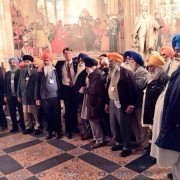
India’s Human Rights record came under attack in the House of Lords on Thursday as Indian Prime Minister Narendra Modi’s government stood accused of allowing extremist nationalist groups to thrive in the country.

The Lords convened in Westminster to discuss growing violence against minority religious groups in India and instances of the government denying NGOs, such as GreenPeace India, funding from foreign sources and restricting their members’ ability to travel.

Topics such as the injustice faced by Sikh protesters in relation to the genocide they suffered in 1984 and more recently in October 2015 when two Sikh peaceful protesters were murdered by police and many more injured, were brought to the attention of the convening Lords.

The points were brought up in the House of Lords in a debate over the extent to which freedom of religion is being upheld in India, in relation to Article 18 of the Universal Declaration of Human Rights.

The debate, which was instigated by Lord Indarjit Singh, also highlighted the annual rise in communal violence under the current regime . The Earl of Courtown also spoke of violence and mistreatment of Christian groups, while Lord Hussain described how an Armed Forces Special Powers Act in Kashmir has granted officers a “licence to kill” Muslim civilians.

The Lords also discussed the rise of “Hindu Extremist groups”, mentioning the Rashtriya Swayamsevak Sangh (RSS) organisation as one such group, as further recent instances of religious intolerance in India were recounted.

The murder of a Muslim man by villagers in Uttar Pradesh in October 2015 for eating beef, and the subsequent handling of the case by authorities, was given as as another recent example in which India has failed to ensure freedom of religion. The government was also accused of denying visas for an independent international watchdog that monitors freedom of religion, to enter into the country.

Lord Singh explained that Prime Minister Modi was elected ostensibly due to economic policies but after his election, he has shown an increase in support of the Hindu extremist agenda of those who helped propel him to his position.

“Narendra Modi’s election was sadly seen as a green light by some Hindu Extremists to make India more Hindu and to put India’s large Muslim minority and Christians and Sikhs firmly in their place,” said Lord Singh.

“Reports from Amnesty International, the Human Rights Watch, the U.S. Commission on International Religious Freedom and other human rights groups all tell the same story of forced conversions of the Muslim and Christian communities, brutal rape and killing and the destruction or seizure of property. This has been paralleled by a general crackdown on the right to free speech.”


Sikh organisation removed from Terrorism Act banned list

After a unanimous decision to overturn the ban was agreed in the House of Commons, Labour MP Andy Burnham stated there was a belief the decision to ban the ISYF was “…based on diplomatic pressure from the Indian government, rather than direct evidence of terrorism”.


On March 15th the British government took the first steps towards removing Sikh political activist organisation International Sikh Youth Federation (ISYF) from a list of banned organisations after 15 years.

A government statement on the overturning of the ban said “The secretary of state has now decided that there is insufficient information to conclude that the group remains concerned in terrorism.”

Originally banned under the Terrorism Act of 2000 as an organisation allegedly affiliated with acts of terrorism, years of lobbying from Sikh political organisation the Sikh Federation UK finally saw the ISYF ban reviewed this year, ultimately leading to an overturning of the decision in parliament this week, with the decision to become official on March 18th.

Dabinderjit Singh of the Sikh Federation UK stated, “No organisation has ever had their ban lifted in this way, this is the first time the Home Secretary has agreed to lift such a ban, but it did follow a legal challenge. The problem with the ban was that it meant thousands of people could be seen as criminals overnight.”

“In 2001 when the ban took place in both the House of Commons and the House of Lords, people from all parties objected. The ISYF made an application to be removed from the list the same year but one crucial thing happened during this time, and that was 9/11. The political atmosphere at the time became such that no  Home Secretary was ever going to remove the ban.”

Listen to Dabinderjit Singh speak to BBC Asian network here – http://www.bbc.co.uk/programmes/p03msfk0.

Jasveer Singh Gill of the Sikh Press Association stated on the issue, “For too long the separatist movement for Khalistan, which has huge support from the Sikh diaspora, has been portrayed as a militant movement fuelled by a religious divide. Calls for Khalistan actually have deep-rooted political and socio-economic foundations which go back decades, if not centuries. It is only fair this movement is viewed objectively for what it is, and the lifting of the ban on the ISYF goes some way towards making this happen. The Sikh Federation UK have done a great job by pushing this through.”

A social media statement from the National Sikh Youth Federation (NSYF) reads, “The UK government has taken a step in the right direction with the lifting of the ban on the ISYF. Sikh activists will continue to develop the conversation around Sikh Raaj and Khalistan. It’s time for more healthy debate and grass roots activism.”

See below for MP quotes.

Pictures and quotes provided via Sikh Federation UK (@SikhFedUK).


Sikhs welcome their New Year with Sikh Environment Day – Hindustan Times

The Sikh community welcomed their New Year by offering prayers at the Golden Temple and by taking part in religious functions that were organised in various shrines of the city as well as at homes.

March 14 or the first day of the month of Chet marks the beginning of the Sikh New Year, which is Nanakshahi Samat 548. The main function was held at Dewan Manji Sahib Hall in the Golden Temple complex where a well-attended ‘Gurmat Samagam’ (religious function) was held. Harmandir Sahib Head Granthi Giani Jagtar Singh wished the community a happy and prosperous new year.

Environment Day

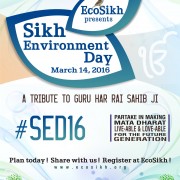
Later in the day, the ‘gurta gaddi diwas’ (enthronement) of seventh guru, Guru Har Rai was celebrated as ‘Sikh Environment Day’. The guru was a great lover of nature and ordained his followers to plant trees and keep their surroundings neat and clean.

To mark the occasion, the Shiromani Gurdwara Parbandhak Committee (SGPC) distributed saplings of various varieties as ‘parsad’ at the Golden Temple and other shrines in the city. On the directions of SGPC chief Avtar Singh Makkar, plants and saplings of trees were planted outside the offices of the gurdwara body here and also in the lawns around the shrine complex.

SGPC additional secretary Daljit Singh Bedi said saplings were also planted in all SGPC-run educational and professional institutions and at its ‘sarais’ (resting place for pilgrims). A special cleanliness drive was launched in SGPC residential colonies.

The SGPC began celebrating the ‘gurtta gaddi diwas’ as ‘Environment Day’ on the suggestions of EcoSikh, US-based environmental group.

This year, EcoSikh gave a call for the introduction of organically grown ingredients in meals served in the ‘langars’ (community kitchens) of gurdwaras. The SGPC has already made a beginning in this direction by starting organic farming of food items particularly wheat and vegetables, on a portion of the agricultural land owned by the religious body.


VIA – http://www.hindustantimes.com/punjab/sikhs-welcome-their-new-year-with-prayers-at-golden-temple/story-OIoawTURTixbG9nCFTvOCN.html

Ludhiana farmer hosts ‘organic langar ‘ to mark Sikh Environment Day – Indian Express

A well-known rose flower farmer in these parts, Jasbir’s farm was visited by Prince Charles during his trip to India.

organic1

People being served black carrots juice as part of the organic langar hosted by farmer Jasbir Singh to celebrate Sikh Environment Day on Monday at his village Ghulal (Source: Express photo) .


In a fitting tribute to the seventh Sikh Guru Har Rai, who was also an ardent environmentalist, a 57-year old farmer from Ludhiana hosted an ‘organic langar‘ on Monday at his farm to observe ‘Sikh Environment Day’.

In a langar (community kitchen), where more than 100 people attended, the menu included food and drinks prepared completely from organically grown vegetables, cereals and even the desserts were prepared using indigenous breed ‘Sahiwal’ cow’s milk.

The langar, primarily a Sikh tradition, was also attended by Deputy Shahi Imam Usman Ludhianvi from Jama Masjid, Ludhiana. The attendees were gifted neem and flowers saplings to mark the day.

Speaking to The Indian Express, Jasbir Singh Ghulal, from village Ghulal near Neelon, said that it has been almost 12 years now that he shunned wheat-paddy farming and started growing organic fruits, vegetables, rice and flowers.

A well-known rose flower farmer in these parts, Jasbir’s farm was visited by Prince Charles during his trip to India.

“The primary source of my income is organic farming now. I know the farmers feel insecure when they think of leaving wheat-paddy farming as organic vegetables market is yet to gather pace. But it is the best feeling when pesticide free veggies and fruits bloom in the farm. Today, I decided to host this organic langar to show that how sumptuous dishes made from organic veggies can be,” he said.

The menu included dal (pulses), mix vegetables, black carrots juice and pickle, gulkand (prepared from roses) and rotis- all prepared using organically grown crops without pesticides. The dessert was ‘kheer’ prepared using Sahiwal cow milk and shakkar (organic sugar).

Ravneet Singh, EcoSikh South Asia project manager said, “Organic food is necessary to revive the true spirit of langar, which is sharing healthy food with the humanity. The campaign aims to make all gurudwara kitchens preparing langar go organic. The target is 50,000 gurdwaras where nearly 50,00,000 people take food daily. It will enhance the demand for organic food, support organic farmers and improve human health.”

The Sikh Environment Day campaign was started by US based organization EcoSikh in 2010, as a tribute to Guru Har Rai, the seventh Sikh Guru, who planted trees, setup a wildlife sanctuary and a herbal medicinal facility at Kiratpur Sahib.


VIA – http://indianexpress.com/article/cities/ludhiana/organic-langar-sikh-environment-day/

Professor Devinderpal Singh Bhullar: A Tragic Miscarriage of Justice – Huff Post

By Damanvir Kaur (Twitter – @Damanvir_Kaur)


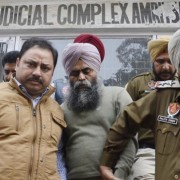
In 1995, Sikh political prisoner Professor Devinderpal Singh Bhullar became the first person in Indian history to be sentenced to death in a split Supreme Court decision. Convicted under the now repealed Terrorist and Disruptive Activities (Prevention) Act (TADA), Professor Bhullar’s case remains one of the most tragic and prime example of miscarriage of justice…

READ FULL ARTICLE HERE – http://www.huffingtonpost.com/damanvir-kaur/professor-devinderpal-sin_b_9424014.html

Five Important Women in Sikh History

Mata Nanaki – The First Sikh


mata nanaki


Mata Nanaki ji was the elder sister of the first Sikh Guru, Sri Guru Nanak Dev Ji, and she loved and nurtured her younger brother. In 1469, when Guru Nanak Dev Ji experienced a divine vision as a young man and became the first Guru of the Sikh faith, Mata Nanaki was the first to follow him. She is celebrated as the first Sikh.


Mata Sahib Kaur – Mother of the Khalsa


MataSahibGuruGobindSingh

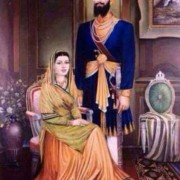
Mata Sahib Kaur is known as the “Mother of the Khalsa”. She would join her husband Guru Gobind Singh Ji in serving langar, fighting battles and singing kirtan. On Vaisakhi 1699, at the first Amrit-Sanchaar at Anandpur Sahib, Mata Sahib Kaur Ji participated in the seva creating Amrit by adding sugar wafers to add sweeetness to it, and was bestowed the honour of eternal motherhood of Khalsa Panth.


Mata Khivi – Pioneer of Langar


Khivi 2


Mata Khivi was the First to follow in Guru Nanak Dev Ji’s footsteps and prepare food for all who came to hear the Guru’s spiritual discourse. When her husband, Sri Guru Angad Dev Ji, became the second Sikh guru, she presided over langar – the free and open kitchen run by Sikhs where food is served to rich and poor of all castes and backgrounds. Today, every Sikh Gurdwara in the world serves langar to the community.


Mai Bhago – The Warrior Kaur


Mai Bhago


The fearless female warrior born in Amritsar, Punjab, Mai Bhago grew up in a time when the 10th guru, Guru Gobind Singh, fought to defend Sikhs against Mughal forces and hill chiefs. During a great siege in 1705, Mai Bhago rallied 40 deserters and led them into battle herself, sword in hand. They died fighting and became known as the Chali Mukte, the Forty Liberated Ones. Afterward, Mai Bhago became the Guru’s bodyguard, donning a turban and warrior attire. 


Her story is told in the animated short film: KAUR – A Story of Courage and Equality – by SikhNe 


Mata Gujri Ji

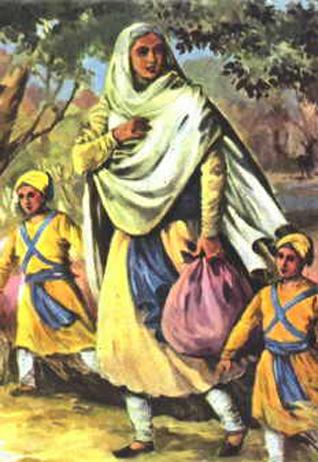
Mata Gujri ji holds the unique position of wife of a martyr, mother of martyr, the grandmother of martyrs and herself a martyr. Wife of the ninth Sikh Guru, Guru Tegh Bahadur; the mother of the tenth and last human Sikh Guru, Guru Gobind Singh and the grandmother of the four Sahibzade. As a wife she supported Guru Tegh Bahadur when he was deep in meditation for years, again while he was on his missionary tour, and finally, when the Guru left for Delhi to make the supreme sacrifice. As a mother she molded the father of the Khalsa, the great Guru Gobind Singh, raising him as a single mother after the martyrdom of Guru Teg Bahadur ji. As a grandmother, when she and the Sahibzade were arrested and confined in Sirhind Fort, she urged them to remain steadfast in their faith. It was due to her role that the seven and nine year old children did not budge from their beliefs and attained martyrdom. Her support of her grandsons played such an important role in Sikhism that as Sikhs, we probably owe our existence to her.

Seeking Extremism

A critique of accusations of “Sikh Extremism”, by Ranveer Singh of National Sikh Youth Federation (NSYF)


As an activist and writer, I appreciate the importance of providing an informed perspective when it comes to matters affecting the Sikh Panth. To do so however, knowledge of Sikh history, ideology and polity are musts to provide a competent viewpoint. Everyone is entitled to an opinion and any attempt made to open dialogue on matters affecting the Sikh Panth must be commended. That said, one’s opinion of Sikh affairs will lose any iota of credibility if it is devoid of Gurmat inspired analysis. That is and always has been the benchmark for resolving Sikh affairs.

An article entitled “Sikh Extremism” was recently published on the Critical Muslim website. Seemingly out of place, a few paragraphs in it becomes clear why this piece is on the site along with articles such as “The Top 10 Jihadi Janes”.

Written by Sunny Hundal, the article sensationalises a handful of protests and the behaviour of a few individuals to tarnish a whole community as having an “extremist” issue.

The author has a track record of denigrating members of the Sikh community with his offensive and mostly ill-informed articles. The real issues which he attempts to discuss lose focus due to his belligerent vilification of the Sikh community with misguided viewpoints that only serve to create controversy.

This latest article of his catapults aimlessly from one issue to another in an attempt to provide support for his proposed theory of “Sikh extremism”. He relentlessly babbles on about the threat of division within the Sikh community with twisted evidence that is grossly out of context. 

To open he refers to the xenophobic behaviour of two individuals who supported the fascist groups BNP and EDL in 2005 and 2010. The author then compares the isolated behaviour of the aforementioned individuals to what he terms “puritanical” Sikhs, thus demonstrating the existence of a division in his own mind between the more “liberal” Sikh. His oxymoronic depiction thus dictates the tone of his entire article and exposes the flaws in his understanding and analysis of Sikh history, ideology, psyche and current affairs.

Branding one side “religious extremists” and another “liberal”, he instantly tarnishes one group whilst simultaneously painting a positive perception of the other. He appears to show concern over a “growing movement of puritanical Sikhs”. Let us consider this conjecture for a moment.

“Guru Nanak’s Sikh is liberal by nature.”

This division which the author talks about exists because of his perceived understanding of Sikh affairs, which is contrary to Sikh polity and Sikh ideology. There can be no “liberal”, “conservative” or “secular” Sikh, as suggested by the author. These terms are a relatively new occurrence created to cause division – rather than point out division – amongst the Sikh Panth.  Derived from the democratic political spectrum, the terms hold no relevance within the Sikh Panth. Secularism, a term used to describe the separation of state and church, is a foreign concept for Sikhs and an affront to the concept of Miri-Piri. This is what I like to term classic neo-colonial objectification; trying to define and view a community and its institutions within the constraints of a foreign system.

The author and many of those who admire his work are accustomed to living in a democratic state where secularism forms a central component of democratic governance. Secularism basically implies that one’s own beliefs should be kept at a personal level. To ensure that they do not interfere with State politics, the people are then obliged to follow the same law, irrespective of its compatibility with their own belief system. This creates a perception that all religious beliefs share the same level of truth-ness. The Guru challenged such systems and instilled a spirit amongst the people which not only saw them clash with empires and governments for their exploitative and suppressive ways but also saw them challenge the manipulation of religion by high ranking priests who had misled the people into idol worship, superstition and empty rituals.

The Guru’s mission was to empower the plebeian cause and he created the Panth as an example of how an egalitarian society should function. The implementation of concepts such as, Miri-Piri, Sarbat da Palla, Sangat and Pangat all serve as a testament to this fact. The Guru created a Sikh, whose very existence throughout history has been enough to challenge all the xenophobic and bigoted societal norms. Guru Nanak’s Sikh is liberal by nature.

Yet Sunny Hundal still feels the need to create a sub-category of Sikh, as if to distinguish between those in tune with Sikhi and those on the “conservative” periphery. The idea that a Sikh who follows the Guru’s mandate is the same today as they would have been in the 15th century seems to create some discomfort for him.

These labels can be traced back to the systematic categorisation of Sikhs during the colonial encounter. This manner of division is counterproductive to the Sikh narrative and must be challenged at every opportunity. The prospect of walking the Guru’s path, as shown by the Guru and great Sikh scholars, poets and warriors, is not enough for some new age followers of Sikhi. They feel compelled to label those traditions and codes of conduct as archaic. This is done to justify and suit their lifestyle, to claim they too follow Guru Nanak but only on conditions which fit around their own interpretation and implementation of the Guru’s instruction, thus creating a total paradox of Sikhi. Hundal seeks to validate this paradox just to seemingly create a point of discussion which he then becomes a self-made expert on.


“The Sikh community has been in a constant state of war with those who wish to dilute the Sikh way of life.”


Unsurprisingly, Hundal’s use of the term “religious extremists” is swiftly followed by a short and ill-equipped reference to the events of 1984 and the continued suppression of Sikh political activism. The author deems both to be as big a problem as his perception of “Sikh extremism” which he alleges “can fuel hate crimes”.

Statements such as this – that unresolved issues around 1984 are as big a threat to the Sikh community as Tommy Robinson appearing on the Sikh Channel – are where Sunny Hundal loses all credibility and descends into the realms of absurdity.

Has he forgotten the peaceful agitations made to discuss and resolve the denial of social, economic and political rights of the people of Panjab before the government of India responded with tanks and machine guns? Has the author no knowledge of how Sikhs in Panjab have been systematically robbed of their rivers, land and their language? At what point will it cross the author’s mind to consider any real destabilisation of Panjab and the Sikh community is orchestrated by the violence of State sponsored military operations? Instead the author wishes to condemn the actions of those who justifiably agitate for a separate Sikh state. Who are the real extremists in all of this?

As a Nation, the Sikh community has been in a constant state of war with those who wish to dilute the Sikh way of life. When Sunny Hundal labels Sikhs “extremists” based on his own petty interpretations, he either unknowingly or maliciously supports this war against the Sikh Panth.


                                                                                                _________________________


Next, the author attempts to build his case for the “extreme Sikh” by turning the reader’s attention to the general racial and religious intolerance shown by Asians in Britain before delving into a personal story from his days at university. He ends this section by questioning the efforts of the ‘Sikh Awareness Society (SAS)’ who work tirelessly to highlight the problem of sexual grooming in the UK. The murky depths of grooming circles in the UK largely perpetrated by Muslim men has only recently come to light. SAS have been speaking about this issue for over a decade.

Sunny Hundal has the audacity to state that the Sikh girls targeted by Muslim groomers were not targets for conversion, rather for sexual exploitation alone. It is strange of him to say this after admitting a leaflet was found to encourage Muslim men to convert Sikh girls in the mid-90s. It seems he will not let facts get in the way of demonising Sikhs, instead suggesting the SAS were speaking out to create anti-Muslim sentiments.

This is his own conclusion based on his own knowledge and experience. It is in no way conclusive or accurate, and citing a “BBC Asian Network investigation” on the issue does not validate his claims either.

So why did the author choose to make such an absurd claim? Well, he is building towards his favourite topic of inter-faith marriages; a topic in which he fails to recognise that much like most of the problems we face amongst the Sikh diaspora, the issue of inter-faith marriages is very simple.

The Anand Karaj is not your conventional “wedding ceremony”. Most “marriages” in other faiths are legally binding contracts between man and wife regulated by the law of the land. The Anand Karaj at no point specifies responsibilities or duties commonly found in orthodox wedding vows. That is because the Anand Karaj ceremony is a union of two Sikhs (in my opinion practicing Sikhs, so there is no confusion over how one defines a Sikh), with the Guru. The first laav is effectively a declaration of allegiance to the Guru and the Sikh way of life. All four stanzas of the Anand Kaaraj are about commitment to the Guru. This is something that is completely undeniable fact, yet remains largely ignored in debates on the topic.

So for someone to get “married” by way of an Anand Karaj, it is only logical that they are a practicing Sikh, otherwise what they are doing would simply be hypocritical. To partake in an Anand Karaj without fully embracing the Sikh faith belittles Guru, which is why this entire subject causes much distress to practicing Sikhs who hold our Guru in the highest regard possible. Taking part without this reverence for the Guru is usually done to appease either family, friends or a partner, or to do what is required of a “Sikh”.

Allowing only Sikhs to part take in an Anand Karaj is not “discrimination against non-Sikhs” like the writer has alluded to, rather it is the most logical method to adopt for anyone that wishes to respect the Guru.

With regards to the author’s vilification of the Sikh protestors: on 23rd August 2015 the Sikh Council UK (SCUK) facilitated a meeting in which over 180 representatives from UK Gurdwaras passed a resolution that only a Sikh, in accordance with the Sikh Rehat Maryada definition, is allowed to participate in the Anand Karaj ceremony. To do something other than this is simply bending the rules for personal appeasements, which not only devalue the Anand Karaj but also question the validity of the Sikh Code of Conduct. Sikhs do not need to adhere to anyone else’s view of what equality is other than our Guru’s.

Furthermore, in a statement televised on Sikh media outlets, the SCUK recognised the efforts of those who protest against inter-faith marriages and described them to be in line with Sikh principles.  


“There is a difference between cultural behaviour and conduct based on the teachings of a certain faith. It seems this subtle difference is lost on many, including the author.”


The author then jumps on the topic of protests made by “around 50 protestors” according to the Guardian, regarding the film Nanak Shah Fakir. Whilst I agree the calls of blasphemy seem a little far stretched, the author makes a mountain out of a molehill. With many Sikhs believing the film should have been allowed to have been shown, it is an issue that calls for dialogue between Sikhs, something which Sunny Hundal himself looks to prevent by simplistically labelling protestors “extremists”.

Hundal also provides a brief analysis of Panjab which provides no real substance or wider context to the social problems faced by women, or even men for that matter. The writer wrongfully implies the problems exist explicitly as a result of the shortcomings of the Sikh community, ignoring actions imposed on the State of Panjab by the central government.

As a journalist he discredits himself when discussing the issue of female infanticide in Panjab by not mentioning the Sikh Guru openly declared anyone taking part in this practice can no longer be called a Sikh. Yet, “Sikh extremist” remains his most sellable product, so he ignores the fact this stems from cultural and not religious issues.

I concur with the Hundal’s comments regarding the silence of UK Sikh leaders on issues such as honour killings. However, most of the social problems referred to are due to the imposed cultural tendencies in Panjab that create this type of behaviour amongst the diaspora. Such behaviour has no place in the teachings of the Guru. There is a difference between cultural behaviour and conduct based on the teachings of a certain faith. It seems this subtle difference is lost on many, including the author.

Maybe to make his article less absurd he could have named it “Panjabi Extremism”.


     ___________________________


An insinuation from Sunny Hundal that 1984 was the tipping point for a defensive mentality where everything reverts to discussions of Khalistan among the Sikhs is unfounded and misleading.

The movement for a Sikh homeland began with Guru Nanak when he founded the city of Kartarpur with subsequent Guru’s building more cities and raising armies to fortify Sikh space and ward off acts to undermine Sikh sovereignty. This is a fact lost on many people today, partly due to colonial history, partly due to the continued suppression of Sikh political activism by the Indian government and its agencies and partly also due to the ignorance of misguided writers and academics.

In the closing paragraphs the author showcases his limited understanding of how an independent Sikh homeland would look. His rhetoric appears to be based on classic anti-Sikh propaganda churned out by the Indian government. The author suggests Khalistan would be a theocratic state, with little explanation for why he believes this to be the case. 

It is glaringly obvious that the author needs to be educated on Panthic matters so that he can hold informed and intelligent discourse on the subject of Khalistan.

The culture of sexism and alcoholism as categorised by Hundal is not a challenge faced by the Sikh community alone, it is a problem faced by every single society on this planet. Due to the soul-draining demands of capitalism, people are glorified based on their gender, women are used as symbols of sex and multi-billion dollar companies have a frighteningly expansive advertising budgets to market and sell alcohol. Instead of disproportionality placing the blame with the Sikh community, how about starting a conversation to tackle the problem of sexism and alcoholism at its root? 

The author has left the most bemusing and laughable statement till the end; “they [the Sikh community] haven’t yet addressed how to keep Sikhs within the fold even if members start to adapt to different lifestyles and cultures”. This is Sunny Hundal at his oxymoronic best.

The Sikh have never relied on numbers to uphold the House of Guru Nanak. If a Sikh adapts to a different lifestyle and/or culture which advocates anything contrary to the tenets of Sikhi then they are no longer a Sikh. It is that simple. Historical precedence shows when 40 of the Guru’s Sikh left Him during war, He didn’t label them apostates, He simply allowed them to follow another path in that moment. When they later approached the Guru to re-join the Panth, He allowed them back in to the fold. The chali mukte (40 liberators) themselves did not attempt to legitimise their stance by saying to their Guru “we will still be Sikh, but we are just pacifist Sikhs that no longer wish to fight”, they understood the position of their Guru and agreed they would no longer be His Sikhs after leaving His side. They were Sikh as long as their conduct and actions defined them as Sikh.

Please note, this article is in no way intended to deny the serious issues that affect Sikhs which the author mentions. However, the tabloid-esque manner of his reporting, combined with a clear lack of understanding of Sikhi itself, do more to harm than help relations within the Sikh community.

It must also be noted, that along with the relatively small rise of things such as Anand Karaj protests is a comparatively massive rise in seva (selfless service) by Sikhs. Statistics compiled by the Sikh Press Association show approximately 10,000 meals a week are served to the needy on the streets of the UK by Sikh charities. There is also the recent opening of a free education centre (the first of its kind opened by a minority community in the UK) and increased encouragement towards practices such as meditation and community integration, all stemming from UK Sikhs maintaining a more adherent approach to Sikhi.

Contrary to the author’s belief, Sikhi will continue to prosper under what many will deem the direst of circumstances, as it has done since inception. The Sikh Panth has faced many external foes but it has learnt that the most destructive enemy is one which lingers within. It would seem the latest threat comes from the many self-appointed writers and commentators who attempt to promote this pseudo Sikh lifestyle and condemn those who follow the Guru’s system as too puritanical. It would be more beneficial for them to reflect on their own devisive actions and try walking the journey, before judging those on the path.


VIA – https://ranveersp.wordpress.com/

 

Spokane’s Sikh Temple vandalized, “holy book” desecrated – Spokesman

NOTE – The title is taken from Spokesman.com.


Spokane community leaders on Thursday denounced religious hate crimes after the Sikh Temple of Spokane was vandalized by a man who mistakenly thought the temple was a mosque and was affiliated with the ISIS terror organization.

Spokane County Sheriff Ozzie Knezovich was joined by two mayors, three city council members and representatives of other faiths in condemning the desecration Wednesday night and early Thursday of the temple at 1420 N. Barker Road.

“No hate will be tolerated in Spokane County,” Knezovich said at an afternoon press conference at the temple’s community building.

Jeffrey C. Pittman, 44, was arrested Thursday morning inside the temple after a short altercation with officers. He was wearing no clothing and holding a ceremonial sword from the temple, sheriff’s officials said.

Knezovich said Pittman told investigators he broke into the mosque through a side door because he was cold and hungry.

Once inside, Knezovich said that Pittman became convinced the temple was a mosque connected with ISIS, the group responsible for the brutal terrorist takeover of portions of Iraq and Syria and for a coordinated bombing in Paris, among other crimes.

Pittman was booked into Spokane County Jail on charges of armed burglary, malicious mischief and malicious harassment based on religious discrimination – Washington’s version of a hate crime.

About $30,000 in damage was done to the interior of the temple, according to temple leaders.

“Our hearts are broken,” said Subarna Nagra, a member of the temple.

Deputy Mark Gregory said officers were called to the temple around 5:45 a.m. Thursday and confronted the suspect, who was holding the sword and had wrapped himself in a blanket that was taken from the temple furnishings.

On Thursday afternoon, the sheriff was joined in condemning the hate by Mayor David Condon of Spokane, Mayor Rod Higgins of Spokane Valley, city council members from the two cities, the police chief of Spokane Valley, Rev. James Waggoner, the bishop of the Episcopal Diocese of Spokane, representatives from the Jewish and Muslim communities and others.

“Sikh values are intrinsic to who we are,” Condon said.

Higgins said, “This not who the people of the Valley are…I hope justice will be swift.”

Admir Rasic, a Muslim and member of the newly formed Spokane County Human Rights Task Force, said the desecration creates undue fear in the religious community and can be particularly difficult for children to understand.

Regina Malveaux, CEO of the YWCA in Spokane, said Thursday’s incident comes at a time when hate rhetoric has gotten more heated across the U.S.

The vandalism was discovered when one of the temple members arrived early Thursday to open the building and say prayers.

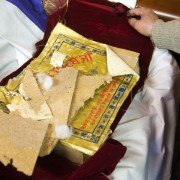
Gurjeet Singh Aujla, the priest at the temple, said the temple’s Sikh holy book was defaced and pages were ripped from it.

Sikhism, which originated in India, has about 20 million adherents worldwide. There are about 300 Sikhs living in the Spokane area, Nagra said.

The holy book contains the accumulated teachings of the first through 10th Sikh gurus.

The scripture in the Guru Granth Sahib holy book is considered an embodiment of the eternal guru, and as such, holds the sacred focal point of Sikhism.

“We believe this is the knowledge of our gurus,” Aujla said.

In Sikhism, the book is opened every morning and the priest selects a passage that becomes the focus of prayer and meditation that day. In the evening, the book is returned to a bed just off the altar and put under covers to let the gurus sleep.

The altar, holy book and bedding were vandalized, Nagra said.

After Pittman was detained, temple members offered the suspect their traditional morning chai tea.

Nagra said temple members feel sympathy toward the man who appeared to have some type of illness affecting his judgment.

“I am definitely hurt,” she said. “At the same time, we are a compassionate community.”

The YWCA of Spokane said in a news release that “actions like this are indicative of growing Islamophobic sentiment across our nation, where there has been a steady increase in backlash and hate crimes targeting Muslim, Sikh, South Asian and Arab communities.” Nagra is a board member of that organization.

Nagra said in the news release, “The Sikh articles of faith, which include the turban and beard, show their commitment to equality, justice and freedom for all. These are not just Sikh values, they are American values.”

VIA – http://www.spokesman.com/stories/2016/mar/03/spokanes-sikh-temple-vandalized-holy-book-desecrat/

Sikh teen shaken after alleged turban attack on bus – SBS

The family of a boy who was allegedly mocked and assaulted for wearing a turban on a Melbourne bus have expressed their shock at an attack they say was a crime against their faith and identity.

When the Singh family came from India to settle in Melbourne with their two children, they thought they had found a country where they could feel safe.

But that changed last week, on February 23, when their 13-year-old son Harjeet said he was assaulted.

He and his friends had been talking with one another on a bus when three strangers boarded at Eltham station in Melbourne.

“They came up to us and started swearing and said the ‘F bomb’ a few times and the girl said I had a ‘worthless towel’ on my head,” Harjeet said.

The girl was referring to his turban, an article he described as a crown of pride for his Sikh faith.

Harjeet said the girl then hit him hard, twice, and attempted to remove his turban.

He said one of the men then told Harjeet “there aren’t that many stabbings in Eltham”.

“I was so scared. I just froze and when my friends got off the bus I got off with them,” Harjeet said.

Once a twice-daily routine, the 13-year-old is now too scared to catch the bus alone, relying on his sister to accompany him.

His mother, Rajinder Kaur Gill, has feared for him every day since.

“This is not just a general crime, it is a racial attack, this is an attack on our identity,” she said.

One week later, she was visibly upset as she recounted her son’s ordeal.

“To hit me, I can bear that. But this, this is hard to even say that they hit my son’s turban and tried to pull it off. This is the biggest insult,” she said.

The whole family has been affected, but Rajinder said their priority was to protect other Sikhs from similar treatment.

“[Some people] think this is a joke, the turban. [But] we wear it as a crown and we are proud.”

Victoria Police have identified a trio of teenagers as the alleged perpetrators, with investigations in the early phase.

They have asked anyone with information to contact Crimestoppers on 1300 555 000.

VIA – http://www.sbs.com.au/news/article/2016/03/03/sikh-teen-shaken-after-alleged-turban-attack-bus

Sikh Cancer Researcher Harpal Singh Kumar Knighted

Harpal Singh Kumar, who is the chief executive of Cancer Research UK, has been honored for services to cancer research and being “hugely influential in promoting research into the prevention, early diagnosis and treatment of cancer, and cancer care.”

“CRUK’s income and research spend are at an all-time high. Under his leadership, it has been instrumental in pushing the government to take further measures to reduce smoking and to ban sun-beds for under-18s,” Kumar’s citation reads.

“He also chaired the Independent Cancer Taskforce and authored the NHS Cancer Strategy ‘Achieving World Class Cancer Outcomes. A Strategy for England 2015-20’, published in July 2015,” it said.

Kumar leads this year’s honors list of Indian-origin names, covering fields of entrepreneurship, financial services and community service.

“He has been instrumental in setting up the Francis Crick Institute as a world-leading center of biomedical research and innovation,” the citation added.

Simranjit Kaur of Sikh educational charity Basics of Sikhi said, “Harpal’s work in cancer research is another example of the Sikh contribution to humanity, something which is a core principle of the Sikh faith. Hopefully we will see many more Sikhs like him contribute to tackling some of the world’s bigger issues.”