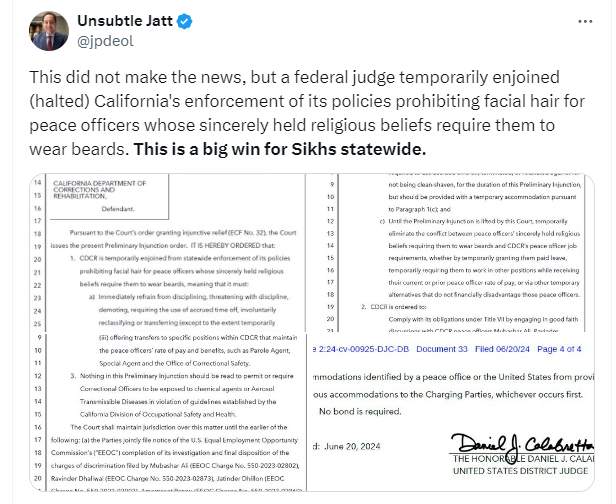
In a significant ruling, the United States District Court has issued a preliminary injunction against the California Department of Corrections and Rehabilitation (CDCR) regarding its enforcement of a policy that prohibits peace officers from wearing facial hair.
This policy has been deemed discriminatory towards practicing Sikh men, whose religion mandates that they do not cut any of their hair, including facial hair.
The civil rights complaint was filed in March to halt California’s enforcement of the rule, saying that it amounts to religious discrimination for Sikhs, Muslims and others who wear beards as an expression of their faith.
Now the Court’s order temporarily prohibits California from enforcing its no-facial-hair policy on peace officers who request to wear beards due to their religious beliefs. The department must refrain from disciplinary actions, threats, demotions, forced use of accrued time off, involuntary reclassifications or transfers (with temporary exceptions), reduced work hours, termination, or retaliation against such officers. Additionally, CDCR must communicate to all personnel that no disciplinary actions will be taken against officers requesting religious accommodations for facial hair.
The court has also ordered that the CDCR must engage in faith discussions with the affected peace officers to explore what accommodations can be made for their religious beliefs. This includes evaluating alternative respirators that allow for facial hair while providing protection from hazards, adjusting staffing, incident response, and respiratory protection policies to align with the need for religious accommodations, and offering transfers to positions within CDCR that do not conflict with the officers’ religious practices.
The Court will maintain jurisdiction over the matter until either the U.S. Equal Employment Opportunity Commission (EEOC) completes its investigation and issues a final disposition of the discrimination charges or until the Court determines that CDCR has fulfilled its obligation to find reasonable accommodations or proven that such accommodations would cause undue hardship.
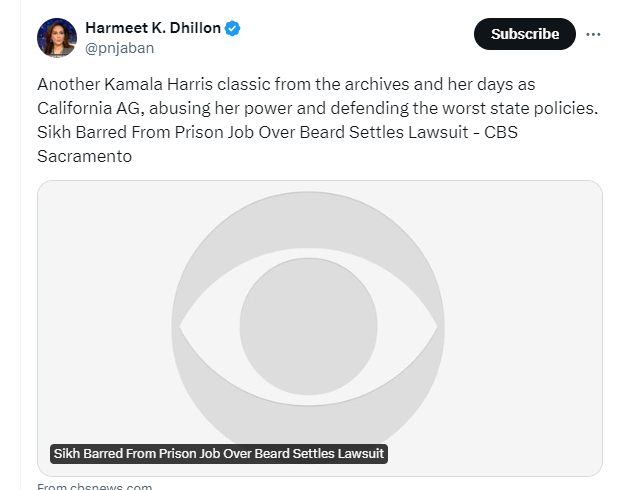
It has been noted by the Sikh community in the US that this is a threat that comes from across the political landscape, with Kamala Harris, the current vice president and Democratic presidential nominee having fought against similar attempts to allow Sikhs to wear beards. During her time as Attorney General of California in 2011, Harris argued to bar a Sikh from being hired as a California state corrections officer because she believed his beard would compromise his wearing a gas mask. Sikh activists have demanded that Harris apologise.
A Sikh man was left to die in front of his wife on the farm where he was employed after his arm was severed off and his employer refused to act, in a case which has shocked labour rights groups and Sikhs across the world.
The death of Satnam Singh on 19th June on a Castelverde farm (in the province of Latina, in the Lazio region of Italy, approximately an hour from Rome) ignited a wave of protests across country, demanding better working conditions for migrant labourers. The incident has also prompted Sikh orgs to again look into the plight of the community in Italy, something which has been compared to slavery as far back as 2017.
In the incident itself, Satnam Singh, described by media as “an undocumented labourer” had his arm severed off whilst working on his farm. Despite his critical condition, his employer, Antonello Lovato, who was driving the tractor which was pulling a combine which tore off Singh’s arm, abandoned him on the side of a road after the incident without calling for medical help, stating Singh was “already dead”. This left Singh’s wife to try to wave down passersby to seek aid for her husband but Satnam Singh succumbed to his injuries two days later at San Camillo Hospital in Rome. Pictures of Singh’s severed arm in a fruit-picking basket went viral, seemingly symbolic of the plight of Sikhs in Italy.
Lovato was later arrested by Carabinieri police. The farmer owner was initially given charges of manslaughter. However, the charge was elevated to homicide with “malice aforethought” after forensic reports indicated that Satnam Singh would likely have survived with timely medical intervention. It was also later revealed Lovato had previous charges pending for being a “gang-master”, a term used for employees treating labourers like slaves due to the level of control they have over their subjects.
Lovato’s father, Renzo, responded to the incident by blaming Singh for not heeding warnings about the equipment, stating that his perceived negligence “will cost everyone dearly”, further showing the callousness within Italian society to migrant labourers. Satnam Singh went to Italy three years ago with his family and was working for €5 an hour, without a legal contract.
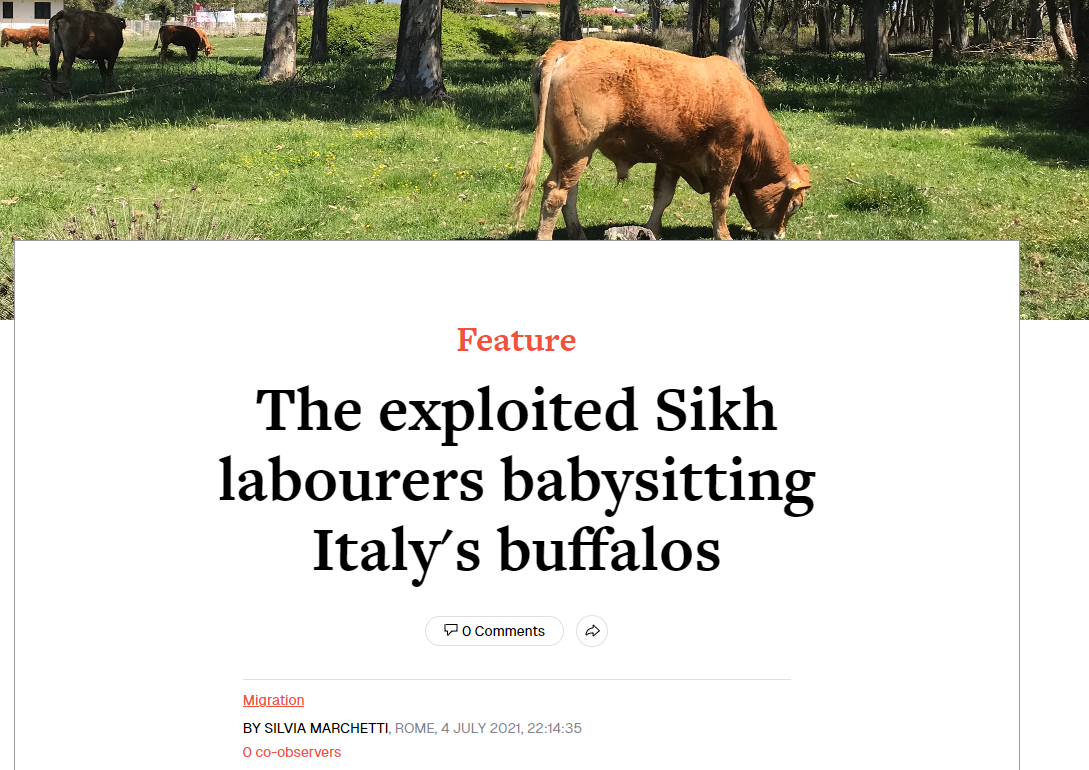
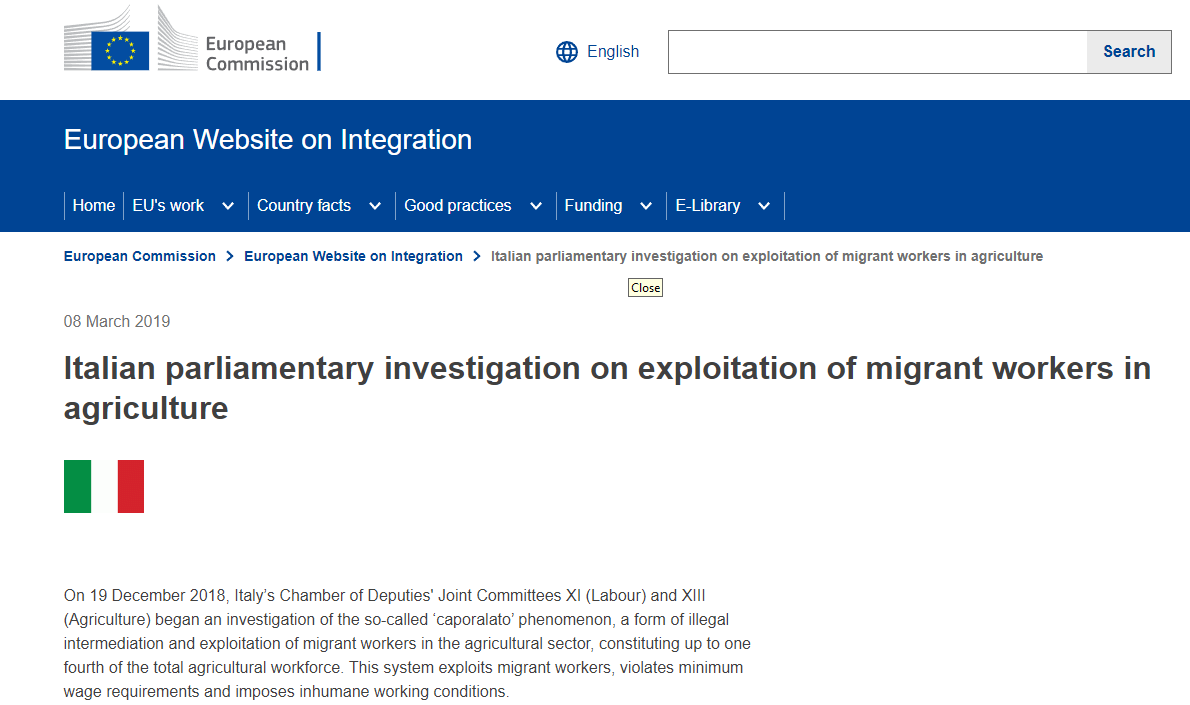
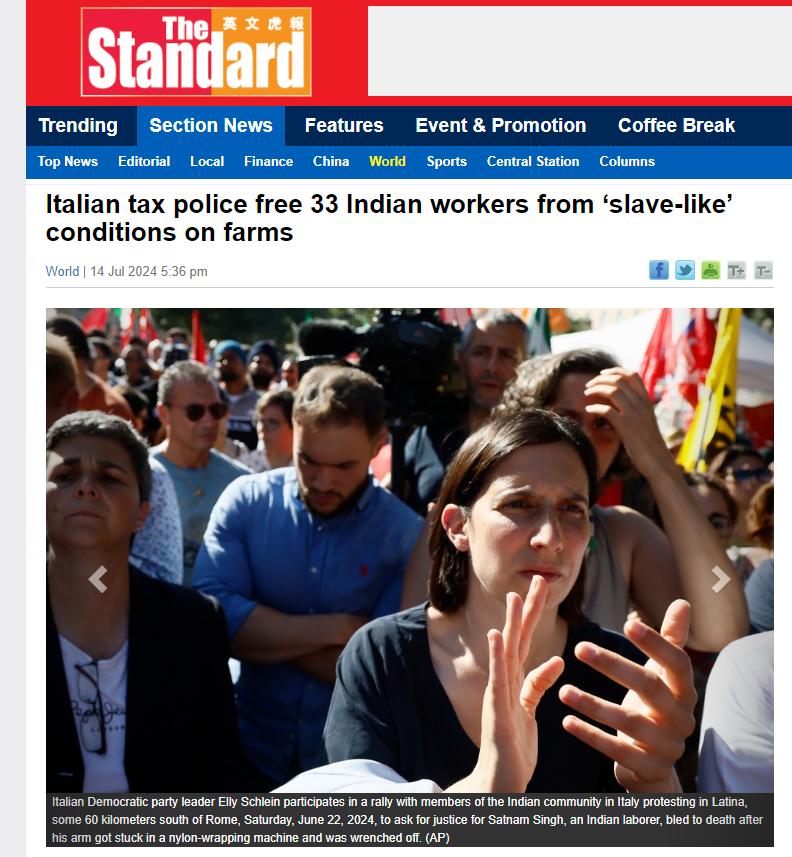
The death of Satnam Singh, 31, has spotlighted the harsh realities of the “caporalato” system, where underpaid migrant labourers are used extensively and exploited in Italy’s agriculture industry. Italian President Sergio Mattarella called out the “cruel” exploitation of workers and “inhuman” conditions in which seasonal farmhands often work in Italy. The leader of the centre-left Italian Democratic Party, Elly Schlein, participated in a rally with members of the Italian Indian community.
However, the issue also has ties back into India’s exploitative VISA agencies, which were this year the focus of mass protests led by community activist Bhaana Sidhu. These agencies offer potential emigrants “opportunities” to “work” in Italy. People pay $10,000+ upwards (often the life savings of some Punjabis) to take the opportunity, only to find themselves stuck on a farm being exploited by racist landowners.
The reaction to Satnam Singh’s death triggered a wave of action against those exploiting workers from Punjab and wider India.
Laura Hardeep Kaur, the General Secretary of an Italian Trade Union, commented on the case to media, saying; “He was left on the road like a bag of rags, like a sack of rubbish … despite his wife begging [the employer] to take him to hospital. Here we are not only faced with a serious workplace accident, which in itself is already alarming, we are faced with barbaric exploitation. Enough now…Foreign labourers continue to be invisible, at the mercy of ferocious bosses, often Italian”.
The death of Satnam Singh also helped expose another farmyard death of a Sikh labourer. Rajwinder Singh Sidhu, 38, died in Taranto (also spelt Tarantino) farming fields in the Laterza countryside (South-East Italy) on 26th May. His employer, Giovanni Giannico, said he had fainted and lost consciousness but medics saw his condition and did not believe it, instead alerting authorities. Autopsy results are still pending at the time of this article’s release but local authorities have stated they view this case as another “gang-master” related death, part of Italy’s ongoing exploitation of migrant labourers, including thousands of Sikhs.
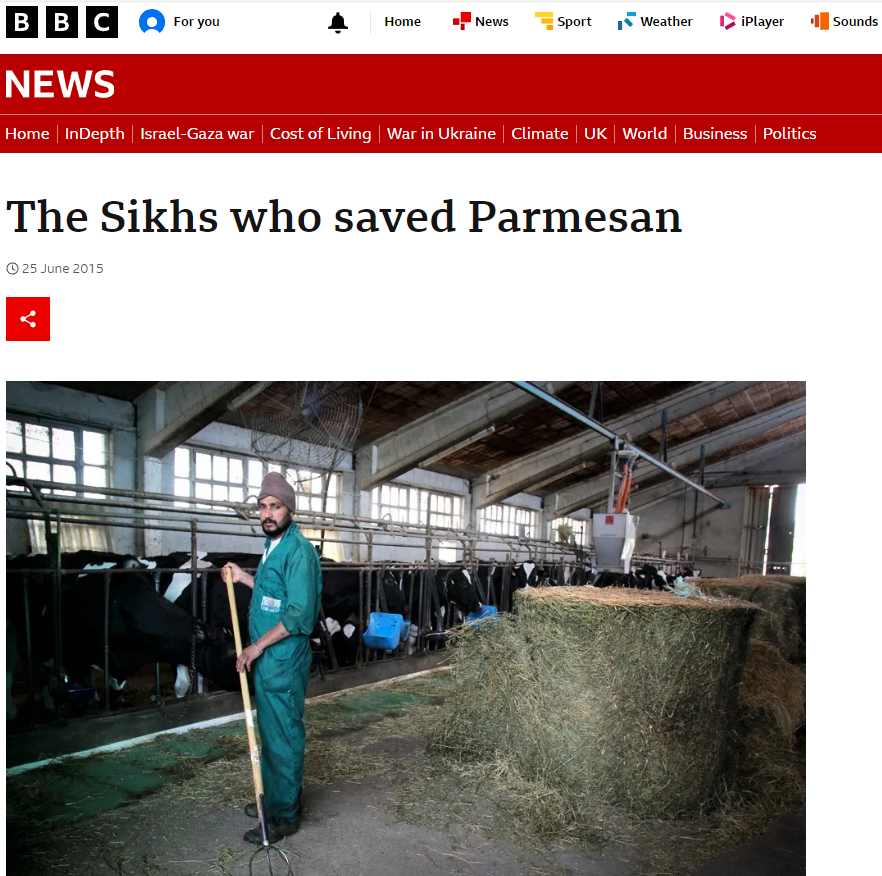
Italy is believed to have the second-largest Sikh community in Europe, after the United Kingdom. The Italian Sikh community is growing rapidly with most coming straight from Punjab for labour jobs, usually on farms. They are attracted to Italy because the land is similar to the land they cultivate in Punjab, opening up possibilities for successful work, as seen with the impact on Italy’s cheese market.
However, NGOs have recently described the conditions of foreign agricultural labourers in Italy as a “modern form of slavery”. The tragic story of Satnam Singh is only one of countless cases where undocumented workers have faced racism and inhumane conditions working on Italian farms and vineyards.
The the European Federation of Food, Agriculture and Tourism Trade Unions responded to the situation too, suggesting authorities need further enforcement of Social Conditionality in the Common Agricultural Policy to tackle such issues.
Speaking on the circumstances of Sikh labourers in Italy, Sikh Press Association Senior Press Officer Jasveer Singh said:
“The recent tragic deaths will prompt a global response from the Kaum (Sikh nation) in response to the plight of Sikhs in Italy. There are basic workers’ rights campaigns run by groups like the Naujawan Support Network of Canada and Jakara Labour Rights Initiative in the USA which are leading such movements.
“The horrifying reality of exploitation in Italy can not be denied. However, there should also be no doubt that such exploitation is allowed because of bigotry which others those of the Sikh identity in Western nations, dehumanising Sikhs to the point some have been left to die on the ground like animals. This will be added to a list of global issues the Kaum is looking to address, for the betterment of Sikhs and the whole of mankind.“
The battle of better labour rights in Italy continues.
UPDATE (24.09.24): Reports by Indian entertainment media have revealed that the CBFC has now ordered 120 cuts to the film, as well as ordering a name change of both the film’s title, its main character and references to Punjab(including parts of Punjab such as the Tarn Taran district), Canada, the UK and, as well as removing dialogue containing GurBani (Guru’s word, Sikh scripture). The cuts also allegedly include depictions of the Tiranga (Indian national flag).
An soon-to-be-released film on India’s Sikh Genocide has been forced to make 85 cuts by the country’s Central Board of Film Certification, and have still not approved its release.
The news leaked this week about “Punjab ’95” starring global Punjabi star Diljit Dosanjh follows-up a previous request for 21 cuts in the film made last year, which the filmmakers tried to fight against in court in a clearly unsuccessful fight against the censorship.
The film relays the story of revered Sikh Shaheed (martyr) Jaswant Singh Khalra, who was killed by Indian police for exposing the magnitude of the “fake encounter” disappearances of Sikhs, a narrative used to hide the police’s mass slaughter of Sikh men, women and children.
Despite the filmmakers’ agreement to these extensive cuts, sources indicate that the CBFC remains hesitant to grant a release certificate. Acoording to Indian media, an insider revealed, “The filmmakers have complied with the 85 cuts, but the CBFC is still concerned about the film’s sensitive subject matter and its appropriateness for release in the current climate. A final decision is still pending.”
This is not the first clash between Punjab ’95 and the CBFC. Previously titled Ghallughara (meaning genocide/holocaust) the film underwent a lengthy certification process in December 2022, with the board initially demanding 21 cuts and a title change. This led to a legal challenge in the Bombay High Court by Ronnie Screwvala’s production house, resulting in the film’s withdrawal from the 2023 Toronto International Film Festival.
The current situation is further complicated by the film’s portrayal of Khalra’s death, which has reportedly led to the producers being advised to consider the project a loss. “The CBFC is concerned about the film’s potentially inflammatory content,” a source noted. “The depiction of Khalra’s custodial death and the negative portrayal of the police might provoke unrest. The film may require a significant overhaul before it can be considered for release.”
Directed by Honey Trehan and produced by Ronnie Screwvala in collaboration with MacGuffin Pictures, the film also features Arjun Rampal and Surinder Vicky in key roles.
Despite the numerous cuts and ongoing uncertainty, a cast member remains optimistic. “The movie might be heavily edited, but the team is determined to release it,” the actor said, “We’re fighting for its very existence“.
The team’s next steps remain unclear.
India has a history of banning films and wider media which may expose human rights abuses in the nation and/or challenge the nationalist rhetoric of India’s regime.
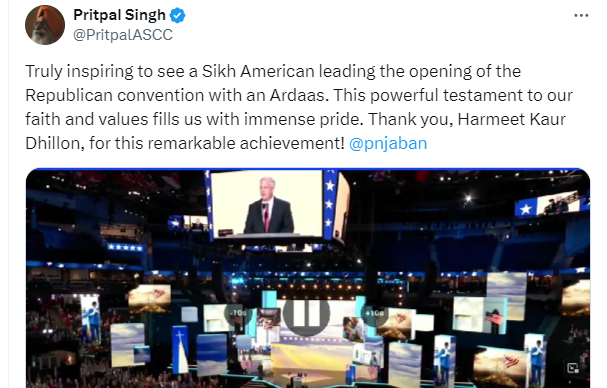
The recital of an ardas (Sikh prayer, also spelled as ardaas) at the Republican National Convention in Milwaukee (16.07.24) triggered a wave of anti-Sikh hate from Christian-American extremists this week.
Harmeet Kaur Dhillon, a California based lawyer who has personally represented Donald Trump and is also a senior member of the Republican Party recited the beginning of an ardas, a prayer to thank Waheguru (Sikh name for God/the divine/the creator) at the end of the convention. Prayers from different faith groups, including Christians, Jews and Sikhs prior to this week (in 2012 and 2016) are a normal part of these events.
As well as being a noted ardent Republican, often speaking in the media on relevant issues, Harmeet Kaur is also noted within Sikh circles for her effort to support the community, both legally in challenging discrimination against Sikh practices and also being vocal to her 800k+ (now 900k+) followers on Sikh issues, something noted by Sikh news outlet Baaz.
An ardas is known as a prayer of humility to the divine in which one usually thanks Waheguru and asks to become one with them in pursuit of goodness for all of humankind. Learn more about the power of ardas via Basics of Sikhi here.
After the ardas, Dhillon said “Dear Waheguru, our one true God, we thank you for creating America as a unique heaven on this Earth, where all people are free to worship according to their faith. We seek your blessings and guidance for our beloved country. Please bless our people with wisdom as they vote for the upcoming election and please bless with humility, honesty, skill and integrity all those who conduct the election”.
The Republican Party is largely affiliated with whites Christians and Dhillon’s speech can be seen as an effort to show the diversity of the Republican image. However, there has been public uproar from several Republican figures calling the ardas blasphemous, based on the idea the USA is a Christian country, with some going so far as to call the prayer “demonic”, based on fanatical interpretations of all faiths other than Christianity.
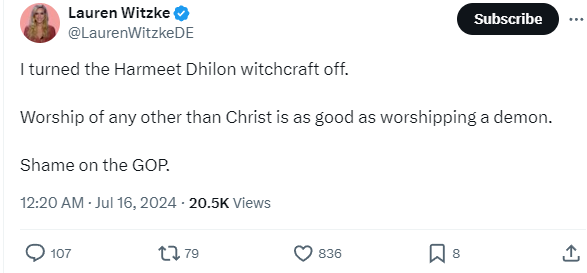
Lauren Witzke, an American far-right activist and former Republican Delaware Senate nominee, called the ardas “witchcraft…worshipping a demon”. Even in response to a tweet from Dhillon with a translation of the section of the ardas she recited, which relays the spiritual divine essence of the prayer to those denied by a language barrier, Witzke responded in hateful fashion, “What a lovely decorated word salad for “Hail Satan”“.
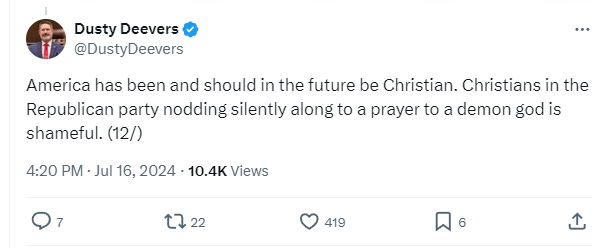
Dusty Deevers, a Christian nationalist pastor and Oklahoma State Senator, said that Dhillon’s ardas was “Attempting to win votes by appealing to religious neutrality is exchanging the truth about the Triune God for worship of pagan and demon entities”.
Thousands – possibly millions – of similar posts were made, including by influencers with hundreds of thousands of followers. Many of these posts were amplified by Indian nationalists, who were capitalizing on an opportunity to further Sikh hate.
Despite all of the hate, the effort to represent Sikhi in the convention was praised by many, whilst countless Sikhs also spoke out on social media against the hate from both Indian nationalists and Christians.
Pritpal Singh of the American Sikh Caucus Committee (ASCC), which seeks to address issues such as military discrimination, violence and bullying of Sikhs, thought Dhillon’s speech to be a “remarkable achievement”, something many echoed, especially as it came just days after an assassination attempt on leading Republic Presidential candidate Donald Trump at the biggest annual event of his party.
Much of the anti-Sikh hate which has been rife in the US recently has been rooted in misunderstandings conflating the physical Sikh identity with the look of Islamic extremism.
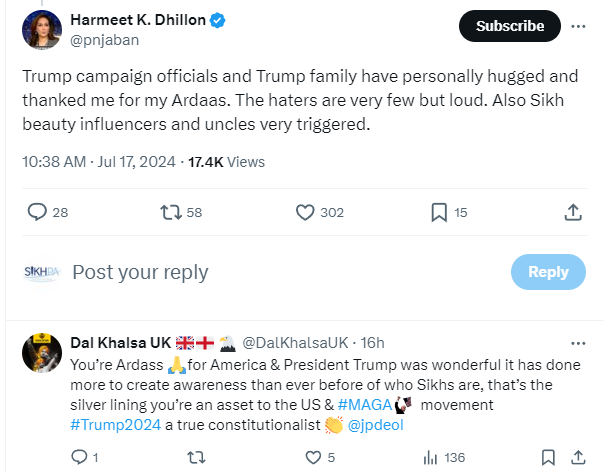
Harmeet Kaur Dhillon has previously called out Indian Prime Minister Modi’s role in the 2002 Gujrati Muslim genocide and spoken against India’s transnational repression such as the assassination of Shaheed Bhai Hardeep Singh Nijjar in Canada and the attempted killing of Gurpatwant Singh Pannun in New York. However, this same effort to address Sikh issues is also why Indian nationalists are attempting to fuel hate and mistrust towards here.
Harmeet Kaur also revealed that the Trump family personally thanked her for the ardaas. Donald Trump is expected to become the next President of the USA for the second time in November’s national election, with Harmeet Kaur expected to continue working with him whilst still advocating on Sikh issues.
The brother of Sikh community leader Bhai Amritpal Singh was arrested on what his lawyer called “false” charges which are part of a larger pattern of Indian State authorities targeting his family.
Harpreet Singh’s legal representative and High Court lawyer Imaan Singh Khara released a video on the arrest calling it “politically motivated” by AAP (party in charge of Punjab and Delhi), which is part of India’s tactic of using “false charges to detain dissidents and activists”. Khara also referenced the arrests of other members of Bhai Amritpal Singh’s family as evidence of the agenda against the leader of Waris Punjab De. Watch the video here.
Police allege Harpreet Singh was arrested whilst his car was found parked on the side of a highway, where he was consuming drugs with another. Police allege they have evidence and a confession from Harpreet Singh which proves the purchase and use of the drugs.
Bhai Amritpal Singh, who is both the leader of social reform group Waris Punjab De (WPD) and also a recently elected MP, became an Indian State Sikh political prisoner last year, after authorities seized Punjab with 80,000+ paramilitary forces to destroy his movement which focused on tackling drug use and trafficking. Lawyer Khara represents all the WPD team, including nine members also incarcerated with Bhai Amritpal Singh, kept over 2000 miles from Punjab in Assam’s Dilburgarh jail.
As well as tackling Punjab’s drug epidemic, Bhai Amritpal Singh was also a big proponent of Sikh sovereignty (namely the Khalistan free Sikh homeland movement). An incident which saw him lead a group to free detainees of a Punjab Police station where torture was being reported is largely the main reason he is cited as a “criminal” by the Indian establishment.
Sikh groups around the world continue to watch the ongoing saga around Bhai Amritpal Singh, particularly after his election, with anticipation to see just how his role as an MP can impact his plight as a Sikh political prisoner and target of the Indian State.
The Indian government’s destruction of for Sikh family homes has seen Sikh authorative body the Shiromani Gurdwara Parbandhak Committee (SGPC) make a global call for Sikh orgs to condemn the in-power BJP Party.
Just weeks ago (26th June) an official government empowered mob of far-right goons, Haryana police and state government representatives of the BJP Party came to the Amupur village (Karnal disctrict) of Haryana and demolished the homes of four Sikh families without prior notice.
The reason given for the demolishment was that the homes were not built with adequate permission, 77-years-ago when the family’s ancestors moved to Haryana from the side of Punjab turned into Pakistan during the partition after the British Raj. Haryana officials claim that the houses were built on encroached land which did not belong to them, despite the fact that the families have been there since partition without any issues or claims to the land.
In response to the BJP government’s actions in Haryana, which led to the demolition of houses belonging to four Sikh families, a delegation from the Shiromani Gurdwara Parbandhak Committee (SGPC) visited Amupur. The affected families were met by the SGPC representatives who expressed their solidarity and commitment to supporting them.
SGPC President Harjinder Singh Dhami has formed a committee specifically to address the situation. This delegation visited the families to understand the situation on the ground and assured them of the SGPC’s unwavering support against the government’s actions.
Buta Singh, a member of one of the affected families, recounted their history. His family, consisting of four brothers, migrated from western Punjab after the 1947 partition and had settled in Amupur village. “Our ancestors migrated from Pakistan during the partition and settled at this place, but suddenly the government came with police to demolish the houses. No notices were served. They left us with no shelter, water, electricity or place for toilet.”
The SGPC delegation announced financial assistance for each of the four affected families and also emphasized that they would provide ongoing support to these families at all levels, whilst also appealing to human rights organisations and activists to raise their voices against the BJP government’s actions.
A spokesperson also called on all Sikh organisations to help these families and call out BJP anti-Sikh actions. The delegation also urged Prime Minister Narendra Modi to address his party’s harassment of Sikhs in Haryana. During a press conference, spokespeople for the SGPC committee also questioned Sikh reps of the BJP, challenging them to explain why Sikh houses are being demolished under a BJP-led government.
The Haryana Sikh Gurdwara Management Committee (HSGMC) have pledged to get the Haryana government to rebuild the homes of the four Sikh families, stating they will buy the land that was stolen form the families if necessary, and do their best to help with the rebuilding.
In the meantime, the local community have come together to support the families, providing them with langar (communal kitchen service) at local Gurdwara, Patshahi Chhevin in Kurukshetra.
The Haryana far-right BJP government has demolished the homes of other minorities in recent years too in a continuation of the bulldozer politics which Just last August (2023) they forcefully bulldozed over 300 homes in Haryana, whilst this act of oppression has also been carried out in other states of India. These actions are in line with the rhetoric of the BJP party, and its aim to make India a Hindu nation, making it known that minorities such as Sikhs are second-class citizens in India.
A Forensic Science Laboratory (FSL) report has ruled that 21-year-old #FarmersProtest2024 shooting victim Shubhkaran Singh was killed by a shotgun, which Haryana Police claim absolves them of the death as they do not use shotguns.
The claim has provoked the ire of Sikh groups, after eyewitnesses saw police firing at #FarmersProtest2024 crowds last February, shortly before Shubhkaran Singh died from a bullet to the head. The FSL report was part of an investigation into the killing, which Haryana Police deny responsibility for, despite even video evidence of police firing.
The report has led to police suggesting that farmer protesters were actually responsible for the death, although none were seen in possession of any firearms, let alone firing them at the massive demonstration on February 21st on the Khanuri border, where a protest camp was set-up for a planned rally to Delhi.
In the same week, an obvious publicity stunt saw Punjab authorities give Shubhkaran Singh’s sister a job with the police, something which was promised – as well as more financial compensation – to Shubhkaran Singh’s family after his death. Why Indian authorities would pay compensation to a family for a murder they deny involvement in is unclear, but tellingly suspicious. To her credit, sister Gurpreet Kaur said the job would not be sufficient for justice for Shubhkaran Singh’s death.
In a Tweet on the issue, respected Punjab based Sikh journalist Parmjit Singh Gazi compared the findings to another Indian Police killing of a Sikh youth. In 2012 protests against police inaction on beadbi (sacrilege) led to police shooting 17-year-old Jaspal Singh dead.
Gazi stated:
“Investigation in Shubhkaran Singh’s killing case appears to mirror the troubling patterns seen in Jaspal Singh Gurdaspur’s killing case. Back in 2012, Jaspal Singh was fatally shot by police, with an AK-47. Despite initial denials of AK-47 issuance on the day of the incident, a court-ordered forensic examination eventually linked the bullet to a police-issued AK-47. The police later claimed the shot was fired in the air and ricocheted to fatally hit Jaspal Singh. Years later, a closure report was filed, asserting no trial was necessary. Now, in Shubhkaran Singh’s case, forensic findings indicate he was fatally struck in the head by shotgun fire. Haryana government’s advocate claims that Haryana police don’t use shotguns. This is indicative of a prevailing implied policy of impunity in cases where police are accused of lethal use of force.“
During the 2021 Farmers Protest Republic Day rally, Navdeep Singh was also shot dead by police in an incident seen by many, but yet again was ultimately ruled an accidental death. A UK based doctor later examined video evidence of the bullet wounds Navdeep Singh had on his body, and categorically agreed they were clearly bullet wounds.
Sikh groups continue to advocate for justice for Shubhkaran Singh, although the latest forensic ruling ultimately eliminates the possibility of any form of justice through the Indian State system, an outcome which is the norm when it comes to such cases.
The UK took to the polls this week, finally giving all Brits a chance to vote in a Prime Minister for the first time since Boris Johnson was elected in 2019.
The premierships of Liz Truss and Rishi Sunak (with just one month between them) were elected within the Conservative Party, giving the wider UK electorate extra incentive to finally make their own choice. And the choice was made emphatically, with a landslide Labour Party majority government coming into power, led by Sir Kier Starmer.
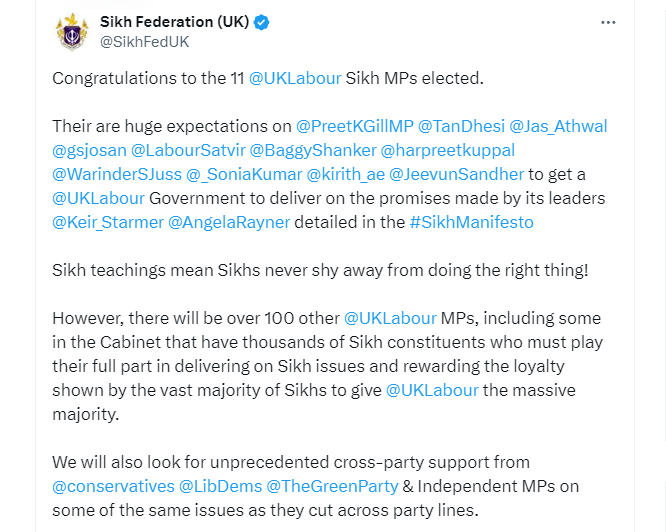
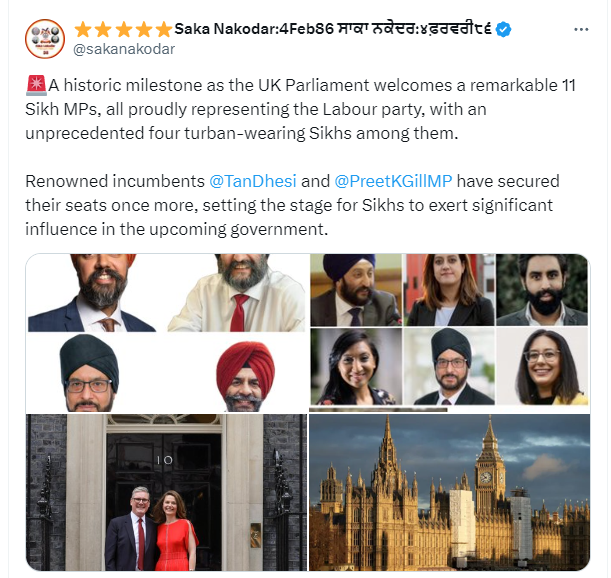
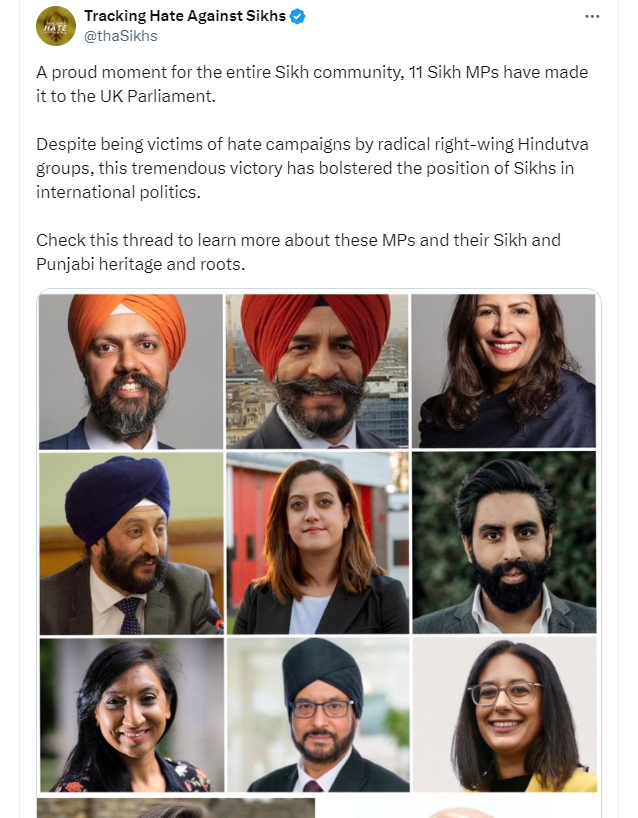
With the Labour victory came a range of reactions from within Sikh communities, largely based on the election of a historic 11 Sikh-background MPs. However, others also raised various issues related to the Sikh kaum (nation) whilst recognising the dawn of a new chapter in the UK.
Here we share reaction to the UK General Election 2024 from Sikh organisations, community figures and others reflecting wider sentiment.
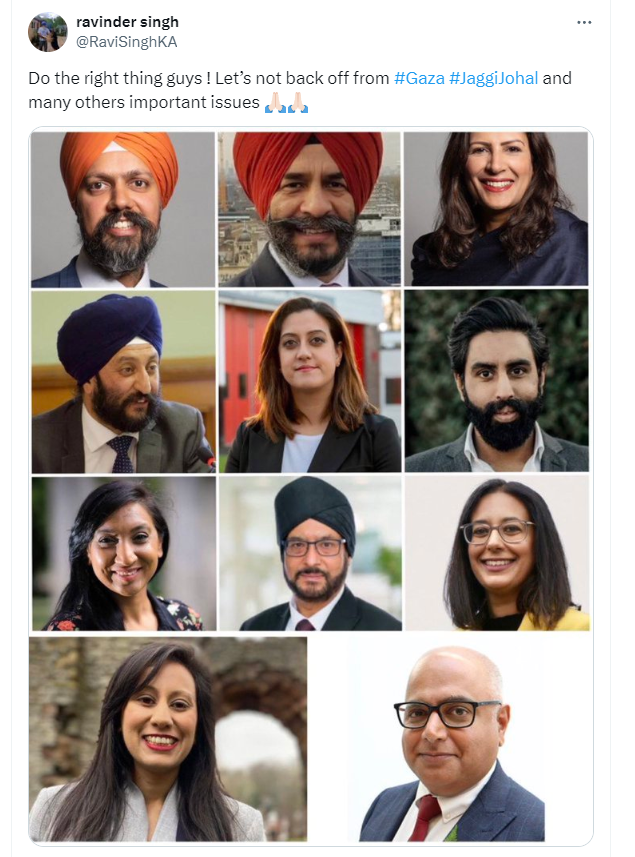
The main focus from Sikh communities regarding the election results in the UK was the election of 11 Sikh MPs.
Many were happy the UK would see three more dastaars (Sikh turbans) in parliament.
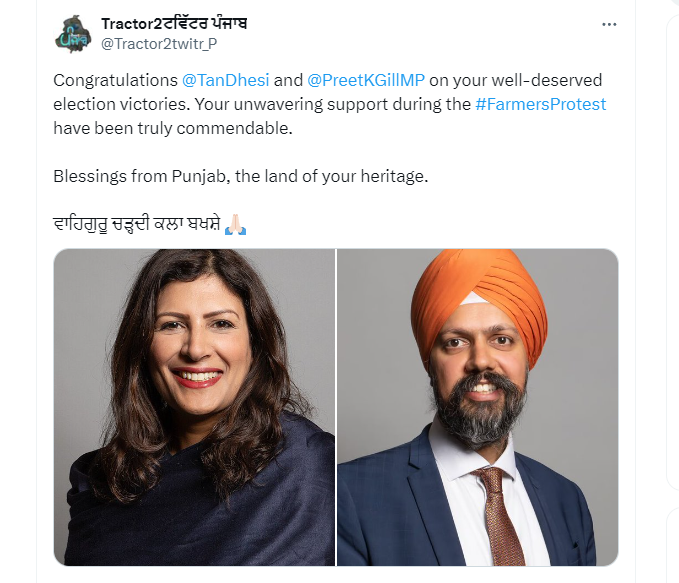
The outcome was welcomed by many Sikhs across the globe, with respected Punjab based #FarmersProtest focused outlet @Tractor2Twitter noting the support Tanmanjeet Singh Dhesi and Preet Kaur Gill gave to their movement against Indian State agricultural exploitation. Some of the newly elected MPs also raised the #FarmersProtest issue whilst with the party when it first came about in 2020.
A Sikh-hate focused X (Twitter) account also noted how many of the Sikh MPs have had to face Hindutva (Hindu extremist) hate, which often claims such MPs are “Sikh extremists” for raising concerns about human rights abuses in India, where Hindu nationalism weighs on politics.
Demands of the MPs began immediately though, with the likes of world renowned humanitarian Ravi Singh calling on them to address the #GazaGenocide and #FreeJaggiNow case.
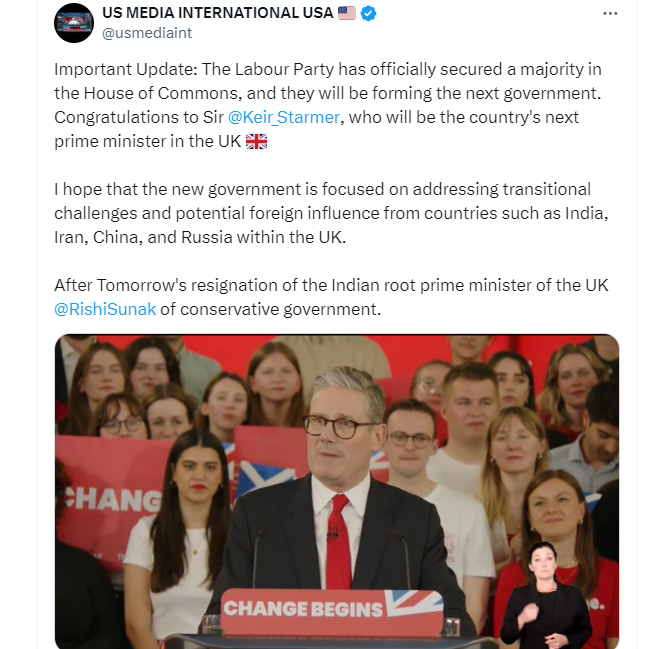
US Media International, an independent Punjabi media outlet which centres around sovereignty related issues, congratulated Starmer whilst raising the issue of “foreign influence”, with India’s anti-Sikh transnational repression being a major concern of Sikhs worldwide and believed to be behind the suspected poisoning of activist Shaheed (martyr) Bhai Avtar Singh Khanda last year in Birmingham.
Sri Guru Southall Singh Sabha were among various Gurdwaras to release statements on the election outcome, going as far as to say “”We know you are committed to working with faith communities, and we stand ready to play our part.” Derby’s Guru Arjan Dev Ji Gurdwara committee also said the election of Baggy Shanker was a “proud moment” for the entire community.
An issue countless Sikhs hope the new Labour government will take on is India’s arbitrary imprisonment of Sikh political prisoner Jagtar Singh Johal. With Jaggi’s brother Gurpreet Singh a Labour councillor, many believe the party may offer the best hope yet to see the Scot finally return home from India after flying out to get married.
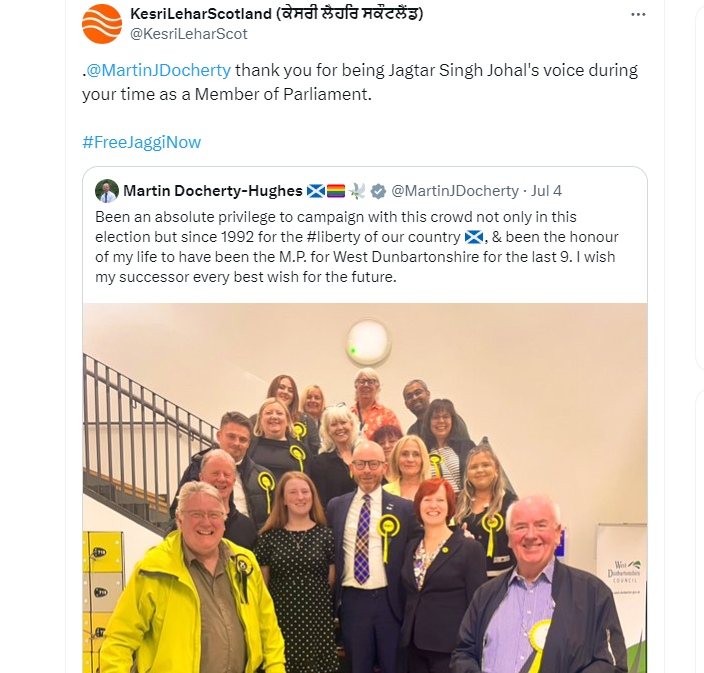
Many Sikhs expressed disappointment in learning that Martin Docherty-Hughes, Scottish National Party MP of West Dunbartonshire, lost his seat to Labour’s Douglas McAllister. West Dunbartonshire is the constituency of Jagtar Singh Johal, British Sikh political prisoner arbitrarily detained in India since 2017. Martin Docherty-Hughes was instrumental in ensuring the #FreeJaggiNow case was constantly raised in parliament and beyond, showing immense support to Jaggi’s family and the campaign in general.
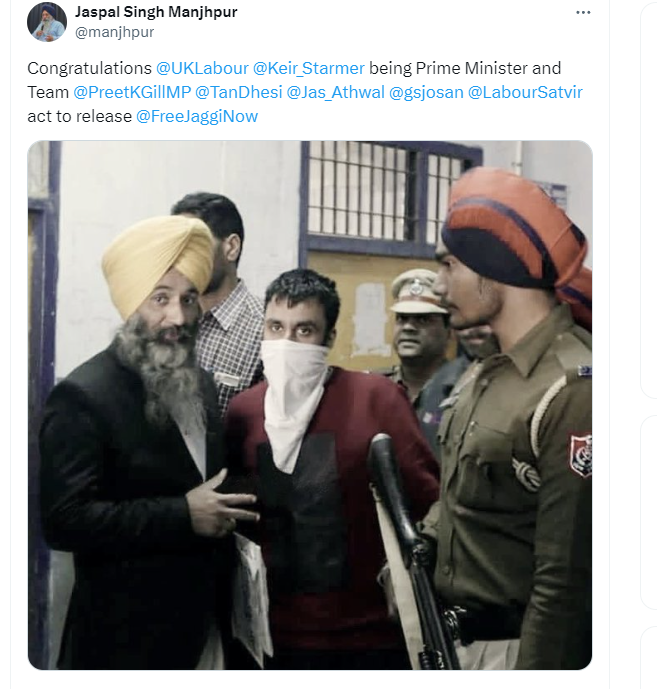
Jaggi’s lawyer, world renowned political prisoner turned self-taught legal advocate Jaspal Singh Manjhpur, also tweeted congratulations to Labour before calling for them to separate themselves from seven-years of Conservative rule by seeing Jaggi come home.
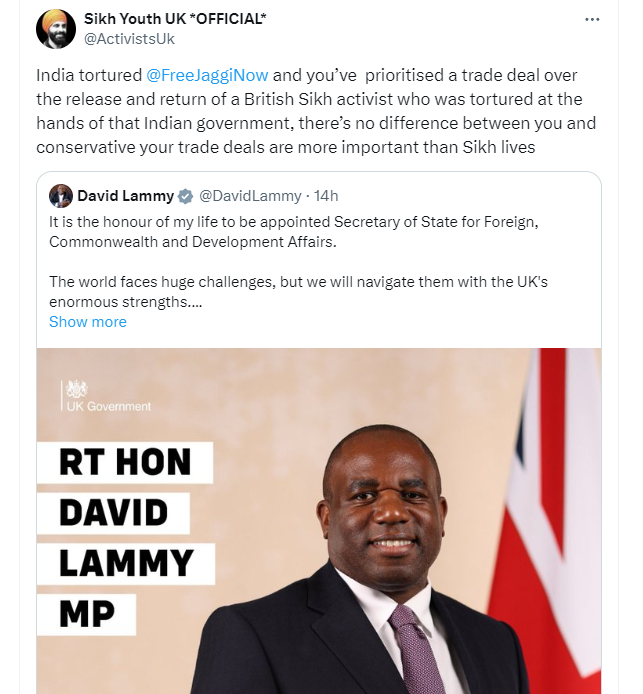
There is concern however, that new Foreign Secretary David Lammy has been prioritising a trade deal with India, with the Free Trade Agreement between the nations still pending. Lammy is expected to visit India within the month to cement relations, something which some Sikh groups say is inappropriate whilst a Brit continues to languish in an Indian prison without being charged with a crime, which should be the priority focus.
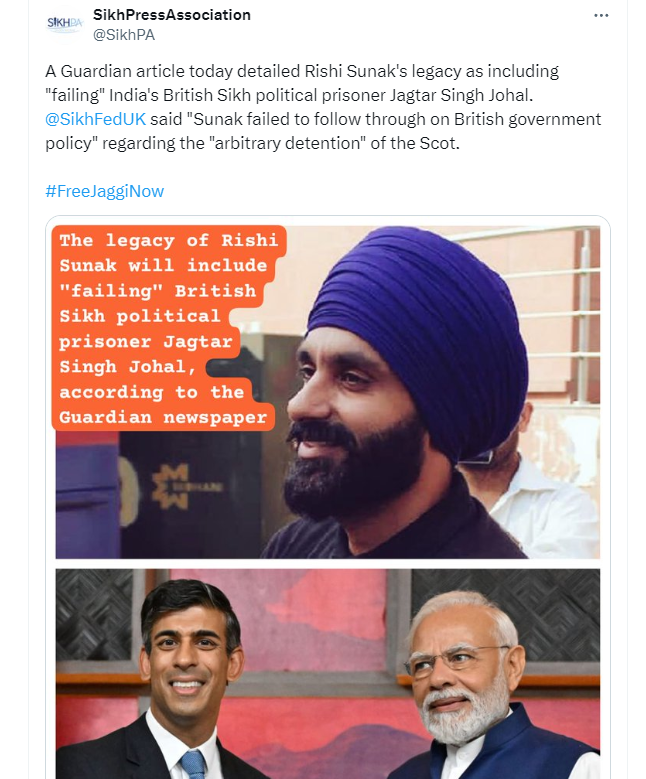
Rishi Sunak leaving as Prime Minister has also provoked some reaction, especially considering many suggested his background means he would be able to better represent the British-Asian community. This idea was not reflected in reality, and some were keen to point that out, leading to the Guardian newspaper including that in an article on Sunak’s legacy.
In summary of global Sikh reaction, Sikh Press Association Senior Press Officer Jasveer Singh said:
“Sikhs across the world are largely delighted to see more Sikhs – especially dastaar wearing practicing Sikhs – in UK parliament with the incoming Labour Party.
“This is partly to do with how previously Tanmanjeet Singh Dhesi and Preet Kaur Gill have helped amplify Sikh issues into UK parliament. The two have set a high standard for the others to follow from a Sikh community perspective.
“Nevertheless, there are many who have concerns about Kier Starmer’s Labour and the role British-Asians played for the last Conservative regime has also left many with a sour taste when it comes to ‘representation’, so not everyone is expecting pure harmony between Sikh kaum (nation) sentiment and the new UK Sikh MPs.
“Tests will soon come, as we approach the 40th year anniversary of the Indian State Sikh genocide and the seventh year of Jagtar Singh Johal’s arbitrary imprisonment in India. Then we will really see these Sikh MPs define for themselves how wider Sikh communities see them, and that will continue through their time in parliament.”
A publicity stunt by a yoga influencer at a holy Sikh site exposed an ongoing Indian nationalist agenda to demonise the community and undermine its institutions, such as the Shiromani Gurdwara Parbandhak Committee (SGPC).
Archana Makwana, an influencer based in Gujrat, faced international backlash after an offensive post where she stood on her head in Sri Harmandir Sahib. After criticism regarding the classless act, the well-known affiliate of far-right Hindu nationalist political party the BJP, Makwana soon began challenging the SGPC and her critics.
NOTE- Sikh PA will not share the disrespectful pictures of Makwana standing on her head in a place of worship.
Leading Sikh body the Shiromani Gurdwara Parbandhak Committee (SGPC) have said Makwana, who is an affiliate of the far-right Hindu nationalist party BJP, is working under a “nefarious, hateful” agenda.
SGPC stated that “she violated Maryada (protocol/guidelines) at Sri Harmandir Sahib, hurting the sentiments of the Sikh community by posting the objectionable photo/video on her social media. After the incident, the manager on duty lodged a police complaint against her, resulting in an FIR (First Information Report) registered by Amritsar Police.”
Makwana initially apologised for “hurting the religious sentiments” of Sikhs but has since released several videos attempting to defend her actions and also claiming she is the victim of death threats. She has claimed that she was not aware of the Maryada (guidelines) during her visit. She also claimed that during her visit nobody stopped her from filming but, in reality, SGPC stated that “she was stopped at the entry gate on June 21 by the on-duty Sevadar (selfless volunteer), when she was filming her entry”. The leading Sikh body in charge of India’s Gurdwaras also said Makwana “did not even pay any obeisance at Sri Harmandir Sahib, or any related Gurdwara Sahib inside the complex”, she simply entered the complex to do yoga and for the photo opportunity on 21st June. SGPC questioned her by stating “if she felt apologetic, then why is she continuing to post objectionable and hateful expressions”.
There is much evidence of Makwana’s political alignment to the far-right affiliated BJP. The situation has also been manipulated by Indian nationalists to suggest Sikh orgs are in conflict with an Indian way of life. Some Indian media even stated Makwana is receiving this backlash because of her caste, despite it having no connection to the issue. Furthermore, various Indian nationalist commentators have posted on social media claiming reaction to Makwana’s disrespect shows “extremism” within the nation’s 2% Sikh community, prompting more anti-Sikh sentiment.
Far-right Hindu rhetoric has consistently been trying to portray Sikhi as just another form of Hinduism, and claim that Sri Harmandir Sahib is a Hindu mandir. Thus, such situations allow Indian nationalist fanatics to claim Sikh authorities are the ones dividing Indians and distorting the Sikh faith. This is despite the fact every respected Sikh educational body advocate Sikhi as completely separate from Hinduism. The disrespect for Sikh Maryada (guidelines) at a Gurdwara from an individual who is affiliated with the BJP is therefore seen as something more sinister than an honest mistake, which is why SGPC have described Makwana’s motivations as “nefarious” and “hateful”.
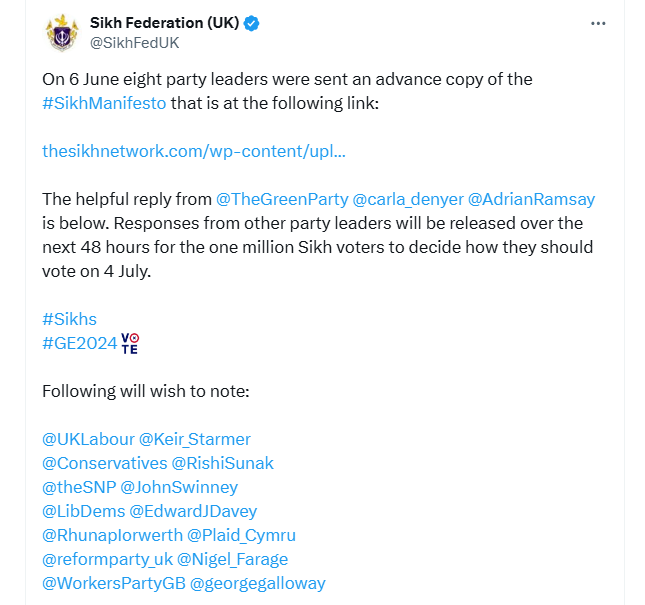
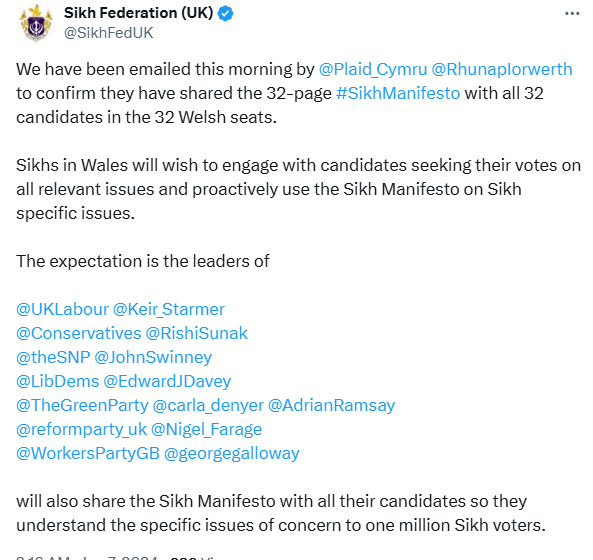
The Sikh manifesto contains several examples of community issues MP candidates are being asked to take a position on to secure Sikh votes. There are 10 sections of the manifesto, including demands on securing the release of Jagtar Singh Johal, combatting anti-Sikh hate crime and protecting British Sikhs from transnational repression by the Indian government.
There have been responses and acceptance of the manifesto from representatives of the Green Party, the Scottish National Party and Plaid Cymru. There have been no responses from the two major parties, the Labour Party and the Conservative Party.
Arguably the biggest political advocate of the Sikh manifestation is Angela Rayner, the deputy-leader of the Labour Party, who met with sangat (Sikh congregation) at Gravesend Gurdwara to try to see current positions on previous commitments from Labour regarding Sikh issues including a public inquiry on UK involvement in the 1984 Indian State attack (culminating in genocide) on holy Sikh site Sri Harmandir Sahib and the release of Jagtar Singh Johal on 30th June. After the meet, SFUK released a statement saying “the majority” of Sikhs are expected to vote Labour, partly due to assurances on manifesto points.
A week earlier senior Conservative MP, former Prime Minister Theresa May, was presented with the manifesto at her local Maidenhead Gurdwara.
Green Party co-leaders Carla Denyer and Adrian Ramsay gave a “helpful” reply to the Sikh manifesto according to SFUK reps, through recognising the need to combat anti-Sikh hate, protect the five Kakaars (Sikh articles of faith) and improve education about Sikhi. They also restated their support for the release of Jagtar Singh (Jaggi) Johal and an independent inquiry into Britain’s role in Operation Blue Star. They also stated their recognition of the right to self-determination, referring to the current struggle for Khalistan (free Sikh homeland).
John Swinney, the Scottish National Party (SNP) leader and First Minister of Scotland, responded by stating the steps they have made to try and create a strong relationship with the Sikh community in Scotland and their belief in the right of freedom of religion and worship. He also restated the party’s support for the release of Jagtar Singh (Jaggi) Johal. Jaggi is a constituent of SNP MP Martin Docherty-Hughes, who has worked with the Sikh Federation (UK) to try to secure Jaggi’s release.
Welsh party Plaid Cymru also confirmed that they shared the Sikh manifesto with all 32 of their candidates in the 32 Welsh seats.
Whilst there has been no response from Kier Starmer or PM Rishi Sunak as leaders of the Labour and Conservative parties, several candidates from both parties have accepted the Sikh manifesto whilst visiting their local Gurdwaras.
On a visit to Guru Nanak Sat Sang Sabha Gurdwara in Maidenhead, the local Sikh community raised their issues to candidates and gave them the Sikh manifesto. The Labour candidate, Jo Smith, the Conservative candidate, Dr Tania Mathias, and Liberal Democrat candidate, Joshua Reynolds, were all photographed with the manifesto.
Former Prime Minster Theresa May also accepted the manifesto, although she will not be standing in the upcoming general election.
Coventry based Labour MPs Zarah Sultana, Taiwo Owatemi and Mary Creagh all attended Guru Nanak Parkash Gurdwara to affirm support for the manifesto, cementing what seem to be already popular positions with local Sikhs, particularly with Owatemi, who was roundly praised for her role in raising the #WestMidlands3 situation in parliament.
A meeting at Guru Nanak Sikh Gurdwara on 30th June saw Edgbaston MP for Labour Preet Kaur sit with prospective Smethwick candidate Gurinder Josan and community sevadaars (selfless servants), discussing points on the Sikh manifesto. However, it also disappointingly revealed Conservative candidate for Edgbaston Ashvir Sangha was “allergic to take up Sikh issues” according to SFUK, when the Oxford Uni graduate refused to be pictured with the manifesto.