
Ex Indian govt employee among five arrested for Amritsar bombings
Five men, including an ex-Indian government employee, have been found to be behind a series of bombings over the past week near holy Sikh site Sri Harmandir Sahib (also referred to as Darbar Sahib) in Amritsar, Punjab.
Indian news reports claim the men were upset about a statement made during a viral incident last month, in which a man doing security for Sri Harmandir Sahib Gurdwara said “This is Punjab, not India”, evident from letters left at the bombing sites. However, the letters allegedly also contained content claiming support for Bhai Amritpal Singh and anti-Sikh actions of authorities in targeting the Sikh leader.
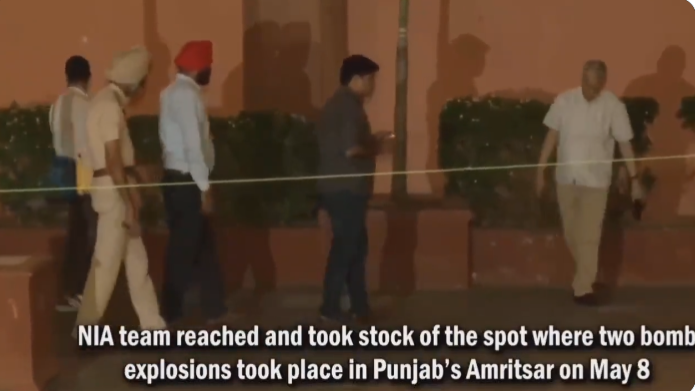
On 6th May at approximately 11pm, 8th May (6.30am) and 11th May (12.30am), homemade explosive devices were detonated in locations not more than 2km from the fabled Gurdwara that is visited by an estimated 100,000+ a day. The explosions on 6th and 8th of May both happened on Heritage Road, whilst the third happened outside Shri Guru Ramdas Ji Niwas Gurdwara.
Five men have been arrested for the bombings after sevadaars (selfless servants) of Sikh leadership body Shiromani Gurdwara Parbandakh Committee (SGPC) had used local CCTV footage to capture for the first culprit and hand him in to police themselves. After pressing for more police action, with the authorities accused of taking the bombings “lightly”, further arrests were made of men named Azad Veer Singh (36), Saheb Singh, Dharminder Singh, Harjit Singh (ages undisclosed) and Amrik Singh (26).
In a confusing turn, Indian media claim there were letters left at the site of each bombing that were torn apart by the explosions which were later pieced together to reveal the men’s motives, which included “the imposition of the National Security Act (NSA) on Amritpal Singh” and “easy access of tobacco in Amritsar”, also noting the men were upset about the rhetoric that “Punjab was not part of India”.
Many Indians have complained about rough-handed treatment dished out by Sikhs (specifically those of the Nihung Singh warrior faction of the Khalsa {initiated Sikhs}) to those consuming or selling tobacco in Sikh spaces. Tobacco is strictly forbidden in or aside any Gurdwara.
Questions will be asked as to why supporters of Bhai Amritpal Singh would want to detonate explosives in a Sikh area, knowing he was a stringent advocate of Sikh sovereignty, respect for Sikh spaces and royal protocol for Guru Granth Sahib Ji, the Sikh scriptural Guru. Causing chaos around a holy Sikh site seems to be a complete contradiction to what Bhai Amritpal Singh stood for, whose only act of so-called criminality was to lead a community movement freeing men from arbitrary arrest at a police station where torture was being reported, as is common in Punjab. As a supporter of the Khalistan (free Sikh homeland movement), ardent supporters of Bhai Amritpal Singh are also in favour of Punjab being separate from India, contradicting media claims about the bombers.
It is claimed three of the men had prior cases with police, with ex-government employee Azad Veer Singh arrested for “hurting Hindu religious sentiments” in 2021 and Amrik Singh arrested for stealing motorcycles, whilst Saheb allegedly having previous under the Explosives Act for running a “cracker making factory” without licence. Azad Veer was also noted as having “travel history back to Pakistan” according to his Hindu accuser for the 2021 case of alleged “blasphemy”. The father of Amrik Singh has been quoted as saying his son is “into drugs” and “small-time theft”, whilst Dharminder and Harjit are outright called “drug addicts” in Indian media.
The homemade bombs, made with drink cans, were described as crudely made, causing only minimal damage and minor injury to two people on Saturday and Monday respectively from their “low intensity”.
Indian media outlets have separately made claims that range from the stating the group show “no connection” to the Khalistan movement to some claiming the violence mimics issues seen during the 1980s when Sikh saint Sant Jarnail Singh Khalsa Bhindranwale led his movement from Amritsar, which is linked to the Khalistan movement.
However, Khalistan resistance attacks always targeted specific individuals who were noted as being heavily involved in perpetrating the Sikh genocide which peaked from the mid 1980s-mid 90s. This included senior policemen and politicians, rather than targeting random civilians. Contrastingly, a history of public bombings are linked with Hindu nationalist support, including attacks aimed at instigating communal violence.
NOTE- Information quoted from Indian media sources are not hyperlinked as they can often come from outlets which are known to propagate anti-Sikh rhetoric.


Leave a Reply
Want to join the discussion?Feel free to contribute!