
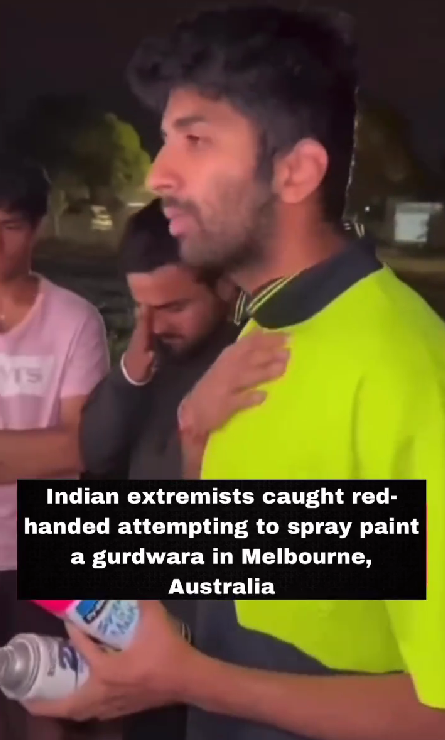
Indian vandals caught red-handed amid ultranationalist attempts to disrupt Khalistan Referendum
An Indian ultranationalist goon admitted he had turned up outside a Melbourne Gurdwara to graffiti Khalistan (free Sikh homeland) Referendum posters, after being caught red-handed by local Sikhs this weekend.
The incident was one of several attempts by Indian ultranationalists to disrupt Australian Sikh efforts to pursue their democratic right to hold the Khalistan Referendum in Melbourne. The Sikhs For Justice campaign has been peacefully and legally held in the UK, Italy and Canada without incident, underlining a growing Hindutva problem in Australia.
On the evening of 29th January a man was caught with four accomplices (three seen in this video by Sikh activist and influencer @Free5ab) acting suspiciously in a car outside Tarneit Gurduara Sahib (Davis Road, Victoria) when they were confronted by sangat (Sikh congregation). They were found with cans of spray paint and when pressured they quickly admitted they came to vandalise posters on the property. The men, who apologised amid their confession, were handed over to authorities. In India, goons caught before attempting beadbi (Sikh sacrilege, usually referring to attacking scripture) and worse have said they were paid to do so by Indian state authorities.
The depth of Australia’s Hindutva (Hindu extremist, which is entwined with Indian ultranationalism in belief of the Hindu rashtra [nation]) problem has been underlined in recent years through the actions of violent Indian mobs targeting Sikhs in various attacks, leading to the deportation of Hindu extremist Vishal Jood. After being kicked out of Australia for his anti-Sikh violence, Vishal Jood has become a figure celebrated by India’s media and countless ultranationalist fanatics.
Earlier this month, video evidence produced by Sikhs For Justice proved that Khalistan Referendum posters were being targeted for graffiti, in what are believed to be attempts to provoke the Sikh community. Pictures of Sant Jarnail Singh Khalsa Bhindranwale, the revered Sikh saint that became the face of Sikh activism in the 1980s), were particularly targeted by the vandals.
Previous to this, Hindu groups in the Melbourne area accused Khalistan supporters of being behind graffiti on Mandir (Hindu temple) property. However, no evidence has been found to connect any Sikh with the criminal act, and Sikh groups have unanimously come out to condemn the act. Many Sikhs have suggested the graffiti was done in an attempt to tarnish the Khalistan Referendum campaign as anti-Hindu, instead of simply in favour of Sikh rights, which is the essence of the movement. Questions are still being asked as to why no CCTV footage has been released by any Mandir to expose the crime.
In Brampton (Canada, Ontario), similar issues saw a man with an Indian Hindu name – Kartik Tugnait – arrested for anti-Sikh graffiti, whilst accusations of Sikhs being behind graffiti of a Mandir were revealed to be seemingly completely made up, embarrassing the likes of MP Chandra Arya, an Indian origin politician that amplified the accusation against Sikhs.
Video footage of skirmishes between supporters of the Khalistan Referendum and Indian ultranationalists that turned up to antagonise them on the day of the referendum have gone viral this week. However, whilst Indian and Australian media attempt to portray Sikhs as the instigators of the violence, more recent footage shows conflicts began when an Indian mob stormed the area. The situation in Melbourne’s Federation Square area was completely peaceful for hours as thousands of Sikhs came to vote during the day. The mood changed when the Indian mob arrived, screaming and making provocative chants about India being a Hindu nation whilst confrontationally standing before Sikhs in the area, which included women and children. Witnesses also state that the Indian ultranationalists were shouting insults towards Sikhs, which included references to recreating the Sikh Genocide of 1984, before some Sikhs retaliated.
Many Sikhs are concerned about India’s influence on Australian media’s coverage of such issues. With the in-power BJP group known to thrive of the ultranationalist rhetoric in India, the Indian state’s influence on Western media has long been a concern. The likes of Damon Johnston, Benn Packham (both of The Australian) and Stephen Dziedzic (ABC) seem to be regurgitating Indian ultranationalist anti-Sikh Indian propaganda, whilst completely ignoring the context of Australia’s Hindutva problem, or the well known fascism within India, which recently become a global topic after a BBC documentary was released on India’s Prime Minister Narendra Modi’s genocidal actions. There is also concern about the impact of India’s ultranationalist online army swaying perception of the issue, through both social media bot networks and also pseudo-media accounts designed to look like regular news outlets but are actually Indian ultranationalist propagandists.
Speaking on this issue, Sikh Press Association Senior Press Officer said:
“Australian media have an important role right now in covering recent events connected with the nation’s Sikh community. The fascism and bigotry that upholds India’s current regime are now well known, and thus the Khalistan freedom movement needs to be viewed within that context. This includes what is happening at a grassroots level in Australia, where Indian nationalist mobs have violently attacked Sikhs in recent years. The fact that the confession of a Hindu man caught red-handed trying to vandalise Sikh property has not made mainstream news in Australia is a sad reflection of how the nation’s media is being distracted from the truth of what is behind recent incidents in Melbourne.
“Any journalist suggesting that the Khalistan Referendum is at the heart of any trouble in Australia is either influenced by India’s state or completely misinformed about what is going on in Australia and with Sikhs worldwide too. We encourage Australia’s media to really delve into the situation and not simply regurgitate Indian media takes on recent incidents in Melbourne.”
Media looking for more insight from a Sikh perspective on recent incidents in Melbourne can email media@sikhpa.com.


Leave a Reply
Want to join the discussion?Feel free to contribute!