

Kabul Gurdwara massacre: Breakdown and Reaction
Yesterday we reported on the tragic terror attack at Gurdwara Sri Guru Har Rai in Kabul, Afghanistan, which killed 25 people and wounded many more. Here we share facts around what happened along with reaction from around the world.
Latest update 27.03.20:
Reports from Kabul state Sikhs found mine-bombs planted around the Gurdwara and neighbouring complex where the community lives. The army were called in to detonate the bombs. No casualties have been reported.
We will provide updates asap.
What happened?
The original attack took place on March 25 while most governments around the globe were focused on measures to prevent the spread of the COVID19 virus. Families across the whole world remained confined inside their homes, concerned about the health and wellbeing of their loved ones and worried about whether or not they had enough food and essentials to last throughout a time spent in forced confinement.
#Breaking: Terror attack attack on a Sikh Gurudwara in Kabul. Suicide bombers enter the holy place.@DrAnarkaliH
— Ravinder Singh Robin ਰਵਿੰਦਰ ਸਿੰਘ راویندرسنگھ روبن (@rsrobin1) March 25, 2020
However, the focus on social-distancing and self-isolation was interrupted early Wednesday morning by the news from Afghanistan, where the coronavirus situation had not yet escalated to a point where a full lockdown was enforced. Reports started coming through that gunmen had stormed the Gurdwara in Kabul. Initial reports stated that they had killed at least 4 people, and were caught in a stand-off with police.
At the time of the attack the Gurdwara was holding a Paath (prayer service) for the good health of all humanity throughout this pandemic, with a sizeable section of the Afghani Sikh community in attendance, as well as several from the Hindu community too. The sangat (Sikh congregation) numbered between 150-200 people when the attack started. From our sources, eyewitnesses spoke of multiple assailants and even suicide bombers among the attackers.
#Breaking– An explosion occurred near to Dharamsala – a worship area of #Sikh which came under attack of gunmen on Wednesday morning – in the Shorbazar area of #Kabul city.
Police said that gunmen are fighting with Afghan security forces in the area.#Afghanistan pic.twitter.com/zETWVtheq3— Ariana News (@ArianaNews_) March 25, 2020
Narender Singh Khalsa, a member of parliament in Afghanistan told news agency Reuters in one of the earliest reports on the incident: “Three suicide bombers entered a dharamsala (place of worship). The gunmen started their attack at a time when the dharamsala (religious place) was full of worshippers.”
Harander Singh, who lost several other relatives including his wife, father and daughter, added: “The attackers arrived on the stairs and started killing the women. My nephew shouted and said to me ‘Uncle, please go downstairs’, and when I tried to go downstairs, they shot my nephew in the head.”
That same morning, Sikh PA spoke to Pritpal Singh, a respected community figure in the Afghan Sikh community known for his work on the history and plight of minorities in Afghanistan through his documentaries and book. His contacts were at the scene of the attack and echoed what was being reported; that multiple gunmen, possibly including suicide bombers, had opened fire on the sangat.
At least four killed after gunmen and suicide bombers attack Sikh temple in Afghanistan's Kabul pic.twitter.com/wy0ZaBpIZZ
— TRT World Now (@TRTWorldNow) March 25, 2020
“They were dressed like the police,” he said. “An eyewitness I spoke to had seen one of them and thought it was an armed policeman who had come to help. He started to feel relieved, but then the man began shooting at him.”
The testimony was corroborated by witness Raju Singh Sonny, who told news agency AFP that a man dressed in a police uniform burst into the Gurdwara and started attacking worshippers in the main darbar (hall).
“Several other attackers also entered the building and they were going from room to room shooting people,” he added.
11 Sikhs killed, 11 more injured in attack on gurdwara in Kabul, Afghanistan.
Harrowing images from the scene. Absolutely heart-breaking. pic.twitter.com/KwEeoCwDh1
— Simran Jeet Singh (@SikhProf) March 25, 2020
Photos and videos emerged before the full death-toll was known, in which gunshots could be heard. Graphic images were shared via social media of dead bodies of both the victims and one of the attackers. It was clear that four people being killed in this violence was a very conservative estimate. Reports began to state that there had been 11 fatalities.
Afghani Sikhs are one of the most persecuted minorities in the world, regularly attacked by terrorists and harassed by local Muslims…in 2018 almost the entire Sikh political leadership of Afg was wiped out by Islamists in the Jalalabad terrorist attack, and now this… https://t.co/hZMXMxEzzp
— Dr MS???? (@sarkaaridoc) March 25, 2020
Again, Sikh PA contacted Pritpal Singh to verify the number of deceased. He confirmed that the number of deaths was far bigger than initially thought and that there were in fact between 20 to 25 people who had been killed. He added that the figure was expected to continue rising as authorities were still at the scene finding more evidence and remains.
The names of 24 of the victims have now been announced. They are:
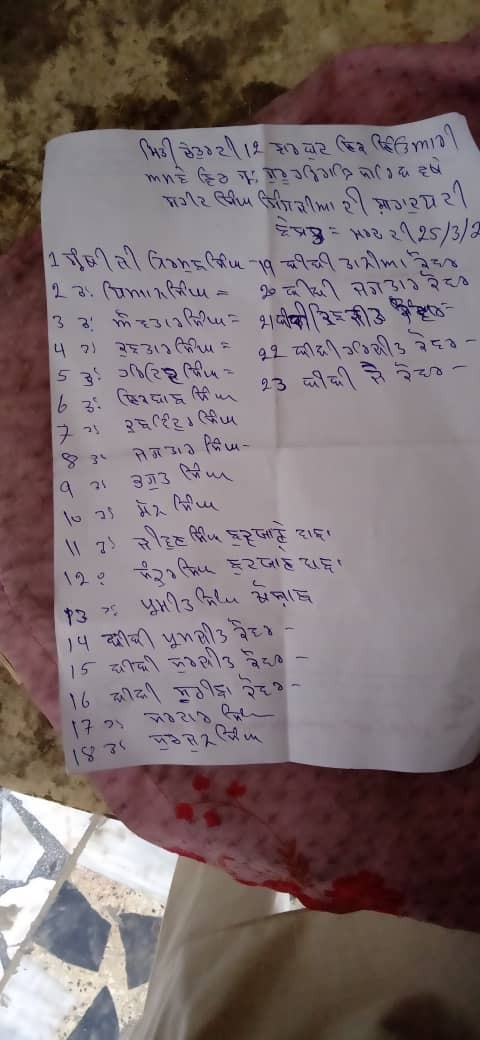
1. Giani Nirmal Singh
2. Dhaiyan Singh
3. Avtar Singh
4. Kultar Singh
5. Harinder Singh
6. Iqbal Singh
7. Kulvinder Singh
8. Jagtar Singh
9. Bhagat Singh
10. Sant Singh
11. Jevan Singh
12. Sunder Singh
13. Parmeet Singh
14. Paramjeet Kaur
15. Surjeeet Kaur
16. Surila Kaur
17. Sardar Singh
18. Surjan Singh
19. Tania Kaur
20. Jagtar Kaur
21. Diljit Kaur
22. Harjeet Kaur
23. Jai Kaur
24. Joginder Singh
While the number of reported victims increased over time, the number of assailants did the opposite.
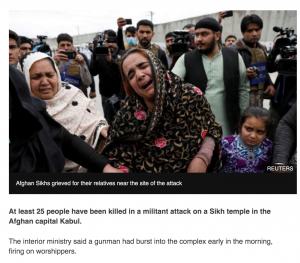
BBC stating it was a lone gunman according to official government reports from Afghanistan.
Afghanistan’s Ministry of Interior told the press that police arrived while the shooting was still ongoing, and that the siege lasted six hours. When spokesman Tariq Arian said that the operation by the security forces was over, he told the press that all attackers had been killed but did not say how many of them there were. The Ministry of Interior later released a statement claiming that there was only one shooter, who acted alone.
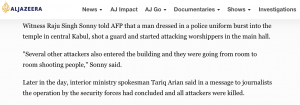
Al Jazeera quoting an eye witness that saw several gunmen, something echoed in the original government statements in Afghanistan.
Despite the suspicious change in story, some mainstream media outlets are choosing to overlook earlier statements from the government and ignore eyewitness reports, and instead accept the ministry’s statement that the devastating tragedy was caused by one man alone.
When news of the attack came to surface, the Taliban immediately denied any involvement. Instead Islamic State (IS), another fundamentalist Sunni Islamic militant group with a presence in Afghanistan, took responsibility for the attack. According to Reuters, IS said that the attack was “revenge for India’s treatment of Muslims in its portion of Kashmir” and the group warned that further attacks could take place.
Most recently, media have named the attacker as Abu Khalid al-Hindi, an Indian national.
During the aftermath of the attack, Afghanistan’s political figures came forward to offer support to the Kabul Sikh community.
NSA @hmohib paid a visit to the Khalsa Gurdwara to comfort our fellow Sikh compatriots and condole with the grieving families of today’s horrific terrorist attack in #Kabul. #Afghanistan pic.twitter.com/Rx6F2qyg5W
— Rafi Fazil (@FazilRafi) March 25, 2020
The second bombing
The following morning, cremation services were held by victims of the massacre, when a bomb blast erupted. Although nobody was killed or injured by the blast, the message was clear: Afghanistan’s Sikhs would not be allowed to mourn in peace.
Sikhs cremate the remains at funerals.
In Afghanistan the local Muslim majorities have taken over cremation grounds, attacked funeral cremations, and often try to force the burying of deceased Sikhs.
Sadly the blasts like this at these funerals is a common event. https://t.co/YNgJWXDI7T
— Gurjodh Singh (@GurjodhMahal) March 26, 2020
The claim by ISIS the attack was revenge against India for their treatment of Muslims ignores the fact that Sikhs are a religious minority in India, and like the Muslim Kashmiri community, have also suffered historic tragedies at the hands of the Indian government. The wider perception of the targeting of a Gurdwara is that this was an attack on the Sikh community, not the Indian state.
I’m disgusted, honestly, The world doesn’t deserve Sikhs , is there anywhere we can go without being targeted? The most kindhearted and selfless people, but this is how we’re treated time and time again with no change. https://t.co/uthJr30AQk
— gully boy (@gurvs1) March 25, 2020
Where in the world can Sikhs live freely & call home without being politically subjugated and targeted by hate crimes/terroristic attacks? pic.twitter.com/ny5AtgrLnb
— Harmanoid (@harmanoid_) March 25, 2020
What is being done for the Afghan Sikhs?
With this attack being one of many and the worst since 2018, the worrying continuation and increase in the level of violence aimed at Sikhs of Afghanistan has prompted lots of discussion on efforts to support the community.
“Sikhs in Afghanistan need help from the international community,” added Pritpal Singh, who has been involved in various efforts to have Afghan Sikhs accepted for asylum in the West. “Whether it is India, UK, Europe, North America or anywhere else, the community needs somewhere that they can go to for asylum.”
The morning after the attack, MP Tanmanjeet Singh Dhesi brought up the attack in UK parliament and called on the British Foreign Office to support minorities who sought asylum from nations such as Afghanistan. What was worrying about Dhesi’s speech was in response the Foreign Office representative in parliament stating he was unaware of the incident, concerning given the magnitude and brutality of the attack that it would not be on the FO radar.
Deeply saddened to hear of the abhorrent terrorist attack on a Sikh Gurdwara in Kabul.
During this crisis, the @foreignoffice must support minorities who sought asylum from nations such as Afghanistan – many of whom are working in the UK, but with no recourse to public funds pic.twitter.com/LiIN88OrKu
— Tanmanjeet Singh Dhesi MP (@TanDhesi) March 26, 2020
Meanwhile in Canada, Sikh advocacy group, The World Sikh Organization of Canada (WSO) renewed its efforts to help Sikh citizens of Afghanistan. The WSO outlined its objective to push the Canadian government for a direct sponsorship program from Afghanistan for its Sikh and Hindu communities, as well as expedite processing of files for the approximately 44 already privately sponsored Afghan Sikh and Hindu families.
????CALL TO ACTION????
ISIS has attacked a Gurdwara in Kabul, killing over 24 Sikhs. They even detonated a bomb near the cremation site.
This is unacceptable, and now is the time to push our federal MPs once again to bring our Sikh brothers and sisters to safety. pic.twitter.com/loYWyVZoJQ
— WSO (@WorldSikhOrg) March 26, 2020
The organisation is also fundraising for the families of the victims of the attack via the Manmeet Singh Bhullar Foundation, and said that the funds will go directly to sponsoring the Sikhs and Hindus who remain in Afghanistan.
A link to the WSO donation form can be found here: https://www.themsbf.ca/donation-form.
One interesting point raised by the WSO team was the Afghan Sikhs do not qualify for acceptance into India under the recently created controversial Citizenship Amendment Act, which is allegedly aimed at helping Indian origin people claim asylum in India from neighbouring countries.
The issue is not so much the money, it is the Government obstacles in the way.
A lot of these families would much rather come directly to Canada than go to India and not get certain rights. CAA also doesnt apply to them. Canada needs to allow direct sponsorship, and expedite.
— Jaskaran Singh Sandhu (@JaskaranSandhu_) March 26, 2020
United Sikhs, a Global humanitarian charity affiliated with the United Nations, also disclosed that in the aftermath of the tragedy, the charity’s legal directors have written to the Afghanistan Ambassador asking what measures are being taken for the protection of the minorities. United Sikhs has also launched a fundraiser to help the victims and their families.
“The recent Islamic State advances and terror attacks raise a real fear that Afghan Sikhs, if not protected, will be subjected to such a level of discrimination and ill-treatment as to amount to a very real and immediate risk of persecution based on ethnic and religious identity. They are desperately in need of international protection,” the charity said in a statement.
“We urge our global community to donate generously and join us in our efforts to put an end to these atrocities and infringement of civil and human rights.”
Sun Kaur, a United Sikhs representative, said “As always, Sikhs are a community of resilience and we must again stand in solidarity to protect our brothers and sisters in Afghanistan. Our hearts are also pouring for the children who’s dreams of growing up have been destroyed. Now is the time for Sikhs to take action. Our prayers are with the Afghanistan Sikhs and we will continue our efforts to ensure Sikhs are safe and protected.”
A link to United Sikhs’ fundraiser can be found here: https://charity.gofundme.com/o/en/campaign/save-the-afghan-sikhs.
However, not all Afghan Sikhs will want to relocate from their homeland, and will resist efforts to repatriate them, something that will be considered in response to this tragic incident.
ਅਰਦਾਸ। Utmost respect for my people who continue to live in places where they are continuously facing death. That is their native home. They are Afghan Sikhs. This, like any other attack on a Gurdwara is an act of war, terror, and aggression. We however are unequipped to respond. https://t.co/MpdJISUmku
— Jasjit Singh ਜਸਜੀਤ ਸਿੰਘ (@JasjitSDhanoa) March 25, 2020
Of the 50 Afghans I interviewed in Delhi for my thesis, I met only one person who had become an Indian citizen without marrying an Indian. The only thing he wanted to do with his passport was go back to Afghanistan to rebuild the watan. And yesterday, he was killed in Kabul.
— Asha Sawhney (@Asha_MKS) March 26, 2020
A Sikh's home is with Guru (Wisdom) and a gurduara, the Guru's Darbar can exist everywhere. Sikhs must always stand for the right to consult their historical gurduaras, many of which are in what is known as India, BUT also Pakistan. And Kashmir. And Afghanistan.
— Asha Sawhney (@Asha_MKS) March 25, 2020
What other reactions have there been?
This is why we don’t want to be associated with India. https://t.co/ZqBTOyb9Zk
— Goku (@Gurinder94_) March 25, 2020
Respected journalist based in India Aditya Menon noticed and wrote about the immediate outpouring of trolling towards Sikhs from Hindu nationalists that were mocking previous Sikh efforts to include Muslims in seva (selfless service) done in the spirit of “sarbat da bhala” (Sikh philosophy meaning to do things for the benefit of the world).
Sikhs have gained respect and love for their humanity stemming from the spirit of Sarbat Da Bhala. Terror attacks, pogroms, hatred and trolling can't silence them #StandWithSikhs https://t.co/lO6Nm5z55I
— Aditya Menon (@AdityaMenon22) March 26, 2020
Sikh educator Harinder Singh of the Sikh Research Institute also spoke to World Sikh News to offer his view that all Sikhs should share blame for allowing this to happen, opening up avenues towards analysis on how to stop this from happening again.
“We are part of the problem too for not providing any concerted, deliberative, and sustainable planned solution that integrates establishment realities with activist outcries.” – Harinder Singh @1Force https://t.co/odLIz3rRC4
— SikhRI (@SikhRI) March 25, 2020
The Basics of Sikhi team released a video of parcharak (educator) Harman Singh discussing the issue and how Sikhs can deal with it from a spiritual perspective, whilst also taking into account Sikh teachings and history.
Various political figures condemned the attack, including the USA’s secretary of state Mike Pompeo and Canada’s NDP leader Jagmeet Singh.
Heartbroken to hear about this act of terrorism in Kabul.
The hatred it takes to kill people because of how they pray is senseless.
I am sending love & support to the Sikh community in Afghanistan & thinking of all minorities confronted w/ violence.https://t.co/xVr4l9NEyg
— Jagmeet Singh (@theJagmeetSingh) March 26, 2020
The lack of media coverage on the topic prompted concern from Sikh Council UK, whilst Naujawani editor Harwinder Singh wrote about the topic, analysing the suggested ways to help as well as the place of Sikhs in Afghanistan.
Breaking News: Funeral of 25 Sikhs in Kabul terrorist attack is disrupted by Bomb Blast.
No coverage on mainstream media. Large Afghan Sikh community in UK is worried. Sikh Community need protection and help.#SikhLivesHealth @BBC @10DowningStreet @itvnews @SikhPA pic.twitter.com/wH4fmjtJEp
— Sikh Council UK (@SCUKofficial) March 26, 2020
Many Sikhs have highlighted the issue and the lack of intervention from any other nations as further reasoning for the Khalistan movement for a free Sikh homeland. Overall, the general reaction has seen Sikhs soul-searching about how the Sikh Kaum (nation) can finally face this issue head-on.
Another attack on innocent Sikh’s in Afghanistan! The world is quiet again! Sikh’s really need a separate homeland man!
— Mandeep Singh (@MS145) March 25, 2020
#Panth – is this going to be another chapter like #OakCreek that we remember just once every year? Or do we have what it takes to come together and solidify our power once again? #KabulGurdwara pic.twitter.com/kPwwdCCcqZ
— ./psingh (@pdvsingh) March 26, 2020


Leave a Reply
Want to join the discussion?Feel free to contribute!