Indian diplomat involvement confirmed in Canadian Sikh leader’s assassination

The latest release of information from Canadian authorities regarding the assassination of Shaheed (martyr) Bhai Hardeep Singh Nijjar has revealed diplomatic communications are part of the “credible evidence” which point to India’s involvement.

The news was broken by CBC News this afternoon (21.09.23), stating:

“The Canadian government has amassed both human and signals (communications) intelligence in a months-long investigation of a Sikh activist’s death that has inflamed relations with India, sources tell CBC News. That intelligence includes communications involving Indian officials themselves, including Indian diplomats present in Canada, say Canadian government sources. The intelligence did not come solely from Canada. Some was provided by an unnamed ally in the Five Eyes intelligence alliance.“

The new information also relayed that Canadian officials found no denials of India’s involvement during direct engagement between both nations’ intelligence services, although cooperation with Canada for clarity was not forthcoming from India.

The diplomatic communications cited are also said to confirm the assassination of Nijjar was sanctioned higher-up the Indian government’s chain of command. Whether this goes all the way to Prime Minister Narendra Modi, is unclear. This would not be Modi’s first alleged involvement in murder, with the former Chief Minister of Gujarat long linked to facilitating the anti-Muslim massacres in the state in 2002, leading to him receiving a ban from entering various Western countries until he became Prime Minister in 2015.

The new information comes after two Indian diplomats were expelled from Canada on Monday, when Prime Minister Justin Trudeau announced the news of India’s involvement in the assassination of Nijjar.

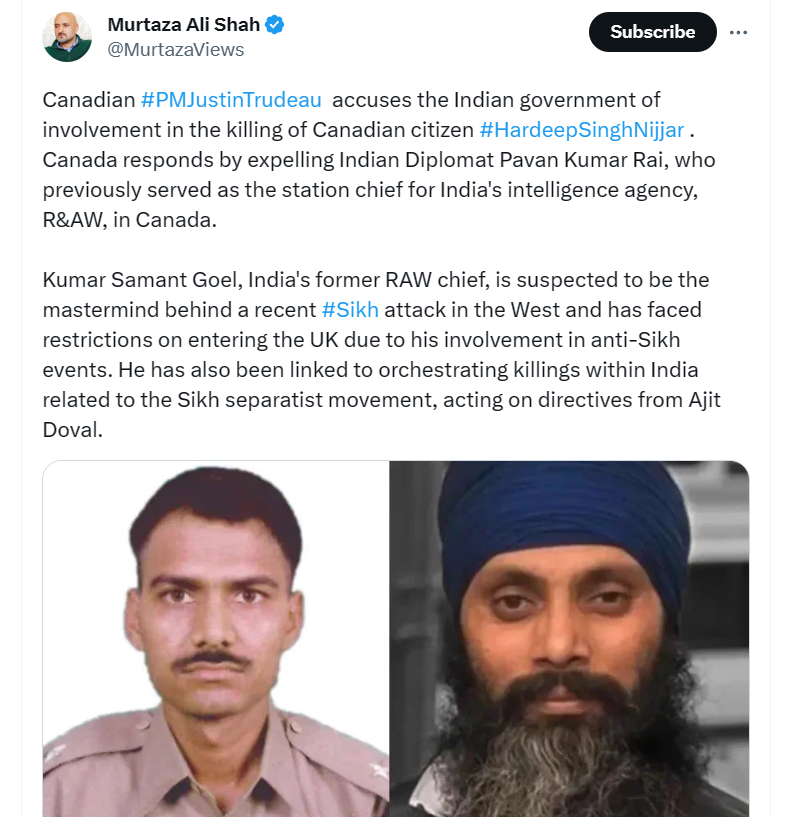
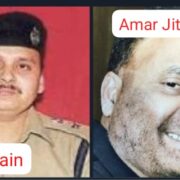
Diplomat Parag Jain of the Indian Consulate in Ottawa, and Amar Jit Singh, the Consul at the Indian Consulate in Vancouver, were the two expelled diplomats linked with the interference, although a third (Pavan Kumar Rai, pictured) was also forced to leave Canada.
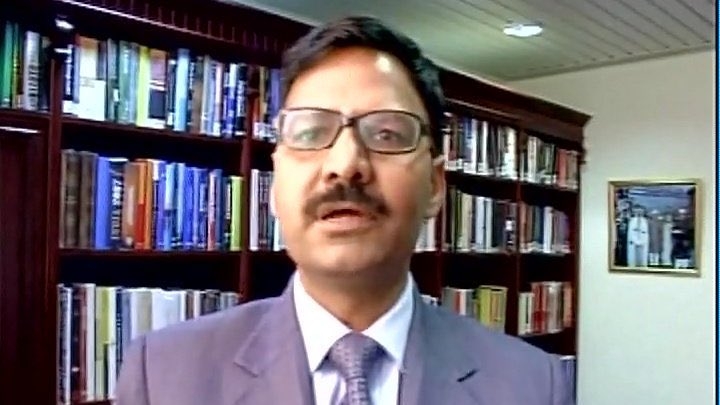

Singh was carrying out undeclared intelligence activities according to The Bureau, including “recruiting sources and agents to infiltrate, monitor and co-opt Sikh diaspora communities“, as well as “interfering and influencing voting in favour of those that were assessed as pro-India candidates“. Singh and Jain were also allegedly “facilitating visas for Indo-Canadian politicians and their friends,” while manipulating “India’s ‘black list’ of people banned from travelling to India“.

The news has once again sent shockwaves around the world regarding India’s targeting of diaspora Sikhs. However, Sikhs have openly stated diplomats were involved in Nijjar’s assassination, evident from the much-talked-about posters released by Sikhs For Justice after the murder. Whilst many political commentators and anti-Sikh media figures used the posters to suggest Sikhs For Justice – the group behind the Khalistan Referendum campaign – were agitating in Canada, the latest news vindicates their efforts to hold Indian officials accountable for the crime, although neither Parag Jain nor Amar Jit Singh were specifically mentioned.

Image

The actions of Indian diplomats and consulate staff have long been cited as questionable by various Sikh groups. In 2020, Indian officials of the Hamburg (Germany) consulate were find attempting to covertly gather data on local Sikhs- Indian government caught spying on Sikhs in Germany | SikhPA. In March of this year, India’s High Commission staff in London were found to be throwing ink at Sikh protesters demonstrating outside of the building.

Meanwhile, US sources have claimed President Joe Biden raised Nijjar’s murder directly with Modi at the recent G20 summit. Biden’s questioning of Modi was part of an interrogation on the Indian PM by members of Five Eyes.

Five Eyes is an intelligence-sharing network comprised of the USA, UK, Canada, Australia and New Zealand. The network comes from an initial intelligence agreement set in 1941 between the UK and USA, with the current form including all five nations cemented in 1955.

Speaking on the new information, Sikh Press Association Senior Press Officer Jasveer Singh said:

“Once again, this news will shock much of the world but not panthic (Sikh path/community focused) groups, who have for decades said India’s interference on Sikh diaspora communities is coordinated at an official level.

“Questions will now be asked of India’s diplomats across the world. Given incidents in Australia and the UK, there will likely be particular scrutiny there, and Sikhs will be anticipating swift action for clarity or perhaps even justice.”

Media inquiries- media@sikhpa.com.
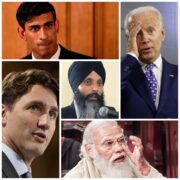
The fallout from Canada’s Sikh assassination admission

On Monday (18.09.2023) Trudeau made a statement confirming that there was “credible evidence” that Indian authorities were behind the assassination of Canadian citizen Shaheed (martyr) Bhai Hardeep Singh Nijjar on Canadian soil.

The news had a drastic ripple impact across the globe, impacting international policy and diplomatic relations. So what exactly has happened since?


Hardeep Singh Nijjar’s murder occurred in Surrey (Vancouver area, BC) in June. Read more on it here.

Shortly after Prime Minister Justin Trudeau made the announcement in parliament, Canada’s Foreign Affairs Minister Mélanie Joly announced that an Indian diplomat had been expelled from Canada. This was later identified as Pavan Kumar Rai, who also held the role of head of New Delhi’s Research and Analysis Wing (RAW) who are an Indian foreign intelligence agency.

RAW have a notorious reputation within Sikh activist circles, with the agency known to carry out alleged abductions, torture and sources of funding for nationalist disruptors in Sikh diaspora spaces. This reputation is even noted in wider media.

Image

Canada also updated its travel advice on Tuesday, warning visitors to exercise a high level of caution in India.

Canadian intelligence agency CSIS identified two more Indian diplomats, Parag Jain and Amar Jit Singh, who were also responsible for carrying out undeclared intelligence activities in Canada. Evidence of their activities targeting the Sikh community in Vancouver was identified in 2017 at a grassroots level.

Image

Amar Jit Singh was known to be a source of constant anti-Sikh tweets, resulting in his agenda in Canada being questioned by many community groups and individuals.

This evidence of Indian diplomats spying on Canadian Sikhs has resulted in questions being asked by other Sikh communities as to whether their British or American counterparts are carrying out the same illegal and undeclared intelligence activities.

Figures and orgs UK Sikh orgs would want investigated include:

  • Conservative MP Priti Patel, who publicly advocated for Hindu extremist group the HSS and attempted to extradite three Sikhs to India to face the death penalty in 2021
  • Conservative MP Bob Blackman, who has been found taking payment from Indian nationalist support groups
  • The Henry Jackson Society, a so-called thinktank working as Indian state propagandists

India’s official response came within hours of Trudeau’s statement, calling his claims “absurd” and are “completely rejected”. The ministry has urged Canada to take “prompt and effective legal action against all anti-India elements operating from their soil”, even though there is no evidence of illegal anti-India activity from any groups, including Canadian Sikhs.

Indian authorities then retaliated to Canada’s actions by ordering a senior Canadian diplomat to leave the country within five days. Local Indian media sources have identified this to be Olivier Sylvestre, the station chief for Canada’s intelligence agency in New Delhi.

The evening of the statement, Canada’s Conservatives were called out for not attending an emergency debate on the news, seemingly in an attempt to distance themselves from the revelations, a move which will concern many Sikh voters in the country.

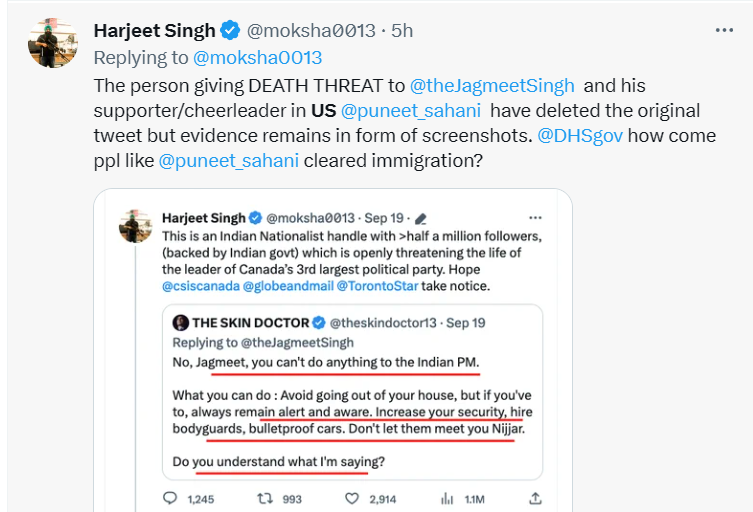
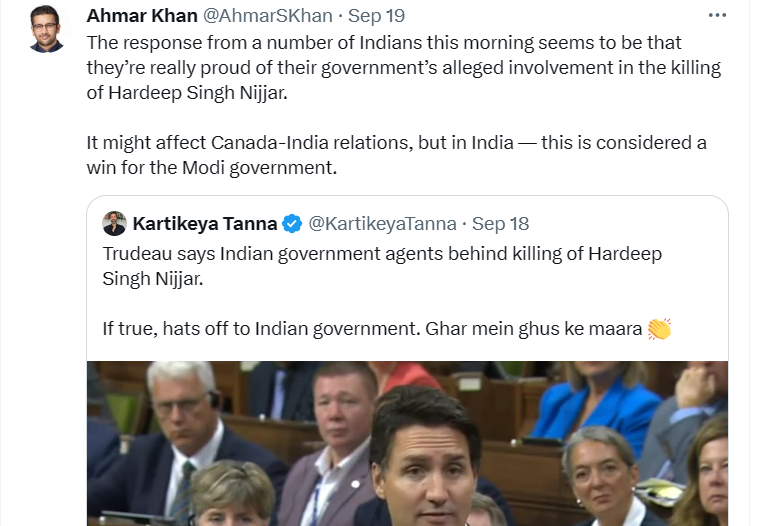
On social media, Indian nationalists not only made death threats towards Canadian politicians, they also celebrated the idea India had killed Bhai Hardeep Singh Nijjar.

The day after Trudeau’s statement, world leaders met in New York for the United Nations General Assembly, which Indian PM Narendra Modi did not attend.

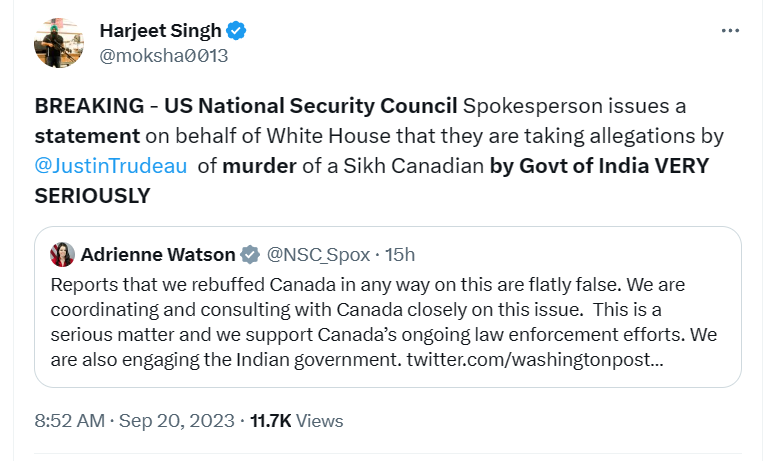
In a statement on Tuesday, the US State Department said that they supported Canada’s investigation and urged the Indian government to cooperate. A senior Canadian official told Reuters that the US “worked very closely” with Canada on the intelligence behind Trudeau’s statement, but this is yet to be confirmed.

Despite the US’s clear response, CBC News and Globe and Mail were found to be presenting a different narrative, and were called out for what seems to be an attempt to undermine Trudeau’s standing internationally.


The Australian government also said in a statement on Tuesday that it was “deeply concerned” by the claims of assassination. Australia has suffered greatly with Hindu extremist Indian nationalists, including being forced to deport a violent gang leader leading attacks on Sikhs in 2021.

The British Foreign Secretary, James Cleverly, did not blame India but said that the UK government also backs a Canadian investigation and that they expect India’s “full cooperation” in the inquiry.

PM Rishi Sunak however was keen not to let the accusations get in the way of a trade deal, his official spokesman saying that “with regards to the current negotiations with India, these are negotiations about a trade deal and we are not looking to conflate with other issues”. The Sikh Federation UK released a statement in response, saying Sunak was putting “British Sikh lives at risk“.

In recent years, the UK, US and Australia all have sought to deepen trade and security ties with India and have been reluctant to criticise India’s human rights abuses in the past, much to Sikh ire.

When Trudeau and Sunak met at the G20 summit in New Dehli just earlier this month, it is understood that Sunak was made aware of the situation. Downing Street says they are not aware of any plans to follow suit and expel an Indian diplomat, despite the fact that Canada expelled four Russian diplomats after the Salisbury poisonings in 2018.

Trudeau’s statement can be seen as an admittance of the activities that Indian Intelligence has been able to carry out in Canada. It has provided further proof for the Canadian Sikh community that their government has been prioritising a trade relationship with India over its citizens.

The case of Hardeep Singh Nijjar is viewed as just one example of India colluding with other governments over Sikhs advocating for Khalistan abroad. It is just one way in which the Sikh community know the Canadian and Indian authorities have been targeting them.

This is also familiar to the British Sikh community where PM Sunak is currently prioritising his relationship with India over the release of British Sikh Political prisoner Jagtar Singh (Jaggi) Johal. Calls are being made to investigate the safety of the British Sikh community too. The safety of British Sikhs has become a national issue.

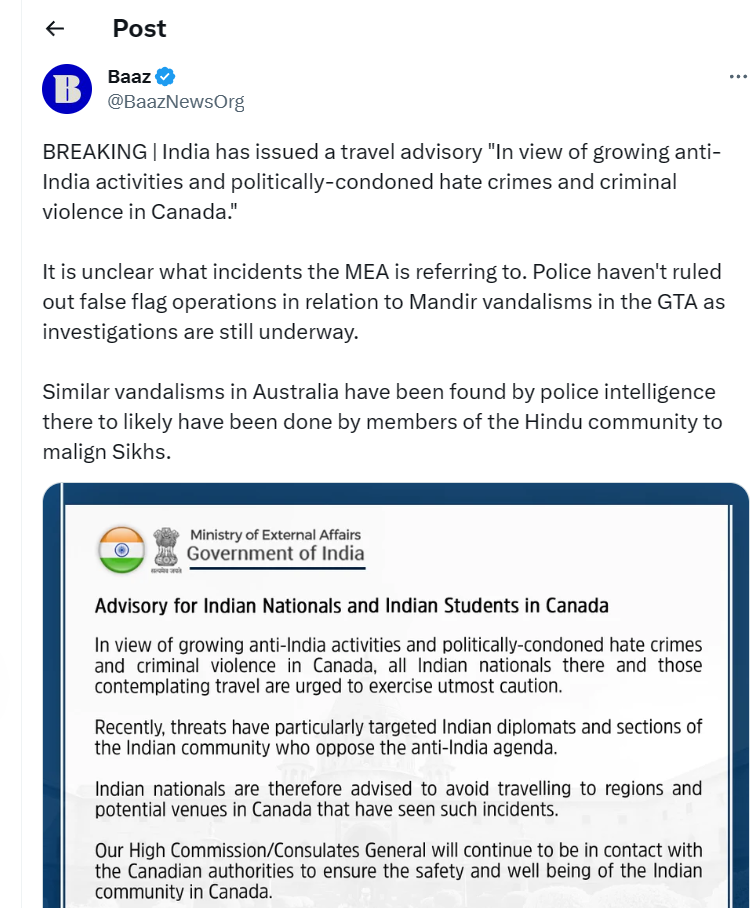
As the fallout continued, yesterday India issued an “advisory” warning for Indians in Canada.

The fact that there is credible evidence for the assassination of Hardeep Singh Nijjar has seen questions again raised as to whether the case is the same in the suspicious death of Avtar Singh Khanda who passed away just three days before Nijjar. The Sikh community is calling for the British authorities to investigate Khanda’s death further after the UK’s earlier unthorough investigation.

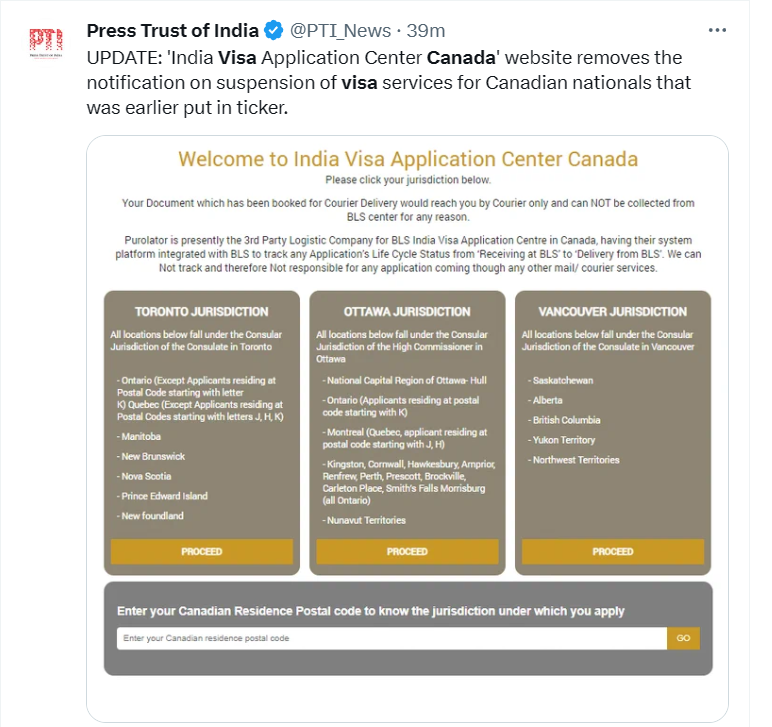
The latest news of fallout has seen India suspend visas for all Canadians, which some India media have said means Canada nationals can no longer enter India for the foreseeable future. However, India’s Press Trust noted a notice on the website for visa applications was quickly removed, so Canadians can still apply. Whether applications will be accepted or not is still unclear, as is the status of Canadians presently booked and accepted to enter India.

Media inquiries- Har-Rai@SikhPA.com

Canadian authorities confirm “credible evidence” shows India murdered Khalistan leader

In a groundbreaking moment in Sikh history, Canadian authorities have come out to confirm what Sikhs have been saying for months; that the Indian State was behind the assassination of Shaheed (Martyr) Bhai Hardeep Singh Nijjar in June.

In news first broken by the Globe and Mail, the Canadian nation security authorities confirmed there is evidence proving India were behind the assassination of Nijjar, shot dead in Surrey (BC), although details of how this has come to be confirmed cannot be revealed for security reasons.

Bhai Hardeep Singh Nijjar was at the time the President of Guru Nanak Sikh Gurdwara Surrey (BC) where he was murdered. Nijjar was also a globally respected leading figure of the Khalistan (free Sikh homeland) movement. For over a decade he had faced threats from India due to his open advocation for Khalistan, which was the same reason he became a hugely popular figure within global Sikh circles, leading to his election as the President at one of the world’s busiest Gurdwaras outside of India.

Read more about the incident and community reaction- Gurdwara assassination leads to pressure for Canadian investigation on Indian interference | SikhPA.

Cementing the news, Prime Minister Justin Trudeau, Conservative leader Pierre Poilievre and NDP head Jagmeet Singh all spoke on the news in parliament today.

In immediate fallout from the situation, an Indian diplomat has been expelled from Canada relating to the assassination. The diplomat was a senior of India’s infamous RAW intelligence wing, known amongst many Sikh groups for facilitating the murder and torture of countless Sikh activists.

Jasveer Singh of The Sikh Press Association said of the news:

“The Sikh Press Association welcome Canada’s acknowledgment of what countless Sikh groups already knew regarding Shaheed (Martyr) Bhai Hardeep Singh Nijjar. We hope this leads to stronger investigations into other types of Indian interference in Canada and there is also an examination into how the assassination was allowed to happen under authorities’ watch.”

Media inquiries- media@sikhpa.com.

Police say Hindu temple vandalism “may have been done by Hindus themselves” to blame Sikhs

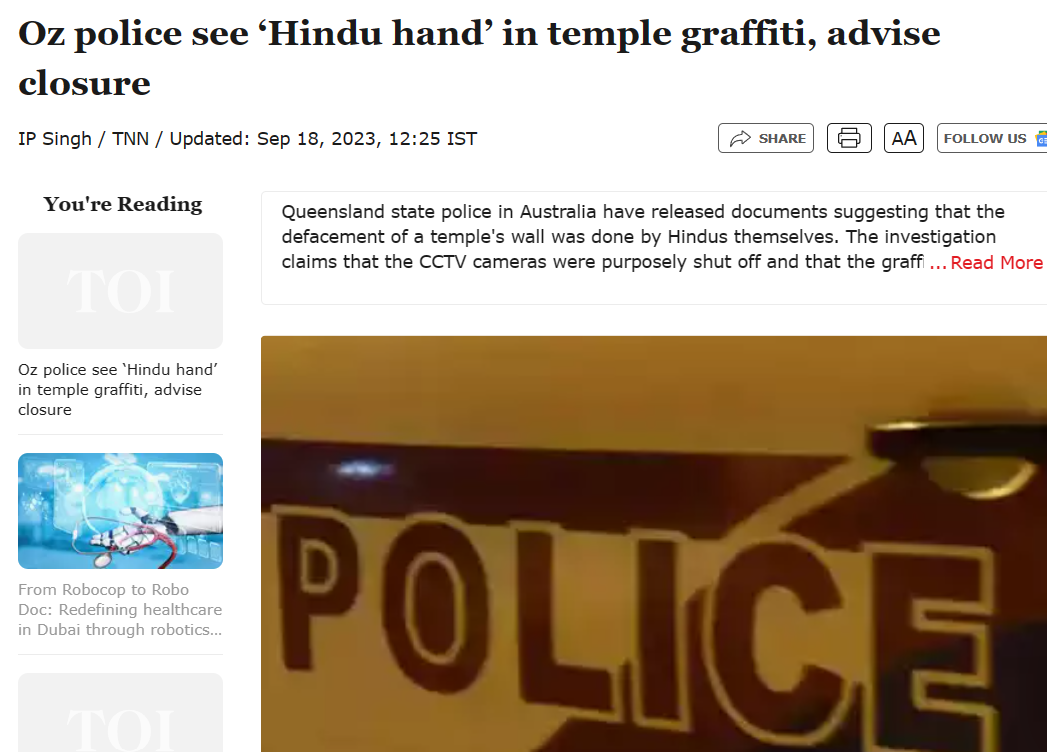
Queensland (Australia) Police have released documents regarding investigations into graffiti on Mandirs (Hindu temples) “may have been done by Hindus themselves”.

The documents were this week released to community sevadaar (selfless servant) Bhabishan Singh Goraya who was pursuing insight into the investigations, due to the fact the crimes were widely being linked with Australia’s Sikh community. Many, including ABC News who subsequently apologised for it, blamed Sikhs for the vandalism.

The incidents were carried out around the time of the Sikhs For Justice Khalistan (free Sikh homeland) Referendum campaign in Brisbane. In the released documents from Queensland Police Service, authorities say the graffiti may have been carried out “in order to generate police attention towards the SFJ group”. Although Sikhs For Justice have peacefully and legally carried out the referendum campaign across the globe, India has designated them a terror group and Australian Indian nationalists reacted to their efforts in Queensland (and also New South Wales) with aggression and venom.

The police documents underlined concerns about why and how CCTV footage at Shree Laxminarayan Mandir were turned off just before the graffiti, also noting “anti-Sihk (Sikh)” activity in the Mandir, link with “encouraging protests against Sihk (Sikh)” gatherings.

See more detail via-

In February 2023, two Indian vandals were caught red-handed when about to carry out vandalism. Read- Indian vandals caught red-handed amid ultranationalist attempts to disrupt Khalistan Referendum | SikhPA.

Belief within Sikh circles these acts of vandalism were being carried out by Hindu extremists attempting to tarnish Sikhs came from the following facts:

  • The random tag of “(BBC)” in a recent Brisbane incident make no sense in relation to Khalistan or any pro-Sikh position. BBC has been under attack as anti-Indian due to recently airing a documentary exposing India’s fascism and Modi’s genocidal past
  • “Sant Bhindranwale Martyr” which was also daubed in one incident in Melbourne is not a Sikh phrase
  • A group of Hindu men were caught red-handed with spray paint outside a Gurdwara in Melbourne, where Sikh posters were also being vandalised
  • No CCTV footage has been released by any of the Mandirs to expose the vandals

Further to the graffiti, Hindu extremists in Australia have been directly attacking Sikhs violently, most notably through the case of Vishal Jood, who was deported in 2021 and welcomed back to India as a hero. Two Indian nationalists were also caught with knives whilst being disruptive in a Sikh space just months ago in Sydney. Read more- “Anti-Khalistan protesters” arrested with knives for “intent to commit indictable offence” | SikhPA.

The Queensland Police investigation into the Mandir graffiti incidents now looks likely to be shut down, due to lack of suspects.

Speaking on the documents, Sikh Press Association Senior Press Officer Jasveer Singh said:

“The police documents show what seems to be considered as the most plausible theory is Hindu extremists have carried out this vandalism themselves.

“This conclusion will be welcome by Sikhs across the world who have seen attempts to blame the community for such incidents, without evidence or rational reasoning. Hopefully this outcome will remain in the minds of all Australians when it comes to Sikh activism in the country, whilst it should also highlight the real issue of Hindu extremism working to divide communities in the country and beyond.”

The news comes just prior to news from Canada where government authorities have found evidence linking the Indian State to the assassination of prominent Khalistan figure Bhai Hardeep Singh Nijjar, further emphasising concerns of Indian nationalist attempts to target Sikh diaspora communities.

Media inquiries- media@sikhpa.com.
Sikh Federation mark 20th anniversary with conference, stating: “Our vote will not be taken for granted”

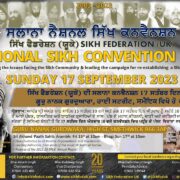
This weekend (17.09.2023) the Sikh Federation (UK) celebrated its twenty-year anniversary with a conference at Guru Nanak Gurdwara, Smethwick. The conference took place at the end of a three-day convention in which over 15,000 Sikhs took part.

The Sikh Federation (UK) is an org which campaigns and lobbies for the interests of the British Sikh community in UK politics and public legislation. The key message coming from British Sikhs at this year’s conference; “Our vote will not be allowed to be taken for granted.”

Speakers discussed key and current events concerning the Sikh community in UK politics, expressing outrage at the growing animosity in the UK government and media towards the Khalistan movement, likening the name “Khalistani” to “terrorist”. There have been several examples of this happening this past year such as the unfounded remarks in the Bloom Report and the defaming claims made on GB News. This evident disregard for the Sikh community has also been shown by the government’s lack of concern for Jagtar Singh (Jaggi) Johal and Rishi Sunak’s choice not to fight for his release when visiting India for the G20.

The current Conservative government has disappointed the Sikh community in the past five years. The actions of senior politicians such as Priti Patel and Rishi Sunak have negatively targeted Sikhs and damaged the Conservative Party’s reputation within the Sikh community.

Therefore, in anticipation of the next general election, the Sikh Federation (UK) has made it clear that the party will only gain the community’s support if Sikhs are listened to. In a statement, Bhai Amrik Singh, Chair of the Sikh Federation (UK), stated: “We must have a Labour government prepared to publicly lead condemnation of the Indian government’s systematic discrimination and promotion of violence towards religious and other minorities in India.”

The Sikh Federation (UK) has developed a strategy for a Labour government and Conservative opposition in preparation. They will release a Sikh Manifesto at least three months before the next general election which will outline what is expected from the newly elected government.

The Sikh Federation (UK) is encouraging the 250+ Sikh Gurdwaras across the UK to put strict measures in place to make sure that the Sikh vote is not taken for granted. In the run-up to the next election, only those politicians who have provided specific public commitments to the Sikh community should be provided with a platform in Gurdwaras.

“We will encourage Gurdwaras to completely change the dynamics in terms of politicians only being given a platform if they make specific commitments to the community.”

The Labour leadership has already made commitments to the Sikh community about recognising and addressing anti-Sikh hate crimes, the release and return of Jagtar Singh (Jaggi) Johal, and an independent public inquiry into the UK involvement in the events of June 1984. However, the Sikh community require a Labour government to additionally deliver a statutory Code of Practice on the Sikh articles of faith, officially recognise the 1984 Sikh Genocide and, working with other governments, take this forward on the global stage.

The number of Sikh MPs in a Labour government is expected to increase from two to nine. Sikh candidates have been selected in existing Labour seats in Derby, Huddersfield, Ilford, and Southampton and seats in seats Labour is expected to win in Bolton, Loughborough, and Wolverhampton.

It was evident that prospective candidates and current MPs, both Sikh and non-Sikh, were invited but not in attendance.

Media inquiries- Har-Rai@SikhPA.com.

Punjab Police Officers finally convicted 31-years (!!!) after Sikh massacre

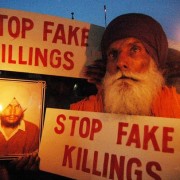
Three Punjab police officers have been sentenced to life in prison for the “fake encounter” murders of three Singhs
(practicing Sikh men) in a fake encounter in 1992.

Former Inspector Dharam Singh and Deputy Superintendent Gurdev Singh were found guilty in a CBI (Central
Bureau of Investigation) Special Court in Mohali, whilst the third officer, Sub-Inspector
Surinder Singh, attended via video call from hospital on the 14th of September 2023. All three were charged with life imprisonment. A fourth officer, ASI Bhupinder Singh, has absconded during the trial and has been declared
a Proclaimed Offender.

The trio were found guilty of their involvement in the murders, but also of conspiracy and
preparing false fabricated records under sections 120-B (Conspiracy), 302 (Murder), and 218
(Preparing False Fabricated Records) of the Indian Penal Code. All three said they will appeal the verdict, with Gurdev Singh citing various illnesses to further his claims to remain free.

The three victims, Harjit Singh, Lakhwinder Singh, and Jaspinder Singh, all in their mid-20s,
were killed in a fabricated police encounter on the 12th May 1992. All three were taken in random police pick-ups, then kept in a notorious torture centre in Amritsar (Mall Mandi) before police killed them. Officers then claimed they had released all three, only for them to “disappear”. The bodies of the victims were not handed over to their families but were instead secretly and illegally cremated.

Harjit Singh’s father, Bapu Kashmir Singh, got legal proceedings against the killers underway when he filed a writ petition to the High Court in 1992 after his son was seen dragged away by police from a bus stop. However, he sadly passed away two years ago, whilst a brother of Lakhwinder Singh also passed just three days prior to yesterday’s sentencing. Countless more family members of fake encounter murder victims have not survived long enough to see the legal charges carried through. Harjt (also spelled Harjeet) Singh’s son, who was one-years-old when his father was killed, did watch on as the murderers were sentenced.

The CBI began their investigation in 1998 but witness statements only began being recorded
in 2016, meaning only 27 of the 55 witnesses cited by the CBI actually had their statements
recorded, with many witnesses having passed away. Originally, nine police officers were accused of
the crime, with five dying during the trial and escaped prosecution.

This eventual justice for the families of the victims has been marred by the long delays that
the Indian judicial systems have had due to the nature of the case. Delivering justice on the
topic of fake encounters and forced disappearances involves the exposure of state-
sponsored human rights abuses which still have their place in governmental structures like
the Punjab police. Sikhs in India have consistently been killed in masses by Indian
government authorities, and fake encounters have regularly been used by the Punjab Police
to do so.

Speaking on the sentencing, Sikh Press Association Senior Press Officer Jasveer Singh said, “Martin Luther King said ‘Justice delayed is justice denied’. This has to apply to these types of situations, where Sikh families have had to see the killers of their children free for over 30-years before courts finally decide to act.

“Sources tell us that only when Indian police officers become elderly and basically useless to the state do courts allow them to be prosecuted for crimes they are accused of. Nevertheless, there is some sense of satisfaction for wider Sikh groups in seeing the ‘fake encounter’ aspect of the Sikh genocide officially acknowledged and certified in law.

“A lot of credit for these convictions must go to the Punjab Documentation and Advocacy Project (PDAP)’s Barrister Satnam Singh Bains, a respected UK community figure that now works in India. This case had a complex history, with a large number of Punjab police officers involved and and spans over three decades. Seeing it brought to somewhat of a conclusion took great work and perserverance by all those involved, seeking justice for Sikh families whose children were targeted simply for being visibly practicing Sikhs.”

The sentenced officers join a growing list of police finally made to pay – in some small way – for their crimes.

Media inquiries- har-rai@sikhpa.com.

Who is the Professor Sikhs across the world are hoping will be free next month after 28-years?

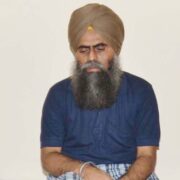
Countless Sikhs await an upcoming judicial decision on Professor Devinderpal Singh Bhullar, but who is the respected activist who has been imprisoned for 28-years?


Sikhs across the globe are anxiously awaiting an Indian High Court decision expected to be made within weeks regarding the status of respected Sikh political prisoner Professor Devinderpal Singh Bhullar.

Countless Sikhs and human rights supporters have followed the case for decades, with it being viewed as one of the more standout examples representative of the typical plight of Sikh activists in Punjab.

So who is Professor Devinderpal Singh Bhullar?

Image

Professor Bhullar became a popular panthic (Sikh path/community focused) figure in the early 90s, when he was was a chemical engineering professor at Guru Nanak Engineering College, Ludhiana.

At the time the Sikh Genocide was at its peak, with thousands of mainly young Sikh men going “missing”, usually after being reported as arrested. Tens of thousands of these men, along with countless women and children too, were murder victims of Indian police carrying out “fake encounter” massacres across Punjab, where officers would either claim to have released someone who then “disappeared”, or fabricate a story where they were forced to kill those they interacted with. Panthic historians of the time estimate anywhere from 50,000-200,000+ Sikhs were killed from 1984-1995 only. As noted by human rights org Ensaaf, killings continued up to at least 2012. Officers guilty of these open-secret massacres are still being prosecuted to this day, although many feel only a handful of those guilty are being held accountable, and only after they have already had decades of freedom after their crimes.

Upon several of his college students going “missing”, Professor Bhullar began speaking out about the atrocities and advocating for justice, leading to him becoming a target for the Indian State. With his speaking out, soon attention turned directly towards the popular panthic academic.

What is Professor Bhullar in prison for?

In 1990, the Punjab Police attempted to connect Professor Bhullar to the assassination of Senior Superintendent Sumedh Saini’s vehicle. No evidence was found to link Bhullar to the case. At the time in Punjab and some would say still to this day, it was common for police to simply find anyone to convict for a major incident to both satisfy public nationalist outcry and also simultaneously eliminate perceived troublemakers like Bhullar, who called out their crimes.

 Due to their failure to implicate Professor Bhullar in the crime, the police abducted and killed his father, uncle and friend, and abducted and tortured his mother and cousin.

In 1993 when the Police were looking for him in connection to the bombing of Politician Maninderjeet Bitta’s government convoy, Professor Bhullar sought political asylum in Canada. On his way he was detained in Germany where the German government rejected his asylum application and instead imprisoned him, before deporting him to Delhi in 1995. Human rights groups cited the deportation was a violation of Article 3 of the European Convention on Human Rights to appeal the deportation. Shortly after Professor Bhullar was sent away, the High German Court overruled his asylum application rejection.

Upon landing in Delhi in 1995, Bhullar was detained without access to a lawyer and tortured, both violations of the International Covenant on Civil and Political Rights (ICCPR). Bhullar was imprisoned without trial for five years until 2001, and then convicted and sentenced to death. Sikh orgs highlighted several issues which rendered his trial and sentencing as unfair.  

An unfair trial

Bhullar’s arrest and conviction are all part of the TADA (Terrorist and Disruptive Activities) Act, used from 1985-1995, which gave police extraordinary powers for arrest and detention. The UN condemned it as “disturbing and completely unacceptable” as it assumed that a person was guilty until proven innocent. It allowed for wide powers to arrest and detain without trial whilst having minimum legal safeguards for fair trial, which is evident in how the case of Professor Bhullar was dealt with.

The direct successor of this act, the UAPA (Unlawful Activities Prevention Act) which is currently active, has been condemned by human rights lawyers and activists in Punjab for the same reasons but is still in use.

The prosecution of Professor Bhullar was a result of an unfair trial. His conviction was based solely on a forced confession. Professor Bhullar was tortured and forced to sign blank papers which a typed confession was later written upon. Confessions are not accepted in court unless they are handwritten or in an audio/visual form, but an exception was made, illegally, in the case of Professor Bhullar.

Despite having five years of Professor Bhullar’s illegal imprisonment to investigate the case, the prosecution was unable to produce any corroborative evidence that implicated him. They produced 133 eyewitnesses, none of whom were able to identify Bhullar as guilty of any offence.

The presiding Judge, Justice M.B. Shah, of the three Judge panel found Bhullar not guilty, stating that “Without there being corroborative evidence… This would not be a fit case for convicting the appellant solely on the basis of so-called confessional statement…”. The other two judges voted for the death sentence, making it the first time in Indian history that the death sentence was given on a split decision.

The fight for release

The Sikh community, both in Punjab and internationally, has been fighting against Professor Bhullar’s imprisonment for decades. However, due to the political nature of his imprisonment, the grassroots consensus on Professor Bhullar’s innocence and on the human rights abuses being committed against him has not yet resulted in his release.

The President of India rejected Professor Bhullar’s clemency petition in May 2011, eight years after the request was filed. During this time, while his mercy plea was being delayed for political reasons, there were worldwide candlelight vigils in 2006 to raise attention to his plight.

In 2013, there was international backlash after a court review upheld Professor Bhullar’s death sentence and his execution seemed imminent. Sikhs across the world called for the Indian government to remove Professor Bhullar from death row immediately and retry his case in proceedings that comply with international fair trial standards. A petition in the UK was signed by 118,000 and the case of Professor Bhullar as well as India’s use of the death penalty was discussed in Parliament.

This resulted in The Supreme Court of India commuting Professor Bhullar’s death sentence to life imprisonment in 2014, the only improvement in his situation to date. This was both on the grounds of an unexplained and inordinate delay of eight years in deciding his mercy petition and because of the mental health of Professor Bhullar.

Professor Bhullar has been receiving treatment for his mental health (schizophrenia) in hospitals during his imprisonment starting some time in the 2000s. This treatment has not been very effective. In 2015 he was transferred from Tihar to Amritsar Jail and was last noted as undergoing treatment at the Government Medical College, Amritsar.

In 2016 Professor Bhullar was released on parole for 21 days and was able to spend time with his family. Whilst some could view this as progress, it was noted by many political commentators as a play for Sikh votes by the in-power Congress Party at the time.

So, what now?

With Sikh groups lobbying for Bhullar’s release among many other political prisoners – including modern example British born Jagtar Singh Johal – , focus has not shifted from his situation for countless human rights supporters.

Image

In 2021, respected human rights Punjab based lawyer Jaspal Singh Manjhpur revealed all legal barriers for Professor Bhullar’s release were now removed and he could be free upon the say-so of Delhi (where Bhullar is imprisoned) Chief Minister Arvind Kejriwal of the Aam Aadmi Party.

In early 2022 protests were held in Amritsar against Delhi CM Arvind Kejriwal for “adopting dilly-dallying tactics” in signing Professor Bhullar’s premature release order before it could be forwarded onwards for final approval.

The legal hurdles for releasing Professor Bhullar and other Sikh prisoners are sparse but, as is the case with political imprisonment, this does not ensure a speedy release. Professor Bhullar has formally been imprisoned for 28 years now, and a person is entitled to apply for release after completing 20 years of their sentence.

On the 14th of December 2022 the NCT (National Capital Territory) Delhi had a meeting regarding the premature release of Professor Bhullar, and as of the 12th of April 2023 the NCT Delhi and the central government had been unable to come to an outcome. When the matter was up for hearing on the 4th of July, no one from the NCT appeared in Delhi High Court to give an update about the status of the matter and Justice Jasjit Singh Bedi issued them a new notice seeking a reply by the 16th of August.

Now, after much delay, on the 18th of October Delhi High Court is set to make their final decision on the premature release of Professor Bhullar, following decades of wrongful imprisonment.

For further insight into Professor Bhullar, check out this breakdown from National Sikh Youth Federation.

“Sikhs are unique”- SGPC respond to RSS attempts to erase Sikh identity

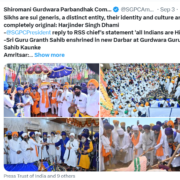
Last weekend (03.09.23) SGPC (Shiromani Gurdwara Parbandhak Committee) President Bhai Harjinder
Singh Dhami released a statement emphasising the distinctness of Sikhs in response to an RSS claim on Sikh identity.

Chief of Hindu extremist Indian nationalist group the RSS, Mohan Bhagwat made a statement earlier in the week claiming “All Indians are Hindus”, in an attempt to advocate India as a Hindu only nation. SGPC President Dhami responded that Sikhs are a “distinct entity, which reflects their originality and uniqueness”.

The statement went on to say that “Mohan Bhagwat gives a fatwa (decree) to every person living in
India to be Hindu to satisfy his mind”
, but that those who call India a Hindu nation should
“read the history of India and especially the Sikhs”.

https://twitter.com/sgpcamritsar/status/1698332440128049196?s=46&t=CgKofHJnOk3dw1 i63vaIMQ

The RSS Chief’s statement reflects the growing Hindutva rhetoric in support of Hindu
Rashtra (Hindu nationalism) which is being taken more and more seriously and is fostering
intolerance and hate for Sikhs as well as other minorities.

In his statement about all Indians being Hindus, Bhagwat also ominously stated that “everybody has understood this. Some acknowledge it, some do not” illustrating how widespread and comfortable the thought has now become among Hindu groups in India.

This thought stems from a long history of the erasure of Sikh identity as Hindu, as is demonstrated in respected Sikh author Bhai Kahn Singh’s famous “Ham Hindu Nahin” (We are not Hindus) which was published in 1898. In the Constitution of India, Sikhs are not recognised as an independent entity and are labelled as Hindu.

The Hindutva agenda aims, amongst other things, to swallow up Sikhi into Hinduism. The
Sikh community are feeling the effects of this agenda in many ways in Punjab, with the
erasure of Sikhi as well as Punjabi language, culture and rights.

As such many Sikhs welcome leading Sikh body the SGPC directly combatting this issue.

Media inquiries- Har-Rai@SikhPA.com.

“Weak” Rishi Sunak accused of both “appeasement” by Indian media and “demonising” Sikhs by SFUK

UK Conservative Party Prime Minister Rishi Sunak has received criticisms from both the Indian media and also Sikh groups for a statement about tackling “violence” of “pro-Khalistan extremism” in the UK, made today (08.09.23).

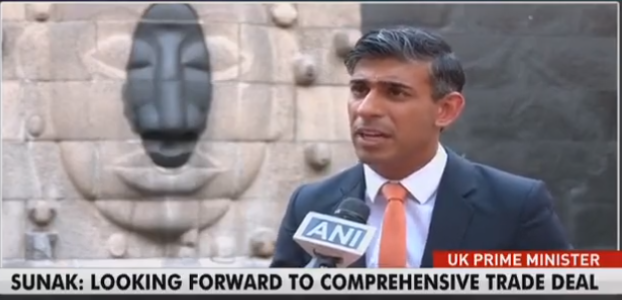
The statement on Khalistan (free Sikh homeland movement) was made to Indian media outlets whilst Sunak was attending the annual G20 world leader summit, this year in Delhi (India) chaired by India’s PM Narendra Modi. The same interview also saw Sunak say he is “looking forward” to a comprehensive trade deal with India.

UK community advocacy group Sikh Federation UK called the statement on Khalistan “dangerous”, whilst nationalist Indian media outlet WION News (part of Zee TV) labelled it “a desperate PR move”.

Uniquely, many panthic (Sikh path/community focused) groups and Indian media both agree Sunak’s statement (which you can see here) was an attempt at “appeasement” towards the Indian State. However, pro-Khalistan groups will say this appeasement is based on affirming India’s claims that the Khalistan movement in the UK is extremist and violent, which there is no evidence of. Opposingly, Indian media like WION News claim the appeasement is based on the UK refusing to clamp down on Khalistan support in the UK, all of which Indian media tarnishes as “extremist” and “violent”, terms which Sunak echoed.

Speaking on the opposing views, Sikh Press Association Senior Press Officer Jasveer Singh said:

“Many UK Sikhs will be angered by Sunak’s comments today because there is no actual substance behind claims the Khalistan movement is violent or extremist. A completely legal and peaceful Khalistan referendum campaign was run across the UK through 2021. Pro-Khalistan events are held by various UK Sikh groups all the time, without issue.

“Yet, for Indian media and Modi’s government, any support for Khalistan is an issue. Famously, after protests last March saw London’s India High Commission flag briefly pulled down, India’s notorious media labelled the incident ‘terrorism’. This sensationalist take was criticised by the likes of Professor Andrew Macleod, but it highlights how different Indian thought is regarding what most Western democracies accept.

“The fact is, Sikhs in the UK and countries like Canada, Australia, the USA and others, use freedoms which do not exist in India to show support for Khalistan, a free Sikh homeland in India. The Indian State does not want Western countries to allow this. They want to see Indian type law imposed on Khalistan supporters. In India sedition is a crime and most Khalistan support falls into that. This is not the case in the West, and Indian nationalists – including the government – are frustrated by this. There is only so much Sunak’s government can do to criminalise Khalistan support, which is completely legal and peaceful across the UK and beyond.”

See the Sikh Federation UK’s statement on Sunak “demonising” Sikh’s comments below.

Image

Image

See the WION News clip accusing Sunak of being “desperate” below.

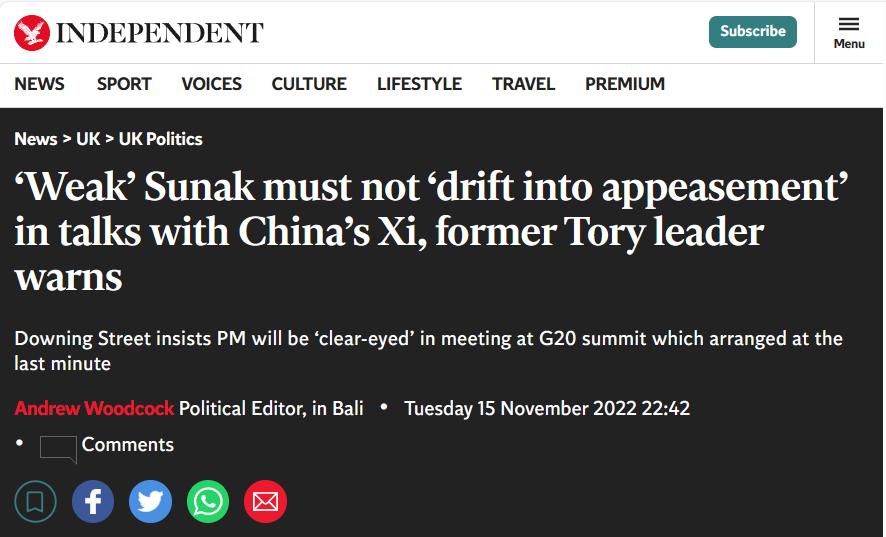
Perhaps revealingly, the criticisim of being “weak” and working to appease a foreign power known for mass human rights breaches has already been directed towards Sunak. The criticisms came from many including some within his own party last year regarding Sunak’s stances on China.

UK Sikhs have long highlighted why many believe the UK Government has an agenda to malign Khalistan supporters, at the behest of India, with trade deals in mind. Previously, Sikh groups have condemned baseless accusations from the likes of the West Midlands Police, Priti Patel, the Bloom Review, Prevent and even Boris Johnson which support Indian State propaganda against the Khalistan movement.

Currently, there is not a single person that has been charged with Khalistan related terrorism in the UK, putting accusations of “violence” into question. Summarising the issue, Sikh PA’s Jasveer Singh said:

“The Khalistan movement not only threatens the stability and power of India by working to detach the state of Punjab from within it, it also highlights India’s mass human rights breaches against Sikhs.

“By trying to frame Khalistanis as an extremist threat, India distracts from its human rights abuses, which help fuel freedom movements across the country. As their media reflects, the Indian State demands for Khalistan support to be condemned and now even targeted by Western governments. Sunak’s comments reflecting this anti-Sikh position today will be worrying for Sikhs across the globe.“

Media inquiries- media@sikhpa.com.
Sikhs follow case of genocide MP finally on trial

Sikhs across the world are following the ongoing trial of infamous perpetrator of the 1984 Sikh genocide, Indian politician Jagdish Tytler.

The politician who was seen leading a mob to burn Sikhs alive in Delhi in 1984 finally saw a legal case stick against him this June, when an Indian court approved a supplementary charge sheet filed by the CBI (Central Bureau of Investigation) against him for his role in the genocide and transferred the case to a special MP-MLA court for trial.

The Court was supposed to hear the case against him on the 29th August, but instead the CBI filed a reply on Tytler’s plea to seek court documents from 1984 to 2023 which were supplied to Tytler’s council. The hearing has therefore been adjourned to the 6th September in order to give his defence time to go through these documents.

According to the CBI’s charge sheet, Tytler is going to court specifically for inciting, instigating and provoking a mob that had assembled outside Gurdwara Pul Bangash, which resulted in the Gurdwara being burnt down and three Singhs (practicing Sikh men) being killed.

This occurred on the 1st of November 1984 as part of the main incident of the Sikh Genocide where, Sikhs were tortured and killed due to state-sponsored violent mobs. Read more on the Sikh Genocide at SikhPA.com/SikhGenocide84.com.

Witnesses state that in Pal Bangash the mob were carrying petrol canisters, sticks, swords, and rods, and Tytler, then a Member of Parliament for the Congress Party, was instigating “the mob to first kill Sikhs and then engage in looting”. He also told the mob to “kill the Sikhs… they have killed our mother”, referring to the assassination of Prime Minister Indra Gandhi.

Whilst Tytler still maintains that there is not even a “single evidence” against him, he was caught on camera in 2018 admitting to his role in the 1984 Sikh genocide. See that video at- https://www.sikhpa.com/indian-politician-caught-on-camera-confessing-to-role-in-sikh-genocide/).

The Justice Nanavati Commission of Inquiry was set up in 2000 by the Indian Government to inquire into the incidents of 1984, though very few convictions have come from it. The CBI registered this case against Tytler in November 2005, and the chargesheet was only recently formally filed against him in May 2023, highlighting the designed flaws of India’s judicial system which allows its elite to flout basic laws.

Even after his evident confession and all of the evidence from eyewitnesses, it has taken 39 years for Tytler’s case to go to court, leaving Sikhs feeling as though the Indian authorities are not concerned with justice.

There is a common feeling in Sikh circles that the recent progress in the case against Tytler is all for optics, an example of the Indian state attempting to show Sikhs that they care about justice. However, taking only a few perpetrators to court does not signify the Indian government properly taking accountability for the events in 1984 where there is much evidence that the violence was state-sponsored and many politicians were rewarded for taking part.