
Bollywood directors hit with legal action for Sikh “blasphemy”

UPDATE- The filmmakers have agreed to remove the disrespectful scene from the film. See their statement here.


A Bollywood film production team have had an official police complaint filed against them by leading Sikh body the SGPC (Shiromani Guru Parbandhak Committee) for “hurting religious sentiments of minority Sikh community”.

The complaint is based on the depiction of a character in film Yaariyan 2, the latest upcoming release by Sapru and Rao. In the film a cleanshaven character is seen wearing the kirpan, a small sword only worn by Amritdhari (initiated) Sikhs, whilst also dancing and singing about consuming alcohol.

Amritdhari Sikhs commit to keeping kes (unshorn hair), as well as staying away from intoxicants like alcohol during their initiation into the Khalsa (collective of initiated Sikhs), which is when they are also given a kirpan to wear. Only Sikhs committed to maintaining strict physical and spiritual faith practices will be initiated into the Khalsa, which has no age restriction and is open to both males and females. Non-Amritdharis wearing a kirpan is seen as not only inappropriate but entirely disrespectful to what the kirpan stands for, which has seen the article of faith become accepted within law in countries across the world.

The anti-Sikh depiction went viral after it was included in a video-song release from the film called “Saure Ghar” on 25th August. Actor non-Sikh Meezaan Jafri is seen in it wearing a Punjabi style kortha-pajama outfit, with the kirpan tied around him with a traditional gatra, using the Punjabi language whilst seemingly harassing a woman on a bus.

The release quickly faced a mass Sikh backlash, with many calling it “blasphemy”. The SGPC pushed for not just an apology but the total removal of the scene from the film and of the social media videos featuring the clip, threatening legal proceedings if Sapru and Rao, along with producer Bhushan Kumar of T-Series, refused. The org, which is in charge of all Gurdwaras in India, also appealed for India’s censorship regulator to intervene.

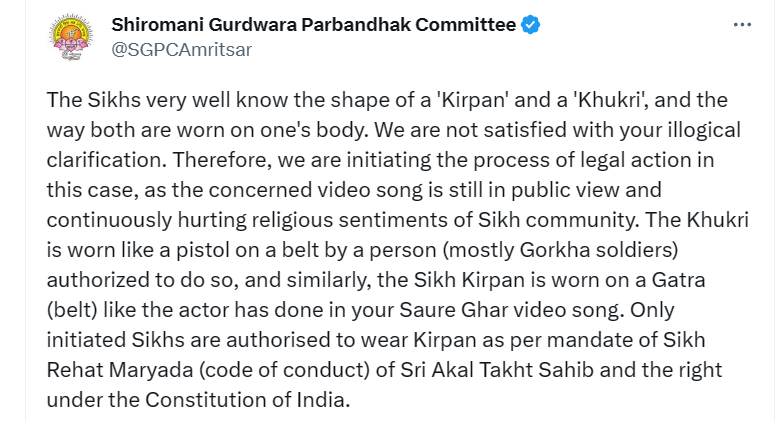
In response, the @SapruandRao official Twitter handle released a statement, claiming the character in the film was not wearing a kirpan, but was in fact wearing a khukri (sometimes spelled kukri), a knife traditionally associated with the famed Nepalese Gurkha soldier community. However, most felt this response was entirely dishonest, with some highlighting how the language and fashion of the character could only be associated with Punjab (the birthplace of Sikhi), whilst the style of the blade only resembled the kirpan, and not the khukri.

Due to this response, on 29th August the SGPC officially filed a police complaint under the crime for a hate crime under Section 295-Aof the IPC which allows criminal charges for hurting religious sentiment, although many feel it is a law only upheld for the majority Hindu community. The complaint has been replicated by Amritsar police, according to the latest media reports on the issue, whilst legal advocacy group United Sikhs have also sent a legal notice to the filmmakers.
The complaints against Yaariyan 2 are far from the first time Bollywood productions have been accused of hurting Sikh sentiments. Both India’s film studios and wider media of the country have been accused of “character assassination” of Sikhs before, with features often depicting the 1-2% Sikh community of India as buffoonish clowns or callous terrorists.

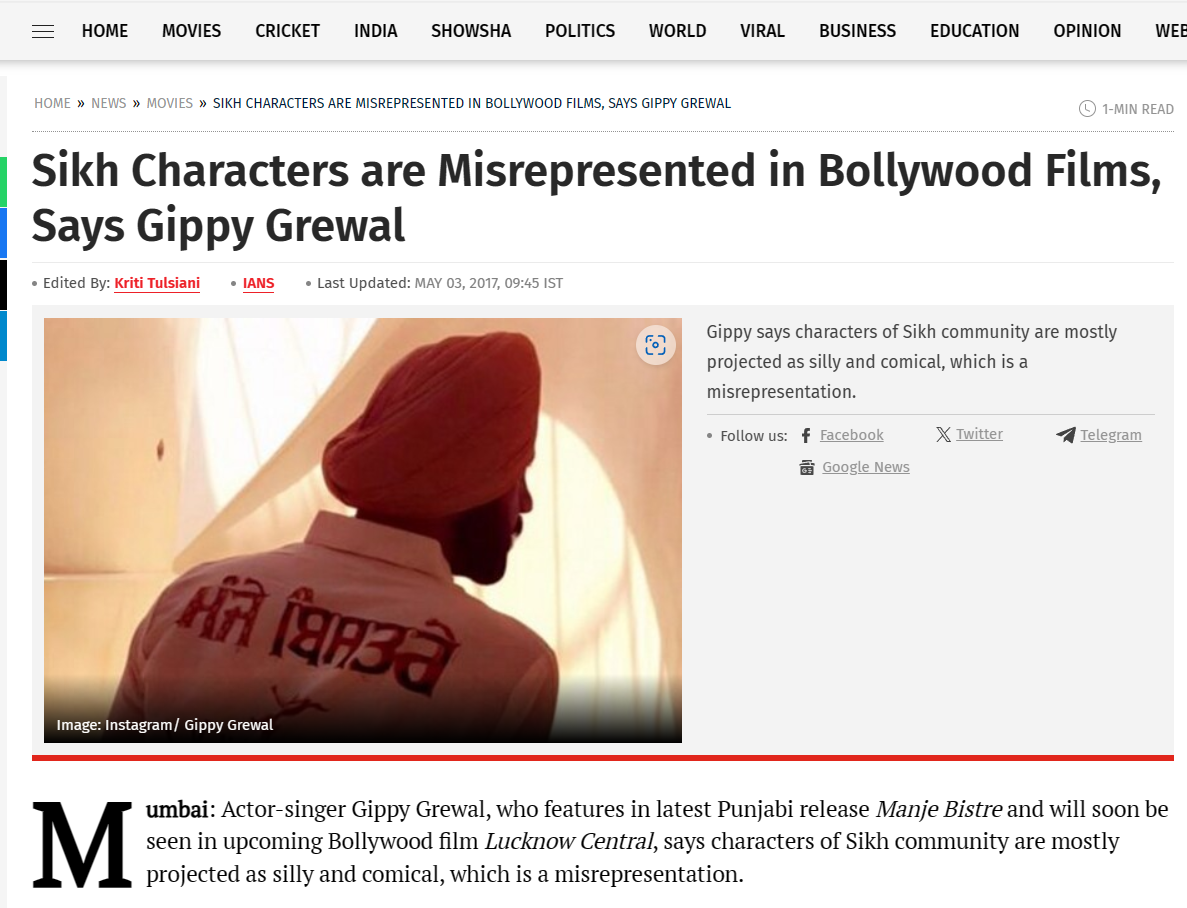
The notorious Santa-Banta characterisations of two Sikhs was challenged in court in 2017 after the mocking depictions were linked with schoolyard bullying. Even famous actors like Punjabi Sikh Gippy Grewal have spoken out against Bollywood’s mocking and disrespectful portrayals of Sikhs.
Indian authorities are yet to make an official comment about the case.

For now, the scene and the videos with it remain up on social media platforms. However, Sikh orgs and individuals are continuing to speak out, mounting pressure on Sapru and Rao, headed by directors Vinay Sapru and Radhika Rao, and T-Series.

Updates on the SGPC legal challenge against the anti-Sikh scene will be shared as they come in.
Sikh women forced into slavery and sexually exploited in Oman

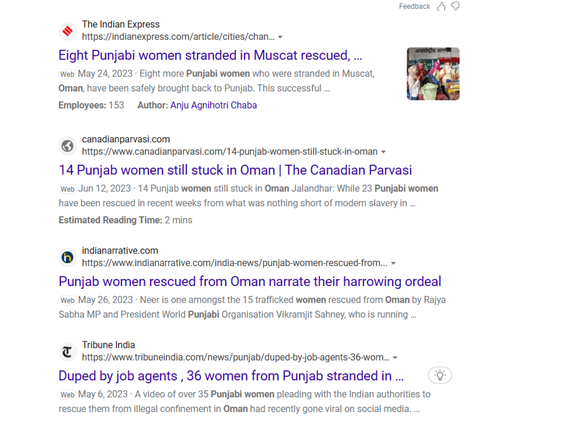
Financially vulnerable Sikh women are being lured from their villages in Punjab to Oman with the promise of a secure job, only to become trapped in sexual exploitation and slavery, according to widespread reports.

There has been a noticeable spurt in Punjabi women (including many Sikhs) being trafficked to Oman post-covid, since individuals’ financial situations have deteriorated. The promise of domestic work abroad – often for countries such as Singapore and Dubai – has seen these women leave their homes and families following promises from travel agents and other middlemen.

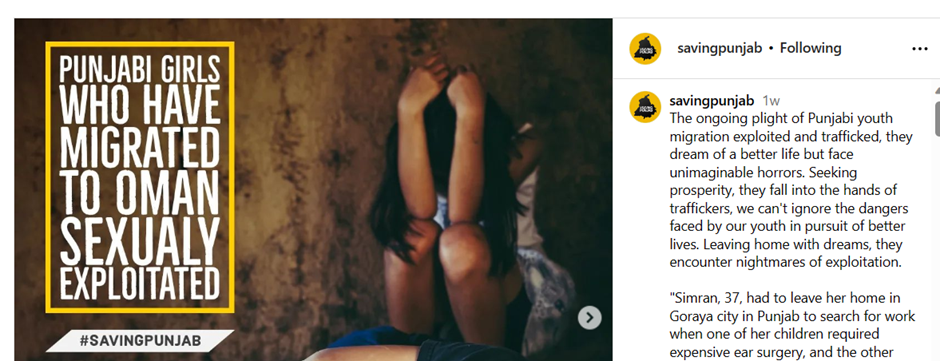
As recently highlighted by respected panthic (Sikh community/path focused) outlet @SavingPunjab, these women are now often instead finding themselves sold into slavery in Oman, with their passports taken away from them and no way to contact anyone for help.

According to reports from Indian media coming through this summer, one woman travelled to Oman to work as a maid, but upon her arrival her employer discovered that she was Sikh and demanded her immediate removal. When she attempted to return back to Punjab the agent who had secured her the job said she had to pay 150,000 rupees (about £1,400), money she did not have. She was then forced to stay trapped in a room alongside more than 30 other girls where ‘potential buyers’ would come to evaluate them for “employment”, despite the fact that that the women were evidently distressed.

Another woman, 37, found that one of her children required expensive ear surgery and treatment for a heart condition, so she left her home in Goraya city expecting domestic employment in Oman. Instead, she was beaten and forced into sexual exploitation, bearing the scars of being tortured with a hot iron rod to force her to comply with sex work.

Those who did carry out domestic work found that the conditions were deplorable. One woman, a vegetarian, was only served rice and non-vegetarian food and was forced to work from 5am to 11pm without breaks. They faced constant beatings if they complained about their conditions and were trapped without their passports and contact with their friends and families.

The exploitation and enslavement of Indian migrant workers in Arab countries is a well- known problem, where they are forced to carry out menial work for little to no pay in slave-like conditions. This issue of the sex trafficking of Punjabi women is a more recent progression of this context and another way in which the financial vulnerabilities of those in Punjab is being played upon.

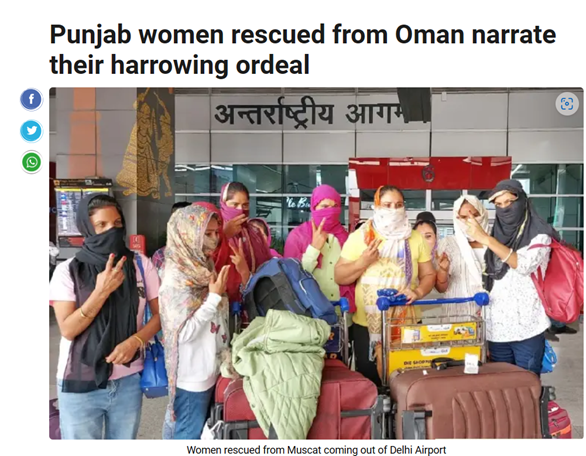
One group of Punjabi women were eventually able to escape earlier this year and sought refuge in a Gurdwara in Oman where they received help from Granthi Bhai Maninder Singh. Nearly 70 women had escaped to this gurdwara, most from Punjab but some from Nepal and other states in India too.

NGO The Sun Foundation have so far rescued 24 of these women and identified dozens more who they plan to bring back to their families in Punjab. See more on The Sun Foundation here.

The cases in Oman speak to a larger problem where the financial insecurity and vulnerability of people in Punjab is being preyed upon. Earlier this year in January, five members of an international human trafficking racket were arrested for luring Punjabi youth to Mexico, Indonesia and Singapore on the pretext of sending them to the US. Once there, they were kidnapped and tortured in order to extort money from their families.

Generally, news sources in India warn people to be wary of the agents who promise jobs in the Gulf and elsewhere, but some of the women in Oman have stated that they were not educated enough to have heard of these warnings. Those most desperate in Punjab and beyond in India are neither given adequate support or protection from Indian authorities, being trafficked to Oman and their plight is also given little attention.

Speaking on the issue, Sikh Press Association Senior Press Officer Jasveer Singh said:

“There is an issue of mass flight of Punjabis from Punjab, and a lot of that is down to the lack of rights the minority Sikh community has in India.

“This is not just about individual rights, which are often trampled on directly by police, but it’s also about worker rights as farmers, opportunities for further learning and employment. Now we see this is impacting Sikh women who are leaving their homes desperately seeking work.

“This is a problem that will not go away and thus Sikh orgs across the world will definitely be paying more attention to it after a rise in reports of this issue through the year.”

Media inquiries – Har-Rai@SikhPA.com.

Body of Sikh man found after days missing in Kashmir, murder suspected

UPDATE: The body of a 75-year-old Sikh man identified as Karan Singh was also discovered in Tral area of South Kashmir’s Pulwama district on 02.09.23, prompting concerns of an uptake in targeting of Sikhs in Kashmir. So far suicide is again not suspected by locals.

Image

The body of a respected Sikh figure has been recovered days after he went missing in Baramulla (city in Kashmir), in an incident of suspected kidnapping and murder.

59-year-old Gurmeet Singh, an engineer for the city, was reported as missing on the evening of 25th August. His car was left in the Kanth-Bagh area of the city and his mobile phone was switched off. Singh’s body was found in a barrage in the Gantamulla village on 28th August. Suicide is not suspected.

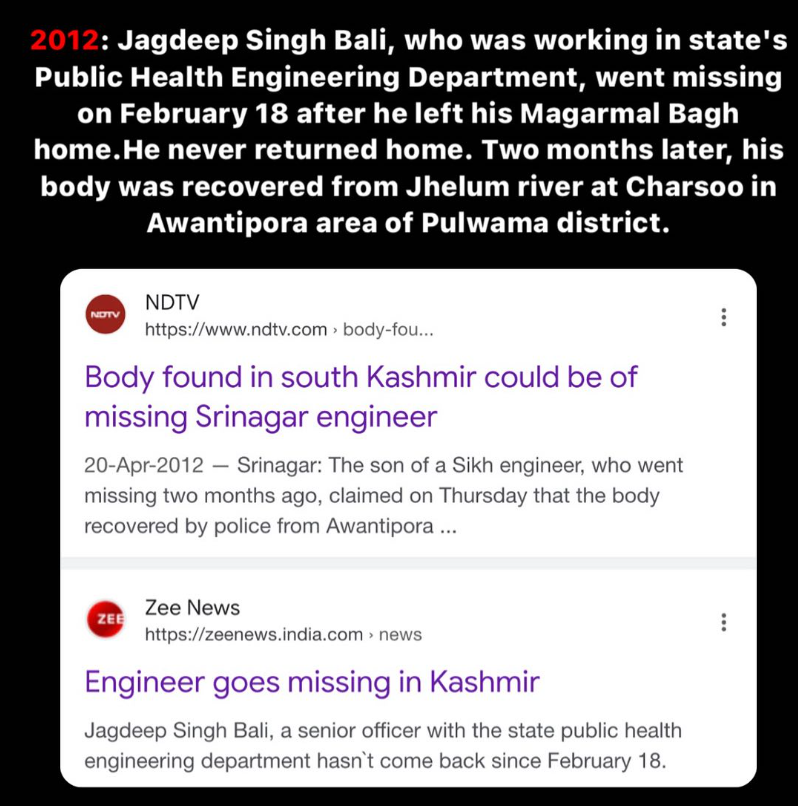
Although what occurred still remains a mystery, Sikhs have historically been plagued by Islamic extremists in Jammu and Kashmir (J&K). It is also not the first time a Sikh engineer has gone missing in J&K, as reported by the Kashmiri Sikh Project group (see image below). Kashmir based Sikh academic Dr Komal Singh said about the murder of a Sikh and J&K, “We know this is not first it won’t be last”.

Most accounts state Gurmeet Singh said he went to attend an official work meeting before he disappeared. J&K is also noted as being one of the most militarised areas on earth, with hundreds of thousands of Indian troops stationed there, imposing many human rights abuses on the area’s citizens.

Protests have broken out, with J&K Sikh groups calling for more government action on protecting the community. The protest was supported by the Civil Society of Baramulla, whilst the local Transport Association also suspended actions in a mark of respect.

Investigations into the murder continue, although a conclusive outcome is unlikely to come any time soon.

Speaking on the issue, Sikh Press Association Senior Press Officer Jasveer Singh said:

“The case of Gurmeet Singh reminds us that across India, and in neighbouring Pakistan and Afghanistan and all that is in between, Sikh lives seem more dispensable then most. Sikhs remain a micro-minority community in these countries, plagued by Islamic extremism on one side and Hindu extremism on the other.

“Between these issues, Sikhs lives are often lost in various ways and the ability for the community to obtain justice remains weak. Hopefully in this case more will come to light. Our prayers and thoughts go out to Gurmeet Singh’s family and the Sikhs of Jammu and Kashmir.”

GB News face Sikh backlash for Nigel Farage “defaming an entire Sikh community”

UPDATE: Wasiq Wasiq, the Henry Jackson Society pseudo-expert on Khalistan, made a public apology for his false allegations made in the report. See it here- The Sikh Press Association (@sikhpa) • Instagram photos and videos


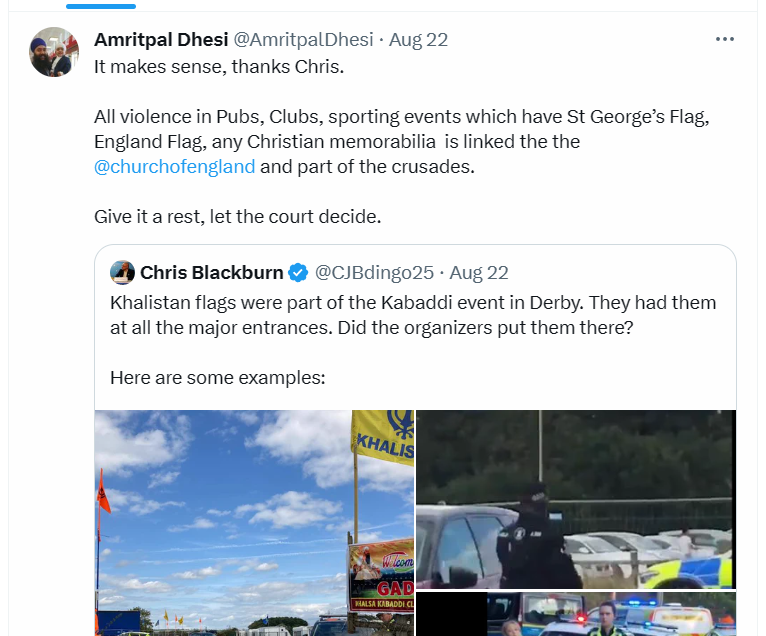
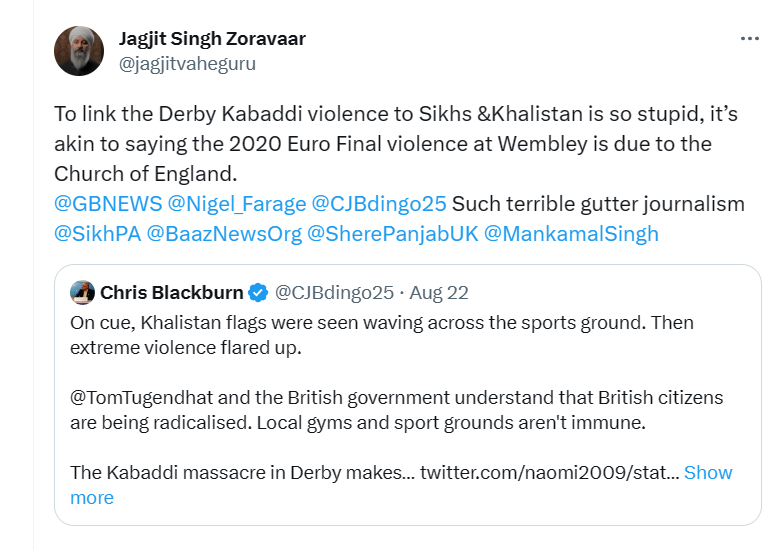
A news report on right-wing UK media channel GB News has faced mass backlash for a ludicrous claim that violence at a kabaddi tournament was linked to the Khalistan (free Sikh homeland movement).

The segment, featured on far-right politician Nigel Farage’s regular weekday 7pm show, centred on an incident at the Kabaddi Federation UK’s tournament in Derby (Midlands, UK) on Sunday 20th August. A group of masked weapon wielding men stormed the site of the tournament in Alvaston to target a specific few others.

See a statement from The Sikh Federation UK on the anti-Sikh report below.

On the report released on 22nd August, after saying the “blame” of the violence lay with “Khalistanis”, Farage, who has long faced strong criticism for racist statements and lying to the British public about Brexit, brought on former music teacher turned pro-India propagandist Wasiq Wasiq for pseudo-expertise on the topic of Khalistan.

Wasiq is an employee of the notorious pro-India UK based Henry Jackson Society, an organisation regularly accused of being funded by Indian nationalist groups due to its open promotion of Narendra Modi’s much criticised fascist regime. The Henry Jackson Society were also investigated for accepting funding to push anti-China propaganda, whilst their attempts to distance last year’s Leicester riots from Hindu extremism have also raised concerns about the group’s influences from India.

In a clear indication of the lack of substance to the allegations made by Farage and Wasiq, there was no attempt to actually explain how the incident was linked to Khalistan. Instead, Wasiq simply said “what is happening in Punjab seems to have spilled over…we have seen Khalistani flags there” as a faux-explanation of how the random violence at a sports event was anything to do with a Sikh political movement, currently mostly noted for its democratic referendum campaign.

A former colleague of Wasiq at West London based Cranford Community College who wished to remain anonymous, said of the Henry Jackson Associate Fellow:

“Wasiq is definitely no expert on anything to do with the Sikh community. Despite working in an area teeming with Sikh organisations, many of them pro-Khalistan, Wasiq was never engaged with them nor even seemingly aware of their existence. It is definitely baffling to see him now paraded as some kind of expert on Sikh politics. He was a good music teacher though.”

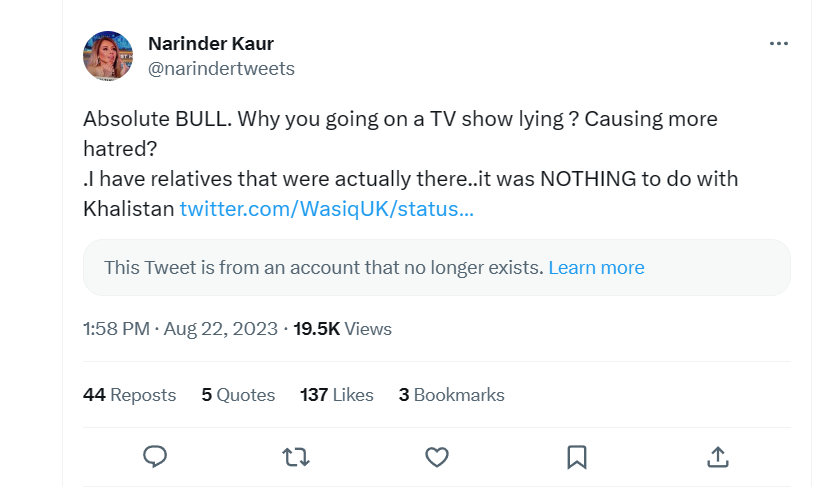
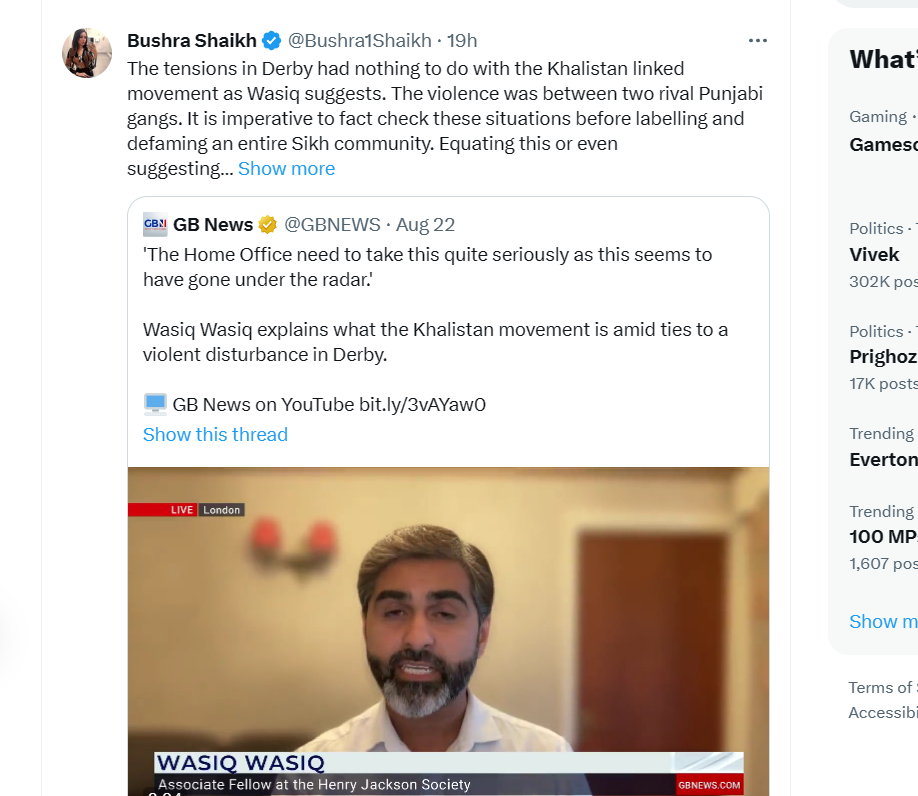
Wasiq and Farage drew mass ire from Sikhs on Twitter after the report came out, with even his GB News colleagues Narinder Kaur and Bushra Shaikh lambasting him for “Causing more hatred” and “defaming an entire Sikh community”.

Rather than attempt to explain his allegations, Wasiq simply deleted his Twitter account.

Along with the Khalistan accusations, Farage also managed to tie the incident into his ongoing anti-immigrant sensationalism, saying “much larger numbers of Sikhs are crossing the English channel in those dingys…I havent got a clue if some of those that are coming are associated with the Khalistani movement…surely we need to know”. Wasiq then relayed stats suggesting asylum seekers could be a danger to the British public, before provocatively stating “we will have to be dealing with Khalistani extremists”.

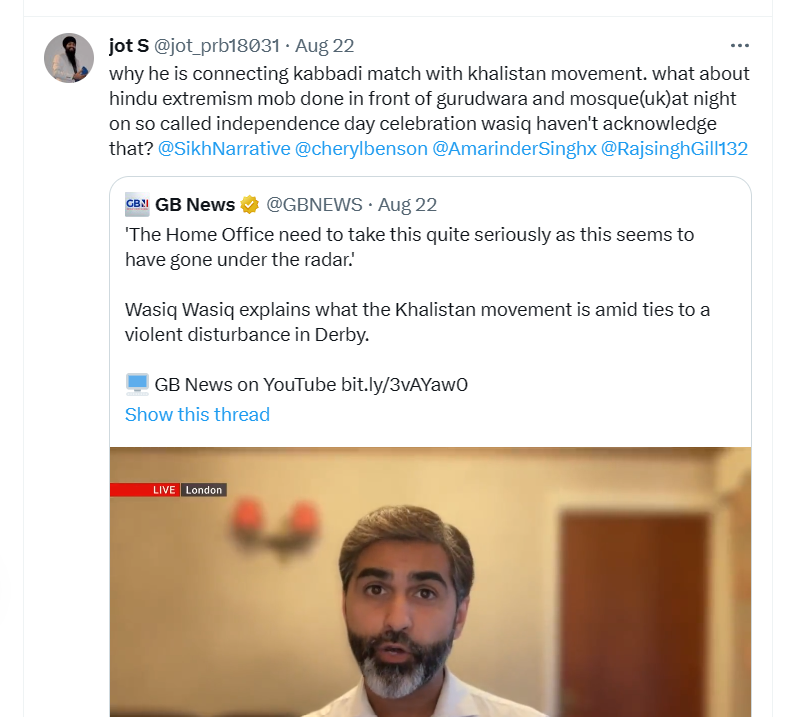
During the segment Farage claimed “politics of the subcontinent are coming to the UK”, yet a violent Indian nationalist mob attacking Sikhs last week was ignored by Farage.

The violence at the Kabaddi tournament saw three men taken to hospital with serious injuries and four men were arrested by armed police. None of those involved have any links to any Khalistan groups, or Sikh organisations. No initial reports from any media or the police suggested it was linked to the Khalistan movement. According to locals, the conflict was part of an ongoing tit-for-tat feud between groups, which has seen attacks carried out across the Derbyshire area.

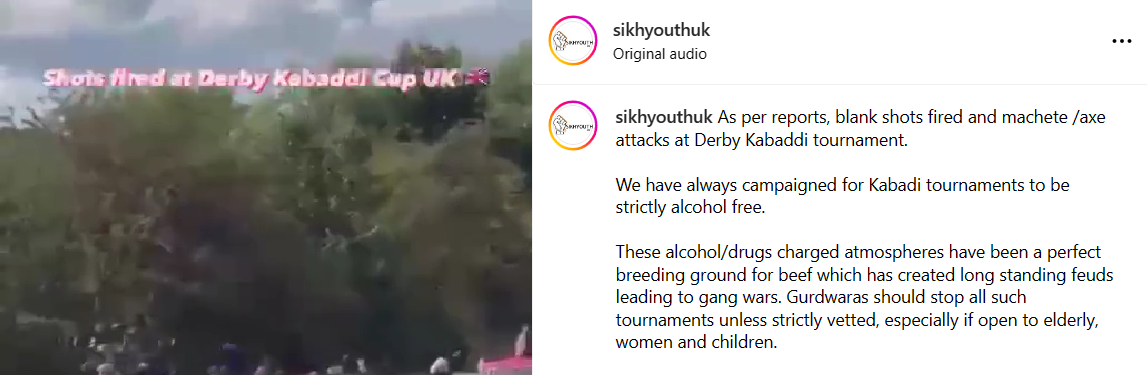
A video released by the England Kabaddi Federation through community group Shere Panjab UK saw the claims from GB News completely dismissed. Immediately after the incident, various Sikh orgs came out to condemn it too, criticising the normalisation of alcohol consumption at such events which can lead to violence. Kabaddi competition, a traditional sport amongst the Punjabi Sikh community, is often supported by Sikh organisations and support for Khalistan or other panthic (Sikh path/community centred) movements is common at such events.

Speaking on the report, Sikh Press Association Senior Press Officer Jasveer Singh said:

“The GB News piece may be the worst example of anti-Sikh reporting from a UK news org I have seen in nearly nine years of covering Sikhs in UK media.

“There is no doubt in my mind, this kind of baseless anti-Sikh journalism has been influenced either directly or indirectly by the Indian State. The act of framing any criminality involving a Sikh as some kind of example of “Khalistani terrorism” is pure Indian nationalist propaganda designed to detract from the movement, which also works to expose India’s infinite human rights abuses.

“We sincerely hope media regulator Ofcom will act now they have been contacted, as GB News show no intention of admitting their allegations about Khalistan are baseless. To the contrary, Farage seems intent to tie in Sikhs into his longtime anti-asylum seeker rhetoric, and the Khalistan allegations are an easy way to do so. The involvement of a Henry Jackson Society employee in the report only further underlines the obvious influence from Indian nationalist rhetoric within this news piece.

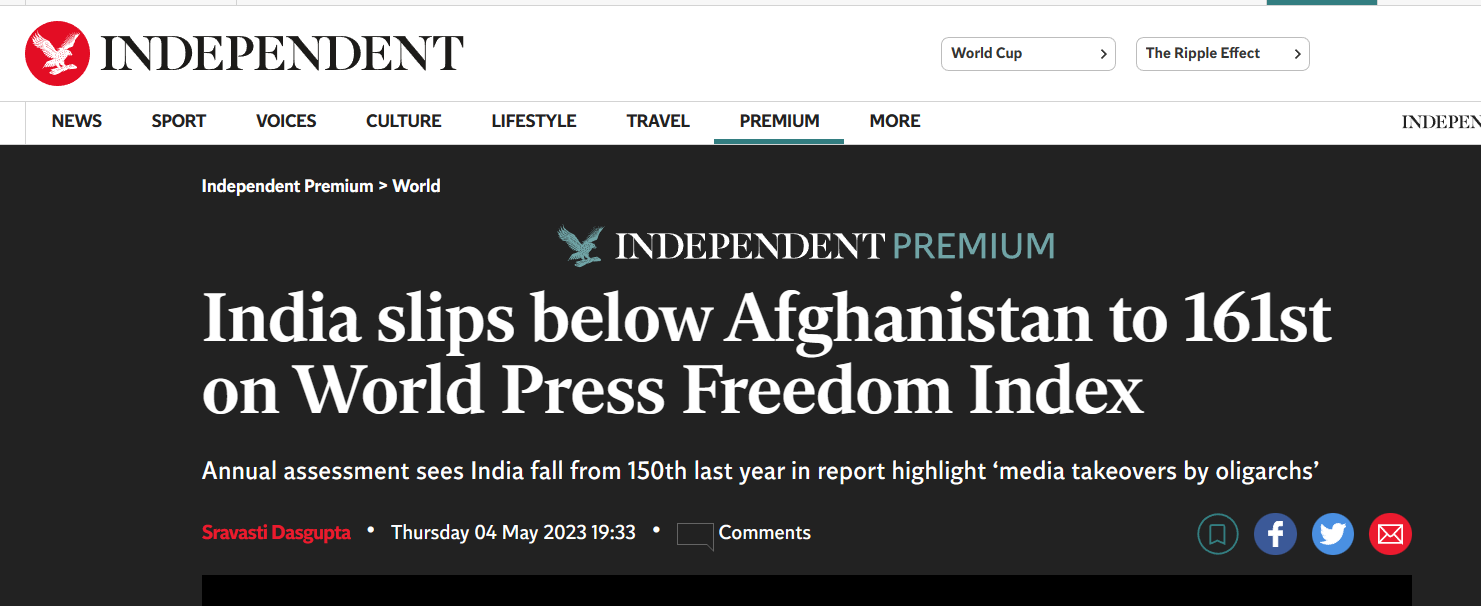
“The UK public should be very concerned about this obvious Indian State influence corrupting the standards of media in this country. We have seen The Times recently been used for obvious Indian nationalist anti-Sikh propaganda, whilst the BBC this year reached new levels of erasing Sikh identity which is associated to Khalistan too. Indian media is ranked 161st of 180 countries for press freedom and the UK is heading in that direction with such reporting.”

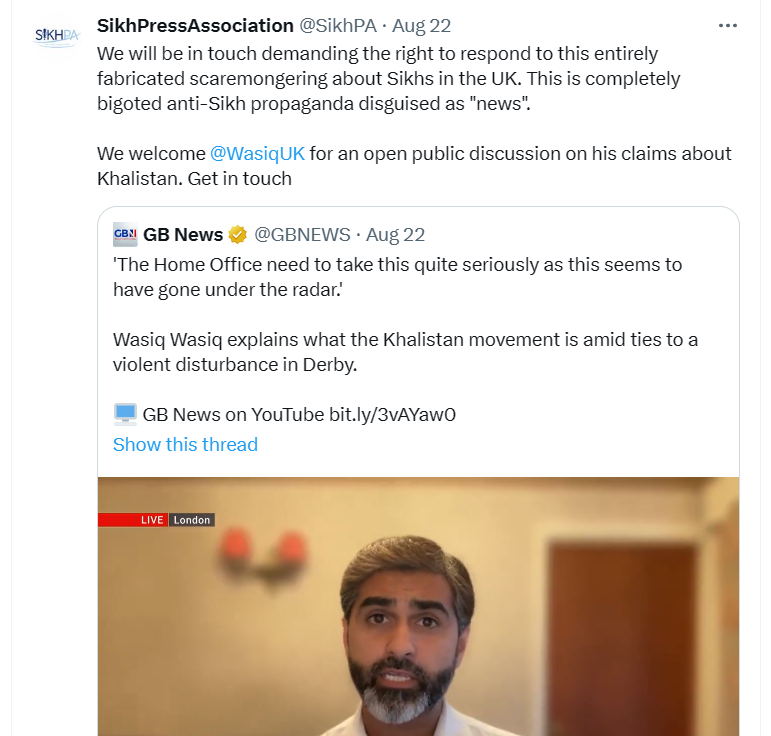
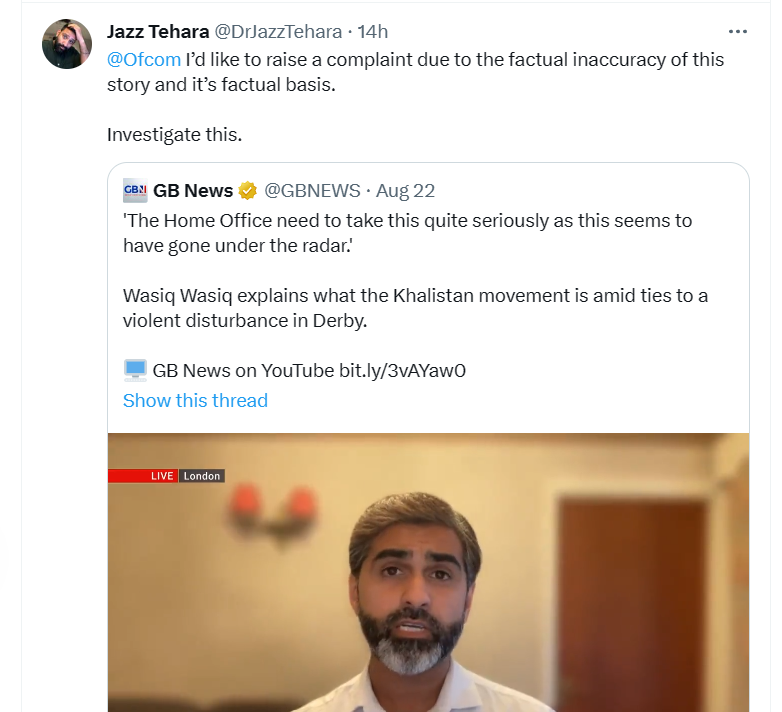
Sikh groups have now raised the incident with Ofcom whilst activists remain encouraging complaints to be registered against the report. Sikh PA will provide updates on a pursuit for GB News to rescind their empty anti-Sikh claims as they come in.
See more Sikh reaction against the report below.

Sikh man dies after police violence amid new farmers march

A Sikh man died from injuries sustained during a police attack, as Indian authorities attempted to prevent a new farmers protest march.

55-year-old farmer Pritam Singh was hurt yesterday (21.08.23) during a lathi (stick) charge by police in Longowal (Sangrur, Punjab) and passed the same night. Singh was part of a Punjab and Haryana farmers union march towards Chandigarh (India’s capital of Punjab), organised to today demand more government support for farmers after recent floods destroyed their lands.

The official police statement of the death claimed Pritam Singh died after falling under the wheels of a tractor, amid a police operation against many of the 32 farmer union groups passing through Longowal for a protest in Chandigarh. The operation saw violence towards the protesters, ending with cases put against 53 farmers, an unaccounted amount also detained and farmer vehicles damaged by police vandalism. Grassroots accounts have solely blamed police for Pritam Singh’s death during the melee, with their heavy-handed approach causing him to fall under a passing by tractor.

A further 100 farmers from Haryana and Punjab were also reported as arrested, with more detained across both states in an attempt to disrupt today’s gathering. Demonstrations about the arrests spread across Punjab, with some groups attempting to block highways in protest, whilst masses joined protests outside Longowal police station regarding the death of Pritam Singh.

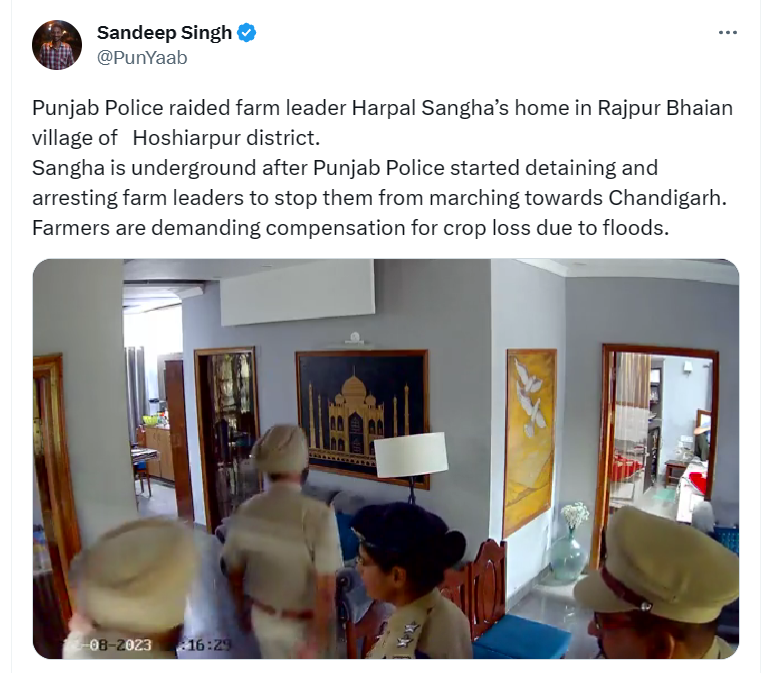
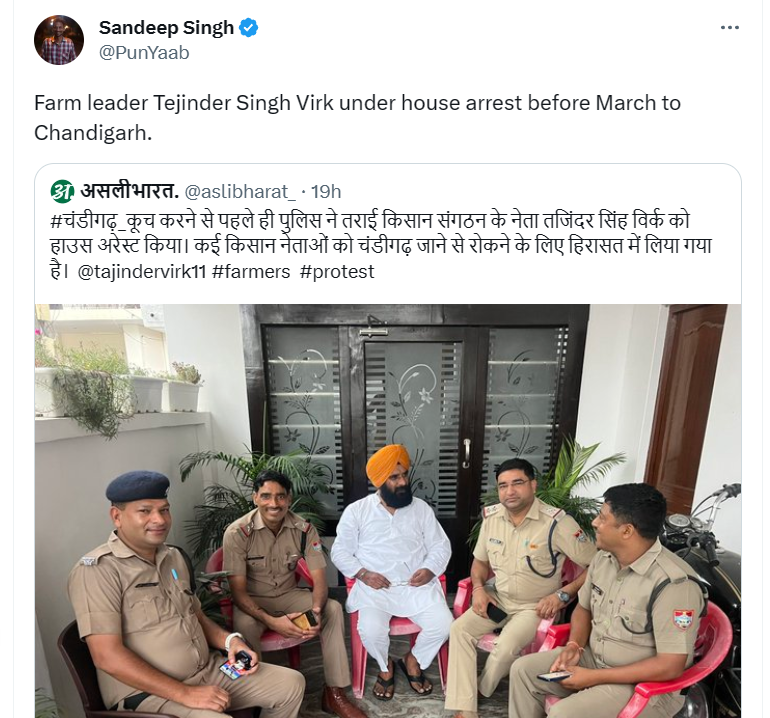
The violence highlights that Indian police in Punjab have been tasked with violently disrupting the new farmer protest attempts by any means. Videos have gone viral of police attacking union groups all over the state, whilst lead figures within the groups have had their homes raided and faced house arrest. Many social commentators are criticising Punjab’s new Chief Minister Bhagwant Mann of the Aam Aadmi Party, whose party was advertised as bringing a fresh approach to Punjab, away from previous violent regimes. However, police violence in the state is arguably the worst it has been in a decade.

The uptake in State violence is believed to be an attempt to curb any potential movement as seen during the famous #FarmersProtest of 2020-2021, which resulted in a partly Sikh led movement forcing the Indian State to revoke three exploitative farm laws being forced on the agriculture sector. News of censorship (via Facebook) to hide the actions of Indian authorities have also been reported, particularly impacting respected journalist Mandeep Punia. Attempts to prevent the Chandigarh protest gathering even saw police trying to drive vehicles off the road.

Demands from the farmers will continue, as compensation packages are sought due to the ongoing impact of the Punjab floods. Along with these demands, farmer groups will now be pursuing justice for their arrested colleagues, some of whom remain imprisoned. Concerns about India’s violent response to the farmer demands remain prominent in global Sikh circles.

Chandigarh today

“Unconstitutional” kirpan ban revoked in Queensland

A long time ban on Sikhs being able to wear the kirpan in schools in the province of Queensland in Australia has been revoked, after efforts by a Sikh campaigner found the ban to be “unconstitutional”.

The kirpan is a small sword which is a mandatory part of the Khalsa (collective of initiated Sikhs) Punj Kakkar (Five Ks) uniform, which men or women of any age can wear if they become Amritdhari (initiated). The school ban was revoked on 2nd August by Queensland Supreme Court after Kamaljit Kaur Athwal highlighted its discrimination towards Sikhs based on the Racial Discrimination Act (RDA).

Originally, the ban was in place through the Weapons Act (1990) which stated “religious purpose” was not a justifiable reason for Sikhs to be allowed to wear the kirpan in schools. However, Kamaljit Kaur Athwal took it upon herself to challenge the ban, taking the state government to court last year, claiming the Weapons Act discriminated against Sikh practices. Presiding judges found that a section of the Queensland Weapons Act of 1990 — which bans carrying knives in public places and schools — is inconsistent with Section 10 of the Commonwealth Racial Discrimination Act of 1975. The final ruling was that Section 51(5) of the Weapons Act is invalid under Section 109 of the constitution.

According to the Guardian Australia, “Queensland will explore all legal options” regarding an appeal against the ruling.

Sikhs across the world have welcomed the Queensland legal ruling. Speaking on the outcome, Sikh Press Association Senior Press Officer Jasveer Singh said:

“The legal ruling in Queensland is a great outcome for not just Sikhs, but religious freedom in general in Australia. Sikhs have long been a successful and celebrated community in Australia that have gone above and beyond to make life in the country better for all, as is the Sikh way. There is no reason any Australian should be anything other than encouraging to Sikhs trying to practice their faith.

“The legal result will galvanize other legal movements to challenge discriminatory rulings which impinge on Sikh freedoms, including beard bans in sport and more issues Amritdhari Sikhs face with the kirpan. Statistics will show more people are injured through attacks with high-heeled shoes than the kirpan. Thus, Kamaljit Kaur Athwal is a hero of the Sikh kaum (nation) for getting this unnecessary ban overturned and she will be given even more support to take on any appeals, which may sadly come from Queensland authorities based on misguided views about safety.”

In 2021 the province of New South Wales temporarily banned the kirpan after an incident which saw it used by a 14-year-old Sikh student against a 16-year-old non-Sikh at a school with notorious anti-Sikh bullying issues which went unaddressed for years. Read more on that here. The ban was reversed months later but remains something many Australian Sikhs wish to amend to be more practical for Sikhs.

Indian nationalist mobs attack Sikhs, two stabbings reported

UPDATE (20.03.24): A Khalistan supporter Sikh man has been sentenced to 28-months imprisoned for violence involving using his kirpan (Sikh sword, article of faith part of the initiated Sikh uniform) during a skirmish with Indian nationalists, which also saw a policewoman injured with the blade. In comment to Sikh PA, locals maintained that the streets of Southall were awash with Indian nationalist mobs on the day, who were intent on stirring up trouble.

An Indian nationalist mob were videoed attacking Sikh Khalistan (free Sikh homeland movement) supporters during a yobbish Indian Independence Day gathering in Southall (West London, UK) last night (15.08.23).

One of several viral videos of the violence showed an Indian nationalist mob surround four Sikh men holding Khalistan flags, screaming and chanting at them, before violence broke out and the mob ended up chasing the men, resulting in at least one ending up on the floor being stomped on. Witnesses reported cries from the Indian nationalists to remove the dastaars (Sikh turbans) of the Sikh men.

See the incident which went viral here.

Videos of other skirmishes circulated around the same time as police sealed off The Broadway, a long road known as a tourist hotspot in Southall. No official police reports have been released but local witnesses have claimed there were two stabbings and that three people were taken to hospital with serious injuries. It remains unclear which side any of the victims were from.

Indian nationalists have long targeted supporters of Sikh sovereignty in India, with the Hindu extremist movement now clearly an issue in the UK where many within the Sikh community use UK freedoms to advocate for a free Sikh homeland within India (Khalistan).

Local Sikh-focused community media group AK Media followed the situation closely and countered early reports which attempted to lay blame on Khalistanis for the outbreak in violence, even though video evidence clearly showed Indian mobs carrying out the attacks.

As has happened for many years, crowds gathered in the mini-Punjab of Southall to celebrate the day India came into existence after Britain relinquished its colonial rule of the territory in 1947. Southall however, is known to be home to a large section of Khalistan supporters, with local Gurdwaras depicting images of Khalistan figures and holding events in support of the movement. Many of these Khalistan supporters have also long attended the India Independence Day gatherings to highlight wider Sikh sentiment that the period was actually a dark time for the community, due to the biggest migration in history and over two million deaths during the chaos of Punjab’s partition under the British. However, the increasingly dark turn of Hindu Indian nationalism in the UK (and beyond) became evident through the evening.

Earlier in the night before police issued a dispersal order a mob was seen chanting Jai Shri Ram marching provocatively past the Park Avenue Gurdwara, which is a 10 minute walk away from The Broadway where crowds gather. The chant is associated with intimidatory mob behaviour in India which has seen Hindu groups attack Mosques, Gurdwaras and anti-state demonstrations (including anti-rape protests).

What is Khalistan and why do Indian nationalists target Khalistanis?

Khalistan is the name of a proposed free Sikh homeland that would be made up of the Punjab state in India. The support for the movement comes partly from the fact the Indian regime has been viewed as carrying out various anti-Sikh actions since its inception, including the Sikh genocide. Khalistan support also comes from the fact that prior to the British Raj, there was a Sikh empire across India, the territory of which was handed over to a central majority Hindu government to control post 1947. Finally, support for Khalistan also comes from faith-based notions of Sikh sovereignty and philosophy. Respected activist and educator Bhai Daljit Singh recently said “Khalistan is not the idea of a Sikh state; it is the Sikh idea of a state”.

Fanatical nationalism across India, stemming from the idea India is a Hindu Rashtra (nation), has demonised those perceived as attempting to break up Bharat Mata (Mother India), resulting in mass anti-Sikh/anti-Khalistan rhetoric being normalised among Indian Hindu nationalist groups.

Anti-Sikh violence has demonstratably been imported to the West. Various reports of attacks have surfaced from Australia, whilst less violent but still concerning incidents have been reported across Canada too. Hindu extremist Vishal Jood was deported from Australia in 2021 for being a ringleader of anti-Sikh attacks in Australia, and was met with a heroes welcome in India. In the UK, Hindu mobs acting similarly as they did yesterday in Southall instigated violence in Leicester in 2021.

Across the world Sikh groups are condemning the violence whilst highlighting it as yet another example of the growing threat of Hindutva.

A Southall Sikh resident and Khalistan supporter, who asked to remain anonymous, spoke with Sikh PA about the incident, saying:

“The Indian nationalist mobs took advantage of the fact there was no coordinated demonstration by the Sikh community of Southall last night. There was a conscious decision by Sikh groups to not do anything that could raise tensions so we allowed this Indian Independence Day gathering to take place.

“The few Khalistan supporters that did attend to highlight the Sikh stand against the Indian state were very outnumbered and thus quickly targeted by the Indian mobs.

“However, Southall has a long history of standing up against fascism and now steps will be taken to ensure what we saw in the town last night will never be repeated. It is up to UK authorities to ensure these Indian nationalist mobs do not provoke violence, as next time Sikhs will not allow them to target our community.”

Sikh PA have reached out to Southall police for a statement on the incident and also to answer questions about concerns of Hindu Indian extremism in the area.

“India assassinated him, UK Covered it up” – Thousands attend Sikh activist funeral

Thousands attend funeral after new revelations of how UK authorities prevented an independent autopsy for Bhai Avtar Singh Khanda to investigate claims he was poisoned.


Thousands of Sikhs from across the UK gathered in Smethwick to pay their respects at the funeral of respected Sikh activist Shaheed (martyr) Bhai Avtar Singh Khanda yesterday (12th August).

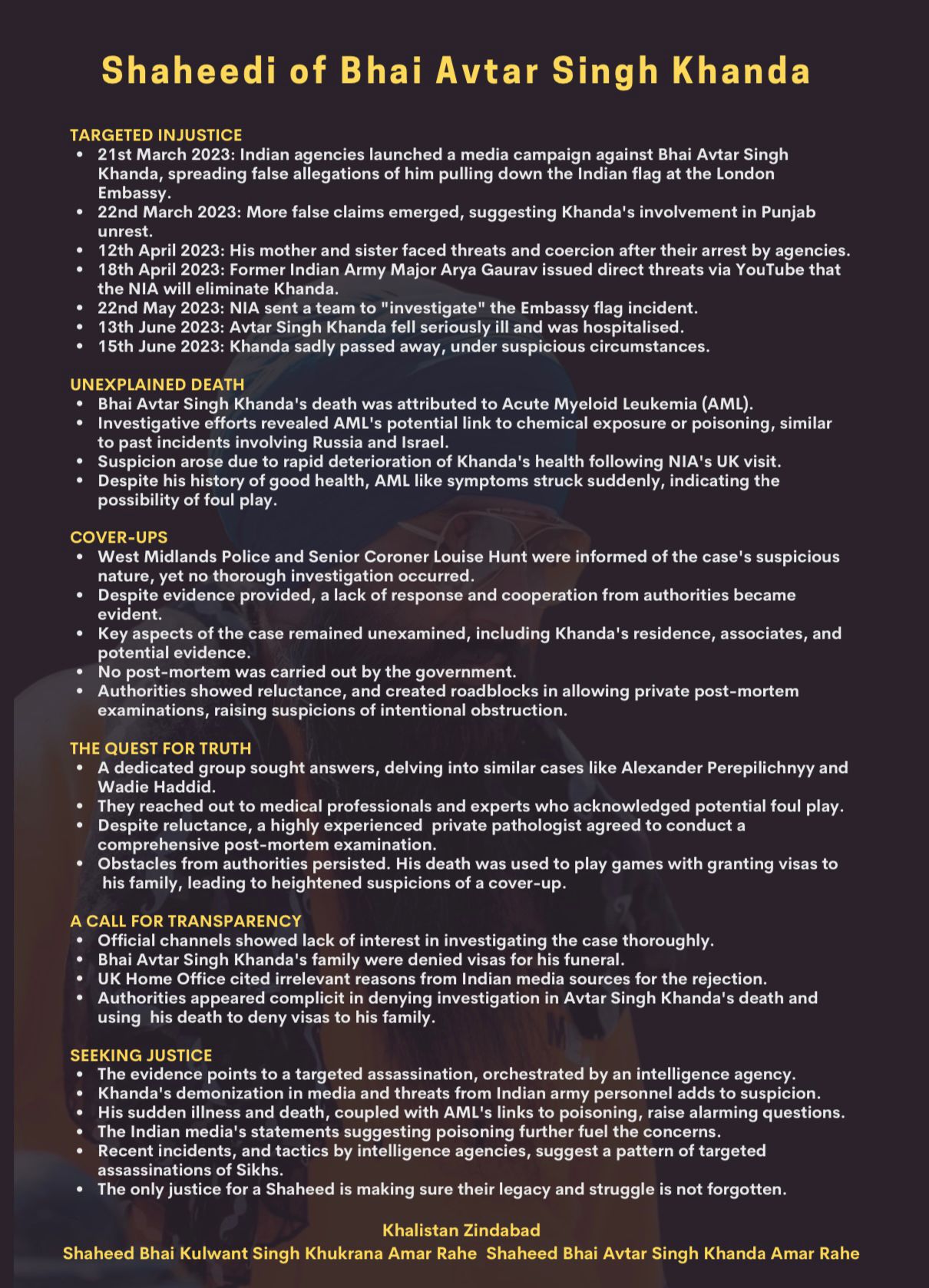
From 9am until 5pm countless mourners came through Guru Nanak Gurdwara Smethwick (Midlands, UK) and the Sandwell crematorium to pay their respects. The UK based Khalistan (free Sikh homeland movement) figure passed in suspicious circumstances in June, just months after an Indian military figure publicly declared he would be “eliminated” by India’s intelligence services. Attendees were given leaflets (see below) explaining events around Khanda’s passing, as seen by his immediate support group.

Read more about the reaction to his passing in June here.

Khanda had long been a target for the Indian state for his leadership within the Khalistan movement, which aims to establish India’s Punjab as a free state run under Sikh philosophy. Support for Khalistan is prominent in Sikh community circles based on India’s mistreatment of Sikhs and the notion of Sikh sovereignty which is part of the faith.

Despite being based in the UK for most of his life and never being investigated or even accused of any specific crimes, Khanda was regularly labelled a “terrorist” within Indian media, which is currently ranked 161st of 180 countries for press freedom.

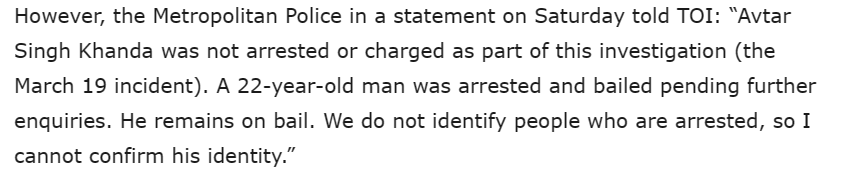
The venom towards Khanda exploded when he was falsely labelled as the culprit of an incident in March in London, which saw India’s flag pulled down from outside the High Commission building. Yesterday London’s Met Police finally confirmed that Khanda was NOT behind the flag incident in a statement given to Times of India (see image below). This was obvious to anyone that looked into the issue, with video evidence clearly showing Khanda was not even in the vicinity of the incident. However, Indian media relentlessly pushed the claim Khanda was behind the incident and fanatical Hindu nationalists echoed the fake news for months. Many openly celebrated Khanda’s death on social media and attributed it to India’s intelligence services when he passed in June.

Khanda passed just weeks after playing a prominent role at the June 2023 annual Sikh Genocide rally as a TV presenter for the Punjab Broadcasting Channel. A sudden illness saw him admitted to Birmingham City hospital, where he passed after a short stay. Official diagnosis labelled the cause Leukemia. However, the suddenness of the passing coupled with the threats from India have left much of the Sikh community justifiably convinced Khanda was assassinated, similarly to how intelligence agencies have killed others through poisoning.

In a video released on Friday prior to the funeral, speaking in Punjab Sikh community figure Shamsher Singh of the National Sikh Youth Federation revealed about the investigation into Khanda’s death, that:

  • Birmingham City hospital admitted only the “basic” tests were conducted on Khanda
  • An independent pathologist stated further tests would be required to investigate claims of poisoning
  • Said pathologist was not allowed to examine Khanda, nor was his body allowed to be taken to a different venue for an examination

Anger against UK authorities was also found in the fact that the UK Home Office refused to allow Khanda’s elderly mother and sister attend his funeral from India. Both were recently shamelessly targeted for arrest by Indian authorities to intimidate Khanda from continuing to speak out against India’s constant anti-Sikh human rights abuses. Those arrests were used to justify the position of India that neither should be allowed to attend the funeral, which UK authorities fell in line with.

Speaking on the situation, Sikh Press Association Senior Press Officer Jasveer Singh said:

“The mass attendance through the day for the funeral of Bhai Avtar Singh, which saw everyone from elder women to young boys paying their respects to him, shows there is mass community support for what he stood for; namely the Khalistan movement.

“The support for this movement does not seem to be fading, even though now two major figures of it have been assassinated by India since June, according to the official position of the majority of Sikh orgs. However, what is fading is trust between Sikhs and the UK, due to the lack of action on India’s targeting of Sikh activists in the country, as well as various examples of collusion between the states to demonise and attack those associated with Khalistan.”

Media inquiries- media@sikhpa.com.

Electrocution marks clear on anti-drug Sikh activist tortured by Punjab Police

A popular anti-drug Sikh activist was pictured with visible burn marks from electrocution torture, after his arrest by Punjab Police last week.

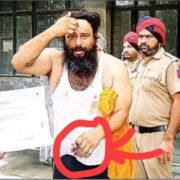
The disturbing image went viral on 17th July, showing Parvinder Singh Jhota in a disheveled state, clutching onto his dastaar (Sikh turban) under his arm, outside a Mansa police station. In the picture Singh’s fingers are blackened from where his fingers were attached to a device to electrocute him, a well known torture technique of Punjab Police.

Image

Parvinder Singh Jhota (also spelled Jhotta or Jhote) was arrested by local police in his home city of Mansa (Mansa district) on the morning of 14th July at his home. Footage of the arrest went viral on 15th July, depicting the Punjab Police force’s heavy-handed tactics, which included aggression towards the elderly parents of Jhota. Jhota was not shown any official documents detailing the reason for his arrest.

Jhota, a father and respected community figure, was arrested for his exposure of Panjab’s drug dealers who were working openly in Mansa. Jhota publicly spoke on social media of police impunity given to dealers working in Pharmacies. On 12th July it was reported (with video proof which has now been removed of Facebook) that Jhota confronted one of these drug dealers, Ashwin Kumar, found selling illegal non-prescription drugs to local addicts. With police ignoring requests to make arrests of such drug dealers, Jhota took up the issue himself and exposed the drug dealer, humiliating him by walking him through the street with a garland of shoes around his neck. Local journalists have also found evidence that Jhota had previously made an official report of crime to the police about Kumar, which was ignored.

*Note- The Sikh Press Association does not share links to Indian media outlets, due to their regular regurgitation of anti-Sikh propaganda. Indian media is ranked 161st of 180 countries in the world for press freedom.

Two days after the incident, dozens of Punjab Police officers raided Jhota’s home to arrest him. Six of his supporters were also imprisoned at the same time. Police have since claimed Jhota and his supporters are under arrest for assault and more around public disturbance. Following his arrest, Jhota’s father who was able to speak to him detailed his son’s account of being tortured. You can see the interview with Parvinder Singh’s father here, posted by respected activist and Sikh social commentator Dr Prabhjot Singh (@Free5ab).

Protests have been made across Punjab, with one attended by thousands taking place today (21st July) in Mansa.

Parvinder Singh Jhota’s Facebook page (which has 40,000 followers) can be seen here, showing mainly his efforts to speak against drug dealing in Punjab. His social media talks on the topic have seen him become a widely respected activist.

The link between Panjab Police officers and the illegal drug trade practiced in and through the state has been a particularly pertinent issue ever since the #PunjabUnderSiege operation from March-April this year.

The chief target of the operation was Bhai Amritpal Singh, head of social reform group Waris Punjab De. At the time of his arrest Bhai Amritpal Singh was leading the Khalsa Vaheer campaign, which was based on challenging the drug epidemic in Punjab, including the impunity of drug dealers.

As the popularity of the Khalsa Vaheer movement grew, so did Police targeting of the WPD team, leading to the famous incident where Bhai Amritpal Singh led an effort to free Sikhs being detained and tortured at Ajnala Police station.

A Police officer involved in the imprisonment of British Sikh political prisoner Jagtar Singh Johal was also relieved of his duties due to his involvement with drug mafias becoming too well known. Officer Raj Jit Singh Hundal remains under investigation. However, often investigations into Police officer crimes can be dragged on for decades, allowing guilty parties to remain free, often until enough time has passed for the case to fall apart. Just last week Hundal was given a “reprieve” according to Indian media, allowing the corrupt police officer more time free, with his trial yet to even start.

Jhota remains imprisoned whilst under investigation. No update on the status of the drug dealer Ashwin Kumar, whom Jhota’s efforts to expose caused all of this, has yet been given.

India prevent British Sikh wife of imprisoned leader from returning to UK home for THIRD time

The British Sikh wife of imprisoned Sikh leader Bhai Amritpal Singh has once again been prevented from leaving India, she announced in a statement today.

Kirandeep Kaur, who was born and raised in England, stated “LOC issues” are being cited by Indian authorities for the reason she has been stopped from boarding flights back to the UK, first in April and now two this past week. Kaur is yet to be shown any official documentation detailing official reasons she is being prevented from flying out of India.

An LOC (Look Out Circular) is issued to make sure that an individual who is absconding or wanted by law enforcement agencies in India is not able to leave the country. Yet, Kirandeep has not been linked with, nor accused of any crime, let alone been charged with anything which would prevent her from leaving India. Kirandeep Kaur is the wife of Bhai Amritpal Singh, the Sikh community leader who was the central target of the #PunjabUnderSiege operation carried out from March to April earlier this year.

Like many of India’s controversial laws (such as UAPA and previously TADA), the LOC requirements and definitions remain obscure enough to be manipulated for use against anyone targeted by the state. An LOC can only be put into action by Deputy Secretary to the Government of India or Joint Secretary to the State government or a Superintendent of Police at the district level. The LOC has previously been challenged for breaching human rights of those it was imposed on, including respected journalist Rana Ayyub, whose Delhi High Court challenge of the LOC saw authorities admit “An LOC is a coercive measure to make a person surrender and consequentially interferes with petitioner’s right of personal liberty and free movement.”

In her statement, Kirandeep Kaur relayed how, after being denied travel in April, she since booked a flight to England in June, a month in advance to leave on 14th July, for which she gave authorities due notice and was told she would be free to leave. On 14th July authorities then asked her to wait a few more days. When Kaur again tried to fly on 19th July, she was once again prevented from boarding her flight from Amritsar airport.

Kaur married Sikh leader Bhai Amritpal Singh in February this year. Bhai Amritpal Singh is the head of social reform group Waris Punjab De. At the time Singh was leading the Khalsa Vaheer campaign, tackling Punjab’s drug epidemic and the corruption facilitating it. Bhai Amritpal Singh also took on Punjab’s Police torture tactics and advocated for Sikh sovereignty (Khalistan, a free Sikh homeland) which led to him becoming a demonised figure within India’s Hindu extremist nationalist society.

On 18th March this year a mass police and army operation targeted Bhai Amritpal Singh and 1500+ Sikh activists, lawyers, journalists, politicians and anyone (including teachers and actors) that was deemed to be critical of India in Punjab. The internet and phone networks were shut-off intermittently across the state, as the operation – dubbed #PunjabUnderSiege – was carried out.

At this time, Bhai Amritpal Singh absconded authorities and stayed out of their reach for approximately a month, leading to the biggest manhunt in history to find him. Amritpal Singh handed himself on April 24th, just days after his wife was prevented from leaving India (20th April), in a viral incident which made national news in India.

Many human rights supporters are concerned that Kirandeep Kaur is being forced into overstaying her visa allowance in India, which will then allow Indian authorities a tangible reason for arresting her. Concerns for her wellbeing in the hands of authorities will peak, due to a long documented history of Indian police and prison officers sexually abusing detainees, particularly women.

In her statement, which was released on social media via WPD figures, Kaur further added:

“They do not want me to attend Avtar Singh Khanda’s funeral (I do not even know when and where the funeral is taking place) they are feeling uneasy about this, assuming that I will give a speech there. They fear I will ‘create a movement’”.

Bhai Avtar Singh Khanda is a UK based Khalistan figure who died in suspicious circumstances last month, in a case of suspected poisoning. His family remain searching for answers amid independent investigations. Khanda was the second of three Khalistan figures to die in a short span of time, with Shaheed (martyr) Bhai Paramjit Singh Panjwar murdered in Pakistan in May and Shaheed (martyr) Bhai Hardeep Singh Nijjar gunned down just over a week after Khanda’s passing, in Surrey (BC, Canada).

India media outlets and Hindu nationalist social commentators have openly attributed all three deaths to India’s intelligence services carrying out anti-Khalistan attacks. Since then, Indian media (who are ranked 161st of 180 countries for press freedom) have reported on a 20-man “Sikh hit-list” of other Sikhs associated with support for Khalistan that will be targeted, including UK, American and Canadian citizens.

Sikh groups across the world are now pressing UK authorities to address the issue and force India to allow Kirandeep Kaur back to her home in England.

Media inquiries- media@sikhpa.com.


FULL STATEMENT FROM KIRANDEEP KAUR:

“I have been stopped for the 3rd time when going to England, as the law requires me to make an entry by 180 days. During April certain media and individuals thought I was “fleeing” back to England, one can not simply “flee” back home. Being a British citizen there are different rules that apply for me. Since then, I booked a flight for 14th July an exact month in advance “after” confirming that I will not have any issues. Up until the morning of departure I was being told that everything is clear for me to go, a few hours before boarding time I was being asked to not leave. They requested I wait some days until the 18th. Therefore, I booked a flight again for the 19th only to experience the same again. No offical has spoken to me directly, they are contacting those in contact with me to convey such messages. They do not want me to attend Avtar Singh Khanda’s funeral (I do not even know when and where the funeral is taking place) they are feeling uneasy about this, assuming that I will give a speech there. They fear I will “create a movement” It is the government and specific agencies stopping me from leaving. All I am trying to do is make a trip back required by law and also a human right to visit my family, my trip would’ve been for a week or two. I do not intend on staying there for a long period, my priority is my Husband. Officials say there is an LOC issues but are not being provided with any documents to show me that there is. If there is, then on what basis exactly and why are they refusing to show me. If there isn’t then they can’t stop me leaving the country.”