UK police investigate beadbi hate crime (Leeds)

A Sikh community demonstration in Leeds (Yorkshire, England) has led to global calls for police to investigate an incident of desecration of Sikh scripture as a hate crime.

On 12th July members of a Sikh family discovered torn and burnt angs (meaning limbs, referring to pages) of a Gutka Sahib in a bin outside their home and scattered nearby. A Gutka Sahib is a small compilation of Sikh scripture, taken from Guru Granth Sahib Ji (Sikh scriptural Guru), used for recitation prayer/meditation.

As with anything adorning GurBani (Guru’s word, Sikh scripture), a Gutka Sahib is mandated to be kept with a high level of respectful protocol. No Sikh would ever purposefully damage a Gutka Sahib or place it in a bin. Sacrilege of Sikh practice is known as beadbi.

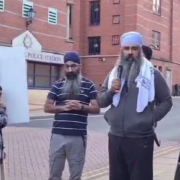
After the incident was raised within the local sangat (Sikh congregation), a crime report was registered with local police. Local Sikh community figures then made the situation public and a demonstration outside a local police station was organised as a community attempt to press police into action on 16th July, with community figures attending from across the UK.

In response, West Yorkshire police assured demonstrators the case would be looked into. In a statement, police also said the incident was being attributed to an “unknown suspect”, adding;

“A crime has been recorded for racially or religiously aggravated criminal damage and enquiries are ongoing to establish the full circumstances of the incident.”

In 2018 a Leeds based Gurdwara was targeted for arson in a racist attack on a day a Mosque was also targeted. Grassroots efforts from community groups led to the culprit being exposed and later arrested for both hate crimes. In Yorkshire, issues of anti-Sikh bullying at schools, sometimes perpetrated by children from a Muslim background, have also been reported in recent years by locals.

Anyone with information is asked to contact the police via 101 or online here quoting reference number 13230395971.

Army figure calls for Indian govt to pay “San Francisco underworld” to target Sikhs

Over the last few days, Indian nationalist commentators and media have accused “Khalistanis” (supporters of a free Sikh homeland) of being behind a minor fire at the San Francisco (USA) India Consulate building. However, Hindu extremist Youtuber Gaurav Arya, a former Indian Army Major, has taken the issue further, by demanding the Indian State hire hitmen to attack American Sikhs. Read below for more.


Fanatical Hindu extremist Indian nationalist youtuber Gaurav Arya is receiving widespread condemnation for his latest video, in which he demands the Indian State fund American criminals to target Sikhs.

The rabid rant came after former Indian Army Major Arya, who has ongoing rape and murder accusations against him, accused Khalistanis of being behind a fire at the Indian Consulate in San Francisco (2nd July 2am). Although San Francisco Fire Department Media have said the incident is being investigated and did not name any suspects, various Indian nationalist commentators and media outlets were quick to blame Khalistanis.

The Khalistan movement, born out of Sikh ideals of sovereignty and fueled by ongoing mistreatment of the 2% Sikh populace of India, including the state perpetrated Sikh genocide, is venomously opposed by Hindu nationalists in view of their Bharat Mata (Mother India) concept.

Videos and images of the alleged attack seem to be producing more confusion, as pro-Khalistan graffiti seen in one image being shared was not visible the next morning on the building (see below). The graffiti was not mentioned in a media statement from the San Francisco Fire Department, which described the incident as “smoldering debris fire on the sidewalk and front door” which caused only “exterior damage to the front door and entryway”, possibly suggesting this was not an attempt to actually burn the building down. The video the next day showed little-to-zero signs of fire damage.

The call for India to use “the underworld” and “mafia” in American cities to target Khalistanis will be particularly worrying for Sikh communities right now, as many believe Canadian criminal gang hitmen were hired by the Indian State for the assassination of pro-Khalistan community leader Shaheed (martyr) Bhai Hardeep Singh Nijjar, who was shot dead by two assailants in the Gurdwara where he was President in Surrey (BC, Canada) just two weeks ago. Similarly, Khalistani figure Bhai Paramjit Singh Panjwar was gunned down in May in Pakistan, whilst investigations into the death of Bhai Avtar Singh Khanda in the UK via possible poisoning continue.

Arya’s rant follows a series of reports from Indian media making completely fabricated accusations towards Sikhs and so-called “attacks” on Indian Consulate buildings in Canada and the UK. During an India Times Now TV broadcast in March, international rights expert Professor Andrew Macleod went viral for condemning Indian media hyperbole in calling protests outside the UK India High Commission “terrorism”. Since then, Indian outlets have even ridiculously claimed “grenades” were thrown at Canadian Indian High Commission buildings.

Accusations of vandalism on Mandirs (Hindu temples) in Australia have also caused controversy, with many Sikhs highlighting how Hindi-style spelling and graffiti tags such as “BBC” do not correlate with the idea Khalistanis (who are near exclusively Sikh Punjabi in background) are behind the acts. Most recently, New South Wales Police requested help finding a car emblazoned with the word “HARYANA” which was seen leaving one of the graffiti crime scenes after an incident. Haryana is a Hindu-majority state. Since the request, there has been no update on the investigation, confirmed by NSW Police in correspondence with Sikh PA.

News of Haryanis engaging in attacks on pro-Khalistan Sikhs has been reported in Canada and Australia. One anti-Sikh figure – criminal Vishal Jood – was deported from Australia in 2021 for leading a gang attacking Sikhs. Upon his arrival back in India, Jood was greeted as a hero. Read more on these issues in Australia here.

Arya’s call for India to spend millions to use criminals to attack Khalistanis will only strengthen ongoing Sikh efforts to have Indian foreign interference investigated in countries such as Canada, the UK, Australia and now the USA.

Yet, as if to double down on the threats, Arya today released a “WANTED” poster on American Sikh and Khalistan figure Gurpatwant Singh Pannun, whilst fellow Hindu extremist media figure Aditya Raj Kaul shared another poster featuring the crossed-out faces of recently passed Khalistan figures, with Pannun’s image remaining uncrossed. Pannun’s crime to Indian nationalists has been running a non-binding democratic Khalistan referendum event, legally taking place already in countries like the UK, Italy, Australia and Canada, with more events to come. For this the respected lawyer has been labelled a terrorist by the Indian State and seemingly become a public national enemy.

Speaking on Arya’s call for collusion between criminal gangs and India, Sikh Press Association Senior Press Officer Jasveer Singh said:

“Firstly, the fact that someone with serious rape and murder allegations against them can become a major media figure says everything about the type of country India currently is.

“Beyond that, the threats Arya has made must be taken very seriously. This call for terrorism in the USA must result in action by US authorities, lest they overlook what is a threat to all Americans. There are reports that hitmen were solicited using the dark-web for the assassination of Shaheed Bhai Hardeep Singh Nijjar. Rather than steer away from these allegations, Arya has now championed them and shown them to be true to the desires of Hindu extremists.

“Sikh communities across the globe will continue to lose faith in their respective government’s if this Hindutva terrorism is not adequately addressed. Not only is Arya threatening the hundreds of thousands of Sikhs whom support Khalistan, he is also threatening the USA itself with becoming a lawless country where criminals can act upon the directions of foreign nations.”

For more Sikh reaction on this story or anything else, media can contact The Sikh Press Association at media@sikhpa.com.

Pakistani Islamic State murder another Sikh

The Islamic extremist group IS-K (Islamic State) have claimed the murder of a Sikh man and also the shooting of another this past weekend in Peshawar (Pakistan).

35-year-old Manmohan Singh was gunned down in his shop (a pharmacy) in Rashid Garhi on Saturday, after Tarlok Singh, another shopkeeper (grocery store) according to media reports, was shot and injured on Friday in the Yakatoot area of Peshawar. Both were said to be targeted for their religion and being active in local community affairs.

The murder, claimed by Islamic State Khorasan Province (sometimes called ISKP), of Manmohan Singh is the third murder of a Sikh in Pakistan this year, with Sardar Singh murdered in Lahore last month whilst Dayal Singh another shopkeeper according to media – was also murdered in April in Peshawar too. Reports on the last two deaths remain conflicting, regarding whether any Islamic extremist group have claimed them or not. However, both are suspected to be part of the ongoing targeting of influential Sikhs in Pakistan.

The targeting of shopkeepers seems to be a trend, as Sikhs in the region (including across the border in Afghanistan) are known to be successful business owners, seemingly causing resentment amongst Islamic extremists. Last year in May two more Sikh shopkeepers were murdered by ISK in Peshawar.

Although other areas of Pakistan are considered possibly safer for Sikhs, the community has faced various issues across the country for decades, an issue which has seemingly not been impacted by government changes in the country. In 2020 of the most important Sikh sites in the world – Nankana Sahib Gurdwara, in the region where Sikh faith founder Guru Nanak Dev Ji Maharaj was born – was attacked by a mob angry at a pursuit for justice by local Sikhs in a case of forced marriage and conversion. Neighbouring Muslim nation Afghanistan has also seen relentless persecution of Sikhs, with the 2020 Kabul Gurdwara massacre of 25 (including a three-year-old) being the prime example of the issue. Another Gurdwara attack in Kabul last year (June) also saw three men killed by IS-K (one Sikh, a Muslim security guard and a Taliban soldier fighting against IS-K).

Problems for Sikhs in Muslim majority nations continue, from forced marriage conversions to outright murder. Efforts to help Sikhs seek refugee status from Afghanistan remain a priority for groups like The World Sikh Organization (Canada) and global aid group United Sikhs. Find WSO statements on the recent attacks below.

Image
Image

Gurdwara assassination leads to pressure for Canadian investigation on Indian interference

The assassination of respected Sikh community figure and activist Bhai Hardeep Singh Nijjar has led to widespread calls for Canadian authorities to thoroughly investigate Indian interference in the country.

Hardeep Singh (46) was shot dead by two gunmen in his truck whilst driving out of the parking lot of Surrey Guru Nanak Gurdwara (BC), where he was President, on 18th June at approximately 8.30pm. Hardeep Singh regularly and openly talked about “Indian agents” wanting him dead due to his advocation for Khalistan (free Sikh homeland) in the face of India’s ongoing persecution of Sikhs.

The Khalistan movement, which aligns with Sikh concepts of sovereignty, gained a continuing wave of support from the 1984 Indian State perpetrated Sikh genocide. With the Khalistan independence movement seen as a destabilizing and disruptive force on the Indian State’s pursuit of further global power, the targeting of pro-Khalistan activists has long been a priority for India, evident from the issue being regularly raised during diplomatic meetings with nations that are home to a significant Sikh population.


Read more on UK-India collusion against Khalistan activists here. Read more on Australia’s issue of anti-Khalistan Hindu extremists attacking Sikhs here. Read more on a series of attacks faced by Canadian Sikhs critical of India here.


Speaking on Gurdwara stages and at Sikh protests, Hardeep Singh often mentioned that CSIS (Canada Security Intelligence Service) were warning him about threats to his life, something which was also recently affirmed by his lawyer Gurpatwant Singh Pannu, who is also the head of the Sikhs For Justice group, in an interview with the Vancouver Sun.

At a community gathering yesterday at Guru Nanak Gurdwara less than 24-hours after the assassination which approximately 1000 Sikhs attended, it was further revealed by community figures that the CSIS have given out various warnings to Sikh community figures viewed as in danger. As such, many are now questioning why little has been done to protect Canada’s Sikh community from being possibly being targeted by foreign intelligence agents. At the gathering, local MP Sukh Dhaliwal said he would support efforts for a thorough investigation into the assassination.

The World Sikh Organization issued a press release which highlighted that messages from India long-claimed there was a bounty on the head of Hardeep Singh, leading some to speculate Canadian criminals could have been hired to carry out the hit for India.

Many Canadian Sikhs have been critical of the lack of comment from political figures on the incident, with some suggesting there was more reaction to graffiti on Mandirs (Hindu temples) than there was to a murder in a Gurdwara. However, a letter from NDP’s Jagmeet Singh was welcomed for highlighting how Sikhs now feel “unsafe” and how India “targeting Canadians” must be “investigated thoroughly”.

Image

The calls for investigation into India’s role in this killing are in contrast to the reactions from India itself on the assassination. Countless Indian nationalist social media accounts are openly celebrating the killing, with many – including senior legal professionals, journalists and popular social commentators – crediting India’s intelligence services (such as RAW and the NIA) for it. Indian media outlets have labelled Hardeep Singh a “terrorist” even though he has never been convicted of any crime in India or Canada. Allegations by Indian authorities about how he planned attacks in India and was wanted for extradition have been made without any evidence or affirmation from Canadian authorities. Respected Canadian journalist Joanna Chiu spoke with a former Canadian Intelligence officer who cautioned against accepting the Indian government’s statements, saying “Sikh extremism (in Canada) has been almost non-existent for years.”

Calls for Canadian media to work to avoid amplifying misinformation stemming from India, where press freedom is ranked 161st of 180 countries, were underlined by national media figure Rena Heer.

As investigations into the death – possibly via being poisoned – of UK Khalistan figure Avtar Singh Khanda continue, direct threats towards him by fanatical Indian nationalist and ex-Indian Army officer Major Gaurav Arya were revealed by the Sikh Human Rights group. In April on his Youtube channel the Hindu extremist stated Khanda would be “eliminated” by the NIA. Similar but less high-profile threats were made towards Hardeep Singh Nijjar. The killing of another Khalistan figure – Bhai Paramjit Singh Panjwar – killed in Pakistan in May is also seen as a possible sign of the Indian State’s tactics to silence the movement.

Amid the celebrations from Indian nationalist social media accounts, further threats have been issued to the likes of the NDP’s Jagmeet Singh and Gurpatwant Singh Pannu of Sikhs For Justice. Hardeep Singh Nijjar was a big supporter of the Sikhs For Justice Khalistan Referendum campaign, which India has designated a terror campaign, despite it only involving legal democratic vote events, which have already taken place ;egally in the UK and Italy, and are still ongoing in Canada and Australia.

In a move to seemingly absolve India of both deaths, some Indian media outlets have claimed the shooting of Hardeep Singh Nijjar is a retaliatory move after the death of Avtar Singh Khanda, based on an internal feud between Khalistani factions. This completely fabricated story has been laughed off by Khalistan groups, who speak of the mutual respect between the Khalistan figures.

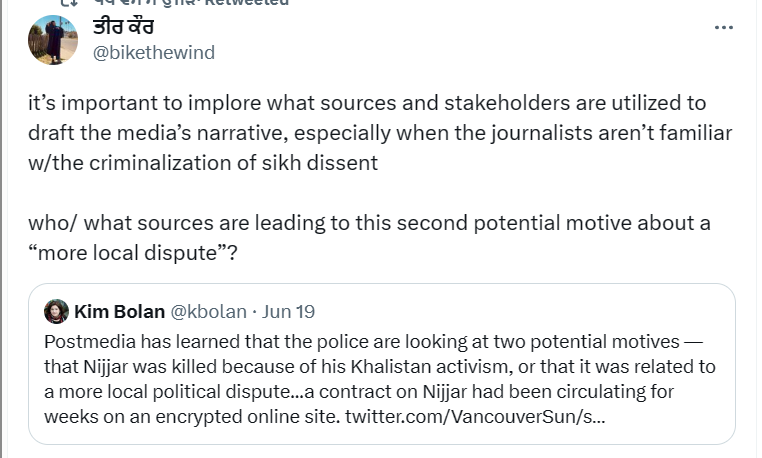
Similarly, accusations that the assassination may have been the result of a “more local dispute” have been criticized for aligning mere speculation alongside the long-documented history of the Indian State targeting Khalistanis, which Hardeep Singh Nijjar himself spoke of openly.

At yesterday’s community gathering, sevadaars (selfless servants) of the Guru Nanak Gurdwara made a request for anyone with relevant camera footage (either ring doorbell or dashcam) to send the videos to them so they can be analyzed for evidence. After the gathering, a roadblock demonstration was held by dozens of attending sangat (Sikh congregation) outside the Gurdwara, expressing angst at the lack of action from police. This was the second night in a row the roadblock demonstration was held.

Speaking on the situation, Sikh Press Association Senior Press Officer Jasveer Singh said:

“The killing of Bhai Shaheed Hardeep Singh Nijjar can only be taken as a warning to the Canadian Sikh community. For years he spoke out openly against the Indian State’s persecution of Sikhs, advocating for Khalistan, and said India wanted him dead for it. Now he’s been killed. The hundreds of thousands of Canadian Sikhs that feel similarly to him will now be wondering if they too are in danger.

“As we wait for answers from the likes of the CSIS, Sikhs the world over will also be taking heed of the lay-of-the-land when it comes to supporting Khalistan and reacting accordingly. Support for Khalistan is not a fringe movement, it is prominent at many of the biggest Gurdwaras in the world and evident at all major Sikh gatherings. If Canada wants to maintain trust with its Sikh community, they need to ensure there is freedom to support Khalistan without fear of being killed due to foreign interests.“

Read more on evidence of India’s Sikh targeted foreign interference via a report from the BC Gurdwaras Council and Ontario Gurdwaras Committee available for download here-

“The fight is not over”: Deportation of Sikh students delayed

Hundreds of Indian overseas students – which includes a significant number of Sikhs – who were facing deportation after being victims of an immigration agency scam have won the right to stay in Canada, for now.

After hundreds took part in an 18-day 24-hour protest outside the Canadian Border Services Agency in Mississauga (Ontario), which was supported by Sikh orgs such as Khalsa Aid and the World Sikh Organization, Canadian immigration minister Sean Fraser announced (on 14th June) that all deportations related to the issue would be postponed until further investigation.

With possibly up to 700+ students impacted and approximately 200+ facing near immediate deportation, once the issue came to light, a collective decision was made to organize a demonstration in the spirit of the fabled #FarmersProtest, which saw a protest camp set up around Delhi for a year until the Indian Govt rescinded contested exploitative laws being imposed on India’s agricultural sector.

The protest camp saw langar (Sikh communal kitchen practice) feeding attendees and Sikh prayers being held to provide spiritual sustenance to the protesters, whom braved perilous weather to remain steadfast in the demonstration, showing Canadian authorities that the community would not simply standby and allow the deportations.

With Canada profiting into the billions of the hundreds of thousands of students coming into the country, groups like the Naujawan Support Network felt it was unfair for the government to punish the students for being victims of a scam, which saw an Indian immigration agency fake university admission letters to get the students into Canada.

Learn more about this via journalist Angad Singh, for Vice News, who breaks down the profiteering and interviews one of the impacted students. A further report by Vice News details how the Sikh concept of morcha (protest) helped drive the protesters to such a victory. Read it here.

The morcha was partly led by the Naujawan Support Network, an Ontario based organization which is fast become an integral tool for Canada’s recent migrants, working on workers’ and student rights issues. The organization was created on the back of countless tales of exploitation facing new immigrants from employers and landlords.

In a statement on the victory of having the deportations delayed, the group were quick to outline “The fight is not over”, detailing ongoing concerns about Sean Fraser’s statement and the ongoing investigations into the issue (see images below).

Image
Image

For regular updates on this ongoing situation, follow Instagram.com/Stand_For_Student and Twitter.com/NsnPeel.

Sikhs orgs demand “urgent investigation” into death of Bhai Avtar Singh

The Sikh Council UK are among various organisations demanding a “postmortem examination” and “urgent police investigation” into the mysterious circumstances around the death of Bhai Avtar Singh Ji Khanda Azaad.

Image

The globally respected Sikh activist and UK based community figure passed away yesterday (14.06.23) in a Birmingham hospital just a few days after being submitted due to a sudden deterioration in his health. Avtar Singh (35) was seen in good health working as a TV presenter for PBC amongst thousands at the annual #SikhGenocide remembrance rally on 4th June.

Indian media outlets and online commentators have suspiciously openly claimed Avtar Singh was poisoned. The pro-Khalistan (free Sikh homeland) activist was long the target of hate and disinformation campaigns stemming from India. However, the Sikh Federation UK have stated Indian authorities “became obsessed” with Avtar Singh in the last three months. This coincides with the #PunjabUnderSiege situation, which saw Indian authorities conduct a mass operation targeting Sikh activists, journalists and others to stem criticism of the state and growing support for the Waris Punjab De social reform movement, led by Bhai Amritpal Singh.

In April this year, the elderly mother and sister of Avtar Singh were arrested by Punjab Police, after Indian media outlets falsely reported that he was the man behind an incident at the London India High Commission which saw India’s flag briefly pulled down. Avtar Singh’s father is respected Shaheed (Sikh martyr) Bhai Kulwant Singh Khukhrana, who was killed by police in 1991 whilst defending the community from the state perpetrated Sikh Genocide, which was then at its peak. Bhai Avtar Singh moved to the UK in 2010 for his own safety, and was welcomed by panthic (Sikh path/community focused) groups.

In a statement on the issue, the Sikh Federation UK stated that such incidents mean “Indian authorities must carry the blame” for Avtar Singh’s death, due to the “immense mental and physical strain” caused to Avtar Singh for his work exposing India’s anti-Sikh human rights abuses, “especially to someone (allegedly) terminally ill with blood cancer which is being reported by the same Indian media (who were demonising him).” The community legal and political advocacy group also highlighted the presence and influence of India’s notorious NIA (National Investigation Agency) in the UK, which includes an ongoing attempt to criminalise Sikhs by circulating their pictures – which many feel is illegal – for simply attending a protest outside the High Commission.

Image

World renowned humanitarian group Khalsa Aid also called for an “investigation and full coroner’s report” into Avtar Singh’s passing, in a letter sent directly to the West Midlands Police, whom cover the Birmingham area. Head of the aid charity, respected Sikh figure Ravi Singh, underlined a request from Avtar Singh’s family “that a postmortem be carried out urgently” whilst also highlighting that “foreign powers” have previously carried out assassinations in the UK using poison, specifying infamous incidents with “Russian death squads”.

Image

Many Sikhs will be skeptical of whether West Midlands Police (WMP) can be trusted in such a situation due to a history of cooperation with Indian authorities to target Sikh activists. In 2018 a series of raids conducted mainly in the Midlands targeting Sikh activists saw Indian media claim they were carried out due to India’s “diplomatic pressure”. Indian media also had information on the raids (including names of those targeted) within 24-hours, which is not possible without a leak from the WMP and/or UK Counter Terror police. Those raids led to one of five Sikh men targeted facing a charge of an alleged breach of Charities Commission rules, even though the man targeted – Kuldeep aka Deepa Singh of community group Sikh Youth UK – was never involved with any charity. The case against Deepa Singh has been kept dangling over his head since 2018, with the trial for the case being constantly deferred. Read more on this story here.

Adding to skepticism around WMP’s stance on Sikh activism, there was a massive community backlash against comments by Assistant Chief Constable Matt Ward in 2021 which claimed there was a threat to the public from “Sikh extremists” in the region. No evidence and not a single incident was referenced to substantiate such a claim.

Similarly empty claims about Sikh “extremism” have been said in the last few years by Boris Johnson and Priti Patel. Articles regurgitating Indian state propaganda about Sikh issues have also become more common in UK media in recent times, exemplified by a complete hit-job on Bhai Amritpal Singh published in The Times in March, written by an Indian who had not prior nor since written anything else for the outlet. The Sikh PA remain taking up a complaint about the article with IPSO.

Speaking on the issue, Sikh Press Association Senior Press Officer Jasveer Singh said:

“The Sikh organisations calling for investigations into Bhai Avtar Singh’s passing are not just acting on behalf of his family, but also on behalf of countless Sikhs who want to know more about how someone can go from looking fit and healthy to passing away 10-days later. The alarming claims stemming from Indian nationalists about his passing are not just shockingly callous, but they are also alarmingly brazen, celebrating Indian agents allegedly breaking UK law to kill a citizen of the country.

“The general British public should be very worried about the possible influence of India’s regime in the UK and even beyond the circumstances of Bhai Avtar Singh’s passing, this is something that needs more focus and investigation, particularly in the areas of policing, media and politics.”

Despite his condition, Bhai Avtar Singh Ji Khanda Azaad managed to relay one final message to sangat (Sikh congregation) before his passing, which you can see below.

Media inquiries about this or any related stories can be emailed to media@sikhpa.com.

“Anti-Khalistan protesters” arrested with knives for “intent to commit indictable offence”

Arrests of Indian nationalists is the latest incident in an ever-increasing series of incidents targeting Australian Sikhs


Two men described as “anti-Khalistan protesters” were arrested whilst carrying knives at last week’s Sydney Khalistan (free Sikh homeland) Referendum on 4th June.

The men, aged 23 and 24-years-old, were part of an Indian nationalist crowd which invaded the Minchinbury area where the non-binding vote event was held by organisers Sikhs For Justice, with intent to disrupt and intimidate, according to Sikh attendees.

Media reported the following statement from New South Wales (NSW) Police: “Two men, aged 23 and 24, were arrested and taken to Mt Druitt Police Station, where they were both charged with custody of a knife in a public place, have custody of an offensive implement in a public place, and use of offensive weapon with intent to commit indictable offence.”

Along with the two arrests, Parramatta Police are also looking for a group of men whom attacked a 42-year-old Sikh man for having a pro-Khalistan sticker on his car, which occurred on the same day in nearby Harris Park. Anyone with information on those behind the attack can contact Parramatta Police or Crime Stoppers on 1800 333 000.

The incidents highlight an ongoing issue of Indian nationalists and Hindutva (Hindu extremists) fanatics targeting Sikhs across Australia. Whilst the freedoms of the country allow Sikhs to run the democratic Khalistan Referendum, which has been peacefully conducted in the UK, Canada and Italy already, Indian nationalists of Australia have reacted venomously to the campaign, which began last year.

This year in February, a conglomerate of Sikh orgs supported an open letter condemning the actions of “Hindutva extremist outfits” whom were trying to “target Sikhs” in Australia. This includes an online campaign demonising the community, being run by Twitter accounts such as @AustHindu, which has been found to be run by Australian barrister Amendra K Singh.

Read more about the man behind part of this online Sikh-hate campaign here.

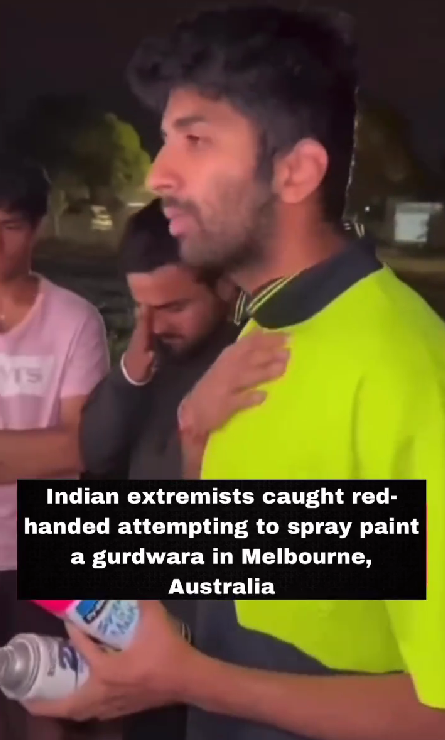
The open letter followed an incident where Indian vandals were caught red-handed prior to attempting to daub graffiti on Sikh premises. In the same week, another Indian nationalist invasion of an area in Melbourne where the Khalistan Referendum was being held also resulted in skirmishes breaking out between the two groups.

In April 2021, Hindu nationalist criminal Vishal Jood was arrested by New South Wales police for leading attacks targeting Sikhs, which led to his deportation later that year. Upon his arrival back in India, Jood was greeted as a hero for his violence towards Sikhs, whom are a minority of approximately 2% in India.

As this ongoing series of attacks against Australia’s Sikhs – largely for exercising their freedom to criticise the Indian State’s human rights abuses and support Sikh sovereignty – continues, many Sikhs have complained about the imbalanced coverage the issues receive from Australian media, possibly due to the influence of India, where press freedom is ranked 161st of 180 countries. Earlier this year national broadcaster ABC were forced to apologise for running a false unproven accusation which claimed “Sikh attacks on temples” were behind graffiti on Hindu Mandirs.

Just recently, NSW police revealed a car emblazoned with “HARYANA” was spotted leaving the site after one incident of graffiti in Sydney. This has reaffirmed a belief held by many that Hindu extremists are actually behind the graffiti which includes tags such as “(BBC)” and “Modi Terrorist”, in an attempt to malign Sikhs. Haryana is a Hindu majority state in India. In both Canada and Australia, news of Haryana natives attacking Khalistan supporting Sikhs has been reported.

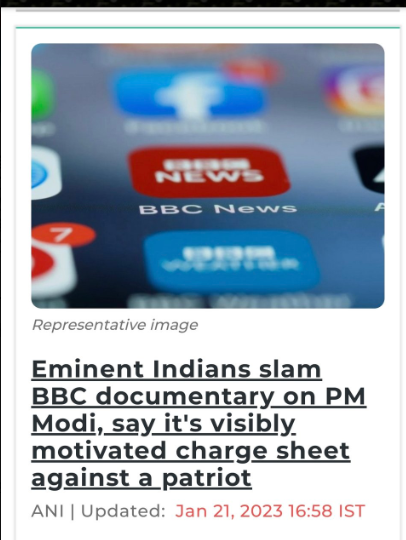
Furthermore, why Sikhs would daub BBC onto a Mandir is unclear. However, Hindu nationalists have been vocally against the BBC ever since the broadcaster aired a documentary exposing the role of Prime Minister Narendra Modi in the 2002 massacres of Muslims in Gujarat.

Speaking on these issues, Sikh Press Association Jasveer Singh said:

“There is a clear issue of Hindutva in Australia, which is currently largely obvious through the attacks – both online and through real life violence – on the country’s Sikh community. These latest arrests show if Australian authorities do not act soon, there is a real danger a Sikh could be murdered soon.

“It is a shame the violence facing Sikhs, going back to Vishal Jood, is not more highlighted by Australian media, as this pattern of attacks on the country’s Sikhs is seemingly hidden to the general public.

“One of the main issues is there is an obvious effort for trade between Australia and India, which can sway how authorities want this issue to be looked at. Australians need to make sure they do not allow Indian nationalists to run rampant in the country for sake of allowing their government to do trade deals with India.”

Christian conversion event cancelled after Sikh complaints

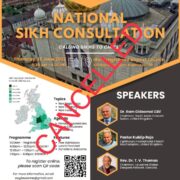
A “National Sikh Consultation” based on “Calling Sikhs to Christ” has been cancelled over a week before it was scheduled to take place after action by the Sikh community.

News of the event, which provocatively was specifically aimed at converting Sikhs, broke on Tuesday (6th June). Scheduled for 15th June at the Ilford High Road Baptist Church (East London, UK), the event was confirmed as cancelled this afternoon.

Local Sikh community figure and Labour Party councillor of the borough of Redbridge Jas Athwal released a statement on the cancellation of the event, after being asked to act on the situation by his constituents. In the statement, Athwal explained “Events that target specific religious communities…undermines the spirit of mutual understanding and cooperation…in Redbridge”.

Image

As the poster of the event went viral, Sikh complaints were widespread, with a belief the event was designed to provoke and antagonise the community.

Across India and mainly in Punjab, Christian missionary groups have been accused of coercing vulnerable and poverty stricken Sikhs into converting with unfulfilled promises of payment and support. Last year two men were even arrested for “forced conversions” of Sikhs into Christianity.

Suspicions about why there is such focus by Christian groups (which includes mass funding) to target Sikhs specifically has raised questions about whether there is a more sinister agenda to dilute Sikh spirit which is behind some of the biggest activist movements in recent history, such as the #FarmersProtest. There is no evidence to suggest Sikhs are more likely to become Christian than any other faith. An explosion in further understanding of the Sikh faith in the last 10 years has actually led to countless Sikhs becoming closer to their faith, thanks to the work of groups that use the internet to connect with the community, like Basics Of Sikhi, who made the video below on the issue.

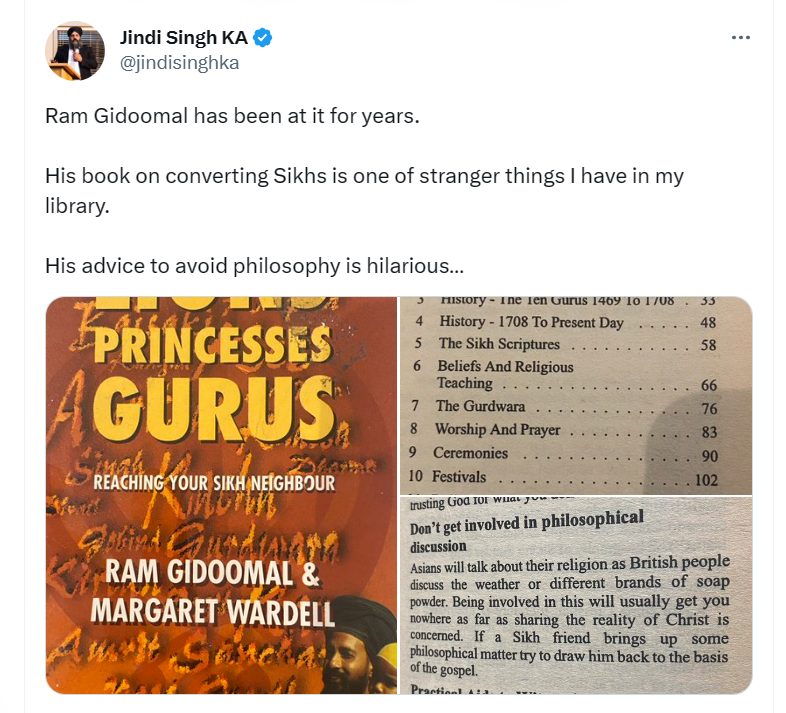
Insight into the groups behind the now cancelled event has revealed a deep and long-running effort to convert Sikhs into Christians.

Speaking on the issue, Sikh Press Association Senior Press Officer Jasveer Singh said:

“The backlash from within the global Sikh community towards this callous event is understandable. Whilst every faith group will consider their own faith superior, to present this belief so confrontationally in face of one specific group was always going to cause rifts, and those behind the event would be aware of this, making it a direct attempt to provoke the Sikh community.

“There is also a long history of Christian missionaries acting in a predatory fashion, targeting those perceived as vulnerable, promising them miracles and sometimes even money. In the UK, such Christian conversion events prey on insecurities minority communities like Sikhs can have, which can stem from being the ‘other’ whilst living in a Christian country.

“Cancelling the event was the right thing to do. However, there remains an ongoing issue of this agenda to target Sikhs, for whatever reasons, and this will be explored and resisted by the panthic (Sikh path/community focused) community.”

Sikh child murdered, two more “seriously injured” after Indian “mob lynching”

A 14-year-old Sikh child died after a mob attacked him and two others aged 15 and 16 in Parbhani, Maharashtra (India) on 27th May, leading to worldwide outrage and calls for action.

The three boys – named as the late Kirpal Singh, and Avtar Singh (16) and Arun Singh (15) – were accused of attempting to steal a goat by locals who degenerated into a murderous mob, beating the teens severely, leading to one death and two serious injuries. The boys were said to be attempting to retrieve escaped pigs from their village stock.

Videos (which we will not share) of the beaten boys surrounded by a mob went viral after the incident, prompting calls for justice led by Sikh authority the SGPC. Media reports claim the boys reported a gang of five targeted them on site as they searched a local Muslim majority area for their pigs.

The incident has underlined concerns that India remains a dangerous place where Sikh lives are cheap as mob justice reigns in the country where the Sikh community remains below 2% of the population. Whilst Hindutva (Hindu extremism) is often viewed as the driving force of most anti-Sikh actions in India, this latest incident was believed to be carried out by Muslims who make up closer to 20% of India.

The boys are part of the sikligar Sikh community, who were historically the ironmongers of the Kaum (Sikh nation) who were revered for their weapon making skills. In the modern day, the sikligar Sikhs have become some of the most impoverished groups within the community and are often targeted for violence, as reported by The Quint.

As of yet, just one arrest has been reported of a man named as Akram Patel, with another arrestee still sought according to latest reports.

NOTE- The Sikh Press Association does not post links to sites from Indian media known to post anti-Sikh content for quotes and info

10 things the Bloom Review DOESN’T tell you about UK Sikhs

Foreword, by Sikh Press Association Senior Press Officer Jasveer Singh

The Bloom Review is a recently published UK government report on faith communities in Britain. It is viewed as one of “the most sweeping” insights into all religions in the UK ever written. This is especially the case for the Sikh community, which was covered with an 11-pages on so-called “Sikh extremism”.

The belief UK-India trade plays a role in such framing of Sikhs cannot be dismissed. An obvious lack of understanding of Sikh philosophy plays a role in Bloom’s report too – which is even noted on page 53. 

Why such disproportionate space was provided to “Sikh extremism”, with questionable examples provided that – even in their worst interpretation – do not compare with other communities, is another question worth asking. Only three pages were dedicated to white supremacist issues, which include murder and planned public bombings.

I have no doubt the team behind the Bloom Review spent time speaking to various Sikhs during a three-year consultation with UK faith groups. However, I also have no doubt those representatives largely come from the already long-established Sikh government-representational circles which have imposed their own biases onto the review. 

Whether deliberately or accidentally, the UK establishment seems to amplify certain voices within the community. Those voices come nearly entirely from those with political and/or academic ties, rather than those that connect with the community or Sangat (Sikh congregation) at a grassroots level. Whilst there is nothing wrong with engaging the political or academic actors, to claim that speaking only to those circles, and ignoring the community grassroots, can give a comprehensive insight into UK Sikh dynamics is misguided at best.

As a trained journalist that has spent eight years employed in a role which is anchored in Sikh community engagement, here I give a breakdown of what the Bloom Review does not tell you about the UK Sikh community.


1)
What the Bloom Review tells us: The government needs to be “discerning” about working with groups displaying “extremist behaviours”

What it misses: The UK government already has 12 different Sikh groups it works with, and only two actively support global panthic issues

The first example of what Bloom is not telling us about Sikhs comes when he says (page 22) the government should avoid legitimising “extremist behaviours” by being more “discerning” about the Sikh orgs it engages with. What the report does not tell us is what Sikh orgs are engaged with government already and which are not.

The Sikh orgs most involved in general government engagement are City Sikhs, Sikh Tories, Sikhs 4 Labour, Network of Sikh Orgs, Sikh Assembly, British Sikh Consultative Forum, British Sikh Association, the Nishkam Jatha, Sikh Council UK, Supreme Sikh Council UK, The Sikh Network and The Sikh Federation UK. Of all these organisations, only The Sikh Network and The Sikh Federation UK (who work closely together) consistently raise the type of issues that see global Sikh mobilisation (#FarmersProtest, #FreeJaggiNow, #PunjabUnderSiege etc). This is self-evident. This is not an opinion. Check their social media pages yourselves. These two groups are the only ones to regularly hold open public engagement events in Sikh spaces that any sangat can attend. So when Bloom talks about government being more “discerning” about Sikh engagement, he is hiding the fact they already have 12 options to choose from, and only two of those consistently reflect the type of issues that bring the community together for protests.

Another thing to note about UK government engagement, is it actively avoids speaking with arguably any of the openly pro-Khalistan groups. These groups tangibly represent massive sections of the Sikh community, yet they are overlooked. Why do the government only talk about Khalistanis, but not talk to them?

2)

What the Bloom Review tells us: Sikh communities expressed the most negativity towards the police

What it DOESN’T tell us: This partly comes from police violence towards Sikhs

A noteworthy stat (page 59) says 40% of Sikh participants have “negativity towards the faith literacy of the police”, the most of any faith group. What is not mentioned is that Sikh negativity towards UK police partly stems from a concerning pattern of mistreatment towards Sikhs, such as sensationalist comments from West Midlands Police on Sikh extremism, concern about info on UK raids ending up in Indian media and inaction on issues of police-Sikh brutality. This negativity is not just about police not understanding Sikh beliefs and practices. It is about police violence and collusion with the Indian State.

3)

What the Bloom Review tells us: Islamic extremism is like Sikh extremism!

What it DOESN’T tell us: This sensationalist take is classic Indian nationalist propaganda

The first highlighted quotation in the section about Islamic extremism (page 114) states; “Take action against these Sikh and Islamic groups who spread hate and glorify innocent killing… [redacted] are misusing charity funds coming from Sikh Gurdwaras and many Islamic groups doing [the] same”.

Why does the Bloom Review make so much effort to conflate so-called “Sikh extremism” with the very real issue of Islamic extremism? Partly at least, because it is clearly consulting people that regurgitate this Indian State propagandist rhetoric. One such figure that may have been consulted is Rami Ranger, Conservative Party Lord and the founder of the British Sikh Association and the Hindu Forum of Britain. Rami is well known for his unhinged Indian nationalist rants, which include openly threatening a UK sevadaar (selfless servant) with violence on Twitter, being slated for comments about Pakistanis working for the BBC and blaming the Sikh genocide on Sikhs from Southall. Ranger is currently being sued by Sikhs For Justice for baseless claims they are funded by Pakistan.

4)

What the Bloom Review tells us: “the English Defence League and Sikh Youth UK” were aligned

What it DOESN’T tell us: Sikh Youth UK have publicly condemned the far-right movement

Once again entwining Sikh activism with real extremist movements that have resulted in murder and terror acts in recent years, award winning community group Sikh Youth UK are mentioned in the startlingly short section about “White supremacy” (page 116). Bloom says SYUK are “aligned” with the English Defence League (EDL). This is false. They were interviewed about their work on grooming gangs by EDL founder Tommy Robinson in 2017 when he worked for Rebel Media. After this, Tommy Robinson was platformed by the BBC at least twice, showing his normalised media presence at the time. The same section also claims that SYUK refused to comment on the link when asked by the Independent. But SYUK did respond after the actual article came out. The response is included in the very article referenced, saying things including, “We have never advocated any of Tommy Robinson’s views on Islam, nor will we”. This response was followed up with a more detailed SYUK statement on SikhPA.com condemning the far-right. Showing further incompetence, the Twitter of @ActivistsUK is referenced by Bloom in relation to the 2017 meet, but the page was started in 2020.

5)

What the Bloom Review tells us: “The pre-eminent (Sikh) organisations are Akaal Takhat and the Shiromani Gurdwara Prabandhak Committee”

What it DOESN’T tell us: These leading bodies glorify Shaheeds (Sikh martyrs) that fought against India

The Bloom Review correctly highlights the two leading Sikh bodies on earth. Although they are not omitted from community criticism, it is largely understood both the SGPC and Akal Takht help maintain Sikh practice and values at a time when they are under attack. This includes supporting Shaheeds (Sikh martyrs) that partook in anti-State violence in 1984, in support of the Khalistan movement and in defence of the Sikh community during a genocide. Bloom later states concern about “glorification of violence and terrorism” (page 131) based on praise of groups like Babbar Khalsa, revered for their stand against India’s Sikh genocide. Bloom should know the glorification of the Sikh freedom fighters he refers to as terrorists is innate within the Sikh faith, from the top down.

6)

What the Bloom Review tells us: There is a “division between some British Sikh communities which is caused by an extremist fringe ideology within the pro-Khalistan movement”

What it DOESN’T tell us: Support for the fascist Indian State is actually a bigger cause of division

Any glimpse at the biggest Sikh Gurdwaras and the biggest Sikh gatherings in the UK (Nagar Kirtans for example) will show widespread support for Khalistan. Pro-Khalistan flags and pictures of Khalistani figures cause no issue and are accepted as a normal practice in Sikh spaces. Of course, this does not mean all Sikhs support the Khalistan movement. However, it does not provoke clashes within the community at any level other than the government representational level.

What is actually a head-turning point of contention in Sikh spaces is support for India. If any Gurdwara were to fly the flag of India, there would be mass community criticism towards those behind the move. The 2020 #FarmersProtest in India was hugely supported by UK Sikhs and it came with a growing understanding of India’s fascism. As such, support for India’s current regime is now easily the biggest divisive factor in Sikh spaces, as it is viewed by many Sikhs as supporting an anti-Sikh fascist regime where rape is normal, minorities are abused and media censored.

7)

What the Bloom Review tells us: “These (Khalistani) minority are controlling Sikh temples”

What it DOESN’T tell us: All Gurdwara management committees are voted in by its sangat (Sikh congregation)

The Bloom Review quoting basic disinformation about UK Sikhs should concern all that wish to learn from its contents. One of the most shocking examples of this (page 123) comes via a respondent stating an extremist minority control “the leading” UK Gurdwaras. Bloom platforms such a view without relaying the fact Gurdwara management committees are elected through a democratic process that offers all local attendees the opportunity to vote.

The same quote goes on to baselessly claim that “youth camps…are trying to recruit youth to follow their hate, terror and division.” This allegation can only have come from someone intent on destroying the support for Sikh orgs creating an environment where anyone can experience an immersive collective experience of Sikh education and practice. Groups that run camps include Khalsa Foundation, Sikh 2 Inspire, British Organisation of Sikh Students, Basics of Sikhi, Sikh Youth UK and more. Thousands attend these camps yearly. This kind of uptake in Sikh education correlates with the incredible level of Sikh philanthropy that occurs across the UK, which is also noted in the Bloom Review.

8)

What the Bloom Review tells us: “Aggressive Sikh activists” bully Sikh “public figures, academics and officials”

What it DOESN’T tell us: Sikh activists face bullying too!

Accusations of bullying in Sikh circles is a sensitive topic. The fact is, bullying is subjective, and now more than ever, every individual has the right to say if they feel bullied by any type of behaviour. The allegation of bullying among Sikhs is raised within the context of a “power struggle” between Sikh orgs regarding government engagement (page 124). There is no doubt that public representational work in the Sikh community anywhere in the world can lead to harsh criticism. This comes from a sentiment that these representatives fail to reflect grassroots concerns, such as the dozens of global protests which occurred in the last month due to the #PunjabUnderSiege situation. Resentment builds as year-after-year the same faces represent the community publicly without making effort to engage with the community at a grassroots level.

This in itself is bullying in the form of ostracization. Grassroots Sikh sentiment and grassroots community sevadaars are pushed out of representation spaces. If such figures try to get involved, they are often met with condescension, with their ability to engage within the political sphere belittled.

If this wielding of power to ostracize and belittle others is not enough, there is also a well-known but less spoken about issue of legal threats being very regularly issued by Sikh political figures to those behind criticisms about unreflective representation. This includes creepily tracking down personal details of Twitter users to send legal threats, including pressuring employers to act against these individuals. For obvious reasons, the culprits of this kind of bullying cannot be named. The bullying even extends to efforts to convince the UK Charities Commission some Sikh orgs are “extremist” and must be investigated for even being associated with Khalistan support.

For many Sikhs, especially the circles more educated in the faith, the concept of miri-piri makes purely “faith representation” efforts redundant without equal effort for Sikh political influence, and vice-versa. This responsibility is expected of official Sikh representatives.

9)
What the Bloom Review tells us: The territorial claim for Khalistan “does not include the part of the Punjab located in Pakistan”

What it DOESN’T tell us: Yes it does!

In a sign of influence from Hindu nationalist propaganda, the Bloom Review inaccurately states the pro-Khalistan “territorial claim does not include the part of the Punjab located in Pakistan” (page 125). This is factually incorrect and based on the idea Khalistani Sikhs are aligned with the Pakistan government, aiming only to destabilise India. However, if asked, Khalistani groups will confirm ambition for the rule of a Sikh homeland to extend into what is currently Pakistan. This was openly declared by the current most prominent Khalistan figure, Bhai Amritpal Singh. The reason the Khalistan movement currently focuses on sovereignty in India is due to the fact India Punjab is a Sikh majority, unlike Pakistan Punjab, and because a Sikh genocide occurred in India.

Paradoxically, Bloom suggests Khalistanis are aligned with Pakistan somehow yet pushes a narrative that one of the most prominent pro-Khalistan groups Sikh Youth UK “allegedly propagated an anti-Muslim agenda” (page 116). Bloom goes as far as downplaying the issue of Sikh targeted grooming, amplifying a suggestion “grooming is being used as a guise to promote anti-Muslim hatred” (page 130). This completely overlooks the fact the 2018 RASE report put together by Sikh Youth UK was taken seriously enough to make Sikh-targeted grooming gang issues headline news across UK media. Aside from Sikh Youth UK, various other Sikh org reps have verified the issue of Sikh-targeted grooming in the UK, including Kaurs.

10)
What the Bloom Review tells us: “some groups have sought to aggressively pressure Sikh leaders and gurdwaras to ban the use of the Anand Karaj (the Sikh marriage ceremony) for interfaith marriages”

What it DOESN’T tell us: Interfaith Anand Karaj ceremonies are only conducted by a few rogue Gurdwara committees commoditising a sacred ceremony mandated only for two Sikhs!

The issue of the interfaith Anand Karaj protests was always going to be mentioned in the Bloom Review. After seven years since the last protest though, one would have hoped to have seen more understanding of the issue. Sadly, this was not seen from Bloom, which poses only sympathy towards the position of allowing interfaith Anand Karaj ceremonies in Gurdwaras (page 129-130). The Bloom Review makes no mention of the fact Gurdwaras conducting interfaith Anand Karaj ceremonies are breaking strict decrees of the same institution they recognise as the leading body for Sikhs (the Akal Takht). Nor does Bloom mention that the Sikh Council UK held a mass meeting participated in by hundreds of Gurdwara reps in 2015 within which it was ratified that the Anand Karaj is only for Sikhs. The Bloom Review even mentions (page 122) the Rehat Maryada (official Sikh code of conduct) but pays it no heed in regards to what it says about the Anand Karaj being only for two Sikhs. This issue is viewed only from the side of allegations against those protesting against the Gurdwaras breaking basic Sikh protocol. A fair look at the issue would highlight that Gurdwaras doing interfaith Anand Karaj ceremonies were going against mandates from the highest Sikh authorities.In summary, the Bloom Review is not an insight into the dynamics of the UK Sikh community. It is actually an insight into the mindset of Sikh representational figures that want to work with the government without engaging with the community at a grassroots level.