Ex Indian govt employee among five arrested for Amritsar bombings

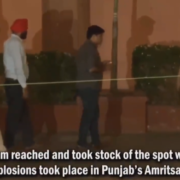
Five men, including an ex-Indian government employee, have been found to be behind a series of bombings over the past week near holy Sikh site Sri Harmandir Sahib (also referred to as Darbar Sahib) in Amritsar, Punjab.

Indian news reports claim the men were upset about a statement made during a viral incident last month, in which a man doing security for Sri Harmandir Sahib Gurdwara said “This is Punjab, not India”, evident from letters left at the bombing sites. However, the letters allegedly also contained content claiming support for Bhai Amritpal Singh and anti-Sikh actions of authorities in targeting the Sikh leader.

On 6th May at approximately 11pm, 8th May (6.30am) and 11th May (12.30am), homemade explosive devices were detonated in locations not more than 2km from the fabled Gurdwara that is visited by an estimated 100,000+ a day. The explosions on 6th and 8th of May both happened on Heritage Road, whilst the third happened outside Shri Guru Ramdas Ji Niwas Gurdwara.

Five men have been arrested for the bombings after sevadaars (selfless servants) of Sikh leadership body Shiromani Gurdwara Parbandakh Committee (SGPC) had used local CCTV footage to capture for the first culprit and hand him in to police themselves. After pressing for more police action, with the authorities accused of taking the bombings “lightly”, further arrests were made of men named Azad Veer Singh (36), Saheb Singh, Dharminder Singh, Harjit Singh (ages undisclosed) and Amrik Singh (26).

In a confusing turn, Indian media claim there were letters left at the site of each bombing that were torn apart by the explosions which were later pieced together to reveal the men’s motives, which included “the imposition of the National Security Act (NSA) on Amritpal Singh” and “easy access of tobacco in Amritsar”, also noting the men were upset about the rhetoric that “Punjab was not part of India”.

Many Indians have complained about rough-handed treatment dished out by Sikhs (specifically those of the Nihung Singh warrior faction of the Khalsa {initiated Sikhs}) to those consuming or selling tobacco in Sikh spaces. Tobacco is strictly forbidden in or aside any Gurdwara.

Questions will be asked as to why supporters of Bhai Amritpal Singh would want to detonate explosives in a Sikh area, knowing he was a stringent advocate of Sikh sovereignty, respect for Sikh spaces and royal protocol for Guru Granth Sahib Ji, the Sikh scriptural Guru. Causing chaos around a holy Sikh site seems to be a complete contradiction to what Bhai Amritpal Singh stood for, whose only act of so-called criminality was to lead a community movement freeing men from arbitrary arrest at a police station where torture was being reported, as is common in Punjab. As a supporter of the Khalistan (free Sikh homeland movement), ardent supporters of Bhai Amritpal Singh are also in favour of Punjab being separate from India, contradicting media claims about the bombers.

It is claimed three of the men had prior cases with police, with ex-government employee Azad Veer Singh arrested for “hurting Hindu religious sentiments” in 2021 and Amrik Singh arrested for stealing motorcycles, whilst Saheb allegedly having previous under the Explosives Act for running a “cracker making factory” without licence. Azad Veer was also noted as having “travel history back to Pakistan” according to his Hindu accuser for the 2021 case of alleged “blasphemy”. The father of Amrik Singh has been quoted as saying his son is “into drugs” and “small-time theft”, whilst Dharminder and Harjit are outright called “drug addicts” in Indian media.

The homemade bombs, made with drink cans, were described as crudely made, causing only minimal damage and minor injury to two people on Saturday and Monday respectively from their “low intensity”.

Indian media outlets have separately made claims that range from the stating the group show “no connection” to the Khalistan movement to some claiming the violence mimics issues seen during the 1980s when Sikh saint Sant Jarnail Singh Khalsa Bhindranwale led his movement from Amritsar, which is linked to the Khalistan movement.

However, Khalistan resistance attacks always targeted specific individuals who were noted as being heavily involved in perpetrating the Sikh genocide which peaked from the mid 1980s-mid 90s. This included senior policemen and politicians, rather than targeting random civilians. Contrastingly, a history of public bombings are linked with Hindu nationalist support, including attacks aimed at instigating communal violence.

NOTE- Information quoted from Indian media sources are not hyperlinked as they can often come from outlets which are known to propagate anti-Sikh rhetoric.

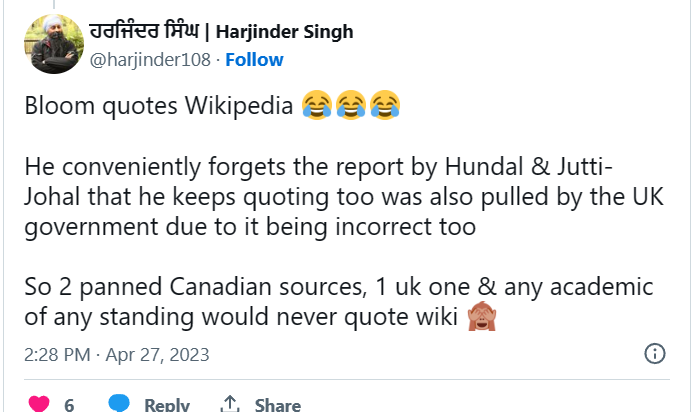
“Citing Wikipedia- LOL!”: Sikhs react to UK Govt “Sikh extremism” report

This week the UK government Department for Levelling Up released their long awaited report on religion, which has been described as one of the most comprehensive reviews on faith ever by the UK government. The review was written by Colin Bloom, former head of Conservative Party faith alliance group the Conservative Christian Fellowship and current government faith advisor. His review included approximately 11 pages dedicated to the topic of “Sikh extremism” which are based on “the power struggle over who will represent them (Sikhs) at official levels” and “extremist fringe ideology within the pro-Khalistan (free Sikh homeland) movement”. The only other group to be tagged with the “extremism” label in the report was Islam. Here we share reactions that reflect wider sentiment about the review, which used sources such as Wikipedia for its conclusions.


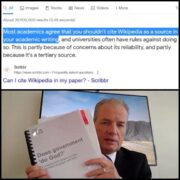
One of the biggest concerns regarding the report’s allegations about Sikhs and Sikh community dynamics is the sources of information cited. This includes referencing Wikipedia on three occasions about Khalistan. Citing Wikipedia is considered inappropriate for serious academic work. Furthermore, Wikipedia has headquarters in Delhi and has been noted by educators for having inaccurate and biased Sikh takes on the site. India is ranked 150th of 180 countries for press freedom.

Along with the amateurish use of Wikipedia, the review also used two highly criticised reports; the UK Counter-Extremism Government report on Sikh activism (2019) and Canada’s Macdonald-Laurier Institute’s “Khalistan: A Project of Pakistan”.

The 2019 UK report on Sikh activism was authored by journalist Sunny Hundal and Dr Jagbir Jhutti-Johal. Hundal has previously received mass criticism from Sikh orgs for hyperbolising “Sikh extremism” whilst having no real presence within the community at any significant level. Dr Jagbir Jhutti-Johal is an academic affiliated with the Sikh Nishkam group, headed by religious figure Bhai Mohinder Singh who received criticism for being part of a Sikh welcoming party for India’s Prime Minister Narendra Modi in 2015. Jhutti-Johal met with Punjab Chief Minister Captain Amarinder Singh just weeks before the 2019 report was released. Captain Amarinder has long been a fanatical voice against Sikh activism, underlined by his accusations towards Canada’s Sikh Defence Minister Harjit Sajjan. Amarinder was also behind the incarceration of British Sikh political prisoner Jagtar Singh Johal, labelling the Scot “guilty” at a press conference before any trial began. The duo’s report was taken down by the government within 24-hours of its release, before being amended and re-released. This was not mentioned by Bloom. Read more about their report here.

The other report referenced by Colin Bloom was written by Terry Milewski, a now retired journalist who is most known for his racistly titled “Samosa Politics” documentary on Canadian-Sikh political engagement and Khalistan support in the country. The Macdonald-Laurier Institute behind his “Khalistan: A Project of Pakistan” report promote trade between India and Canada. The movement for a free Sikh homeland within India is considered destabilising to India’s trade agreements with Western countries. As well as being condemned as “vitriolic” by 56 Canadian academics, the reports contents became extra questionable after Terry Milewski was forced to admit “he does not know whether Pakistan is involved” in the Khalistan Referendum, the current biggest global Khalistan support movement, after a lawsuit was issued against him by organisers Sikhs For Justice for making the claim they are Pakistan funded. None of this is mentioned in Colin Bloom’s review.

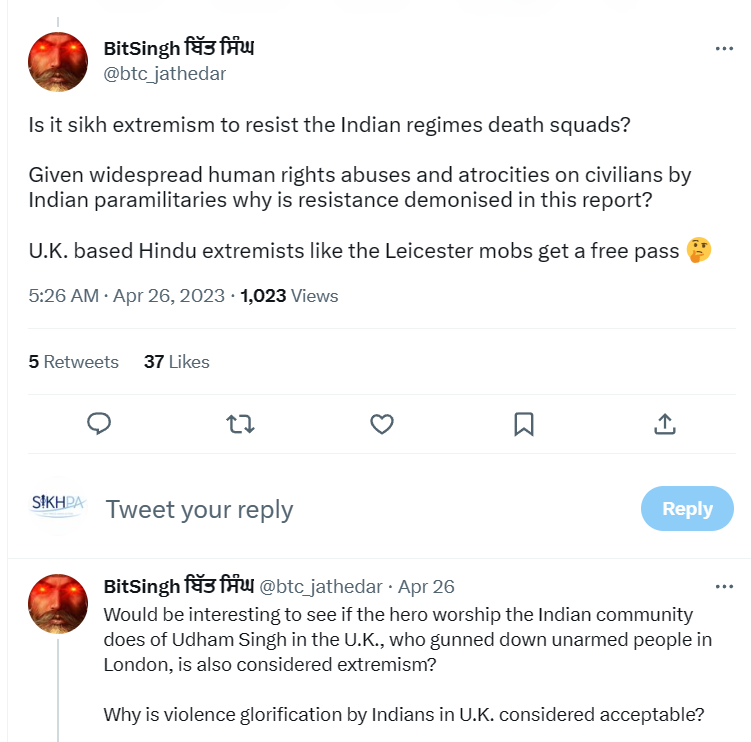
The telling effort Bloom makes to compare so-called “Sikh extremism” with Hindutva (Hindu extremism) directly is also prompting concern, as he was seen doing so on BBC Newsnight this week. Just last year Hindu mobs partly incited riots in Leicester, which would logically suggest Hindutva warrants more focus then conjecture about Khalistan support. Not to Bloom though.

Furthermore, the violent ultranationalist fascism plaguing India and oppressing Sikhs is well documented, including by groups like the European Consortium for Political Research. Yet, Bloom only dedicated two paragraphs to “Hindu nationalism” (not labelling it extremism), without making any overseas references as he did repeatedly about Khalistan. For example, the issue of fanatical violent Hindus in Australia attacking Sikhs is ignored. This stance raises concerns of Indian State influence on Bloom’s review. You can read more about anti-Sikh Indian interference in Western countries in this report by the the Ontario Gurdwaras Council- Indian Foreign Interference: Canadian Gurdwara Bodies Publish Report (panthpunjab.com).

Within the Sikh faith, reverence for freedom fighters and Shaheeds (martyrs) is part of Sikh practice. For the likes of Shaheed Udham Singh, this is widely accepted and understood within mainstream media, with his assassination of a British military figure covered favourably by the likes of the BBC. Yet, support for freedom fighter Shaheeds of the Khalistan movement is being labelled as “promoting violence, including murder, as acceptable” by Bloom. This shows a complete lack of understanding of Sikh philosophy.

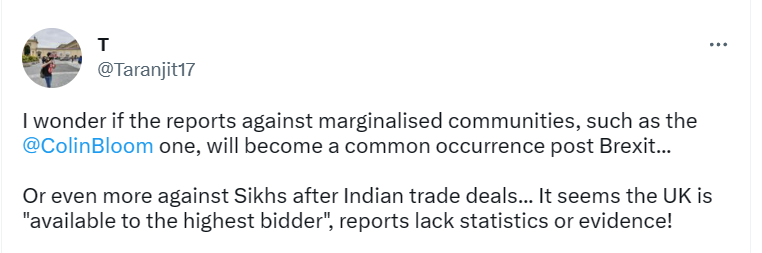
In consideration of the reason behind a recent uptake in anti-Khalistan rhetoric in the UK, the influence of the trade relationship between India and the UK has to be considered. Margaret Thatcher’s government’s support for India’s attack on Sri Harmandir Sahib (part of the #SikhGenocide) in 1984 was due to military trade between the countries. SNP MP Martin Docherty-Hughes has been very vocal about his belief that India’s trade with the UK is why his constituent and British Sikh political prisoner in India Jagtar Singh Johal is not being given more support by the UK.

In 2017 Leeds University research fellow Dr Jasjit Singh conducted the largest and most open consultation process by an academic within the Sikh community for his report on “Sikh Radicalisation in Britain”. The report found that although there were internal conflicts within the Sikh community, there was nothing to suggest there was a wider threat from so-called Sikh radicalisation. For some reason the report was overlooked by Colin Bloom, even though it was submitted to him by Dr Jasjit Singh.

The Sikh leadership disputes, which are highlighted mainly from the perspective of Lord Singh of Wimbledon, frame alleged “bullying” in this area within the “Sikh extremism” issue. However, the UK government has its own issue of bullying still unresolved, which are not framed as an “extremist” issue. Lord Singh of Wimbledon has long been arguably the most prominent figure of UK government-Sikh political engagement. Many feel there should be a broader range of Sikh representatives the government engages with. Bullying accusations fly in both directions within this dispute, with some political figures claiming they are berated for their (perceived lack of) engagement efforts, whereas others at a more grassroots level feel they are bullied through ostracisation and condescension when attempting to get involved in UK-Government engagement.

The National Sikh Youth Federation released a comprehensive statement on the review by Colin Bloom, ending it with a call for further discussion with Bloom which Sikh PA are working on arranging. A standout piece of information is the highlighting of Bloom using SATP as a reference, an org started by convicted sex offender KP Gill, a notorious Indian police officer known as “The Butcher of Punjab” for his involvement in the extrajudicial murders of Sikhs.

For more information on Sikh panth (community/path) responses to the review, media can email media@sikhpa.com.

Second anti-Sikh “fake news” Times article prompts concerns

The second article on Khalistan (free Sikh homeland movement) in The Times UK to be branded “fake news” within two weeks has prompted concerns about Indian State influence on the newspaper.

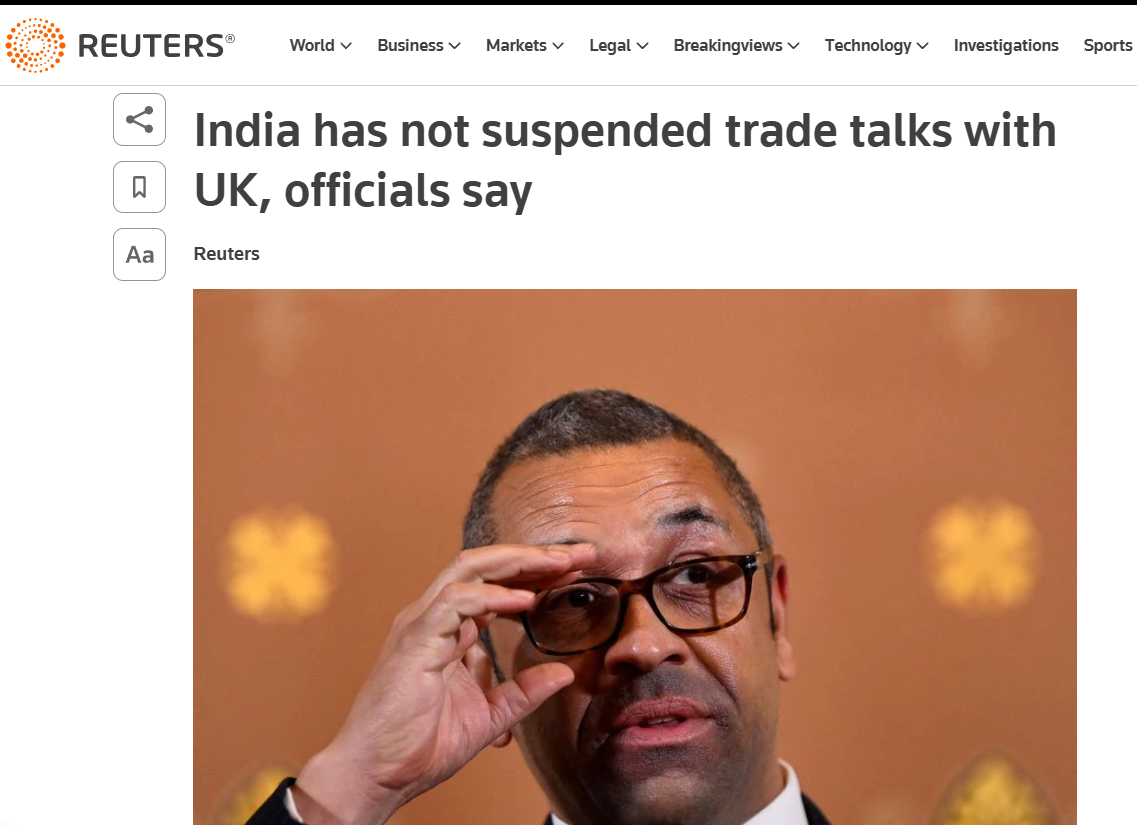
An article released on 9th April in the prestigious establishment media outlet was headlined “India halts UK trade talks over Sikh extremists”. The article claimed unnamed “sources” in the British government revealed trade talks between the nations were halted until Britain further condemned an 18th March Sikh protest outside India’s London High Commission. A spokesperson for Britain’s Department for Business and Trade has since confirmed this is false.

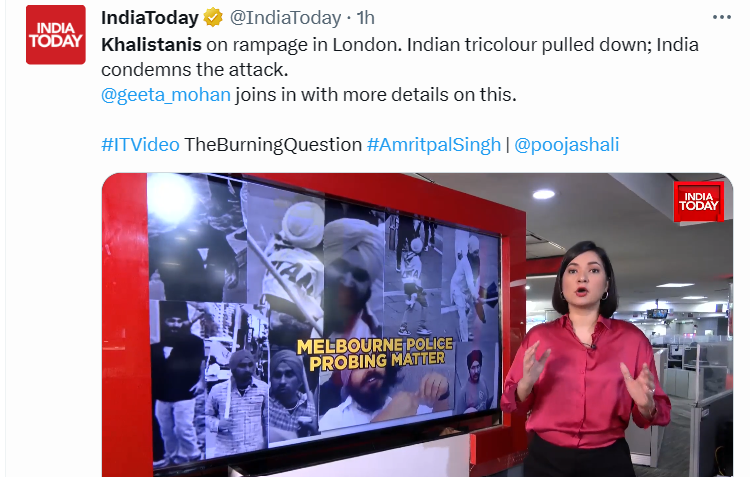
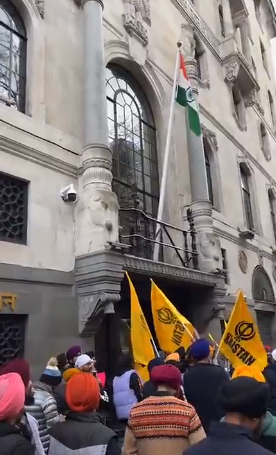
The 18th March demonstration saw three windows allegedly cracked by protesters, along with the Indian flag by momentarily pulled down, leading to one arrest (and no charges pressed as of yet). The incident was shamelessly called a “terrorist attack” by some Indian media.

The #PunjabUnderSiege situation triggered the protest and dozens more by Sikh diaspora groups across the world in the last three weeks, after Indian authorities cut off the internet in Punjab to cover-up mass human rights breaches during the targeting of Sikh activists. To date over 1500 Sikhs have been imprisoned or detained during the operation, including journalists, academics and even teenage, elderly and disabled protesters. Although up to 300+ are reported now to have been freed, many are still “missing” within police imprisonment.

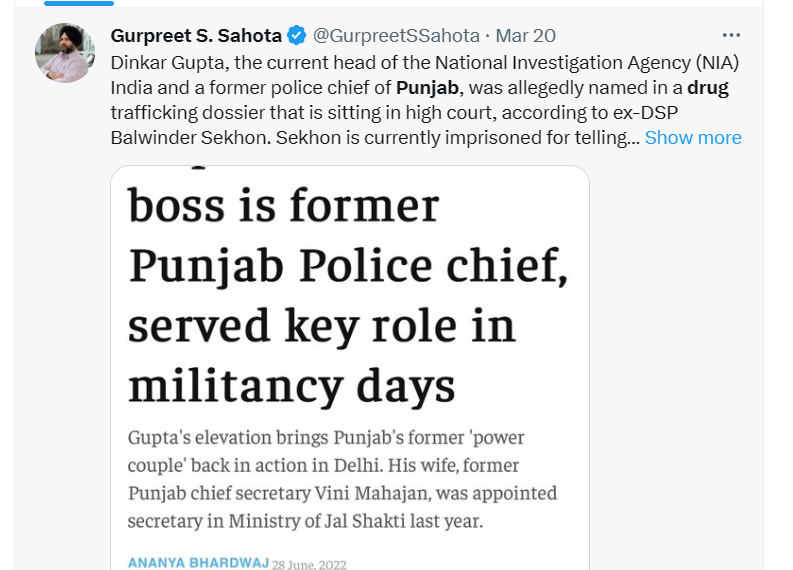
Indian authorities claim the operation in Punjab, which involved thousands of officers and paramilitary groups, was designed to “crackdown” on a Sikh faith based movement led by Sikh leader Bhai Amritpal Singh. The charismatic head of social reform group Waris Punjab De (Protectors of Punjab) had garnered attention for his efforts against the addiction and drug dealing epidemic in the state, which is well known to be entwined with corrupt local authorities.

The official reason for the operation was due to Bhai Amritpal Singh leading a raid on a police station in late February to free prisoners being tortured for being affiliated with him. Indian police are well known to use torture during custody, even on those they intend on freeing quickly. Bhai Amritpal Singh’s targeting is also connected with his open support for Khalistan (free Sikh homeland movement). Talk of secessionism is officially illegal in India.

On 27th March The Times released an article by Kapil Komireddi titled “Separatist or stooge: mystery of Amritpal Singh, Sikh preacher on the run” which is filled with false information, regurgitating pure Hindu ultranationalist propaganda, with baseless claims about Amritpal Singh which contradict his own words in the many video interviews he has given. The Sikh Press Association remain chasing up a complaint with The Times on the article.

The 9th April article on trade talks were also condemned for headlining Sikh Khalistan support as the alleged main focus of trade talk concerns, when three other issues regarding UK-India trade were also mentioned, including Home Secretary Suella Braverman’s recent comments on Indian migrants, which The Times themselves claimed at the time had put trade talks “in peril”.

Speaking on the issue, Sikh PA Senior Press Officer Jasveer Singh said “Sikh groups from all over the world challenged the basis of the article, and the fact that within 24-hours its content were officially debunked have raised serious concerns about what is going on at The Times when it comes to reporting on Sikh issues in Punjab, centered around Khalistan.

“The articles in The Times are well below the expected standard of journalism in British press. Why they would allow themselves to be used to push anti-Sikh Hindu ultranationalist propaganda will raise many questions about what is going on behind the scenes there.

“It has long been known the Indian State works to influence Western media to help cover-up its many human rights abuses. The uptake in this since the #PunjabUnderSiege situation has been noticeable, with bias and imbalanced articles appearing in The Times and The Washington Post. The Times must be embarrassed by the latest article being revealed as ‘fake news’ so quickly, and we hope this will see a change in their approach from hereon.”

The Sikh Press Association will continue to pursue the issue with The Times.

Bhai Amritpal Singh: Messages to the Kaum (Sikh Nation) as he evades capture

UPDATE: Bhai Amritpal Singh has handed himself in.


Bhai Amritpal Singh is a Sikh community leader that heads Waris Punjab De, a social reform group that focus on tackling Punjab’s addiction epidemic. On 18th March he was the main target of a mass police and paramilitary operation in Punjab targeting Sikh critics of the Indian State. Having evaded capture, which would have certainly meant torture, see messages he has sent to the Sikh nation below.

29th March 2023: A speech from Bhai Amritpal Singh (in Punjabi) below, released as he remains a fugitive, shared via Akaal Channel. An English translation can be found via Baaz News below.

May be an image of text
No photo description available.
May be an image of text
May be an image of text that says "Baaz so are the other Sikhs. ask for forgiveness, again, for any mistakes. Waheguru Ji Ka Khalsa, Waheguru Ji Ki Fateh Û AND SUPPORT INDEPENDENT JOURNALISM FOR THE IKH DIASPORA SUNG AT BAAZNEWS.ORG"

30th March 2023: An audio message circulated within panthic (Sikh community/path based) circles, with translations via Saffron Studios below.

The Khalsa belongs to God. Victory belongs to God.

Firstly to those people that are saying the police made the video and that I do not speak like this – even in the past when I’ve made my own videos I tend not to look directly at the camera and that never became a trait of mine. Secondly that day my health was not great but it’s not an issue and let the Sangat know that I am in Chardi Kala (high spirits).

I have not asked for any demands regarding the conditions of my arrest, these are all gossip and rumours. I have not spoken about my arrest with anyone nor have I set any conditions. I have asked the Jathedar to call a Sarbat Khalsa. Please call a Sarbat Khalsa to affirm your position as the Akal Takht Jathedar. If we are still going to continue our previous political affirmations then what are we going to do with this position of Jathedar? So we need to understand that we need to stand together as one. I am asking all Sikh groups to stand together and we need to prove that we are still alive as a Panth. Today the authorities are oppressing one group of people tomorrow it could be anyone.

I am not scared of being arrested or going into police custody, they can do whatever. So please send this message to the Sangat. People start to think who made this and it’s a conspiracy. There is no conspiracy in these messages we’re not using the equipment we used to before at this current moment so there’s also that difference.

Yes, my health has slightly deteriorated there is no doubt, because food intake has reduced. Please let the Sangat know that we do not need to put doubt on everything.

God has blessed us so much and we are in Chardi Kala.

The Khalsa belongs to God. Victory belongs to God.

30th March 2023: A video message following the audio message, shared with translations via Sikh Youth UK.

Passionate global protests take place in response to siege of Panjab

Protests by Sikh diaspora groups across the world have taken place in direct response to India authorities’ siege of Punjab.

On Saturday morning (18.03.23) Indian authorities began a siege of Panjab which involved shutting down internet and mobile phone networks across the state, whilst simultaneously targeting over 300 (to date) Sikh activists in mass police operations involving paramilitary that remain ongoing.

This occurred a day before remembrance events in the state for Panjabi music star Sidhu Moosewala, who was murdered in suspicious circumstances, with a self proclaimed Indian nationalist confessing to being behind it. Moosewala was particularly popular among Panjabis for often referencing and praising Sikh figures in his music, including famed freedom fighters that put up resistance to India’s Sikh genocide that began in the 1980s.

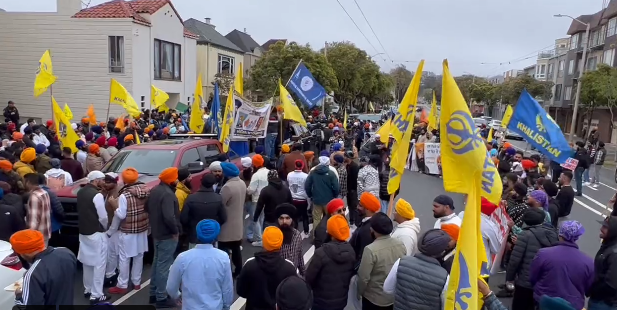
This weekend protests have taken place in response to the siege of Panjab in San Francisco, Auckland, London, Vancouver and beyond.

The London (UK) protest has made international headlines due to an attempt to bring down an Indian flag hanging outside the country’s consulate and replace it with a Khalistan flag. An incident of a window being smashed, leading to one arrest of a protester, also occurred in London. India’s notoriously ultranationalist (ranked 150th of 180 countries for press freedom) media have reacted in typically sensationalist fashion to the incident, with some declaring it a “rampage”.

A Surrey (BC, Canada) demonstration was held to prevent a “Friends of India and Canada” event taking place in the city which India’s High Commissioner of Canada was set to attend.

Image

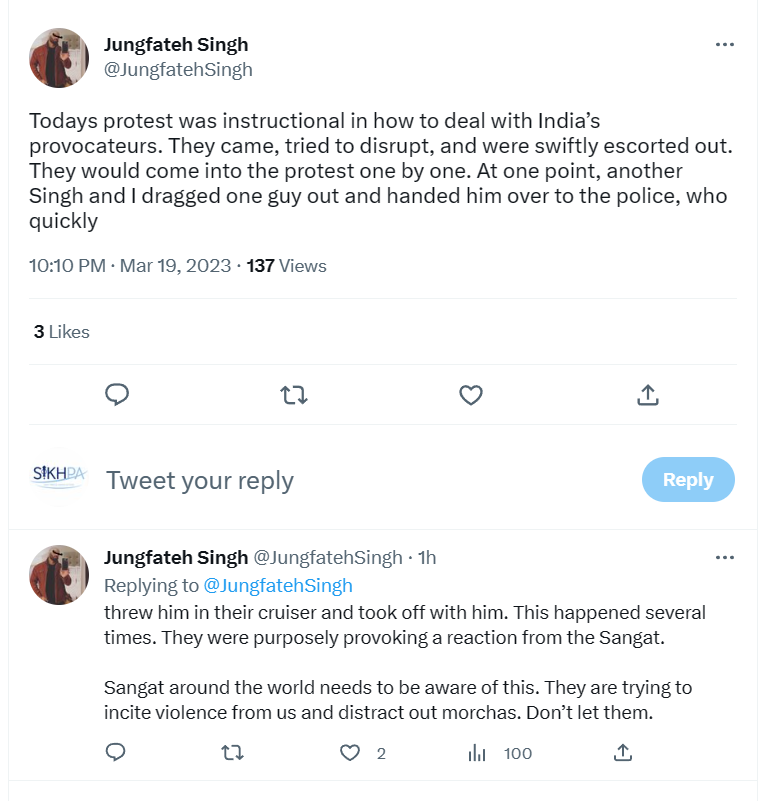
Approximately 700 people joined a blockade outside the gates of the venue in the city with an estimated 500,000 Panjabi population. However, some “Friends of India and Canada” supporters still turned and acted provocatively towards protesters, leading to minor skirmishes which police and protesters worked together to resolve, as explained (see Tweet below) by one attendee.

In California over a thousand Sikhs were joined by Dalits (Hindus of a caste considered “low” according to Indian hierarchy and thus are often illtreated), Christians, Muslims and general human rights supporters for a demonstration in San Francisco outside the city’s India Consulate. Graffiti stating #FreeAmritpal was found sprayed on part of the building.

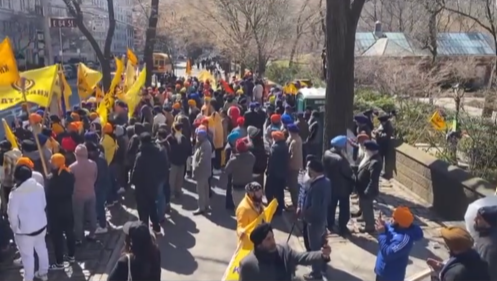
Protests also occurred in New York (USA, pic below) and Auckland. These are just a few of many that occurred this weekend.

Other protests and meetings by Sikhs are planned through the week, with major Western cities expecting mass disruption due to India’s siege of Panjab.

Speaking on the protests, Sikh Press Association Senior Press Officer Jasveer Singh said, “The passionate protests taking place across the world are just the beginning of what will be a sustained effort by the Sikh diaspora. The aim is not only to show solidarity with the Panjabi Sikhs being targeted by India right now, but also to actually press governments into action.

“Whilst many – led by India’s sensationalist media and ultranationalist online bot army – may decry minor incidents in Surrey and London, what we are seeing is a desperate attempt by Sikhs to stave off further violence. If some slight damage to a consulate building is more important for an MP to talk about than an entire state being blacked out and invaded to target a minority community, then Sikhs will feel they have no friends in places like the UK Govt.

“India’s current treatment of Panjab is near identical to incidents which preceded the 1984 state perpetrated Sikh genocide. The longer Western Govts fail to act by at least condemning India’s actions, the more fervent Sikh protests are likely to get.”

Punjab’s internet blocked amid mass targeted operation against Sikh activists

UPDATE: Punjab Police have released a statement confirming 78 arrests have been made amid a “crackdown” on Sikh activists they have described as “criminal”. In the statement they claim Bhai Amritpal Singh is a “fugitive”. However, numerous reports witnessed him being arrested, leading to concern that a “fake encounter” extrajudicial murder of the Sikh leader is in the works.

Popular Sikh leader Bhai Amritpal Singh has today been arrested, as Indian authorities enforce an internet blackout and deploy military along with a mass police operation in Punjab targeting Sikh activists.

The lead of Waris Punjab De (Protectors of Punjab), a social reform activist group started by Shaheed (Sikh martyr) Deep Singh Sidhu, the actor turned activist who died in suspicious circumstances last year, was arrested after an alleged car chase, where police followed his convoy during his touring of Punjab.

Punjab Police – notorious for torture and extrajudicial killings – are yet to provide any update about the arrest or the largescale operation targeting Sikh activists.

Along with Bhai Amritpal Singh, his affiliates and Sikh political figures have also been targeted for arrest, despite no official warrant or known reason being conveyed to explain the move by Indian authorities. Bhai Amritpal Singh’s family home in Punjab is currently being surrounded by hundreds of police. Sikh protests have already begun across Punjab. Concerns are growing about state violence, which has been the go-to reaction of the Indian state to suppress Sikh activism.

Bhai Amritpal Singh has been touring Punjab pushing an anti-drug message amid Punjab’s addiction epidemic, along with advocating support for Sikh sovereignty, which is a faith-based mandate for Sikhs.

The internet blackout comes just a day before mass gathering were planned in Punjab to mark the death of global superstar Punjabi music artist Sidhu Moosewala (Shubdeep Singh Sidhu). Moosewala was particularly popular for music which supported Sikh resistance against the Indian state, including freedom fighters and water rights positions maintained by the panth (Sikh path/community).

See more on Sikh reaction via our Twitter or Instagram, with some takes posted below. For ongoing updates we encourage following Baaz, Unmasking India, Free5ab, CSYA and Shere Punjab UK.

Sikh pilgrims attacked by Hindu group in Himachal Pradesh

Sikh pilgrims staying at a historic Gurdwara found themselves attacked by locals last week in Himachal Pradesh (India).

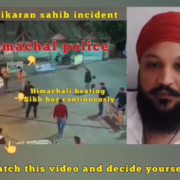
Visitors from Punjab often stay overnight at Manikaran Gurdwara, which is noted for being a site Guru Nanak Dev Ji visited. On the night of 5th March, local Hindus spread a rumour a Sikh part of the Manikaran sangat (Sikh congregation) had abused a local girl, before forming a mob attacking pilgrims.

Himachal Pradesh has recent history of issues of Hindutva (Hindu extremist) mobs destroying Mosques and attacking Sikhs. The mob formed at approximately 11pm, pelting the Gurdwara with stones before carrying out a full-scale assault on the sangat, with one Sikh man allegedly losing an ear according to local reports given on video to the Akaal Channel. Police were filmed standing by as Sikhs were attacked.

Sikh retaliation to the attack was the centre of mass focus from India’s notoriously ultranationalist “Godi media”, which is ranked 150th of 180 countries for press freedom. However, various Sikh groups and activists have spoken out against yet another example of anti-Sikh issues in India.

Sikh body SGPC (Shiromani Gurdwara Parbandakh Committee) urged police to bring tackle issues of anti-Sikh fearmongering.

Other social media content also indicated that the border between Punjab and Himachal Pardesh had been blocked off stopping people from entering Himachal Pardesh by police. This has been denied by local police.

Sangat now continue to come through and are doing darshan(paying respect via physically meeting) of Gurdwara Manikaran Sahib. However, concerns about the safety of sangat in the area remain within Sikh communities.

Complaints flood in regarding ABC News false “Sikh attacks on temples” report

UPDATE-
ABC apologised for their false claim against Sikhs:


(Original article) Sikhs across the world have spoken out against an ABC News broadcast which reported a false claim of “Sikh attacks on temples”, without any evidence such an issue exists.

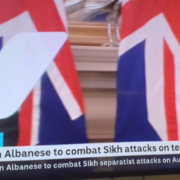
As revealed by respected Sikh diaspora focused outlet Baaz News, an ABC report which aired this week claimed India’s Prime Minister (PM) Narendra Modi stated “Sikh separatist attacks” were behind vandalism on Mandirs (Hindu temples) in Australia. The report was based on a meeting between Australia PM Anthony Albanese and Modi in Delhi.

However, Sikh Press Association reports have found no such comment was made in any of Modi’s official statements. ABC News themselves do not quote Modi making the comment in their own article on the meeting. ABC have referenced no official source for the statement, instead using the word “apparently” to justify the baseless claim in an online post. However, a ticker display the fake news on TV labels Sikhs as being behind the attacks as fact, breaching broadcast guidelines on accuracy.

Sikh PA have made a formal complaint to both ABC and the Australian Communications and Media Authority. Complaints to ABC can be made at- www.abc.net.au/contact/complain.htm.

The false news report refers to incidents in Melbourne and Brisbane which have seen some Sikh related terms daubed in graffiti on Mandir property. As police investigations continue, no evidence has been found to prove any Sikh is behind the vandalism. The graffiti has been concurrent with the Khalistan (free Sikh homeland) Referendum campaign going on in both cities. This has led to accusations against Australian supporters of Khalistan. However, many Sikhs have suggested the graffiti is an attempt to tarnish the Khalistan Referendum campaign as anti-Hindu, instead of simply in favour of Sikh rights, which is the essence of the movement. The Indian state has a long history of trying to subjugate the Khalistan movement, which entwines with the state perpetrated 1984 Sikh Genocide.

Belief these acts of vandalism are being carried out by Hindu extremists attempting to tarnish Sikhs comes from the following facts:

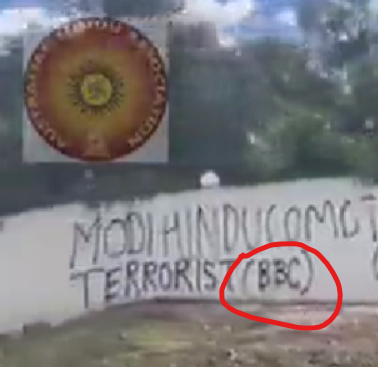
  • The random tag of “(BBC)” in a recent Brisbane incident make no sense in relation to Khalistan or any pro-Sikh position. BBC has been under attack as anti-Indian due to recently airing a documentary exposing India’s fascism and Modi’s genocidal past
  • “Sant Bhindranwale Martyr” which was also daubed in one incident in Melbourne is not a Sikh phrase
  • A group of Hindu men were caught red-handed with spray paint outside a Gurdwara in Melbourne, where Sikh posters were also being vandalised
  • No CCTV footage has been released by any of the Mandirs to expose the vandals

The Khalistan Referendum has taken place peacefully and legally in Italy and the UK already. In Canada where similar incidents have arisen, a man with a Hindu name was arrested after being found behind acts of anti-Sikh graffiti, whilst another incident also revealed at least one claim of anti-Hindu graffiti on a Mandir to be false. Ontario authorities also confirmed a “false flag” has not been ruled out.

The Sikh Press Association is concerned about ABC news and Australian media ignoring Hindutva issues in the country. The depth of Australia’s Hindutva (Hindu extremist, which is entwined with Indian ultranationalism in belief of the Hindu rashtra [nation]) problem has been underlined in recent years through the actions of violent Indian mobs targeting Sikhs in various attacks, leading to the deportation of Hindu extremist Vishal Jood. After being kicked out of Australia for his anti-Sikh violence, Vishal Jood has become a figure celebrated by India’s media and countless ultranationalist fanatics.

With the in-power BJP group known to thrive of the ultranationalist rhetoric in India, the Indian state’s influence on Western media has long been a concern. The likes of Damon Johnston, Benn Packham (both of The Australian) and Stephen Dziedzic (ABC) seem to be regurgitating Indian ultranationalist anti-Sikh Indian propaganda, whilst completely ignoring the context of Australia’s Hindutva problem, or the well known fascism within India, which recently become a global topic after a BBC documentary was released on India’s Prime Minister Narendra Modi’s genocidal actions. There is also concern about the impact of India’s ultranationalist online army swaying perception of the issue, through both social media bot networks and also pseudo-media accounts designed to look like regular news outlets but are actually Indian ultranationalist propagandists.

Speaking on the issue, Sikh Press Association Senior Press Officer Jasveer Singh said:

“ABC have put Australian Sikh lives in danger with this callous and inflammatory false news broadcast. There is no evidence Sikhs of any kind are behind the so-called temple attacks yet the entire community has been tarnished.

“No Indian official mentioned ‘Sikh attacks’ in the Delhi meeting, yet for some reason Stephen Dziedzic and the entire ABC team have decided to speak for not just India’s Prime Minister but even Australian police by blaming Sikhs for these attacks.

“This style of news reporting may be fair game in India, where press freedom is ranked 150th of 180 countries on earth, but Stephen Dziedzic and ABC News should not be allowed to degrade all the country’s media by bringing it to Australia. The facts are, there is no evidence to confirm any Sikhs are behind the graffiti.

“It is a great shame an institution like ABC News has fallen for Indian ultranationalist anti-minority propaganda. We will be urgently chasing repercussions for ABC’s dangerous anti-Sikh actions, and we will continue to follow their news broadcasts on Sikhs closely.”

UK Sikhs demand answers from Brunel on “Sikh extremist” slur

Brunel University has been besieged with complaints from UK Sikhs after a module was found labelling a revered Sikh seminary as a “Sikh extremist movement”.

This week a module on “Terrorism and Counterterrorism” being taught by International Relations (Defence and Intelligence) lecturer Dr Neveen Shaaban Abdalla included a presentation slide (see picture below) with the allegation against Damdami Taksal, a Sikh educational institution with centuries of tradition that thousands of British Sikhs have learnt from.

The seminary based in Amritsar (Punjab) was founded by the 10th Sikh Guru, Guru Gobind Singh Ji in the early 1700s and has bases in countries including the UK, Canada and the USA. Its teachings form the structure of Sikh practice and understanding for millions of Sikhs across the world, which are still taught in Gurdwaras and Sikh spaces across the world daily, rendering the statement from Dr Abdalla’s course an allegation against countless Sikhs.

The slide shown in the course included a picture of Sikh saint Sant Jarnail Singh Khalsa Bhindranwale, a former Jathedar (Head) of Damdami Taksal, who is called “leader of the Sikh extremist movement Damdami Taksal”. Sant Ji as he is affectionately known, has become synonymous with the Khalistan (free Sikh homeland) movement due to leading a panth (Sikh community/path) stand against the Indian state in the 1980s based on Sikh rights and police extrajudicial killings of Sikhs. The Indian state responded with the Sikh genocide.

Sant Ji and the Khalistan movement as a whole have been the focus of decades of Indian state propaganda to label both as “extremist”, in an effort to deflect from the growing recognition of the state’s fascism, which includes subjugation of minorities in the country, such as Sikhs.

This “extremist” image of Sant Jarnail Singh Khalsa Bhindranwale is rejected by the Sikh panth, evident through the fact that his picture is displayed at major Gurdwaras and in Sikh spaces (such as Nagar Kirtans), whilst he was also named the greatest Sikh of the 20th century by the Akal Takht, the supreme Sikh authority.

Sant Ji is pictured next to Shoko Asahara in the slide, a Japanese cult-leader found guilty of 27 counts of murder. Comparatively, Sant Jarnail Singh Khalsa Bhindranwale was never even put on trial for any crime, let alone convicted. Sant Ji was killed during India’s infamous Operation Blue Star attack on holy Sikh site Sri Harmandir Sahib, an assault which was carried out with guidance from Margaret Thatcher’s British government, resulting in the deaths of thousands of civilians in the process of targeting Sant Ji and the Sikh resistance. A grassroots panth created documentary on the incident was released last year titled Battle Of Amritsar.

The Sikh Press Association can confirm we are aware of complaints sent to and plans for a demonstration at the West London based university.

Speaking on the issue, Sikh Press Association Senior Press Officer Jasveer Singh said “Brunel University must answer concerns of the Sikh community regarding what they are teaching about the faith. The casual labelling of a Sikh seminary that influences millions of Sikhs as ‘extremist’ is dangerous. In an age where Sikhs are regularly attacked for the kesdhari (unshorn hair, keeping the Sikh physical identity) look, such allegations cannot be made lightly.

“Recently the BBC released a documentary which exposed the incredible level of human rights abuses perpetrated by the Indian state. This understanding of the reality of India has to impact what is taught in academia. We like to know if there was at least balance; that Sant Jarnail Singh Khalsa Bhindranwale’s saintly status among the respected British Sikh community is mentioned alongside India’s allegations against him.

“At the minute, the arrogant silence from Brunel prompts further concerns of Indian state influence at Brunel University, which is an issue within academia that has been noted by Sikhs in the UK, USA and Canada. We await further dialogue between Brunel and UK Sikh groups.”

Sikh Press Association requests for comment on this issue from Brunel University have remain ignored at the time this story was published.

NOTE- Damdami Taksal is an institution that impart just one of various Sikh schools of thought. However, this does not dilute the overall perception of Sant Jarnail Singh Khalsa Bhindranwale as a revered figure in the faith, or general Sikh respect for Taksal as an educational institution.

Ontario and BC Gurdwaras call for extradition law change

Two of the Canadian Sikh communities’ largest representative bodies have called for the nation’s extradition laws to be changed, amid concerns about “the lack of human rights protections”.

The Ontario Gurdwaras Committee (OGC) and British Columbia Gurdwaras Council (BCGC) have submitted a joint brief to the Parliamentary Standing Committee on Justice and Human Rights calling for “urgent reforms” to Canada’s extradition procedures and revoking agreements with countries with “poor human rights records”.

The 10-page brief comes on the heels of Canada’s recent Indo-Pacific Strategy and ongoing concerns about India’s efforts in “cracking down” on Sikh diaspora activism. Canadian Sikhs have regularly held demonstrations regarding the ongoing arbitrary imprisonment of British Sikh political prisoner, Jagtar “Jaggi” Singh Johal, who has suffered torture since his detainment in 2017.

Along with Jaggi’s case, the brief highlights how Sikh concerns are “accentuated” due to “Canada’s wrongful extradition of Hassan Diab in 2014” and “the torture of Régent Boily in Mexico”.

The brief includes recommendations “to ensure that those guilty of serious criminal offences around the world are held accountable, while also ensuring that international norms and human rights principles are upheld”.

Read the official brief summary here, which includes a link to the full submission. Interview opportunities regarding the submission with spokesperson Moninder Singh are available upon request.

For media inquiries: please email members.ogc@gmail.com.