Two arrested for “forced Christian conversion” on Sikh

Pressure from Sikh orgs on Indian authorities to investigate concerns about forced Christian conversions in Punjab have resulted in the arrest of two men.

Reports of Punjab’s impoverished Sikh community being forced and/or financially coerced into converting to Christianity have caused tensions to rise between the communities. Earlier this month the Akal Takht (supreme Sikh body of authority) Jathedar (head) Harpreet Singh calls for authorities to look into the issue, following Sikh acts of disruption to Christian conversion events which went viral across the globe.

Read more on that from Sikh PA here.

Media reports (released on 13.09.22) from India have named Balkar Masih and Jagtar Singh as those arrested for forcing one Onkar Singh to convert into following Christianity. Police stated that the duo made repeated visits to the home of Onkar Singh in Ludhiana, pressuring him into converting. Police have cited this officially as “forced conversion”. In such instances promises made in regards to paying off debts, finding miracle cures for illnesses and emotional pressure are usually part of what makes individuals convert.

Onkar Singh’s forced conversion issue was looked into after local Sikh orgs, including representatives of respected Sikh seminary Dam-Dami Taksal, pressed the issue with local police.

Some Punjab based Christian groups have condemned the actions of the Christian groups involved in the forced conversions with Apostolic administrator of the Jalandhar Diocese, Bishop Agnelo Rufino Gracias calling the actions of some Christian groups “suspicious” and admitting there was “aggressive proselytization” in Punjab in a recent media interview.

Two more Punjab Police Officers convicted for 1993 “fake encounter” Sikh murders

Two Punjab Police Officers were sentenced to life in prison for their roles in the “fake encounter” murders of two Sikh men in 1993.

Chanan Singh and Tarlok Singh were convicted today (6.09.22) for their roles in the murder of Balwinder Singh, Baljinder Singh Latu and Balwinder Singh. Balwinder Singh and Baljinder Singh Latu were abducted illegally by the officers in Amritsar whilst travelling on a bus with their parents, with no criminal reason behind their detainment.

At the time, the other Balwinder Singh was already being detained by Punjab Police. The officers fabricated a “fake encounter” incident which allowed them to claim they needed to shoot all three. Two other officers involved in the murders – Baldev Singh and Nirmal Singh – died of old age before they could be convicted for their roles in the murders. At the time Punjab Police were acting on behalf of the Indian state to strike fear into the Sikh community and attempt to eradicate any resistance to the state by killing as many Sikhs as they wanted. The issue, which was most prominent from 1984-1995, has been documented as the main part of the ongoing #SikhGenocide of India.

The news was broken by the Punjab Disappeared team who explained only the incredible persistence of Lakhbir Kaur, the mother of Balwinder Singh who was travelling with her young son when he was detained, saw the case against the officers get pursued. For eight years the officers avoided a summons based on Lakhbir Kaur’s complaints, and the case only went to trial in 2017, 24 years after the incident occurred. The Punjab Disappeared team played a key role in ensuring the case was followed through with due legal process, even after Lakhbir Kaur passed away in 2019.

The three victims and Bibi Lakhbir Kaur who spent decades seeking justice for the killings of her son

The conviction follows last week’s sentencing of Police Officers Tarsem Lal and Kishan Singh for other Sikh targeted “fake encounter” murders. Both received life in another case pursued by the Punjab Disappeared team, headed by UK born Indian Supreme Court barrister Satnam Singh Bains. The team have helped convict several other officers for similar killings by offering free legal support for the families of victims of “fake encounters”.

Whilst the sentencing of such officers will be welcomed, many still feel the actions are too little too late to be viewed as justice for the murder victims. However, efforts to imprison officers involved in such killings by the Punjab Disappeared team continue.

May be an image of 4 people

Sikh body condemn ongoing Christian “forced conversions” in Punjab

The Jathedar (Head) of the Akal Takht, the supreme Sikh body of authority, has called for the Indian government to “control” the Christian groups “forcibly converting Sikhs” in Punjab, whilst also motioning Sikh action on the issue.

The statement by Giani (meaning “Knowledgeable One”, referring to a Sikh faith leader) Harpreet Singh was released this week after an incident which saw Nihang (followers of a specific Sikh martial order) Singhs (Sikh men) disrupt a Christian conversion event in the village of Daduana, Amritsar (Punjab), an action taken based on reports the missionary groups were bribing and tricking poorer Sikhs into converting.

Indian media have reported that over 150 Nihang Singhs have been booked for investigations into their alleged crimes after complaints from a Christian pastor. Giani Harpreet Singh said about this, “The case which has been registered against Sikhs should be cancelled immediately as Sri Akal Takht Sahib (the supreme Sikh authority body) and Sikhs of the entire world are standing firm with them.” The Jathedar went on to say on 5th September a resolution will be motioned by the Akal Takht on measures to be taken to counter the “pakhandwaad” (trickery/fakery/hypocrisy) of the Christian missionary groups.

Various Christian missionary groups have been targeting Punjabi Sikhs affiliated with a “low caste” (according to cultural labels in India) background. The Sikh faith mandates no value, status or discrimination is made based on caste. However, cultural practices continue to see those associated with certain backgrounds – usually the Dalit (untouchable) caste – suffer with poverty and discrimination. This has made members of the group vulnerable to being targeted for conversion, with various reports of monetary incentives offered by Christian missionaries for people to convert, including promises to pay off debts, handle healthcare issues (sometimes through promises of miracles) and even arrange emigration for youngsters to the West, but only if families accept Christianity and renounce Sikhi. There have also been reports that families are being called to attend community support gatherings that are then revealed to be Christian conversion events where financial incentives are given to attendees to convert. Even upon converting, some families have complained they receive no financial aid and were simply used to publicise conversion to Christianity on social media. Speaking to Indian media, Nihang leader Baba Major Singh stated that Sikh groups had complained to authorities about these actions of Christian groups but no action was taken, leading to their decision to deal with the situation themselves. Giani Harpreet Singh stated that government inaction against Christian missionary groups was due to their “vote-bank” influence.

Jathedar Giani Harpreet Singh also highlighted the role of “foreign funding” in the Christian missionary efforts and called for it to be investigated, whilst ending his statement by saying should the cases against the Nihang Singhs not be cancelled, “a big action programme” would be taken by Sikhs, which would be the “responsibility of government”. Speaking to Indian media, the Jathedar also said the Sikh community needs to “seriously think about demanding an anti-conversion law” in Punjab.

Whilst the issue of Christian conversions has been raised for over a decade in some Sikh circles, in the last few years it has become a more pressing issue as cases of forced conversion seem to be rising.

Christian groups and supporters of the conversions have claimed that “high caste” discrimination from Sikhs is the main factor as to why other Sikhs are converting. Whilst issues related to this topic exist, the reports of financial coercion of poorer Sikhs to convert remains the main point of contention for those standing against the conversions. The issue of foreign funded missionaries targeting poorer communities of India has caused clashes between various groups and Christians across the country. Some speaking against the actions of the Nihang Singhs at the Christian conversion event have suggested they are based on caste discrimination. This argument completely ignores the fact that many of the Nihang Sikhs are of the same caste background which the Christians target for conversion, although as Khalsa (initiated Sikhs) they of course do not propagate this caste association.

On the night this statement was released, a church in Patti (Taran Taran, Punjab) was targeted for vandalism, with statues of Mary and Jesus destroyed and a car set on fire, furthering tensions between Christian groups and other communities in Punjab. In response, some churches decided to remain shut for days in protest until charges were made against the perpetrators. The incident is being investigated by police.

Speaking on the topic, Sikh PA Senior Press Officer Jasveer Singh said, “The grassroots incidents that take place regarding coerced Christian conversions in Punjab should not distract from the bigger issues which remain apparent in the state, which this issue only further highlights.

“What is behind the highly funded agenda to convert Punjabis to Christianity? The Sikh faith is naturally tied into activism which has been problematic for the Indian government and foreign powers. Christian conversion not only changes the demographics of Punjab, it could also long-term change the spirit of Punjab, which is ingrained with Sikh resistance, evident during the #FarmersProtest.

“Why are large coordinated actions of Christian groups that are guaranteed to be allowed The inaction of authorities in dealing with this issue also reflects an age-old complaint of Sikhs, where police are deemed as ignoring many Sikh faith based complaints until we are forced to take our own action, and then suddenly Sikhs are criticised for doing so.

“All of this causes instability and tensions to rise within the Sikh homeland of Punjab. This fuels the Indian nationalist narrative about Punjab being dangerous and violent, which is used to justify things like the state perpetrated #SikhGenocide, which was mostly carried out through police ‘fake encounter’ massacres.

“The Sikh diaspora has a lot of reason to be suspicious of what is going on regarding Christian conversions in Punjab.”

Mother of Sikh activist finally released after eight months imprisoned

The mother of a popular Sikh activist has finally been released on bail after over eight months of detainment by Indian authorities based on obscure charges.

50-year-old Jasvir Kaur is the mother of 28-year-old Jagmeet Singh, who became an icon of the #FarmersProtest movement after he was videoed walking through water canons fired by police at protesters as they headed towards Delhi from Punjab. The two were arrested for sedition on 26th December 2021, based on as of yet unproven claims they both were supporting the Sikhs For Justice Khalistan referendum, which is a democratic vote campaign that is illegal in India.

Whilst supporters of the #FreeSikhPoliticalPrisoners movement have welcomed her release, her initial detainment has been recognised by most as continuation of India’s policy of targeting not just Sikh activists but their families too. Concerns about Jasvir Kaur’s treatment inside have also been raised, due to the countless accusation of sexual abuse of female prisoners against Indian authorities such as prison guards and police officers.

India has categorised the SFJ referendum as an illegal terror campaign and has arrested countless people for even posting about it on Facebook, despite the fact it is entirely peaceful and within accepted democratic practice, verified by a group of world renowned democratic experts that oversee the campaign as the Punjab Referendum Commission. It is unclear if Jagmeet Singh has any connection to the campaign, with many suspecting the arrest of him and his mother is more connected to his status as a respected Sikh activist and Indian state attempts to continue to associate the movement with Khalistan.

Jasvir Kaur was released from Gurdaspur jail to a welcoming party from local Sikhs, who gave her a siropa (shawl-cloth given as a sign of respect in Sikh culture) for her bravery in bearing the imprisonment.

Jasvir Kaur’s son Jagmeet Singh and a family friend named as Ravinder Singh (23) remain imprisoned. The next stages of the investigation’s into Jasvir Kaur’s alleged support for a democratic Khalistan referendum remain unclear.

UK Police admit lying about anti-Sikh incident, officer faces gross misconduct hearing

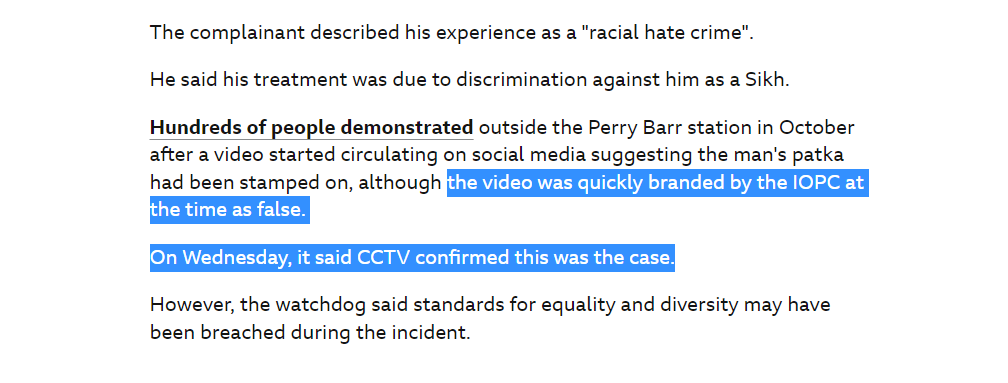
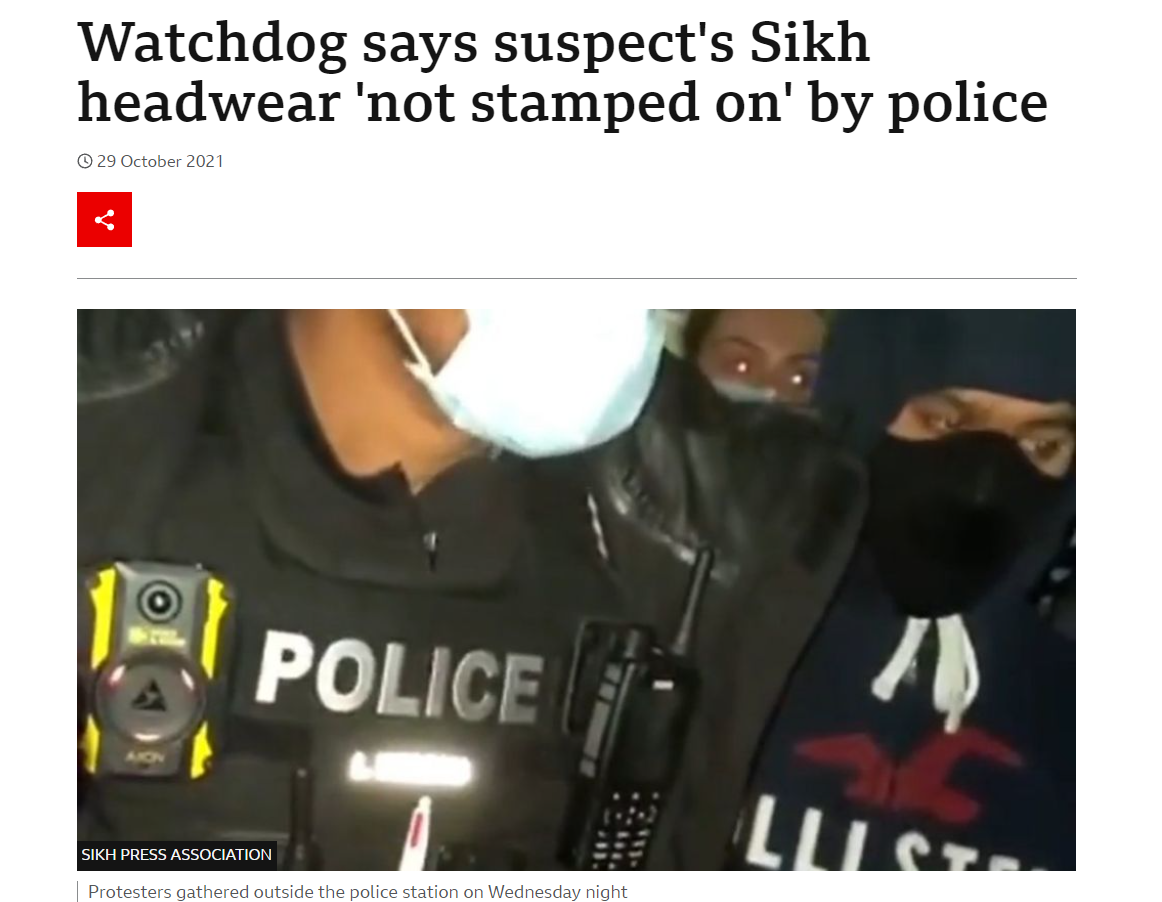
The Independent Office of Police Conduct (IOPC) have confirmed an incident of a West Midlands Police officer removing and then stamping on the patka (religious head covering) of a Sikh man took place, after originally claiming it was false.

Following the incident in October last year, which saw a Sikh man detained for an alleged traffic violation, panthic (Sikh community/path based) organisations circulated information about the hate crime whilst calling for a mass protest against WMP. As reported by the likes of the BBC, at the time the IOPC claimed the allegations were false, but last week (24.08.22) confirmed CCTV footage proves the incident did take place as described by the panthic orgs.

At the time, WMP stated the removal of the head covering carried out in a Perry Barr (Birmingham) police suite was done to search for weapons, whilst denying the stamp altogether. However, the Sikh man did not have any items of clothing removed for a weapons search and the suggestion he could be hiding weapons in the thin cloth material tightly wrapped to his head for a patka was deemed ridiculous. There were also calls for the police to immediately share CCTV and body camera footage to back their claims that the allegations of an anti-Sikh hate crime were false.

A month after the incident and after protests, as reported by Sikh PA at the time the officer in question was given a “gross misconduct notice”. Six other officers with him were also each given a “misconduct notice” as investigations continued. At the time  IOPC Regional Director, Derrick Campbell said the misconduct notice given to seven WMP officers “does not necessarily mean that misconduct proceedings will follow. It is only once our investigation is complete that we will make decisions about whether or not the officers have a case to answer and should face disciplinary proceedings.”

Nearly a year later with no details as to why the investigations took so long, the IOPC have stated the officer that snatched the patka off – Kashif Shafiq, believed to be of Muslim background – will face an official gross misconduct hearing. The other six involved will not face hearings although four of them “would benefit from taking part in reflective practice” according to media reports. The IOPC also admitted the incident caused community tensions but did not acknowledge any fault on their part for originally claiming Sikh groups were lying about what took place.

A misconduct panel will now be put together by West Midlands Police. Although no date has been confirmed for the hearing, Sikh groups across the UK are anxiously awaiting a suitable outcome for the act of anti-Sikh hate.

With this update, many are wondering why the Metropolitan Police are yet to give any update on complaints about one of their officers punching a Sikh man in the face in an unprovoked attack during the 2020 #FarmersProtest #KisaanRally in London, which legal group Kaurs Legal have pushed for.

Sikh PA will provide updates on these stories as soon as possible.

National Sikh Police Association face community backlash for #FreeJaggiNow statement

The National Sikh Police Association UK received a furious community backlash for a statement referencing recent news about India’s Scottish political prisoner Jagtar “Jaggi” Singh Johal being spied on by UK intelligence.

The official #FreeJaggiNow campaign, The Sikh Federation UK and Sikh Council UK were among various Sikh orgs and individuals critical of the statement released this week, which denied any involvement from the NSPA UK with the Indian state or UK intelligence services regarding Jaggi’s imprisonment.

Human rights anti-torture NGO Reprieve revealed this week they discovered details of a case in a UK investigatory powers commissioner report which exactly matched the case of Jaggi, exposing the role of UK intelligence services MI5 and MI6 in getting the Scotsman abducted and subsequently tortured by Indian authorities in 2017. In 2018, information cited as coming from Jaggi’s torture was used by UK police to conduct raids on five Sikh activists.

Reprieve’s revelations resulted in mass condemnation of the actions of UK intelligence from MPs, Sikhs and general human rights supporters across the world. This condemnation comes based on a growing understanding that Jaggi is just one of many Sikh activists targeted by India for revealing the country’s human rights abuses. Such activism is viewed as the reason various other UK Sikh activists have been subjected to police raids, extradition attempts, property seizing, travel bans and more by UK authorities.

Within Sikh community discussions about the issue of spying and policing, the role of the National Sikh Police Association was raised and questioned. Many within Sikh panth (path/community focused) circles have complained that the NSPA UK has acted as a buffer for UK police, deflecting complaints and criticisms regarding the policing of the Sikh community to instead present an image of cosy relations between Sikhs and the police, whilst various community issues go on unaddressed.

Issues of this kind include (but are not limited to):

Seemingly in response to criticisms, the NSPA UK released their statement which said they aim to ensure “the Sikh interest is better understood” encouraged the Foreign Office to “lobby the relevant authorities to be granted regular access to Jagtar Singh Johal and document his treatment”.

In response, the Free Jaggi Now team highlighted how NSPA UK have never previously reached out to their team, whilst also stating the statement was an effort for “damage limitation” and “They do not have our best interests at heart.”

The Sikh Council UK directly asked “Will you STOP working with @PunjabPoliceInd due to their active role in the torture of a British national?”, based on reports that India based officers have visited their UK counterparts and even took part in raids on Sikh activists.

The Sikh Federation UK stated “you’re an internal Police network that has confused & betrayed the community with questionable actions. Your colleagues @WMPolice are complicity in acting on & providing intel used to torture Jaggi!”.

The SFUK tweet refers to how the torture of Jaggi was used to name Sikh activists he worked with in the UK, who were then raided by UK police. These activists’ names ended up in Indian media within less than 24-hours of the raids, an indicating a link between the actions of the UK police forces and India. Leaking the names of those raided is said to be a breach of protocol, according to Sikh PA sources. No UK Police groups have ever attempted to explain how those names ended up in Indian media.

Further evidence of UK-India collusion was also exposed through documents that named Jaggi among UK based activists targeted for police raids. When the NSPA UK was formally launched in 2019, WMP Chief Constable talked about police “tensions” with the Sikh community regarding “Indian extremism” (believed to be based on support for Khalistan, a free Sikh homeland), before talking of the “operational” involvement of the WMP Sikh Police Association, which has been running since 2013. This is believed to revolve around the same 2018 raids which came from information extracted from the torture of Jaggi. Such incidents are what led to a UK wide ban on police from entering Sikh spaces in promotional capacity.

The backlash towards the NSPA UK further underlines calls from groups like Sikh Federation UK that the association should be disbanded, echoed by various Sikhs including some that work with police in a liaison role.

Speaking on this issue, Sikh PA Senior Press Officer Jasveer Singh said, “The NSPA UK’s statement triggered release of sentiments that have been around for years but became more publicised since the 2018 #5SinghsUK raids, which have been noted as happening due to information taken from the torture of Jaggi. “The fact is, many Sikhs feel UK police have been carrying out the dirty-work of Indian authorities in how they have targeted various Sikh activists, something which Indian media have openly stated is the case.

“The outcome of these raids, including the #WestMidlands3 fiasco, has not seen prosecutions for anything, let alone something that could be construed as terrorism towards India, which is usually mentioned as what is behind the targeting. The role of UK Sikh police officers within this has been seemingly to either ignore or on occasion justify this targeting of UK Sikhs.”

Media wanting more information on these issues can email media@sikhpa.com.

Mass protest takes place over “forced conversion” of Pakistan Sikh woman

Dozens of Pakistani Sikhs took part in a protest in outside a police station in the Khyber Pakhtunkhwa province after allegations of the “forced conversion” and marriage of a Sikh woman to a Muslim man.

Gurcharan Singh claimed his 25-year-old daughter, named as Meena/Deena/Dina (depending on sources) Kaur Kumari, was coerced into meeting with a Muslim man and subsequently taken at gun-point and kept away from her family. The woman was then later announced as married to her unnamed abductor.

Police inaction on the issue resulted in a Sikh community gathering to protest outside a station in Peer Baba on Buner Road. Traffic was blocked outside the station. The protest was criticised for blocking an ambulance, whose passenger then died. The family of the deceased demanded police action against the protesters.

A video was later released by a veiled woman claiming to be Meena, a school teacher, in which she said she voluntarily converted and married her Muslim husband, and she did not wish to return to or visit her family in Darul Aman. Sikhs in Pakistan, as well as in Kashmir and Afghanistan, have regularly complained about the targeting of Sikh females for conversion.

Speaking on the issue, Sikh PA Senior Press Officer said, “This latest case is a classic example of how blurred and obscure the truth can be. The first point of contention is the fact Sikhs in Pakistan often feel they cannot rely on the police for any kind of help when it comes to cases of forced conversion, which is what triggered the protest.

“Beyond that, there is also no way to decipher the truth of the safety of the woman involved in the case in the current situation. Is she being forced to say she willingly converted and married? If she did convert and marry willingly, why cannot a meeting between the families be facilitated by authorities so they can see her confirm this in person? Sikh families in these situations often complain about being threatened by local Muslims, which is what happened in this case. How are Pakistani authorities ensuring their safety?

“Finally, when we take into account the context of various witnesses attesting to Sikh women being kidnapped at gun-point, especially in the Khyber province, as well as underage Sikh girls being groomed by Muslim men, the reaction by Pakistan’s Sikh community is understandable.”

Various political figures in India have spoken out about the case, with some suggesting that the police in such regions work to cover-up forced conversions, instead of working to prevent them. The Akal Takht (supreme Sikh authority) Jathedar (Head) Giani Harpreet Singh condemned the incident and referenced previous complaints about similar issues taking place.

Punjab Police Officers to finally be sentenced for “fake encounters” murders, 30 years after Sikh men killed

Update: Both officers received life sentences.

After 30 years two Punjab Police Officers will finally be sentenced TODAY (16th August) for a triple murder that was part of the India’s #SikhGenocide “fake encounters” massacres, which saw countless Sikhs murdered by police mainly from 1984-95.

Kishan Singh and Tarsem Lal have evaded any form of justice since 1992, when they murdered three Sikh men – Sahib Singh, Dalbir Singh and Balwinder Singh – after arresting them. The two officers, along with a third officer Rajinder Singh who died before the convictions came, took the Sikh men to a police station and then claimed they were shot dead in a crossfire during a shootout between a group that had attempted to free them from the police.

All evidence pointed at the three Sikh men being executed by the officers, whilst a fourth murdered man during the incident – Balwinder Singh – was also believed to have been killed by the officers, although the officers managed to evade being charged for his murder. Yet, police only registered the crime in 1997, after years of the families of the men persisting in their pursuit for convictions against the officers, who were openly known to have carried out the killings with the complicity of approximately 20 other officers at the Mehta Police Station in Amritsar (Punjab). The bodies of all four murdered Sikh men were illegally cremated by the officers, which was the standard practice of Punjab Police at the time.

The Indian State at the time was using police to massacre Sikhs to stem dissent and activism against the government’s decades long anti-Sikh actions. Many killed were often just picked randomly, with children and youngsters not exempt from the fatal savagery being practiced by police under government orders. Whilst convictions against the officers that carried this out have become more common in recent years, many Sikhs still feel there is no form of justice available after so long since the murders.

Officers Kishan Singh, Tarsem Lal and Rajinder Singh were allowed to remain free whilst the families of the men pursued their conviction, with the case only going to trial in 2006 and the officers only required to attend court on some occasions. In recent years the Punjab Disappeared team headed by India Supreme Court Barrister Satnam Singh, who moved to India from the UK to practice law, helped get progress on the case, leading to the conviction of the officers on 12th August (last week).

People across the world will be watching the outcome of the sentencing closely, as the pursuit of some form of punishment against such officers that murdered countless Sikhs continues.

Canadians continue to call for answers on anti-Sikh bomb hoax incident

The Canada branch of Sikh legal advocacy and aid organization United Sikhs have released a statement repeating calls for a “full investigation” into last month’s anti-Sikh bomb hoax in Ottawa.

The incident saw police arrest, search and interrogate two organizers of a Sikh gathering, based on a random “tip-off” which claimed they planned to bomb their own event. Canadian Sikhs are still searching for answers regarding the incident, which was clearly done to disrupt a gathering to mark the 1984 Sikh Genocide.

Read more on the incident, including an 18month timeline of anti-Sikh incidents in Canada here.

United Sikhs released a statement which was sent to various elected officials of Canada on 4th July. See the statement below.

Image
Image

Sikh Press Association Senior Press Officer Jasveer Singh spoke to MPs Peter Julian (NDP, New Westminster) and Parm Bains (Liberal, Steveston-Richmond East) at the 26th June New Westminster Nagar Kirtan (religious procession) about the incident. See what they had to say below:

Peter Julian-

“Jagmeet Singh and the NDP caucus addressed the incident in Ottawa and I stand with their statements. This incident is part of a broader pattern that we are seeing that targets Sikhs, Muslims, the Jewish community and others. We are seeing more racism, more misogyny and more homophobia. All Canadians need to speak out in this rise of targeting of minorities to push back against this hate. I found what happened in Ottawa disturbing and the NDP has taken on a number of motions to push back against this. I think the Sikh community is right to be concerned. We have to fight against this together and it is something the entire NDP caucus is dedicated to doing.”

Parm Bains-

“The Sikh community has contributed to every facet of Canadian society to make it what it is today, and just when we think we are in a good place things like this happen to remind us we still have work to do. The Liberal Party immediately took the issue to the Securities Minister who is trying to implement change and support Sikhs against these kinds of attacks. At a more grassroots level, the key to changing this is education. Gurdwaras and other Sikh groups are doing great work already to educate people on Sikh issues, but if we can help that as a society we must, because education is the key to tackling this hate.”

Toronto forces Sikh security guards to lose their work, then quickly reinstates them

A “City of Toronto rule” declaring all security guards must be cleanshaven led to over 100 Sikhs losing their jobs, before the ruling was quickly overturned to reinstate all that had been impacted.

The issue was raised in the media by Sikh advocacy leadership group World Sikh Organization (WSO) of Canada yesterday (04.07.22), with the municipal government ruling being overturned today (05.07.22). The Sikh faith mandates keeping kes (unshorn hair), with Amritdhari (initiated) Sikhs committing to keeping kes without any exception.

Word about the treatment of Sikh security guards started coming forward after security companies began enforcing the Shelter, Support and Housing Administration (SSHA) division’s requirement for the use of N-95 mask of all security guards through April, after some employers complained they were being fined and/or warned about Sikh employees not being cleanshaven. Sikh security employees then found themselves either demoted to lesser paying work where the N-95 mask was not required, or being laid-off altogether.

WSO took forward complaints to the City of Toronto authorities and media, leading to an announcement that the ruling would be removed for those religiously exempt, and all Sikhs that were impacted by the issue would be reinstated.

The issue of Sikhs supposedly not passing mask “fit tests” due to their beards is one that has plagued the community through the pandemic, with issues in the UK, Australia and USA being raised and addressed by Sikh advocates. The “Singh Thattha Method” of tying up a beard, first pushed by UK based surgeon Dr Rajinder Pal Singh, has now been formally recognized as a tested and approved method of having Sikhs pass mask fit tests. However, insights into this issue have also proven that other facial features aside from a beard can see people fail a mask fit-test, whilst Sikhs with beards have also many-a-time passed mask fit-tests too, rendering the need to be cleanshaven unproven and often useless. The Sikh Press Association covered this widely during the pandemic period of 2020-2021.

A lack of awareness around these beard related findings by bodies that make such rulings means the issue festers on. For this reason Dr Singh has begun a petition calling for support to have Health and Safety Executive (HSE) of the UK officially endorse the technique for those that work in healthcare and other relevant places of work, such as prisons. Recently Australian Sikhs also pushed for wider acceptance by authorities of such techniques through an official report on the issue.

Whilst the discrimination against Sikhs continues, efforts by Sikh advocacy groups will continue to be important. For media looking for more information on this issue, email media@sikhpa.com.