Claim of “Pro-Khalistan Extremism” made to “appease” India, say Sikh Federation UK

A claim in a recent independent review of Prevent which stated the UK government counter-terror initiative should be “mindful” of “Pro-Khalistan extremism” in the UK was made to “appease…the Indian government”, according to the Sikh Federation UK.

In a press release, community legal and political advocacy group Sikh Federation UK stated the inclusion of alleged “Pro-Khalistan extremism” along with the omission of Hindutva (Hindu extremism) despite evidence of its growth in the UK showed “British politicians” were acting on “pressure being applied by the BJP Indian government”.

See the Sikh Federation UK statement in full here.

Last week (07.02.23) a government commissioned independent review of Prevent was released. The review was done by William Shawcross, a journalist by trade with an Eton-Oxford background who has also worked for The Sunday Times, BBC and the UK Charity Commission. The review by Shawcross has been widely criticised, with Amnesty International UK saying it is “deeply prejudiced” and “has no legitimacy”, due to bias from Shawcross and his history of “bigotry”.

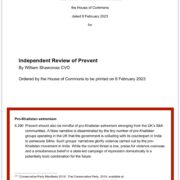
The review included one sole paragraph on alleged “extremism” within the Sikh community, included as a footnote without any data or specifics to support the claims (see image below). The statement on Khalistan (free Sikh homeland movement) included that “the current threat is low”, making Shawcross’ claims against British Sikhs purely speculative.

Image

The paragraph claims there is a “false narrative…that the UK government is colluding with its counterpart in India to persecute Sikhs”. At least three recent incidents in recent memory contradict this claim, proving that the UK has indeed colluded with India in efforts to target Sikh activists. These are:

  1. Findings from journalist Phil Miller which showed Margaret Thatcher’s Conservative government provided advice to India for their 1984 invasion of holy Sikh site Sri Harmandir Sahib, leaving thousands of civilians dead, seen as the beginning of India’s Sikh genocide
  2. Claims by Indian media that “diplomatic pressure” was behind the UK’s counter-terror raids on five Sikh men in 2018, which has been linked by famed human rights lawyer Gareth Peirce to the torture of Scotsman Jagtar Singh Johal. The outcome of the raids was one single charge of a Charities Commission breach of one of the men who has never worked for a charity. The charge has still not been taken to trial five years later and remains in limbo.
  3. Findings from non-Sikh human rights NGO Reprieve which show UK intelligence facilitated India’s capture and subsequent torture of British Sikh political prisoner Jagtar Singh Johal

Along with the above, random mentions of Sikh “extremism” by MPs Priti Patel, Boris Johnson and Bob Blackman (who was found to be taking money from Indian nationalist support groups) have suggested to Sikhs that the Indian government’s efforts to claim there is a Sikh extremism problem to silence Sikh activism against the state’s human rights breaches have crept into UK politics and even UK policing, evident from West Midlands Police’s Matt Ward’s comments on the non-issue. There were also concerns from UK Sikhs regarding a 2019 UK government Counter-Extremism Commission report on “Sikh activism”, due to its undue focus on minor incidents which many felt were undeservingly focused on through the “extremism” lens and using evidence from just 12 hand-picked interviewees. A report on similar issues given more credibility by grassroots Sikh organisations was the CREST review of “Sikh Activism in Britain” by Dr Jasjit Singh, which was created after various meetings with Sikh groups and lengthy reviews into specific incidents within the community. The findings of the CREST review showed there was no Sikh threat to the public.

Sikh Federation UK’s Principal Adviser Dabinderjit Singh highlighted how the UK would be better of turning attention to the very real threat of Hindutva in the UK, saying, “This reference to Sikhs contrasts with a deliberate oversight by William Shawcross of Hindu nationalism, known as Hindutva, in Britain that recently reared its ugly head in widespread violence and terror in Leicester”.

Media looking for more information on Sikh concerns about the unwarranted India state influenced speculative focus on “Khalistan extremism” can email media@sikhpa.com.
Sikh orgs condemn ongoing Australian Hindutva (Hindu extremist) anti-Sikh campaign

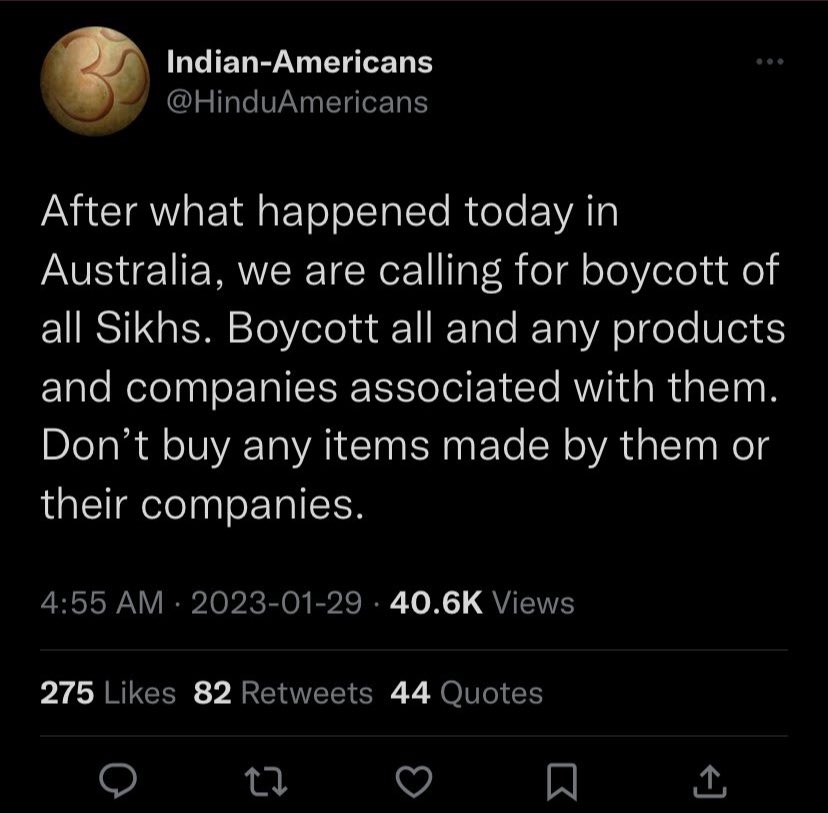
Various Australian Sikh organisations have spoken out about an ongoing anti-Sikh campaign being pushed by Hindutva (Hindu extremist) Indian ultranationalists in the country, which includes boycotting Sikh businesses and attempting to have the kirpan banned.

Note- Hindutva is entwined with Indian ultranationalism as it believes Hinduism must dominate India.

The Sikh Council of Western Australia and the Miri Piri Gurduara both released statements this week detailing community concern about the anti-Sikh campaign. The statements come on the back of a call made by Indian Hindu groups to boycott Sikh businesses and a petition by Australian Hindu asking Australian authorities to “deport” Sikhs and have basic faith practices “banned”.

The business boycott plan has been pushed by the “HinduAmericans” group in response to incidents in Australia, as well as the “Indians in Melbourne” Facebook page. Lists of Sikh owned businesses and/or businesses with Sikh and Punjabi sounding names have been circulated online, with some owners noting the negative impact with news outlet SBS.com.

Image

The petition, which had seven demands including “deport every Nihang (Sikh warrior faction)”, was allegedly handed over to MP Clare O’Neil when she visited Durga Temple in Melbourne, according to a tweet by Hindutva org Australian Hindu Media. However, the format of the demands – scruffily hand written on paper with several mistakes and signed “Victorian Hindus” without any specific organisations or individuals putting their name to it – suggests the petition was created on the spot and does not have any official consensus backing. MP Clare O’Neil has also not made any reference to the petition, making it unclear if it was ever even presented to her.

The petition also comes on the back of false claims Sikhs used “knives” (likely a reference to the Sikh article of faith the kirpan, a small sword) during the skirmishes with the Indian ultranationalist mob on 28.01.23. No kirpans or knives were seen in use or reported by police after the incidents. However, Indian ultranationalist Hindutva supporters have made this false claim to try to attack the Sikh practice of carrying weapons for selfdefence and to protect others.

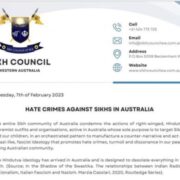
The statement from the Sikh Council of Western Australia highlighted “Hate Crimes” against Sikhs from “Hindutva extremist outfits” that are targeting “Sikhs and our children”. This came as Hindutva supporters began circulating pictures of Sikh children online they claim were involved in the skirmishes against Indian ultranationalists, even though some look no older than 10-years-old.

The Sikh Council of Western Australia also highlighted a history of Australians being victim to India’s Hindutva issue, citing the murder of an Australian missionary by Hindu extremists in India.

See their statement in full below.

Image
Image

Miri Piri Gurduara stated “The Sikh community have been repeatedly targeted”, whilst also highlighting that accusations Sikhs were behind graffiti on Hindu temples came “without a thorough police investigation” (and no evidence of Sikhs being behind the crimes since). See their statement in full below.

Image

The anti-Sikh campaign in Australia has been vehemently upped by Indian ultranationalists ever since a Sikh backlash against an attempt to disrupt the recent Khalistan (free Sikh homeland) referendum in Melbourne. The incident saw an Indian ultranationalist mob storm the area where the referendum was being held, chanting anti-Sikh slogans and intimidating all in sight, which included women and children. Minor skirmishes then broke out as Sikh men retaliated against the mob.

The mob invasion was just one of several incidents in the lead up to the Khalistan Referendum in Melbourne, including a spate of vandalism which saw one group of anti-Sikh Indians caught red-handed in an attempt to graffiti Gurdwara property. Read more on these incidents here- Indian vandals caught red-handed amid ultranationalist attempts to disrupt Khalistan Referendum | SikhPA.

With another Khalistan referendum event announced for Brisbane for 19th March, the anti-Sikh campaign is likely to continue. Speaking on the issue, Sikh Press Association Senior Press Officer Jasveer Singh said:

“There is no doubt that these attacks on not just the Sikh community but the Sikh faith itself are driven by Hindutva Indian ultranationalist antagonism towards the Khalistan referendum. Similar incidents in Ontario (Canada) indicates there is some kind of fascist template that Indian ultranationalists follow to disrupt movements of Sikh sovereignty.

“It should be of great concern to Australian authorities that Hindutva and its twin Indian ultranationalism are trampling on the freedoms which allow Sikhs in Australia to hold the Khalistan referendum, just as Sikhs have done in the UK, Italy and Canada. Politicians and media need to ensure they are not coerced into speaking in support of the fascism that upholds India’s regime creeping into Australia.”

Indian vandals caught red-handed amid ultranationalist attempts to disrupt Khalistan Referendum

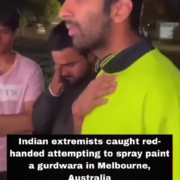
An Indian ultranationalist goon admitted he had turned up outside a Melbourne Gurdwara to graffiti Khalistan (free Sikh homeland) Referendum posters, after being caught red-handed by local Sikhs this weekend.

The incident was one of several attempts by Indian ultranationalists to disrupt Australian Sikh efforts to pursue their democratic right to hold the Khalistan Referendum in Melbourne. The Sikhs For Justice campaign has been peacefully and legally held in the UK, Italy and Canada without incident, underlining a growing Hindutva problem in Australia.

On the evening of 29th January a man was caught with four accomplices (three seen in this video by Sikh activist and influencer @Free5ab) acting suspiciously in a car outside Tarneit Gurduara Sahib (Davis Road, Victoria) when they were confronted by sangat (Sikh congregation). They were found with cans of spray paint and when pressured they quickly admitted they came to vandalise posters on the property. The men, who apologised amid their confession, were handed over to authorities. In India, goons caught before attempting beadbi (Sikh sacrilege, usually referring to attacking scripture) and worse have said they were paid to do so by Indian state authorities.

The depth of Australia’s Hindutva (Hindu extremist, which is entwined with Indian ultranationalism in belief of the Hindu rashtra [nation]) problem has been underlined in recent years through the actions of violent Indian mobs targeting Sikhs in various attacks, leading to the deportation of Hindu extremist Vishal Jood. After being kicked out of Australia for his anti-Sikh violence, Vishal Jood has become a figure celebrated by India’s media and countless ultranationalist fanatics.

Earlier this month, video evidence produced by Sikhs For Justice proved that Khalistan Referendum posters were being targeted for graffiti, in what are believed to be attempts to provoke the Sikh community. Pictures of Sant Jarnail Singh Khalsa Bhindranwale, the revered Sikh saint that became the face of Sikh activism in the 1980s), were particularly targeted by the vandals.

Previous to this, Hindu groups in the Melbourne area accused Khalistan supporters of being behind graffiti on Mandir (Hindu temple) property. However, no evidence has been found to connect any Sikh with the criminal act, and Sikh groups have unanimously come out to condemn the act. Many Sikhs have suggested the graffiti was done in an attempt to tarnish the Khalistan Referendum campaign as anti-Hindu, instead of simply in favour of Sikh rights, which is the essence of the movement. Questions are still being asked as to why no CCTV footage has been released by any Mandir to expose the crime.

In Brampton (Canada, Ontario), similar issues saw a man with an Indian Hindu name – Kartik Tugnait – arrested for anti-Sikh graffiti, whilst accusations of Sikhs being behind graffiti of a Mandir were revealed to be seemingly completely made up, embarrassing the likes of MP Chandra Arya, an Indian origin politician that amplified the accusation against Sikhs.

Video footage of skirmishes between supporters of the Khalistan Referendum and Indian ultranationalists that turned up to antagonise them on the day of the referendum have gone viral this week. However, whilst Indian and Australian media attempt to portray Sikhs as the instigators of the violence, more recent footage shows conflicts began when an Indian mob stormed the area. The situation in Melbourne’s Federation Square area was completely peaceful for hours as thousands of Sikhs came to vote during the day. The mood changed when the Indian mob arrived, screaming and making provocative chants about India being a Hindu nation whilst confrontationally standing before Sikhs in the area, which included women and children. Witnesses also state that the Indian ultranationalists were shouting insults towards Sikhs, which included references to recreating the Sikh Genocide of 1984, before some Sikhs retaliated.

Many Sikhs are concerned about India’s influence on Australian media’s coverage of such issues. With the in-power BJP group known to thrive of the ultranationalist rhetoric in India, the Indian state’s influence on Western media has long been a concern. The likes of Damon Johnston, Benn Packham (both of The Australian) and Stephen Dziedzic (ABC) seem to be regurgitating Indian ultranationalist anti-Sikh Indian propaganda, whilst completely ignoring the context of Australia’s Hindutva problem, or the well known fascism within India, which recently become a global topic after a BBC documentary was released on India’s Prime Minister Narendra Modi’s genocidal actions. There is also concern about the impact of India’s ultranationalist online army swaying perception of the issue, through both social media bot networks and also pseudo-media accounts designed to look like regular news outlets but are actually Indian ultranationalist propagandists.

Speaking on this issue, Sikh Press Association Senior Press Officer said:

“Australian media have an important role right now in covering recent events connected with the nation’s Sikh community. The fascism and bigotry that upholds India’s current regime are now well known, and thus the Khalistan freedom movement needs to be viewed within that context. This includes what is happening at a grassroots level in Australia, where Indian nationalist mobs have violently attacked Sikhs in recent years. The fact that the confession of a Hindu man caught red-handed trying to vandalise Sikh property has not made mainstream news in Australia is a sad reflection of how the nation’s media is being distracted from the truth of what is behind recent incidents in Melbourne.

“Any journalist suggesting that the Khalistan Referendum is at the heart of any trouble in Australia is either influenced by India’s state or completely misinformed about what is going on in Australia and with Sikhs worldwide too. We encourage Australia’s media to really delve into the situation and not simply regurgitate Indian media takes on recent incidents in Melbourne.”

Media looking for more insight from a Sikh perspective on recent incidents in Melbourne can email media@sikhpa.com.
Instagram target Sikh activist accounts in banning spree

Two prominent Sikh activist Instagram pages were removed from the app last night, including the official campaign account for British Sikh political prisoner Jagtar Singh Johal.

@FreeJaggiNow and @SikhActivists were removed from the world’s most used social media site just weeks after the @SikhYouthUK page was also removed. The @SikhActivists page was the official backup page for @SikhYouthUK, with both pages posting regular updates on the #FreeJaggiNow campaign.

The two organisations work closely on highlighting the plight of India’s British Sikh political prisoner Jagtar Singh Johal, who enters his sixth year of being imprisoned in India without being convicted of a crime. The banning spree follows an ongoing pattern of Sikh activist accounts being censored on all social media sites.

Many Sikhs believe the influence of the Indian government, who have criminalised Sikh dissent, is evident in the actions of social media moderators. However, in meetings with groups like The Sikh Press Association, the team behind Instagram and Facebook have previously said targeted “malicious” mass reporting has led to Sikh censorship.

The issue will be taken up with Instagram directly, although previous issues of Sikh censorship remain unaddressed.

Complaints made to FA over Sikh footballer patka pulling incident

Complaints have been made to the English Football Association (FA) regarding an incident which saw a Sikh footballer sent off for his reaction to having his “head covering (patka) pulled”.

Semi-professional athlete Charan Singh Basra was playing for Langford FC (05.01.23) as they were 3-1 up against Real Bedford in a league game of the 10th tier of English football when his patka – a form of Sikh headcover when by practicing Sikhs – was pulled by Bedford’s Jordan Brown, causing Charan Singh to assertively defend himself by manhandling Brown, who then fell to the floor feigning injury. Charan Singh received his second yellow card of the evening for this and was thus sent-off. Brown was only given a yellow card.

The Sikh Press Association can confirm that the incident (first reported by West London based community group page @UB1UB2) is being looked into by the FA after Sikh complaints about the incident, which went viral on social media, have become apparent, whilst Langford FC will also appeal the decision. The FA’s current Head of Diversity is a dastaar (Sikh turban) wearing Sikh, Dal Singh Darroch, who has worked to engage with the Sikh community at a grassroots level.

Sikh Press Association Senior Press Officer Jasveer Singh said of the incident, “The FA must make a ruling that touching a faith headcovering is an automatic long-term ban. If we want to encourage more Sikhs into the game, this is an important step that must be taken.

“The community will always stand by Sikhs like Charan Singh Basra that defend themselves from faith based attacks such as the disgusting act Jordan Brown was caught on camera doing, especially as similar incidents have been reported happening at all levels, including among children. As such, if the FA do not act on this, they will be partly responsible for not only any more anti-Sikh attacks that happen on football pitches in England, they will also be responsible for the resulting Sikh reaction.

“The ignorant response of the Real Bedford Chairman, who was in complete denial that the incident of targeting another person’s faith symbol was ‘discrimination’, is also an embarrassing reflection of where English football is at. Hopefully FA action will make the club realise how they are tarnishing the entire English game by not having their player apologise and we will see them act accordingly soon.”

Read a statement from Charan Singh Basra below:

The following statement is in relation to the incident that occurred during the Real Bedford vs Langford game where Real Bedford players pulled at my religious head covering.

Before explaining the incident I would like to give some contextual background about a Sikhs hair and their Turban. Kesh (uncut hair) is the practice of allowing one’s hair to grow naturally out of respect for the perfection of God’s creation. It is kept with the upmost respect and covered by a turban. British Sikhs who served in both World Wars refused to replace their turbans with steel helmets (a lawful command). Despite potential death being the punishment for disobeying a lawful command, Sikhs were willing to choose that option over replacing their turbans – that is how highly our hair/turbans are regarded. I personally wear a turban daily and during sporting activities this is replaced by a Patka (a smaller head covering). I have not cut my hair once in my 29 years which is why I have not taken lightly to the following actions.

There were two incidents during this game where my Patka (religious head covering) was pulled at, both videos have been attached. The referee was informed after both incidents yet remained despondent, even after informing him that it is a religious symbol. Contrary to Real Bedford’s statement, these were the only two incidents I was involved in which will be supported once the full video is obtained. The first incident you can see me winning the ball both times before being thrown off the ball, I’ve then attempted to regain possession. In an attempted to play the ball, I was slightly late and caught the player, not dangerous play in the slightest (that is not my character), my studs were down and my body remained on the ground. The reaction from the Real Bedford players however was not acceptable. The video footage provided by Real Bedford ‘conveniently’ turns away from the incident once I am thrown to the floor, hopefully the unedited video obtained will show events clearer. A Real Bedford player has hit me in the face and pulled at my Patka. You can quite clearly see me on the floor holding my face with one hand while the other hand is trying to keep my Patka on my head. I have been playing football for over 20 years, been in numerous tackles, headed the ball on multiple occasions and my Patka has not once come loose as I tie it securely. That shows the amount of force that would’ve been needed to remove it from my head, which is why I am sure it was pulled at intentionally. Once the video footage is obtained you will see my trying to retie/secure my Patka on the pitch for the next 5/10 minutes after the incident. From my introductory background about Sikhs hair/head covering, I am sure you can appreciate the significance of this players action.

Real Bedford’s statement incorrectly mentions dangerous tackles on many occasions, which quite frankly is astonishing as to where they have obtained this from – again video evidence will show the correct story. The second incident started from a horrible tackle from behind with no intention of winning the ball by Jordan Brown on one of our players. Difference being you didn’t see any of our players crowding the offender as Real Bedford players did with me in the first incident. You’ll see from the footage that a number of Langford players simply moved Jordan Brown away from the player injured on the floor and walked away, Jordan has directly come back and targeted me and you can quite clearly see him tugging at the back of my Patka. The Referee was told by myself and the linesman what Jordan Brown had done but again no repercussion for pulling on a religious head covering? 

You may be aware that this incident has gained significant traction online with over 1 million views in just 24 hours and now a news article. Langford and myself have not partaken in any of these social media interactions. I personally do not think Jordan Brown or anyone at Real Bedford is racially profiling, I think they are just uneducated on the matter however this does not excuse their actions and repercussions need to be taken. The Referee needs to answer to why he thought actions of pulling on my Patka were not serious enough to be taken into consideration, it was his job to protect me from such incidents but failed. There needs to be more awareness from players and referees to prevent incidents like this occurring in the future. 

43 Indian police officers given reduced sentence for murdering 10 Sikhs in 1991

A long-running case against dozens of Uttar Pradesh police officers has led to 43 of them being given reduced sentences for the “fake encounter” deaths of 10 Sikh men, six years after 47 officers were found guilty for the killings.

Presiding judges Justice Ramesh Sinha and Justice Saroj Yadav reduced the 2016 conviction from “murder” to “culpable homicide” for the officers in an Allahabad High Court hearing on 15th December. The reduction came even after most the officers have already benefitted from India’s corrupt legal system which has helped keep nearly all of them free since 1991. The reduction means the men were given just seven years in prison each instead of life, for murders which were described as “barbaric and inhuman killing of the innocent persons” in court only last June, as reported by Sikh PA.

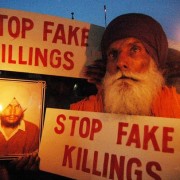
A transcript of what was said about the reduction in court stated the judges believed there was “no ill-will between the accused and those killed. The accused were public servants and their object was the advancement of public justice”.  This will outrage countless Sikhs, many of whom have long followed this case as a black-and-white example of the “fake encounter” murders which were the main way the killings of India’s Sikh genocide were carried out in the 80s-90s. The killings in 1991 came after police halted a bus taking Sikhs on a religious trip to a Gurdwara. Officers randomly took 10 men and one Sikh child and later claimed three separate incidents occurred which forced them to fire on the Sikh men, leading to their deaths. No evidence of any such incidents exists, with it being well known at a grassroots level the officers involved carried out “fake encounter” killings on them.

In 2016, 47 men linked with the case were found guilty of crimes connected to this incident. It is unclear if all are police officers although it is now known at least 43 of them are. 12 of the 47 were not imprisoned at any point, and instead given immediate bail in 2016 due to their elderly age and/or physical ailments. It is believed 35 of the murderers have since been imprisoned, although it is well known within the Indian judicial system that government affiliated detainees are often given shocking levels of freedom when they are meant to be locked up. Sikh PA last covered the case when it was revealed that 34 of the officers were denied bail. The change in the charge means it is possible some of those men that may have been imprisoned in 2016 before they were officially sentenced would be immediately made free due to the fact they have completed approximately six years of a seven year sentence already.

In June of this year Indian media also reported that one child was murdered along with the 10 Sikh men. This detail is missing from recent media coverage on this case. Recent Indian media reports on the incident are now also claiming that some of the Sikh men were linked to terror activities under the notorious TADA act. This information was missing from previous reporting on the case, which has caught the attention of Sikhs around the world and others following India’s atrocious human rights record.

Speaking on the case, Sikh Press Association Senior Press Officer Jasveer Singh said, “This case is a great example of why many eel justice for the Sikh genocide cannot come via the Indian judicial system.

“The case took 25-years to find officers guilty of a crime whole communities knew they were responsible for. Even being found guilty was not enough to put all of these men behind bars, and for those that have been, they now serve a reduced sentence which means some may be released immediately.

“The presiding judges threw out much of what previous courts had settled on, and instead tried to portray these officers as simply making a mistake in the pursuit of justice. What they actually did was act as a hit-squad for a tyrannical government that wanted to eradicate Sikh activism by any means.

“This outcome is a disgrace but a fair reflection of how India treats its Sikh community, who make up approximately 2% of the population.”

US Senator joins Sikh calls to designate India “Country of Particular Concern”

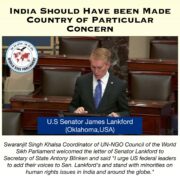
Senator of Oklahoma (USA) James Lankford has released an open letter calling for India to be designated a “Country of Particular Concern”, joining calls from members of the American Sikh community.

The call from Senator Lankford came as part of a general request for the USCIRF (United States Commission for International Religious Freedom, an office of the United States Department of State) to release a delayed report which will explain why it omitted India from its list of countries of concern for 2022.

In the open letter, Lankford highlighted that “India was not formally designated despite overt and repeated severe violations of religious freedom”, also adding that “Formally designating countries under IRFA (International Religious Freedom Act) can be an effective diplomatic tool to encourage and secure changes in behavior”.

Read Lankford’s letter here-

American Sikh community figure and Norwich (Connecticut) City Council member Swaranjit Singh said of the open letter “I urge US federal leaders to add their voices to Senator Lankford’s and stand with minorities on human rights issues in India and around the globe“. Swaranjit Singh Khalsa, who is also a sevadaar (selfless servant) of official United Nations NGO (Non-Government Org) Council member the World Sikh Parliament, has long campaigned to have the USA recognize India’s human rights abuses against its minorities, such as the Sikhs. Swaranjit Singh has taken up these efforts with the backing of countless American Sikhs who have voiced concerns about India’s abuse of minorities, whilst also speaking on behalf of US based human rights group Justice For All.

Various American Sikh groups have worked with State authorities to highlight the growing fascism of India which has seen ongoing human rights abuses of Sikhs, from police targeting of Sikh activists to state authorities destroying Sikh homes.

Zahir Adil, a non-Sikh team lead for Justice For All’s Save India From Fascism campaign said, “We thank Senator Lankford for this bold stand. We are happy that he has expressed that the United States as a leader of human rights, should continue to ask partner nations to improve in their own records. India’s pluralism and secularism are at risk under Modi and his Nazi inspired ideology of Hindutva (Hindu extremism) and we must oppose its strengthening by all available means.“

Based on Lankford’s request which echoes calls from various groups in the USA, many will be watching closely to see if the US Department of State’s USCIRF team will designate India as a country of concern for 2023.

Media wanting more info/interviews on this topic can email media@sikhpa.com.

UK Census reveals Sikh community growth of 24%

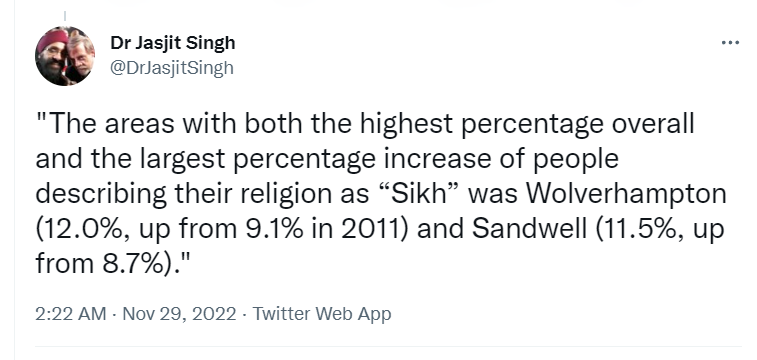
Findings from the 2021 UK Census of Population have revealed the Sikh community has grown to over 524k since the last census in 2011.

The 2011 Census showed 423,000 Sikhs lived in the UK, meaning a Sikh population growth of 24%, making the community now 0.9% of the entire population of the UK. British Sikh Report editor, statistician and community figure Jagdev Singh, has released a full comprehensive breakdown of what the Census reveals about Sikhs. Download it here-

See more takes on the findings below.

UK MPs condemn Hindutva activist spreading anti-Sikh hate

The Labour Party’s Tanmanjeet Singh Dhesi is among a group of MPs that have condemned the divisive actions of a notorious Hindutva (Hindu extremist) figure spreading anti-Sikh hate.

Rashmi Mishra is an open Hindutva activist that made recent headlines for pushing plans to stage a Hindutva demonstration in Leicester, just months after violence erupted in the city between Hindus and Muslims, with many suggesting this was triggered by Hindutva demonstrations. Speaking to The Telegraph, Tanmanjeet Singh said Mishra is “seeking to divide communities”.

Slough MP Dhesi was joined by fellow Labour MPs Claudia Webbe and Virendra Sharma in condemning the fanatical Hindutva figure’s actions in The Telegraph article. Mishra was exposed as being behind a notorious tweet from the “Inspiring Indian Women” account (since deleted) which threatened Sikhs with another genocide, causing Southall MP Sharma to resign as a patron of the group. This is said to be just one example of her anti-Sikh rhetoric, with Mishra also said to be behind Hindutva WhatsApp propaganda, which is known to be a source of inflammatory misinformation.

Mishra has close ties to another former patron of the now defunct Indian women’s group, Conservative House of Lords member and fellow Indian ultranationalist Rami Ranger, with some even accusing her of being paid by Ranger to run campaigns against those exposing their divisive agenda. Ranger has won the ire of UK Sikhs many-a-time for his advocation of Indian ultranationalist anti-Sikh rhetoric, and even replication of their tactics, seen when he threatened a UK Sikh community figure with violence openly in a Tweet.

In efforts to stop the influence of the divisive agenda of Mishra, UK Hindu groups have begun work exposing her hate-spreading. Despite Mishra being the focus of current efforts to curtail the growing influence of Hindutva, she is by no means believed to be the only mouthpiece of India’s fascist regime in the UK. Recently MP Bob Blackman of Harrow East, an area with a strong Hindu population, was found to be taking funding from groups linked to the Indian regime. Blackman has been pictured posing in parliament with Mishra.

Speaking on the issue, Sikh Press Association Senior Press Officer Jasveer Singh said:

“The role of figures like Rashmi Mishra and at a higher-level Bob Blackman and Rami Ranger, is to justify the well-known fascist actions of the Indian state, and further still attempt to rally people behind it. India is plagued by corruption and intolerance at all levels, but many people profit from this system of governance, so they fanatically defend it by attacking anyone exposing it under the guise of protecting the Hindu nation. This is what Hindutva does for India.

“Through a faith mandate, the Sikh community are bound to exposing the injustice and tyranny of nations like India, where Sikhs often suffer like all minorities do in the country. As such, the Sikh community becomes targets for fanatics like Mishra. It is great that well-intentioned Hindus and MPs are now being more vocal about this Hindutva influence in the UK.

“However, there needs to be real investigations into how deep this goes. In Germany, three Indian intelligence spies targeting Sikhs have been arrested in recent years. In Canada, security experts have been open about Indian intelligence ‘harassing’ Sikhs. Many UK Sikhs believe something similar is happening here but our authorities do not seem to be investigating it. Instead, we get undue focus on ‘Sikh extremism’, which in itself is revealing, especially when Indian media have claimed ‘diplomatic pressure’ is used to get UK authorities to target Sikh activists, which has not resulted in findings of any crimes.

“The UK Sikh community will be hoping the exposing of dangerous Hindutva fanatics like Rashmi Mishra is just the beginning of efforts to deal with Hindutva in the UK.”

Sikh leader begins “peaceful agitation” social reform campaign across Punjab

A campaign to encourage Sikhs to deepen their faith and tackle the addiction epidemic of the state has been launched by Bhai Amritpal Singh Sandhu, head of community organization Waris Punjab De (WPD- Protectors of Punjab).

The “Khalsa Vaheer” (Khalsa March) campaign started this week (23.11.22) from Amritsar and will go across Punjab for “months” according to Bhai Amritpal Singh, aiming to encourage Sikhs to become Amritdhari (initiated into the Khalsa collective), whilst also bringing support for Punjabis of any faith to come into the WPD fold for help fighting addiction.

Becoming Amritdhari (via the Amrit sanchar ceremony) means making a strict commitment to the Sikh Guru to maintain a spiritual lifestyle, be dedicated to service and justice and always wear the Punj Kakkar (Five Ks) uniform, including maintaining of kes (unshorn hair). Generally, it is considered within the faith that all Sikhs should aim to one-day join the Khalsa, to which there is no age or gender restriction. Becoming Amritdhari is often referred to as becoming “baptised”, although many Sikh educators prefer not to use Christian terminology for Sikh practices.

The “Khalsa Vaheer” will also challenge addiction in the state, which in 2015 was said to have at least 200,000 addicts (considered a conservative estimate), hooked to hard drugs such as alcohol, heroin and crack-cocaine. During previous speaking events where Bhai Amritpal Singh addressed Sikhs, families have come forward to ask for support to help their addicted kin, leading to this open call for those with issues to come forward. Drug addiction issues in Punjab have been linked with ongoing discontent among the people there, due to lack of life options, a poor social infrastructure and also a lack of policing on drug smuggling and use in the country. Part of this issue includes the constant stream of contaminated intoxicants – including alcohol – into Punjab, which result in the deaths of even moderate users. Due to the lack of policing on this issue, Bhai Amritpal Singh Sandhu has said he will stretch the issue into also challenging drug dealers, asking people to come forward and name perpetrators.

The campaign is the latest groundbreaking act of the charismatic young Sikh leader, who at just 29-years-old has quickly become an extremely popular and powerful figure among Sikhs after being given the role as head of WPD after the untimely and suspicious passing of activist and actor Deep Sidhu. For the past year, Bhai Amritpal Singh has been helping Sikhs make the step into the Khalsa whilst also highlighting the deep anti-Sikh issues of India which impact Punjab. This has all circled around the topic of Sikh sovereignty, which Bhai Amritpal Singh has spoken in favour of, including in the form of the Khalistan (free Sikh homeland) movement. His outspokenness and sudden rise has rocked the Indian establishment, with many media and ultranationalist figures demanding action be taken against him for the way he is organizing Sikhs. Hindutva (Hindu extremists) and Indian ultranationalist types have long demonized Sikh activism efforts as they threaten the hierarchy of India’s current tyrannical regime.

Speaking at the Khalsa Vaheer launch, Bhai Amritpal Singh said:

“We will cover around 20 kilometres every day. There will be a religious gathering every evening. Our aim is to make the youth initiated Sikhs. People from all religions are welcome to make Punjab free of drugs and other problems.”

One aspect of Bhai Amritpal Singh’s efforts which has particularly been attacked by Indian ultranationalists is the fact he travels with armed guards and has previously spoken in favour of Sikhs becoming armed. Sikhs are mandated to be armed and revere weapons as a faith practice, which includes guns. However, in modern times some outside of the panth (Sikh path/community) have attempted to suggest this is a backward practice, despite the fact Sikhs have suffered with a genocide from 1984 onwards.

Speaking on this, Bhai Amritpal Singh said:

“There are some organisations which are objecting to weapons of Sikhs. Weapons always had great importance and these are worshipped at all five Takhts of Sikhs. Even Hindu gods have the weapons. This controversy is unnecessary.”

Bhai Amritpal Singh has also demanded more internal focus from Sikhs, with the objective to bring more support to the issues of Punjab specifically.

In summary of the Khalsa Vaheer, Bhai Amritpal Singh said:

“It is a peaceful agitation. We are going to ask for our rights. We are going to do preaching.”

The Khalsa Vaheer is overwhelmingly supported by Sikhs in Punjab and in the diaspora. However, there are still concerns that the Indian state will aim to clamp down on it, which usually means police violence. Given the history of such issues in Punjab, many feel this is a tense time in the state, although many others are celebrating this revival in Sikh organization and parchar (education).